
Scientists confirm: This is the most effective way to get your cat’s attention, according to new research
Elderly Couple Refuses Reserved Seats—Viral Train Standoff Sparks Fiery Debate on Courtesy
Editor’s Note: You will not find a score in this review. This isn’t an oversight, but a choice. The Mate X7 is a very good smartphone in some respects, but it’s completely disconnected from the market on too many points, due to the U.S. embargo still affecting Huawei. If we were to rate it for what it is, it wouldn’t deserve the highest score either, as it has serious shortcomings. And when compared to current foldables, it would be overshadowed instantly. It’s a smartphone to buy with a clear mind, knowing exactly what you’re getting into.
For years, we’ve witnessed a frantic race for specs where artificial intelligence and extreme miniaturization rule. In this context, Huawei maintains its position as a resilient outsider in the face of the U.S. embargo. The Chinese manufacturer continues to develop its own technologies, often in isolation, to circumvent the inability to collaborate with giants like Google or ARM.
The Huawei Mate X7 positions itself in the ecosystem as the direct successor to the Mate X6, launched a year earlier. It targets a niche of demanding users, seeking a hybrid device capable of transforming into a genuine work tablet. The marketing promises are lofty: the world’s most durable foldable smartphone, equipped with the best camera ever integrated into this format. On paper, it seems to fulfill its promises.
However, the reality faced by purists is more nuanced. Compared to the competition’s 3-nanometer chips, Huawei’s in-house processor shows a noticeable technological lag. Additionally, the native absence of Google services remains a significant psychological and practical barrier for the general Western public.
Thus, the Mate X7 faces a colossal challenge: to justify its ultra-premium positioning through the excellence of its chassis and optics, while asking the user to make significant software compromises.
Specifications
| Model | Huawei Mate X7 |
|---|---|
| Dimensions | 144.2 mm x 156.8 mm x 4.5 mm |
| Screen Size | 8.0, 6.49 inches |
| Resolution | 2416 x 2210 pixels |
| Pixel Density | 412 ppi |
| Technology | OLED |
| Internal Storage | 512 GB |
| Rear Camera |
Sensor 1: 50 Sensor 2: 40 Sensor 3: 50 Mp |
| Front Camera | 8 Mp |
| Wi-fi | Wi-Fi 7 (be) | 6.0 |
| NFC | Yes |
| Fingerprint Sensor | Side-mounted | USB Type-C |
| Battery Capacity | 5300 mAh |
| Weight | 236 g | Black, Red |
| Product Sheet |
This review was conducted with a smartphone lent by the brand.
Design
From the first moment you hold it, the Huawei Mate X7 commands respect with its slimness, even though other foldable smartphones do slightly better in this regard. Unfolded, the device is just 4.5 millimeters thick, folding back on itself to reach 9.5 millimeters.
This slimness is accentuated by the delicately rounded edges of the aluminum chassis. This aesthetic choice, unlike the flat edges popular with competitors, greatly facilitates opening the terminal, offering a natural and secure grip. The weight of 235 grams is perfectly distributed, making one-handed use quite comfortable.
Our test model sports the “Nebulous Red” color (also available in black), covered in a high-quality faux leather. This material is not just a cosmetic choice: it resists fingerprints remarkably well and offers superior grip, reducing the risk of accidental drops. The outer screen is protected by “Kunlun Glass 2,” Huawei’s answer to the famous Gorilla Glass.
The true revolution in this design lies in its durability, as it is certified IP58 and IP59. A 5 rating indicates excellent protection against dust. The number 9, rare on a foldable smartphone, indicates that the device can withstand very high-pressure jets of water at high temperatures, in addition to surviving immersion in 2 meters of water for 30 minutes.
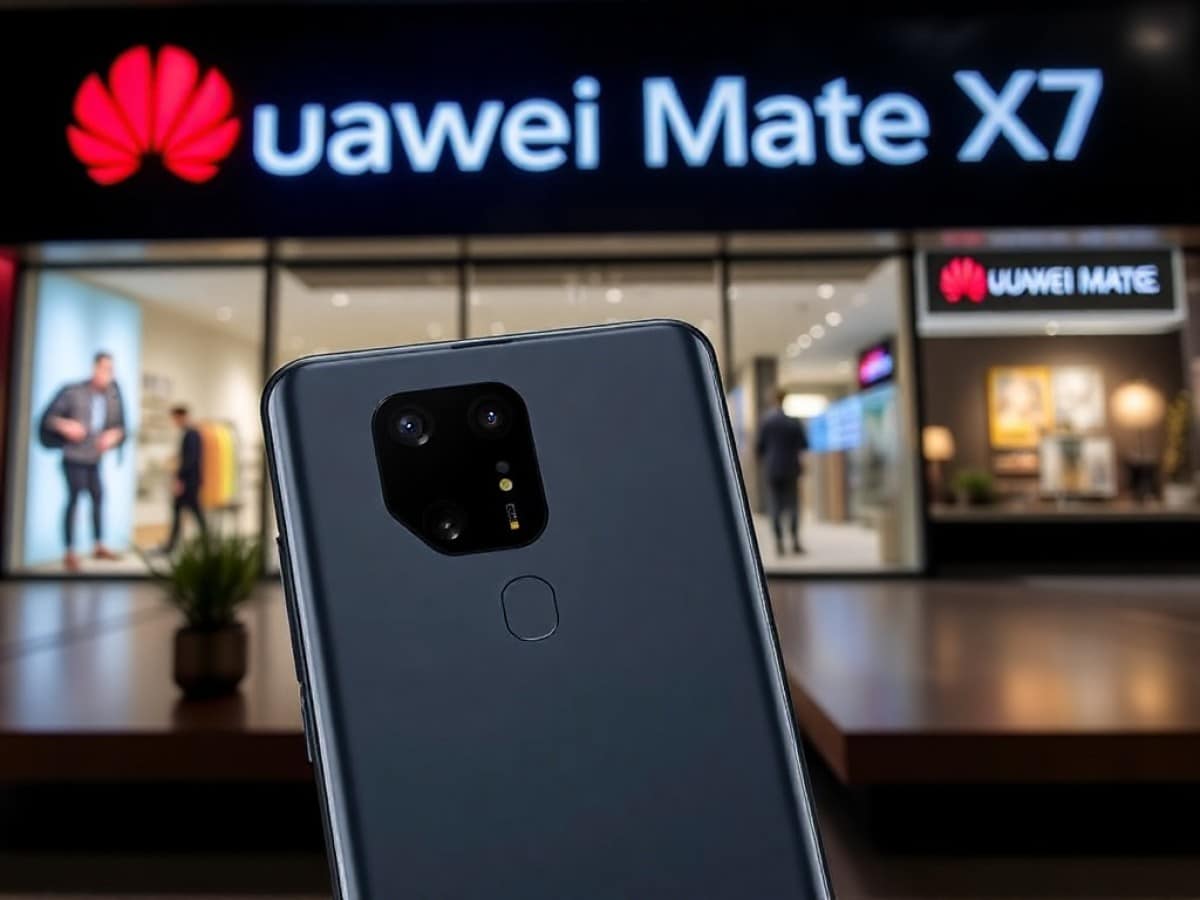
At the back, the photographic module has been redesigned. Gone is the simple circle, replaced by the “Time-Space Gate,” a deliberate and textured protrusion that houses the precious sensors. While this module significantly protrudes from the casing, making the phone wobble when placed flat, the faux leather case included in the box (equipped with a very practical metal kickstand) cleverly compensates for this imbalance. The placement of the buttons is also well thought out, with a fingerprint sensor integrated into the responsive power button on the right edge, naturally falling under the thumb.
Verdict
The Huawei Mate X7 impresses with its slimness and natural handling, enhanced by premium vegan leather finishes and a chassis with rounded edges. Beyond its refined aesthetic, the device marks a historic turning point in terms of durability for a foldable, thanks to its IP58 and IP59 certifications offering unprecedented resistance to water and dust. Despite a prominent camera module, the overall balance and build quality confirm that Huawei has successfully addressed the usual fragility of this format.
Screen
The display is the heart of any foldable smartphone, and the Mate X7 does not disappoint with its two high-quality panels.
The inner screen is a massive 8-inch foldable OLED panel, boasting a resolution of 2,210 x 2,416 pixels. It uses LTPO technology, which allows the screen to dynamically vary its refresh rate from 1 Hz for a static image to 120 Hz, thus massively preserving battery life.
The outer screen is equally impressive, offering a very comfortable 6.49-inch diagonal, also in OLED LTPO (1,080 x 2,444 pixels). Both screens benefit from a very high PWM dimming rate set at 1440 Hz. (PWM dimming, or Pulse-Width Modulation, is the technique used by OLED screens to lower brightness by turning the screen on and off very quickly. A high frequency like 1440 Hz makes this flickering totally invisible to the naked eye, thus avoiding eye strain and headaches in sensitive users).
In brightness tests, the numbers are excellent, although slightly lower than the leading models from Samsung. Huawei promises peaks of 2500 nits internally and 3000 nits externally. The Mate X7 remains perfectly readable even in full sunlight, with well-controlled reflectance that limits annoying glare.
The display supports the HDR Vivid standard (a dynamic alternative to HDR10, optimizing contrast scene by scene), but the lack of maximum Widevine L1 certification blocks Netflix and similar services at standard quality, a significant drawback at this price.
Finally, let’s address a frequent concern with foldables: the crease. On the Mate X7, thanks to a new-generation steel hinge (supporting a pressure of 2350 MPa) and a screen reinforced by a three-layer composite structure, the crease has become almost mythical. It is very slightly perceptible to the touch, but in front of the lit screen, it is practically invisible.
Verdict
The Huawei Mate X7 offers a top-tier visual experience with its two fluid and extremely bright OLED LTPO panels, ensuring perfect readability even in full sunlight. While we applaud the eye comfort provided by the high-frequency PWM dimming and an almost invisible internal crease in use, we regret the absence of Widevine L1 certification, which limits the quality of streaming on major platforms. It’s an exceptional screen for productivity and browsing, slightly hindered by software constraints for pure entertainment.
Performance
At the heart of the device beats the in-house Kirin 9030 Pro processor. Due to the U.S. embargo preventing access to Taiwanese foundries (TSMC), this chip is manufactured in 6 nanometers by the Chinese company SMIC. With its 6 nm process, Huawei is three generations behind.
The internal architecture consists of 9 computing cores, including a main core clocked at a modest 2.75 GHz, far behind the chips of its rivals. The processor is supported by 16 GB of RAM and UFS storage. While the amount of RAM is generous, it does not mask the raw weakness of the CPU.
Benchmarks are unequivocal. On Geekbench, the Mate X7 shows scores comparable to a mid-range smartphone, i.e., half the power of the Galaxy Z Fold 7. The graphic processor (GPU) Maleoon 935 indeed offers a 75% gain compared to the previous generation, but it remains incapable of handling modern technologies like Ray Tracing.
Overall, the Mate X7 ranks last among 2026’s foldable smartphones in terms of performance. Even an old Honor Magic V2 does better with its Snapdragon 8 Gen 2. Worse, in 2026, the same average performance can be achieved with a 600-euro smartphone, the Realme 16 Pro Plus.
But the real problem lies in thermal management, or “throttling.” During our intensive stress tests, the Mate X7 collapsed, displaying a stability of only 54.6% on Wild Life, and plummeting to a dramatic 33% in the folded position. Heat struggles to dissipate in this ultra-thin 4.5 mm chassis. Surprisingly, the smartphone performs almost flawlessly on CPUThrottlingtest for almost the entire benchmark, before performance drops in the last few minutes.
Yet, paradoxically, the real-world feeling on a daily basis is far less catastrophic. For web browsing, multitasking, or video, the phone remains smooth and responsive. The interface is remarkably well optimized to mask these shortcomings.
However, launch a highly demanding game like Genshin Impact with maximum graphics, and stuttering will appear very quickly, accompanied by noticeable heating on the back of the device. Opening heavy apps also takes a fraction of a second longer than on a competing flagship.
On Wild Rift, we observed behavior we had never seen before. In Medium quality, the game manages to reach 120 FPS on the external screen but caps at 90 FPS on the internal screen, even though it displays a “zoomed” version of the game to fill the entire screen.
Verdict
This is the main Achilles’ heel of the Mate X7. Hindered by technological restrictions, its Kirin 9030 Pro processor is several generations behind the competition, resulting in raw scores worthy of a mid-range smartphone. While the interface remains smooth for standard daily use thanks to excellent software optimization, thermal management and throttling seriously limit intensive gaming sessions. Overall, the Mate X7 is an elegant productivity tool, but it’s clearly not cut out for high-level gaming.
Software
The Huawei Mate X7 runs on the EMUI 15 software overlay. The first difficult pill to swallow is that this system is based on the open-source code (AOSP) of Android 12, a version of Google’s OS released in late 2021. In terms of kernel modernity, it’s a real step back by five years. Moreover, sanctions force Huawei to do without Google Mobile Services (GMS), which means no pre-installed Play Store, Google Maps, or Gmail.
Fortunately, the overall ergonomics of EMUI 15 remain excellent. The interface strikingly resembles Apple’s iOS or Xiaomi’s HyperOS, with large dynamic folders and a very intuitive widget system. The exploitation of the large folding screen is a clear success: multitasking is smooth, allowing the screen to be split vertically or horizontally with adjustable ratios, while adding floating windows on top.
The transition of an app from the external to the internal screen, or vice versa, is better managed than on the Mate X6, where different behaviors could be observed depending on when the app was opened. However, in some games, we still notice that the transition is not visually perfect.
To compensate for the absence of the official Play Store, users must turn to alternatives like Huawei’s AppGallery or the Aurora Store. (The Aurora Store is an unofficial open-source client that connects directly to Google’s servers to download the usual Android apps).
While the interface is clean and the catalog identical, the illusion has its limits. Automatic updates are often capricious, and above all, it is very complex to restore your paid apps or make in-app purchases (purchases within an app) without risking malfunctions related to Google’s DRM.
Once your apps are downloaded, they still need to launch without a hitch, and this is where MicroG comes into play. (MicroG is a free and open-source rewrite of Google Play Services, those invisible but essential gears that manage location, notifications, and authentication on 99% of Android smartphones).
To fool demanding apps like Uber or WhatsApp, the system uses Signature Spoofing (a technique that allows MicroG to pass itself off as Google’s official seal). While the technical feat is admirable, it relies on a fragile software house of cards.
Yes, it’s convenient because you can sync your photos with Google’s cloud, sync Google Chrome with other devices, or retrieve your game progress instantly when a Google backup exists.
But for intensive users of the American ecosystem, the transition feels like a daily obstacle course. We were notably unable to retrieve our passwords saved in Google’s manager because the device could not be verified. And this was even after trying to install older or newer APKs of Micro G and Chrome than those offered on the Aurora Store.
It’s also impossible to pay with Google Pay or use Android Auto to replicate your GPS on your car’s screen, as these functions require deep system permissions inaccessible to MicroG. A few little things that could quickly become deal-breakers for many people, requiring significant effort to adapt and manually transfer their data.
On the artificial intelligence front, the situation is also lacking. While the competition deploys impressive generative features (magic retouching, real-time translation, intelligent summaries), the global version of the Mate X7 is remarkably empty. Its voice assistant Celia is basic, and image manipulation functions are limited to a rudimentary magic eraser in the gallery. Even worse, Huawei does not commit to any clear long-term update policy, whereas Samsung or Google now promise 7 years of software support.
Verdict
The user experience on the Mate X7 is a mix of frustration and ingenuity. While the EMUI 15 interface is a model of ergonomics and fluidity for multitasking, it rests on a dated Android base and suffers severely from the absence of official Google services. Despite efforts from alternative solutions like MicroG to simulate a Google environment, users must deal with a fragile software house of cards: contactless payments are impossible, Android Auto is absent, and AI functions are almost non-existent. In the absence of
Similar Posts
- Galaxy Z TriFold: Rumors Promise Top-Tier Selfie Game! Here’s the Scoop
- Samsung’s Galaxy Z Trifold Makes Its Debut: Is Huawei in Trouble?
- iPhone Air 2 Release Date Revealed: Discover Apple’s Next Big Hits!
- Amazon Set to Unveil Revolutionary Foldable Tablet Next Year: Here’s What to Expect
- Galaxy Z Flip 8 Camera Revealed: What Surprises Does Samsung Have in Store?

Maya Singh is a senior editor covering tablets and hybrid devices. Her work explores how these tools reshape digital productivity and learning. She also contributes to feature editorials on emerging tech.