
Scientists confirm: This is the most effective way to get your cat’s attention, according to new research
Elderly Couple Refuses Reserved Seats—Viral Train Standoff Sparks Fiery Debate on Courtesy
Over a year after the highly successful Amazfit Bip 6, the Chinese brand has returned with a larger version, the Bip Max. This smartwatch features a large battery, a 20-day battery life as claimed by the manufacturer, a 2.07-inch screen, local mapping, a GPS chip, and an optical heart rate sensor. Most notably, it is priced under 100 euros.
Given the specs, the value for money appears particularly attractive. The question remains whether the watch lives up to its promises…
Amazfit Bip MaxTechnical Specifications
| Model | Amazfit Bip Max |
|---|---|
| Dimensions | 42.76 mm x 49.58 mm x 10.93 mm |
| Screen Resolution | 432 x 514 pixels |
| Panel | AMOLED |
| Internal Memory | 4 GB |
| Weight | 52.6 g |
| Accelerometer and Electronic Compass | Yes |
| Sleep Analysis | Yes |
| Ambient Light Sensor | Yes |
| Protection Rating | 5ATM |
| Product Sheet |
The watch for this test was provided by the manufacturer.
Amazfit Bip MaxA Bulky Design That May Not Suit Small Wrists
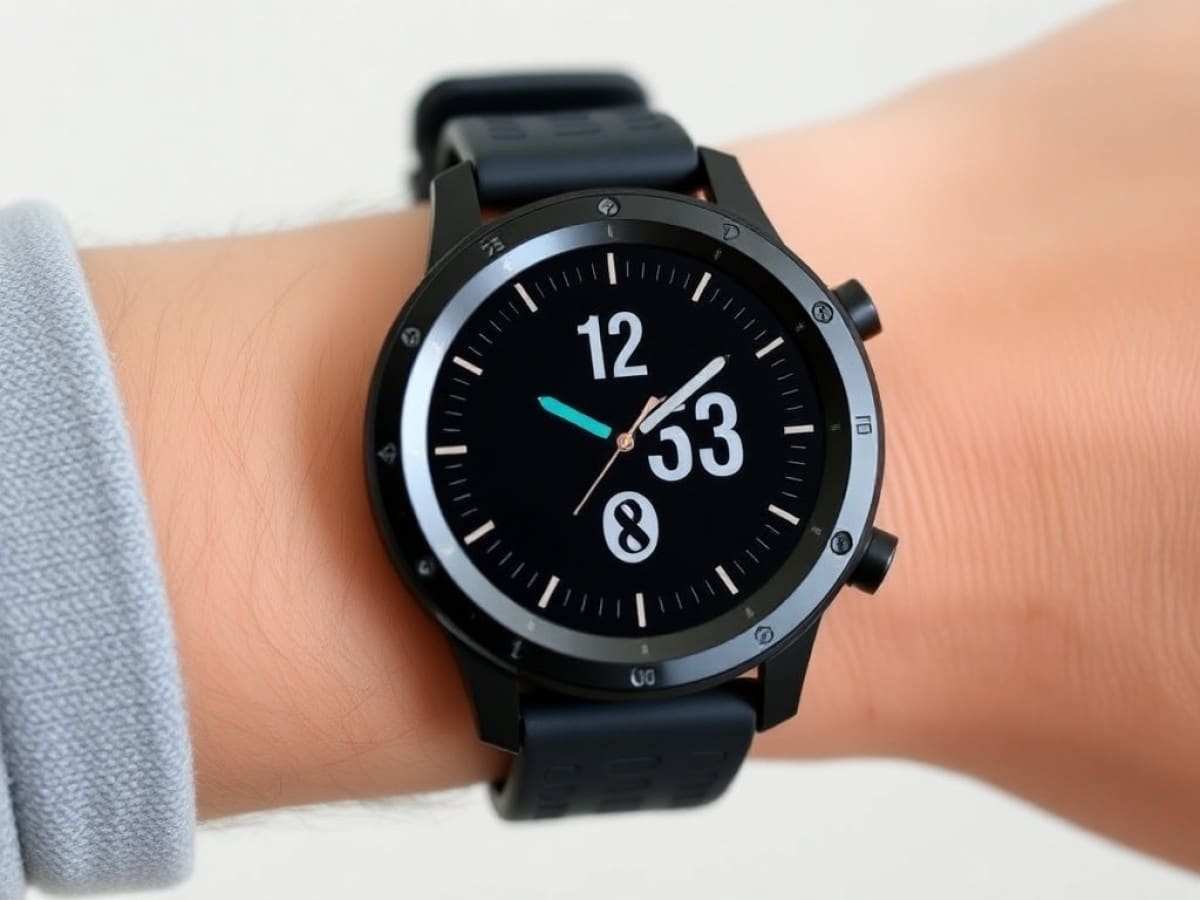
Distinctly different in style from the Active series, the Bip Max features a rectangular and imposing design. The case measures 42.76 x 49.58 mm, and its thickness, with the optical sensor, is 13.24 mm, compared to 10.93 mm without. With the strap, the watch weighs 52.6 g. Although lighter than an Amazfit T-Rex 3, the Bip Max is noticeably heavier on the wrist than more compact variants, making it more suitable for larger wrists. In our case, it was already quite limiting, making it a bit more difficult to wear on a daily basis. While we are used to wearing a smartwatch nearly 24/7, this time we felt the need to remove it occasionally during the week.
Regarding materials, the frame is made of aluminum and the base of the case is plastic. The difference between the two parts is barely visible, giving the smartwatch a polished look. The device includes a speaker and a microphone for making and receiving calls without taking your smartphone out of your pocket.
Like most serious models on the market, the Bip Max is waterproof and certified 5 ATM, which is the minimum required for use in water. It can therefore be worn in the shower or during a surface swimming session. However, it is not designed for underwater diving or more intense water activities such as water skiing. This choice is somewhat paradoxical with the term “Max,” as the watch is meant to be accessible for more extreme sports than usual.
The supplied strap is made of silicone, a material that tends to retain heat, especially at this time. Opt for a nylon strap in hot weather. The other issue is that its attachment system is quite cumbersome. If we have already dealt with straps with a small latch that posed no problem, here, it is difficult to use. You have to push the latch in one direction to insert the other end, then release once both sides are in place. The latch is too fragile and tends to come out. In short, changing the strap should not be frequent.
Amazfit Bip MaxA Gigantic and Very Bright Screen
The watch features a very large 2.07-inch screen, displaying a resolution of 432 x 514 pixels, which translates to a pixel density of 324 pixels per inch. This is more than adequate for use. As is common in this segment, the smartwatch includes an AMOLED panel. The brand also claims a peak brightness of 3,000 cd/m², a particularly high value. However, we do not have the necessary equipment to verify this figure on a smartwatch. In use, we have never encountered any difficulty in viewing the information displayed on the screen, even outdoors.
The device also includes an ambient light sensor that performs its role adequately. However, we noticed a slight lag between the wrist movement and the screen lighting up. Ideally, this reaction should be almost instantaneous. However, we had set the detection sensitivity to the “Sensitive” mode, which is supposed to provide the fastest response. Nothing truly prohibitive, however.
Thanks to the programming of a sleep mode, the smartwatch automatically goes into standby at the times defined by the user, while continuing to monitor health. You are therefore not at risk of being dazzled in the middle of the night. As is now the norm for this type of product, an Always-On mode is also offered to display a dial continuously, even when you are not looking at the watch. Ten dials are pre-installed, but it is possible to download many others via the Zepp app.
Amazfit Bip MaxAn Efficient OS and a Pleasant Companion App
The Amazfit Bip Max comes with 4 GB of internal storage, mainly intended for downloading offline maps. The watch indeed includes a local mapping feature that allows you to find your way without an Internet connection. This is a particularly rare feature on smartwatches sold under the 100 € mark.
The Bip Max runs on Zepp OS, the proprietary operating system developed by Amazfit. We appreciate it for its clarity and well-thought-out ergonomics. The interface is generally smooth and, despite some occasional slowdowns, the experience remains pleasant on a daily basis.
The essential functions, such as heart rate monitoring, sports modes, and notification management, are easily accessible. From the outset, most of the usual features are intuitive and fall naturally under the finger.
- Swiping to the right gives direct access to all sports modes
- Swiping to the left presents the main menu of the watch (exercise history, training status, calendar, plan…)
- Swiping down gives access to quick functions like sleep mode, battery level (pressing on it activates energy saving), or the function to make the phone ring.
- Swiping up presents your BioCharge, the weather, or even the music that relies on your phone’s playlist, which you can briefly control by pausing or playing next or previous.
The Bip Max has two physical buttons, both placed on the right edge of the case (or on the left if you have reversed the orientation of the watch). The white button provides access to the main menu, while the red button directly launches sports modes. When you are already in an application, the latter allows you to return instantly to the main dial.
Like most current smartwatches, the Bip Max can display notifications from an Android or iOS smartphone. The messages received are readable directly on the screen. However, it is not possible to respond to them, as the watch lacks a virtual keyboard.
The device is accompanied by the Zepp app, whose interface shares the main qualities of that of the watch: it is clear, easy to use, and pleasant to use. The homepage notably highlights the “HybridCharge,” the new recovery score that replaces the previous BioCharge indicator.
Expressed on a scale of 0 to 100, this index aims to estimate your overall energy level based on several parameters, including sleep quality, physiological recovery (notably heart rate variability), training load, stress level, and certain feelings reported by the user. The goal is to provide, at a glance, a clear indication of your ability to face the day or to carry out a more or less intensive sports session. You also have access on the same page, by scrolling, to your last night’s sleep duration, your HRV, and your training status.
For the rest, the watch settings accessible from the app are clear and easily accessible via the “Device” tab. They allow you to download new dials, configure heart rate alerts, manage notifications app by app, and activate automatic detection of sports activities.
Amazfit Bip MaxA Convincing Heart Rate Monitor and GPS
The Amazfit Bip Max is equipped with an accelerometer, a pedometer, a compass, a blood oxygen measurement sensor (SpO2), and a heart rate monitor based on the brand’s optical BioTracker sensor. It also includes a single-band GPS compatible with five satellite constellations.
On paper, a single-band GPS is generally less accurate than a dual-band solution, which is better able to handle certain signal disturbances. In practice, however, this assertion deserves to be nuanced. During our tests, the Bip Max was particularly convincing and offers geolocation performances much better than what its spec sheet might suggest.
The Accuracy of the GPS of the Amazfit Bip Max
To evaluate its geolocation capabilities, we systematically wore our test unit alongside an Apple Watch Series 9, our reference model, during our outings. We alternated between routes in open terrain and trips in urban environments, a context generally more demanding for smartwatches due to the many obstacles likely to disrupt GPS reception.
| Runs | Apple Watch Series 9 | Amazfit BIP Max | Difference |
|---|---|---|---|
| Run 1 (park) | 6.65 km | 6.63 km | -0.30 % |
| Run 2 (park) | 4.02 km | 4.02 km | 0 % |
| Run 3 (city) | 4.93 km | 5.01 km | +1.62 % |
| Total | 15.6 km | 15.66 km | +0.38 % |
In the first case, the Bip Max is very close to the Cupertino watch. On a 6.65 km route, only 20 meters separate the two devices, a negligible difference. This difference can be partly explained by the fact that each watch was worn on a different wrist: one on the right, the other on the left. Naturally, one of the two arms always covers a slightly greater distance than the other.
Even better, during a second trip in another park, both watches recorded exactly the same distance: 4.02 km. The Amazfit manages to produce a consistent track, with very few zigzags, a flaw often observed on watches equipped with a poorly performing GPS. The result is therefore an excellent surprise, especially since the exercise is also successful in an urban environment.
We thus completed a route in the heart of Paris, in the vicinity of Notre-Dame Cathedral, an area composed of many narrow streets. Once again, the Chinese watch pleasantly surprises. It manages to maintain a credible trajectory and rarely crosses buildings, a problem that is often frequent on less accurate models. Naturally, in a dense urban environment, the track is not as clean as in open terrain. Some zigzags appear and slight shifts remain, but the overall result is quite convincing.
At the end of this outing, the Bip Max displayed a distance of 5.01 km compared to 4.93 km for our reference watch, a difference of only 80 meters. Nothing that can be considered problematic in use.
In total, over more than 15.5 km of cumulative running, the difference noted between the two devices is only 0.38%.
The Accuracy of the Heart Rate of the Amazfit Bip Max
The Amazfit Bip Max incorporates a heart rate monitor based on an
Similar Posts
- Amazfit Bip 6 Review: A High-Performance Sports Watch That’s Surprisingly Affordable!
- Amazfit Active 3 Premium Review: Could This Be the Best Watch Under €200?
- Huawei Watch Fit 4 Review: Precision Meets Affordability in This Smartwatch!
- Amazfit Balance 2 Review: Elegance Meets Sports and Smart Health Features in a Versatile Watch
- Decathlon Fit 100 Review: Discover the Lightweight, Affordable Sports Watch!

Maya Singh is a senior editor covering tablets and hybrid devices. Her work explores how these tools reshape digital productivity and learning. She also contributes to feature editorials on emerging tech.