
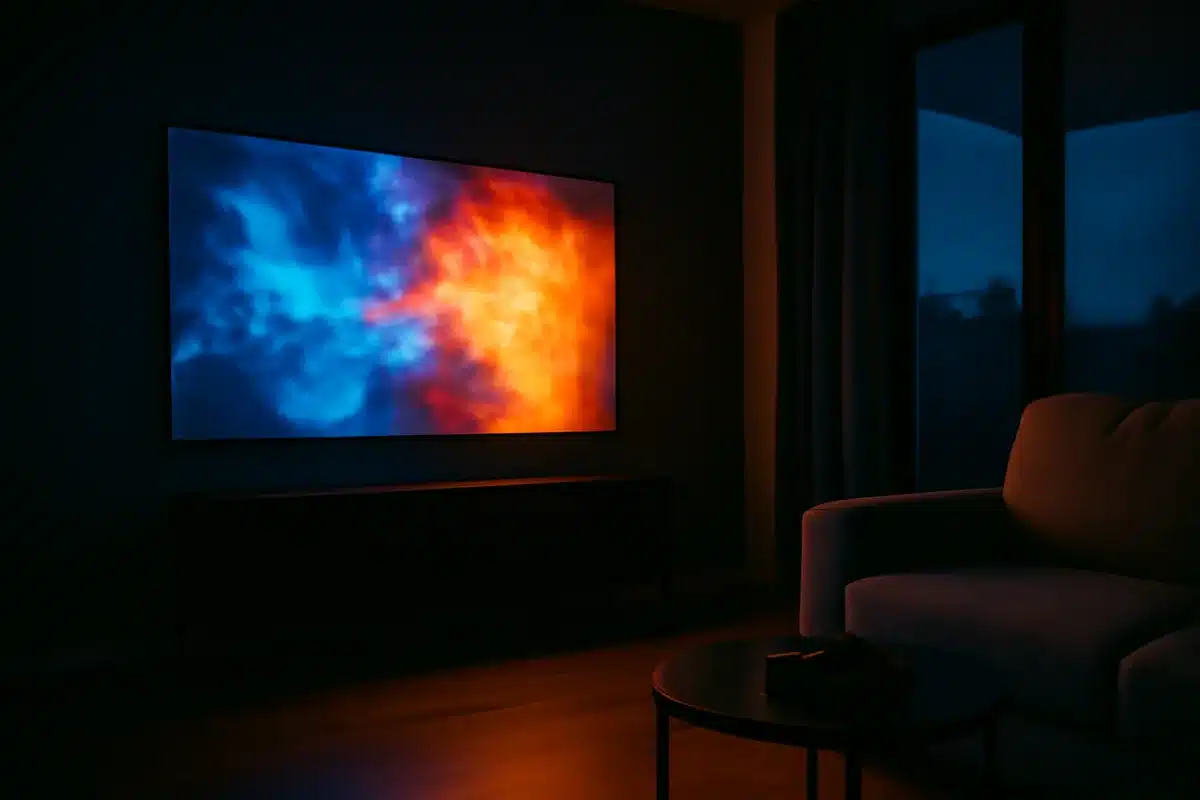
Haier is making a notable re-entry into the French television market with its 65-inch QLED model, designed for everyday entertainment and gaming at a competitive price against Chinese rivals. Here is my detailed review.
Scientists confirm: This is the most effective way to get your cat’s attention, according to new research
Elderly Couple Refuses Reserved Seats—Viral Train Standoff Sparks Fiery Debate on Courtesy
The Haier H65S80GUX is part of the S80G series, a QLED line that spans 6 sizes from 43 to 85 inches, demonstrating the Chinese manufacturer’s intent to meet the diverse needs of French households. It features a Direct LED QLED panel with Quantum Dot technology, offering richer colorimetry than traditional LEDs. The system is powered by an AiPQ processor responsible for managing backlighting and MEMC motion compensation.
Compared to competitors like TCL's C655 or Hisense’s E7NQ, the Haier H65S80GUX stands out by running on Google TV with gaming features, and notably includes two HDMI 2.1 ports supporting 120 Hz through DLG technology, a feature seldom found at this price point. However, it lacks Dolby Vision processing, which is available in the brand’s higher-end models. The TV also benefits from an artificial intelligence module called Homey AI, designed to enhance content recommendations and daily TV usage.
On paper, the specs are not groundbreaking: no Mini-LED, no Dolby Vision, and a peak brightness not exceeding 320 cd/m². But real-world measurements reveal a surprise: this TV impresses with its color accuracy.
Haier H65S80GUXTechnical Specifications
| Model | Haier H65S80GUX |
|---|---|
| Screen Size | 65 inches |
| Maximum Resolution | 3840 x 2160 pixels |
| Display Technology | LCD |
| Backlight | Yes |
| Backlight Type | Direct LED |
| HDR Compatibility | HDR10 |
| Refresh Rate | 60 Hz |
| VRR | Yes |
| ALLM | Yes |
| Audio Power | 30 watts |
| Channels | 2.0 |
| Sound Processing | Dolby Audio |
| Audio Outputs | Headphones, Speakers |
| Number of HDMI Ports | 4 |
| HDMI ARC/eARC | Yes |
| Antenna Input | 2 |
| Satellite Input | 1 |
| Number of USB Ports | 2 |
| Optical Output | 0 |
| Headphone Jack | Yes |
| Analog Audio/Video Input | 1 |
| Ethernet | Yes |
| PCMCIA Port (CI+) | Unknown |
| Wi-Fi Version | Wi-Fi 5 (ac) |
| Bluetooth Version | 5.1 |
| Frame / Stand Color | Black |
| Stand Position | Central |
| VESA Standard | 200 x 200 mm |
| Operating System (OS) | Google TV |
| Assistant | Google Assistant |
| AI Features | Yes |
| Chromecast Compatible | Yes |
| Microphone on Remote Control | Yes |
| TV Dimensions with Stand (WxHxD) | 1444 mm × 864 mm × 300 mm |
| TV Weight without Stand | 12.29 kg |
| TV Weight with Stand | 12.47 kg |
| Energy Efficiency | E |
| Durability Index | 7.5 |
| Product Sheet |
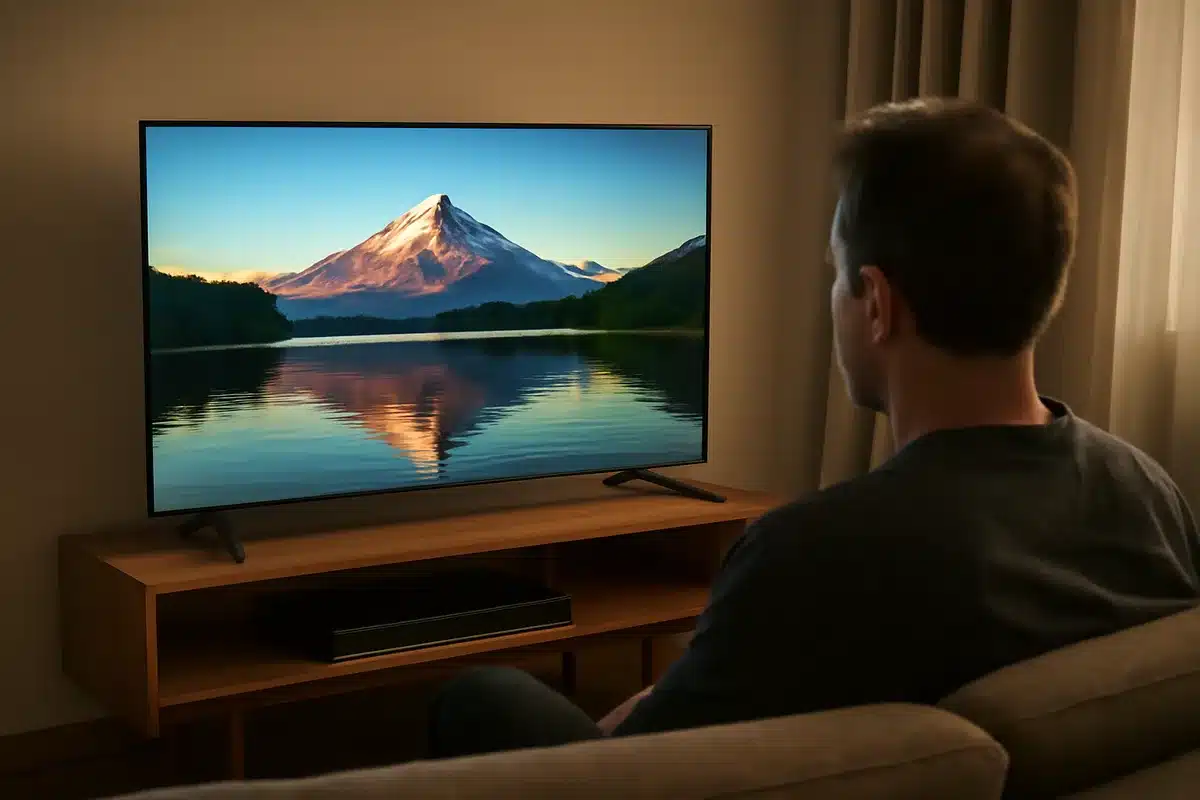
Haier H65S80GUXDesign, Simplicity First
The H65S80GUX is supported by a black plastic stand, delivered in several parts for self-assembly. The assembly process is straightforward, although it’s not possible to adjust the height of the TV or the spacing between the two parts of the stand, unlike some competitors’ offerings. Once set up, the screen stands just 3 cm above the TV cabinet, which can be a problem if you plan to install a soundbar taller than this — in that case, consider using a riser or wall mount.
The base of the stand measures 54 cm in width and 30 cm in depth for this 65-inch model. This small footprint allows it to be placed on a narrow cabinet, which is advantageous.
The TV’s chassis is made of plastic with some reinforcements on the back, typical of entry-level models. The finishes are well-executed, aligning with the television’s price point. The screen borders are average in size. There are thinner options on the market, such as TCL’s C89L, but they come at a significantly higher price.
Why You Should Never Reheat These Foods in the Microwave – The Hidden Dangers Experts Warn About
I tried the top 5 guard dogs—here’s what makes these breeds the ultimate protectors
Haier H65S80GUXConnections
The TV offers 4 HDMI inputs, two of which support gaming features (VRR and ALLM) to optimize video games. One of these is eARC compatible for audio return to a soundbar. Also included are an Ethernet port, a composite analog input, a headphone jack, and an optical audio output. There are also two USB-A ports and, of course, two Tuner connectors. A CI+ port rounds out the array.
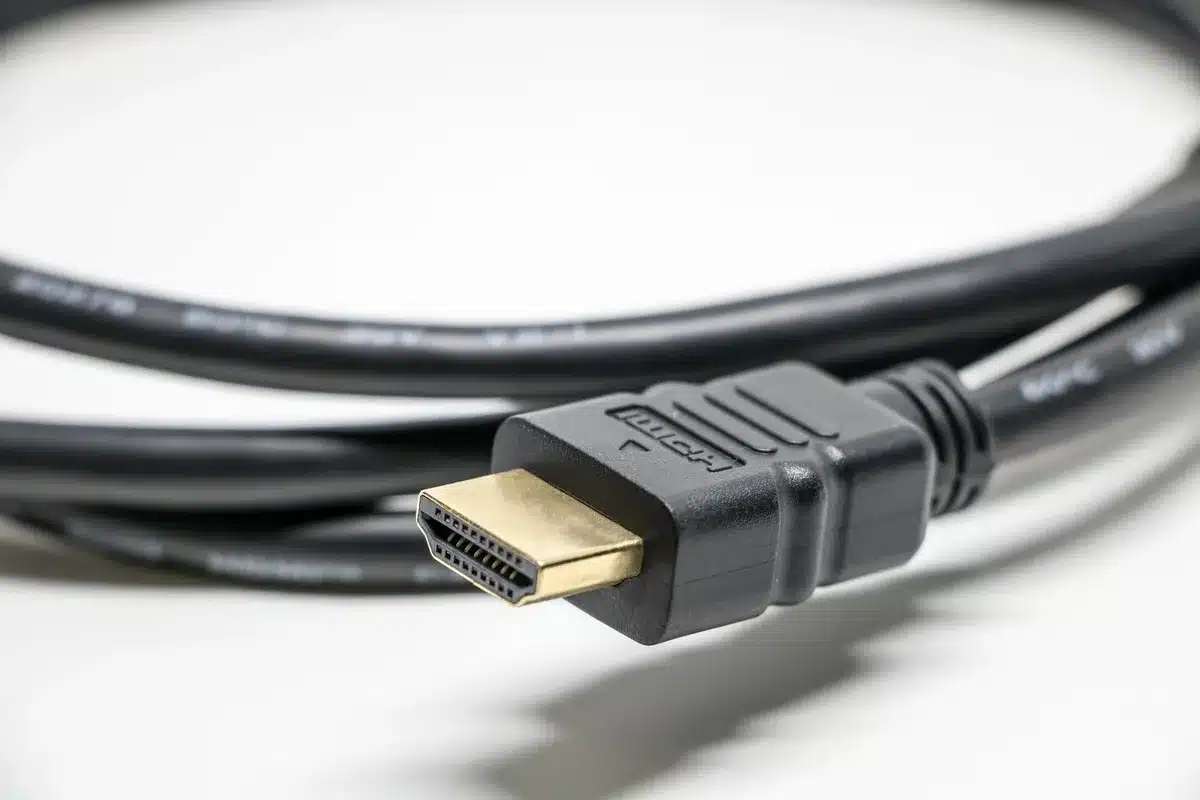
Thus, the essentials are covered, consistent with the device’s price. A minor criticism is that the ports are not labeled, especially the HDMI inputs, which can complicate connections if needed.
The Remote Control
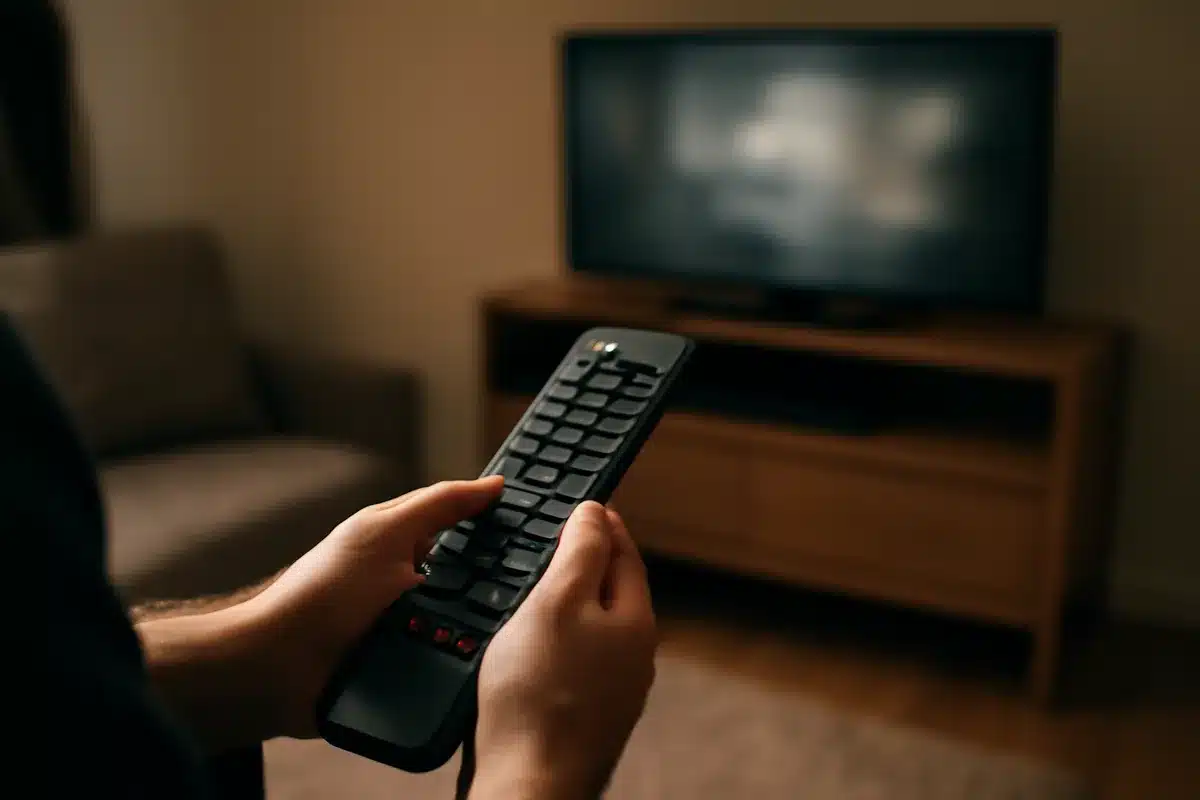
The accompanying remote control is large. It includes all the numbers for direct channel selection and several shortcuts to streaming platforms (Netflix, Prime Video, YouTube, YouTube Music), as well as access to applications. The buttons are pleasant to the touch, with a short travel and good responsiveness, but the absence of backlighting is a drawback. However, it does include a microphone and a specific button to launch the media player application.
Haier H65S80GUXSubjective Image Quality
The H65S80GUX features a standard QLED panel, without Mini-LED or local dimming (Local Dimming). The results are very tangible in use: a perfectly stable luminance regardless of the size of the element displayed on the screen, without any pumping effect or darkening — a behavior not always found in direct competitors, where zoned backlighting can cause noticeable variations. The downside, unsurprisingly, is the lack of any dazzling effect on small bright areas (water reflections, night lights), giving HDR images a flat, almost “luxury SDR” appearance.
For movie or sports content, the image remains natural, with accurate skin tones and sky gradients that avoid any artificial look. The absence of an Automatic Brightness Limiter (ABL) is also a real advantage for sports or snow scenes: the image never darkens abruptly, unlike some more powerful but less well-regulated panels. On the other hand, in a fully lit room, the TV struggles to maintain contrast due to insufficient brightness.
The uniformity of the panel is generally good, with exceptions at the top right and bottom left corners, though not deal-breakers. No color banding was observed on color gradients. However, blooming is still visible, as with all the models in the range tested.
In terms of HDR compatibility, the H65S80GUX supports HDR10 and HDR10+, but not Dolby Vision — a notable absence compared to rivals that do offer it.
Haier H65S80GUXMeasurements, Probed and Tested
As with other TVs in the range, measurements were taken with default settings (“out of the box”), across all available image modes.
In SDR, the Standard mode should be avoided: with an average temperature of 9116 K compared to the expected 6500 K, the image is noticeably too cold, and an average gamma of 1.88 contributes to a washed-out, depth-lacking image. The average Delta E there climbs to 10.54, well above the perceptible threshold of 3. Fortunately, the Film and User modes largely rectify this: temperatures of 6419 K and 6413 K respectively, gamma close to the target (2.24 and 2.23), and especially an average Delta E of only 1.28 and 1.37. These are the most accurate modes in the range under these conditions, ensuring an image faithful to the director’s intention. The contrast was measured at just over 850:1, which is acceptable.
In HDR, the hierarchy of modes remains the same. Peak brightness reaches 319 cd/m² in Standard mode and 318 cd/m² in Sport, but at the cost of an EOTF curve that deviates significantly from the target and an average Delta E of 5.99 and 5.75, respectively. The Film (270 cd/m², Delta E 1.27) and User (273 cd/m², Delta E 1.3) modes, on the other hand, offer surgical accuracy, with a maximum of 2.57 across all tested hues in User mode. This is on par with top brands in this regard.
Regarding HDR color space coverage, the H65S80GUX displays 92.8% of DCI-P3, placing it in the excellent average for QLEDs on the market. However, BT.2020 coverage tops out at 68.53%, a typical physical limit for this type of panel, comparable to what TCL’s C645 or Hisense’s E7K/E7N offer, but naturally lagging behind very high-end QLEDs or QD-OLED panels. Finally, rec709 coverage in Film mode reaches 96.3%, a solid score.
Against direct competition, the closest rivals at TCL are the C655 (or P7K), and at Hisense, the E7Q: two models that share with Haier a global backlighting technology rather than a Mini-LED architecture, which explains this very particular stability of luminance. On initial accuracy, Haier takes the lead: achieving a Delta E under 1.3 in HDR Film and User modes without manual calibration is a performance not always reached by entry-level models from TCL or Hisense. On the other hand, compared to a TCL P7K or a Hisense E7Q, the H65S80GUX shows a notable lag in HDR dynamics and BT.2020 gamut depth, as these models aim to please the eye with extra brightness, even if it means sacrificing some precision.
Haier H65S80GUXGaming, Potential but Settings Need Tweaking
The H65S80GUX is limited to 60 Hz in UHD, with a 120 Hz acceleration mode reserved for Full HD. With default settings, the measured input lag climbs to 172 ms, a very high value that would severely penalize any gaming use. Fortunately, activating the PC mode in the settings reduces this value to 38.2 ms, which is just over two frames of delay between pressing the controller and the display on the screen — acceptable, though not at the level of the best gaming monitors on the market.
This high input lag in default settings was reported to Haier France during the test. The manufacturer confirmed that to achieve the best result, it is necessary to manually disable MEMC and ALLM, then activate the Low Latency manual function in the Game Mode menu. These details could not be
Similar Posts
- I Tested the Hisense UR9S TV: Best Color Accuracy Ever & Dolby Vision 2 Compatible!
- TCL 27G64 Review: Affordable Mini-LED PC Monitor Breakthrough!
- I Explored Samsung’s R95H TV: Experience Top-Tier 75-inch Micro RGB Brilliance
- Acer PD163Q Review: Double Your Productivity with This Dual-Screen Portable Monitor?
- TCL 65C7K Review: Is This the New Premium Segment Leader?

Maya Singh is a senior editor covering tablets and hybrid devices. Her work explores how these tools reshape digital productivity and learning. She also contributes to feature editorials on emerging tech.