
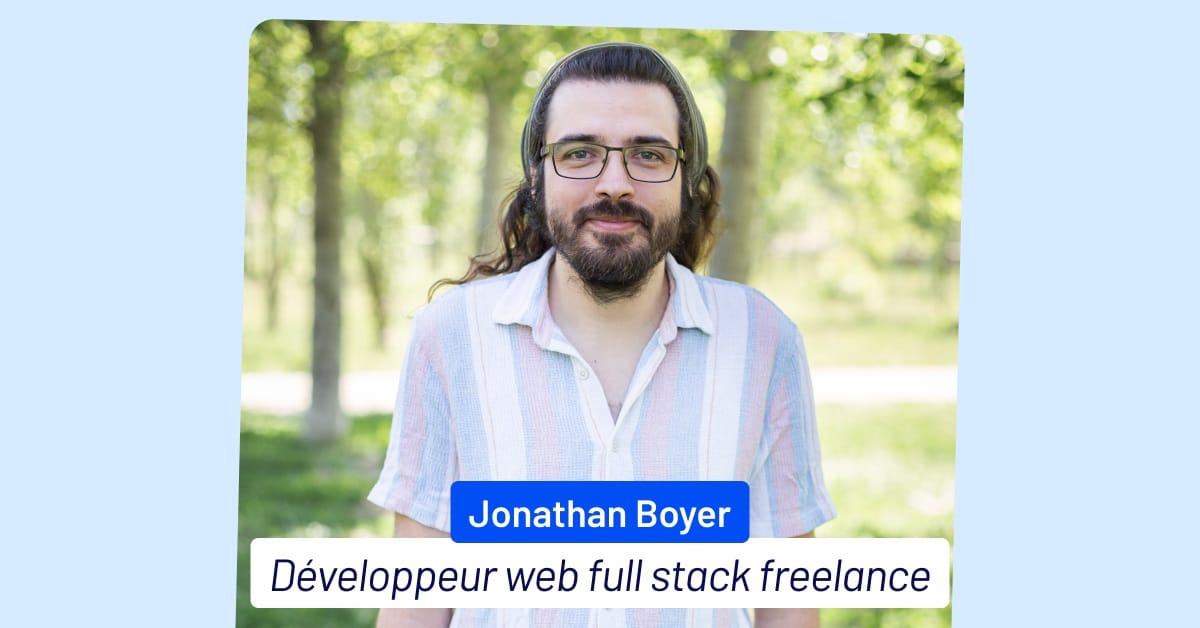
With the rapid growth of AI and increasing market demands, becoming a full stack web developer requires both patience and perseverance. Jonathan Boyer, a freelance professional in this field, shares his insights and advice with BDM on entering the sector in 2026.
Scientists confirm: This is the most effective way to get your cat’s attention, according to new research
Elderly Couple Refuses Reserved Seats—Viral Train Standoff Sparks Fiery Debate on Courtesy
In 2026, full stack web development continues to be a constantly evolving web discipline, disrupted by the rise of AI tools and coding agents. What skills are truly essential to get started? How can one leverage AI without becoming dependent on it? Freelance full stack web developer Jonathan Boyer decrypts the realities of this profession for BDM and shares his tips for a successful career in this field.
Becoming a Web Developer
Jonathan Boyer, Freelance Full Stack Developer
My name is Jonathan Boyer, and I have been a freelance full stack web developer for over 17 years. I also run the website Grafikart.fr, where I publish videos to share my knowledge and passion for web development.
What defines the role of a full stack web developer in 2026? What does this role entail today?
The term “full stack” may not be clear to everyone and can mean different things to different developers. In my case, a full stack web developer is someone capable of handling all tasks related to the creation of a web application:
- Basic understanding of server management and deploying an application (system administration / DevOps),
- Management of a database and creating a server-side application to interact with it (back-end),
- Designing the style and managing interactions on the browser side (front-end).
This profile offers complete autonomy in project creation and has long been highly sought after by startups. However, as companies grow, they tend to divide tasks and prefer specialized developers over cross-functional profiles.
What are the essential skills needed to become a full stack web developer?
The main skill required in this field is patience.
Web development is essentially about spending time solving problems, whether through research, experimentation, or simply figuring out why something isn’t working as expected. It’s a job that demands perseverance.
Another often overlooked skill is proficiency in English.
The vast majority of resources available online (documentation, tutorials, conferences) are in English. Without a good understanding, it becomes very difficult to learn independently and progress over the long term (even though translation tools have improved, important nuances can be lost in the process). If you have gaps, now is a good time to start watching your movies and series in the original version.
Lastly, an important skill is the ability to work in a team and accept critique.
In a professional environment, code reviews are a daily occurrence. It’s a time when other developers will evaluate your changes (your code) and give feedback. It’s important to take them for what they are: an opportunity to progress, to improve, not a personal attack.
I’ve seen too many developers dig in their heels, refuse criticism, and stagnate. Also, you must be humble, know how to say “I don’t know,” and not hesitate to ask for help. The developer community is generally very friendly and will not hesitate to help you progress.
Should one specialize (front-end, back-end) or aim directly for full stack? What is the most strategic career path to start and progress in this field?
It’s not a simple question to answer, as it depends on many factors, including the type of position you’re aiming for. A freelance web developer will benefit from being versatile to maximize opportunities for assignments. However, within a company, roles are often more compartmentalized, and being versatile is not a major asset (except perhaps in the ability to apply).
In my case, the full stack profile allows me to work on a wider variety of projects. However, in practice, when I work with companies, I tend to be limited to a particular role. This type of profile serves me more on smaller-scale missions where I have to manage all aspects of the project.
What I also observe is that my missions are increasingly leaning towards the front-end, but I couldn’t say if this is a trend that is specific to my profile or if it is representative of a global trend.
Finding Training in Web Development
How is AI profoundly transforming web development? What are your thoughts on this matter?
It’s hard to ignore AI today. From a developer’s perspective, we’ve seen it arrive in various forms. Currently, it’s fashionable for agents (such as Claude Code, Codex…), which are systems to which you can pose questions and which will write code for you, and which can also plan to solve more complex problems.
They act as sorts of virtual assistants and often cause us to question the future of the developer profession.
Why continue to be a web developer when a Large Language Model (LLM) seems capable of writing code on its own?
Even though I must admit that the capabilities of these new tools are impressive, they do not necessarily mean the end of my profile as a web developer:
- Small errors often creep into the generated code (it’s important to remember that the models are trained on code found on the Internet). If you look closely, it often contains imperfections that, when added up, will lead to small bugs that are difficult to correct and, subsequently, to future security issues.
- It’s often overlooked, but for LLMs to be able to generate functional and maintainable code, they need to be well directed. Having experience as a developer helps to make the most of these tools.
What I love about the profession of a developer is the thought and research of architecture to solve a specific problem. Also, I do not necessarily see the arrival of AI in a good light, as it replaces the part of the profession that interests me.
Also, I naturally tend to use them only to automate repetitive and less creative tasks. But this is not necessarily the case for everyone.
Jonathan’s Recommendation
I tend to favor a hybrid approach where the human starts to architect things and the LLMs then use the created model to be able to add on top. This allows me to ensure the quality of the code and to always be in control.
What tools, languages, and/or methodologies must a full stack web developer master today?
The technical scope of a full stack web developer is broad, by definition. On the back-end side, the choice of language is relatively free, but there is one technology that seems essential to me: JavaScript.
JavaScript is the only language natively usable on the browser side, and it can also be used on the server side (via Node.js), which avoids having to learn two distinct ones. It’s therefore a very good starting point for someone who is beginning.
For my part, I started with PHP, a language I still recommend for its ease of learning and the abundance of available resources. Whatever the technology chosen, the fundamentals of programming transfer from one language to another: once the basics are acquired, changing tools is much easier than it seems.
The Roadmap to Becoming a Full Stack Web Developer
Here is the roadmap to follow to get started in this profession:
- Learn the basics of the web: HTML, CSS, and the HTTP protocol
- Know a first programming language and the basics of algorithms
- Master project management and versioning with Git
- Manage data persistence with databases
Do you have any advice or message to share with future professionals looking to enter or switch to this field?
I don’t necessarily have specific advice because when I started in this field, we were in a completely different environment (the concept of smartphones didn’t exist, screens had a resolution of 800×600…). When I entered the job market, having some basic skills was enough to find a job, which is no longer the case today.
What I can say is that you should know what to expect:
- Learning takes much longer than most training programs suggest. They provide the basics, but it’s real project practice that will truly build your skills, and this takes time.
- The job market is more saturated than before. Job offers have decreased, while the number of candidates continues to increase.
That said, if you’re ready to overcome these obstacles, it’s a fascinating profession that is constantly evolving. And that’s precisely what makes it interesting!
Training to Become a Web Developer
Similar Posts
- Top Computer Courses in 2025: Discover the Most Popular Programs!
- Product Management in 2026: Key Skills to Dominate a Reinventing Market
- Become a DevOps Expert: Essential Studies and Training Paths to Follow!
- Single Developer Controls Code Agents Constellation: AI Revolutionizes Software Development
- Top Web Development Careers 2025: Discover the 5 Highest Paying Jobs!

Jordan Park writes in-depth reviews and editorial opinion pieces for Touch Reviews. With a background in UI/UX design, Jordan offers a unique perspective on device usability and user experience across smartphones, tablets, and mobile software.