
Scientists confirm: This is the most effective way to get your cat’s attention, according to new research
Elderly Couple Refuses Reserved Seats—Viral Train Standoff Sparks Fiery Debate on Courtesy
Xiaomi is known for delivering reliable products at very appealing prices, including robot vacuums like the S20 Plus, as well as batteries, earphones, and TVs. The brand adopts this same approach with the H40, a fairly straightforward robot vacuum. Gone are the fancy mopping systems, oversized stations with water tanks, and other advanced features.
This model is very affordable and is ideal for daily dusting of your floors, although it’s not equipped to handle a spilled cup of coffee.
In this complete review, let’s see how it performs in everyday use and how it compares to other, more advanced products on the market.
Xiaomi Robot Vacuum H40Technical Specifications
| Model | Xiaomi Robot Vacuum H40 |
|---|---|
| Dimensions | 34 cm x 9.7 cm x 34 cm |
| Obstacle Detection | Yes |
| Color | White |
| Mopping Function | Yes |
| Product Sheet |
Xiaomi Robot Vacuum H40A Simple and Discreet Design
The design of the H40 is similar to some older vacuum models like the Ultenic T10 and EZVIZ. It features a vertical and very compact charging station measuring 340 x 160 x 326 mm. This station is solely for recharging the robot and emptying the dust, thanks to the large 4 L disposable dust bag located on top under a plastic cover.
The robot docks directly on the floor without a protective tray. This means that if the mopping module is not removed, it remains in direct contact with the floor, which can be problematic on wooden floors, especially if it’s wet.
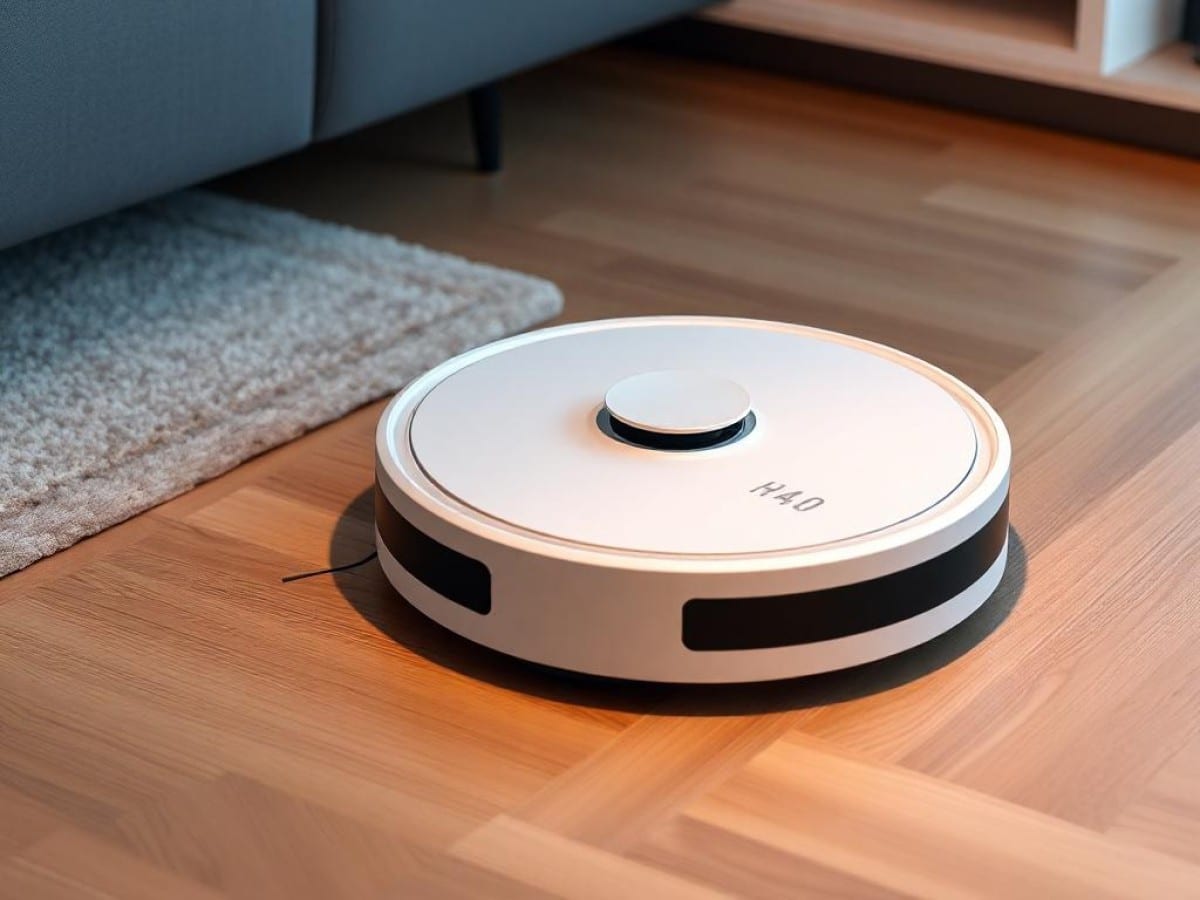
The robot itself maintains a fairly standard circular format, with a LiDAR dome on top, accented by an orange rim on the interior. Next to this are two control buttons, while the rest of the design is quite minimalistic. A flap located on the rear half allows access to the dustbin and filter.
The underside mainly features a hybrid brush roll with silicone blades and nylon thread bristles, as well as a side brush. The robot comes with two brushes, a standard three-arm version and another with two arms, designed to minimize tangling of hair and pet fur.
The mopping module is separate from the robot and clips onto the rear part. Two small buttons on each side allow for its removal without having to turn the robot upside down. Likewise, it can be attached flat, without having to lift the device. It includes a small water tank, which can be filled directly under the tap. The mop itself is attached by sliding one end into a groove on the module and is held in place by Velcro.
Finally, on the front, there is an obstacle recognition module, although it is not a camera like some high-end models.
Let’s conclude with the finishes and build quality, which are very good, especially for an entry-level product. The alignments are precise and the whole unit seems sturdy and solid, with no noticeable play.
Xiaomi Robot Vacuum H40An Overly Basic App
The Xiaomi H40 is controlled via the Xiaomi Mi Home app, simplifying daily use if you use other products from the brand. Pairing takes just a few minutes, and the initial setup involves mapping your home. This task is accomplished using the robot’s LiDAR rangefinder, which segments the different rooms. These are not automatically identified, and the robot is not capable of recognizing furniture. The mapping may lack precision, with some rooms being grouped into a single large area in the app.
What if you left the mowing of your garden to a robotic lawnmower? Until August 31, the manufacturer Mammotion is offering up to 591 euros off its top models. Enjoy a flawless garden without any effort.
Fortunately, you can edit the map as needed to merge or divide rooms, assign names, add virtual walls, or define no-go zones. You can also add your furniture and especially your rugs to the map, allowing the robot to avoid them in mopping mode. Indeed, it is not capable of detecting them on its own, and you will therefore need to place them manually on the map, which seems quite surprising for a modern robot.
Once the mapping is done, the app allows you to start a complete cleaning or of specific rooms, or even of a customizable area. However, it does not integrate an automatic smart mode. You must manually choose between four cleaning options: suction only, mopping only, simultaneous suction and mopping, or suction followed by mopping. Each mode allows you to adjust the suction power, water flow, and number of passes. However, it is not possible to set different cleaning parameters for different rooms, which would have allowed, for example, to configure a deeper clean in the kitchen and a lighter one in the bedroom.
The app also allows you to schedule cleaning according to a predefined schedule and to activate a Do Not Disturb mode, especially to avoid it emptying at night and not waking the household.
Finally, even though the app interface remains streamlined, it sometimes requires several manipulations to access simple settings, which seems confusing for daily use and much less intuitive than what the competition offers. For example, it takes far more clicks than other apps to start cleaning a specific room, making daily use unnecessarily complex.
Fortunately, the H40 is compatible with Google Assistant and Alexa, allowing easy voice control.
Xiaomi Robot Vacuum H40Subpar Cleaning Performance
With a suction power of 10,000 Pa, the Xiaomi H40 has enough power to clean hard floors. However, this is almost a third of the power of a high-end vacuum, which does not allow it to tackle thick rugs on a daily basis.
Xiaomi has opted for a hybrid roller, which combines silicone blades and nylon threads. This approach maximizes the amount of dust and dirt collected by the roller, while minimizing the entanglement of pet hair and human hair around the brush.
Meanwhile, a side brush directs dirt in corners, along furniture and walls towards the roller, so that they are well vacuumed.
In practice, the suction results are relatively good: crumbs, small particles, and dust are quite well vacuumed, but it happens that some residues remain on the floor. The side brush sometimes tends to scatter dirt, which means that they are not vacuumed in the robot’s path. However, using a grid pattern, the dust is well vacuumed and no visible residue remains. For example, I spilled salt and cereal crumbs on the floor, which were mostly vacuumed after one pass, while a cross-cleaning with two passes had managed to remove the dirt.
As for carpets, the H40 is suitable for thin carpets, but will be too weak for thick or long-pile rugs. The suction power and the simple brush roll will not be suitable for deep cleaning in the fibers and dislodging dirt, and will only provide a surface cleaning.
The side brush manages to dislodge dirt along the walls, but the lack of an extendable side brush makes some corners difficult to access for the robot.
Regarding wet cleaning, it is more anecdotal than really effective. Since the station is not equipped with a base plate, the base of the robot is in direct contact with the floor, which can damage the parquet if the wet mop is not removed. It is therefore advisable to remove the module after each use, if only to fill it with clean water and to rinse and moisten the mop.
During cleaning, the robot continues to moisten it according to three adjustable levels in the app. In practice, two small nozzles allow water to flow, which tends to only partially moisten the mop, leaving a visible uneven trail on the floor. Speaking of trails, the robot is not capable of lifting its mop and will therefore moisten the floors in its path, even in rooms it does not clean. If there are rugs in its path, it will also cross them with the wet mop, unless you manually indicate them on the map, in which case it will bypass them, provided an alternative path is available.
The mop is of course not washed automatically, neither during nor after cleaning. It is also not vibrating, which means that it only wipes the floors with a bit of water. In case of light stains, the H40 manages to remove them. However, do not count on it to clean up spilled coffee or sauces. Indeed, in this case the robot is more likely to spread the dirt and even spread it in its path. However, it is not intended for this use and we therefore forgive this wet cleaning, which is mainly intended to refresh the floors, rather than to clean them thoroughly.
Finally, let’s talk about the noise level, which reaches 65 dB in normal mode. This is reasonable, but relatively high, especially given the modest suction power. On a daily basis, it remains tolerable, but can become annoying for having a phone conversation or watching TV.
Xiaomi Robot Vacuum H40Approximate Navigation and Almost Blind Obstacle Detection
The Xiaomi H40 mainly uses its LiDAR rangefinder to move around and orient itself. It moves relatively well from one room to another and manages to orient itself without difficulty, even if it can take a significant amount of time to reposition itself if it gets lost. Cleaning is methodical, starting by following the edges before cleaning in parallel strips. It’s basic but the operation is satisfactory.
However, obstacle detection is catastrophic. The robot is not capable of detecting slippers, laundry, or cables in its path and charges straight at them. It manages to avoid hard obstacles that exert a force on its bumper, like furniture legs, but that’s about it. It also got stuck on a threshold it couldn’t cross, and pushed against the skirting board, even though it wouldn’t have been able to cross it.
Overall, navigation is quite disappointing, especially because of the too basic obstacle detection. The H40 will therefore not be suitable for households with children or pets who may leave objects on the floor, and will be more suitable for homes where the floors are cleared of all obstacles before launching the robot.
Xiaomi Robot Vacuum H40Basic Maintenance, Except for the Mop
Despite its accessible price, the Xiaomi H40 includes a charging base equipped with a dust bag, allowing for automatic emptying after each cleaning. This promises several months of autonomy without having to manually empty the reservoir.
However, the robot does not maintain its mop automatically and it requires special attention. Indeed, it must be moistened manually before each cycle and the water tank of the module must be filled before placing it on the robot. After cleaning, it is better to remove it and clean it quickly, otherwise it may damage the parquet under the robot.
Even if you have tiles, moisture will promote the proliferation of bacteria and bad odors, and it is therefore better to remove it and dry it manually or put it in the machine. Moreover, for large surfaces that are quite dirty, it is ideal to wash the mop several times to avoid spreading the dirt, which adds even more manual maintenance. On a daily basis, the wet cleaning of the H40 is not worth it and it will mainly serve to quickly refresh slightly dirty floors, rather than truly cleaning them.
Finally, despite Xiaomi’s anti-tangling promise, pet hair and human hair tend to accumulate around the brush. If this is the case, it is enough to remove it to remove the hair to avoid it getting stuck.
Xiaomi Robot Vacuum H40Price and Release Date
The Xiaomi Robot Vacuum H40 is priced at 249.99 euros in France.
Xiaomi Robot Vacuum H40
at the best price
-
Xiaomi
-
Amazon
Similar Posts
- Xiaomi Robot Vacuum X20 Max Review: Top Features at a Low Price!
- Tapo RV50 Pro Omni Review: Discover Your New Daily Companion!
- Roborock Qrevo Slim Review: Achieve Thorough Cleaning Even Under Low Furniture!
- Dreame Aqua10 Ultra Roller Review: Does This Self-Cleaning Mop-Vacuum Robot Deliver?
- Ecovacs Deebot X11 OmniCyclone Review: Discover the Bagless Robot Vacuum with Unlimited Battery Life!

Maya Singh is a senior editor covering tablets and hybrid devices. Her work explores how these tools reshape digital productivity and learning. She also contributes to feature editorials on emerging tech.