
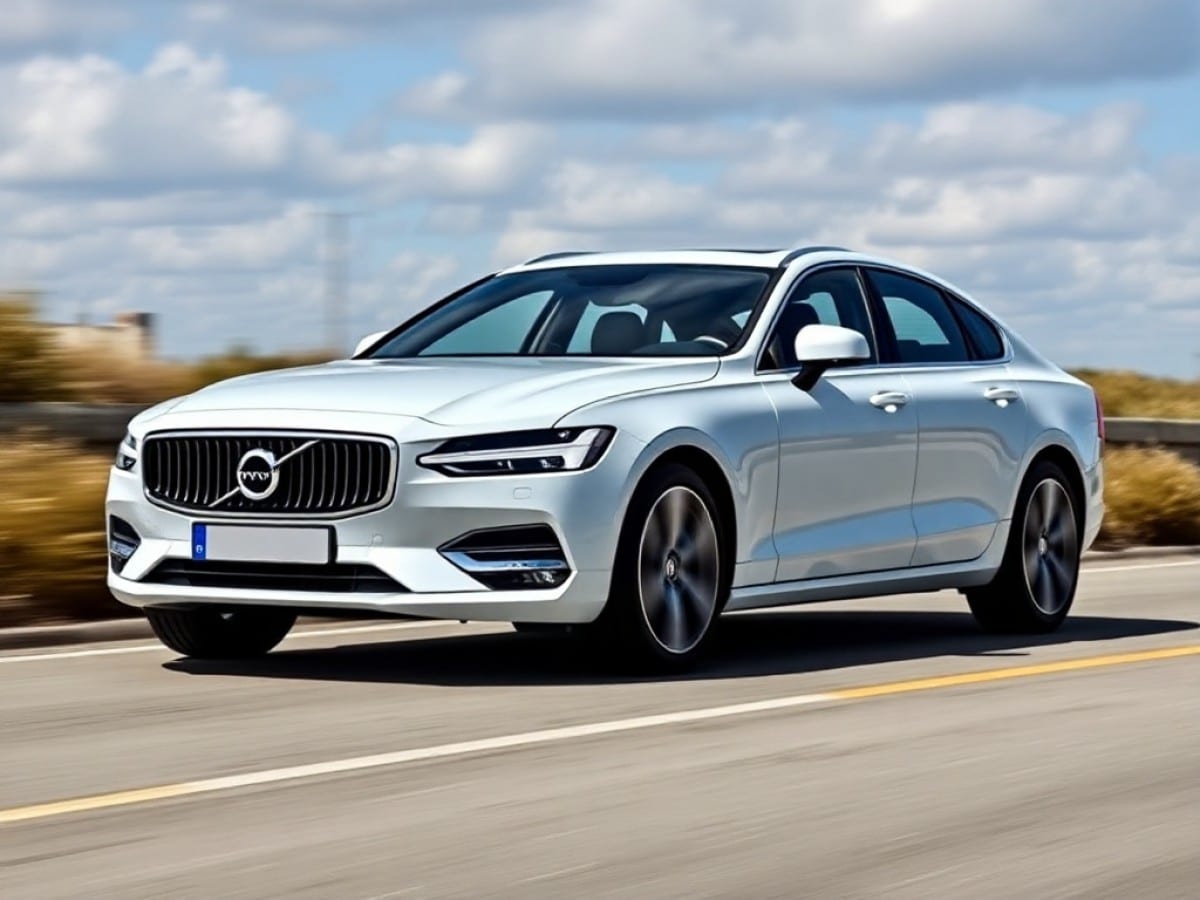
Volvo is entering the electric sedan market with the introduction of the ES90. As a brand long renowned for its station wagons and sedans, expectations are high for this new electric vehicle, which promises up to 700 km of range and rapid charging capabilities. Having had the opportunity to drive it, here are our thoughts!
Scientists confirm: This is the most effective way to get your cat’s attention, according to new research
Elderly Couple Refuses Reserved Seats—Viral Train Standoff Sparks Fiery Debate on Courtesy
One year after testing the EX90, I found myself behind the wheel of another electric Volvo. The ES90 holds significant importance for the Swedish automaker. While it might not become the top-seller of the lineup, it represents a pivotal shift for the brand, which is known for the quality and reliability of its sedans and wagons.
In March, we were first introduced to its impressive specs, including large batteries, powerful engines, and an 800-volt platform. We’ve finally had the chance to test drive the Volvo ES90.
Fiche technique
| Model | Volvo ES90 |
|---|---|
| Dimensions | 5.0 m x 1.94 m x 1.55 m |
| Power (HP) | 680 HP |
| 0 to 100 km/h | 4.0 s |
| Autonomy Level | Semi-autonomous driving (level 2) |
| Top Speed | 180 km/h |
| Embedded OS | Android Automotive OS |
| Main Screen Size | 14.5 inches |
| Car-side Plug | Type 2 Combo (CCS) |
| Entry-level Price | €75,900 |
| Product Sheet | View Product |
Design: Volvo’s Signature Serenity
Volvo’s designs have always resonated with me, from the simplistic form of a 850 to the more daring style of a C30. The ES90 did not disappoint, presenting a calm, unaggressive, and reassuring aesthetic. It makes one think that no ill-intent person could emerge from a Volvo—a Volvo driver must surely be as relaxed as the car’s design.
The new model features the brand’s latest light signature with a Thor’s Hammer motif, while the new logo is centrally placed on a filled-in grille. The traditional rectangular grille crossed by a perpendicular line has been replaced, yet Volvo retains this line with an embossing that continues the arrow of the logo.
The hood is slightly ribbed, with a LiDAR positioned above the windshield, its slight prominence reminiscent of a taxi light, which makes sense for a sedan. From the side, the design is understated, with body-integrated door handles only noticeable when they slide out to let you in.
The rear also keeps it simple. The C-shaped light signature frames the license plate area, while the distinctive vertical lights from Volvo’s wagons and SUVs appear as light bars on each side of the rear window.
Spaciousness: A Nordic Limousine
Volvo has always excelled in the spaciousness of its sedans and wagons, a well-known fact to its clientele. The rear seats are particularly impressive. Even with the driver’s seat adjusted for my height of 1.86 m and a fairly reclined driving position, there was more than enough legroom—I could even cross my legs without touching the front seat.
Rear passengers can enjoy reclining backrests (28 to 33 degrees) with a touch control near the window button. The seats are heated and ventilated, and the climate control is four-zone.
The central armrest is labeled ‘premium’: it’s wide, includes two cup holders, and a document holder. However, it’s best left unfolded as once folded down, it obstructs the driver’s view through the rearview mirror.
Ergonomic Flaws
The front is just as comfortable with electrically adjustable seats that perfectly fit any body shape, from lumbar support to seat inclination and height.
Adjusting the steering wheel and mirrors, however, is less intuitive, hidden in sub-menus on the central screen. A puzzling design choice as it complicates what could be a straightforward adjustment: you select these elements on the central screen and adjust their position using the steering wheel’s touch arrows.
Despite the criticism I had for the EX90 a year ago, Volvo continues with this setup. Similarly, window controls are limited to just two buttons for four windows—opting to switch between front and rear windows. While this might save on buttons, it’s hardly fitting for a premium vehicle.
However, the finish quality is high, with well-fitted and pleasant materials. The wood veneer on the dashboard stands out in an era dominated by gloss black, aluminum, Alcantara, or fabric finishes. The media selector’s crystal dial quickly adjusts volume.
The Trunk
If a customer is interested in a Volvo, they’re likely also considering the cargo space, which, while not outstanding at 446 liters, is more practical than a sedan’s trunk thanks to its liftback design. The front trunk, or ‘frunk,’ adds an extra 22 liters, although it’s relatively minimal.
Infotainment: Trusting Google
The ES90 features a 14.3-inch floating screen in portrait orientation using the Volvo Car UX interface. Like all recent Volvos, it runs on Google Automotive, meaning navigation is powered by Google Maps and users can download their preferred apps like Waze or Spotify from the Play Store. Apple CarPlay and simple Android Auto are also available.
In use, the screen is responsive and user-friendly. The interface and gestures are similar to those on a smartphone, which is straightforward for my generation, but perhaps less so for older customers typically interested in this type of vehicle.
Beneath the central screen, there’s a phone charging pad and two USB-C ports. The driver’s display is a 9-inch screen aligned with the steering column, showing essential information like speed, traffic signs, navigation, and the status of the autonomous driving system. The display is straightforward, which is ideal since it should not distract the driver.
The audio system in our test car, an Ultra model, was a Bowers & Wilkins system with 25 individually adjustable speakers and a total output of 1,610 watts (an optional upgrade). As usual, the sound quality in a Volvo is among the best I’ve experienced, comparable to the Mark Levinson systems in Lexus vehicles.
Standard on the Plus and Ultra versions is a 940-watt Bose system with 14 speakers.
Driving Assistance: A Competent Autonomous System
In addition to the standard ADAS required by the EU’s GSR II regulations, the ES90 is equipped with an advanced autonomous driving system using the roof-mounted LiDAR, along with 7 cameras, 5 radars, and 12 ultrasonic sensors.
This suite of sensors supports an array of functions, such as lane departure and rear cross-traffic alerts, lane-keeping assistance, and pedestrian and cyclist avoidance aids.
We tested this semi-autonomous system on the highway, and it performed well even where road markings were faint. Lane changes were easy—just activate the turn signal.
Lane keeping was accurate, and the adaptive cruise control even handled curves on the highway, making it a pleasure to let the artificial intelligence take over some of the driving tasks.
Route Planner: Volvo Also Trusts Google (Maps)
Using Google Maps’ data, the ES90 can calculate the optimal route based on current traffic conditions, battery life, and charging needs. When it’s time to recharge, the car offers several options, including highway rest stops, supermarkets, and Tesla Superchargers, with Google Maps providing helpful insights like “Fast” or “Very Fast” to assist in choosing a charging station.
The vehicle supports Plug and Charge: once a payment method is registered in the navigation system, you can just plug in at a compatible charging station without needing to scan a card or use an app.
The system can also pre-condition the battery to optimize charging times, making Google’s route planner one of the easiest and most effective I’ve used.
Driving: A Well-Rounded Sedan
Our test model was the Single Extended Range version with a 333-horsepower rear-mounted motor.
The power is more than sufficient for this sedan, which weighs 2,366 kg. It accelerates from 0 to 100 km/h in 6.9 seconds, with a top speed limited to 180 km/h. Despite its significant weight, the car doesn’t feel cumbersome to drive.
The low center of gravity, with most of the weight in the floor-mounted battery, and the 22-inch low-profile, wide tires, which deform little, contribute to good handling. The Pirelli P Zero EV tires provide substantial grip.
Combined with the active air suspension (which adjusts 500 times per second based on the vehicle, route, and driver input), double wishbone front and multi-link rear suspension, the ES90 handles well despite its weight. It’s not uncomfortable in the Prealps near Nice, where we conducted our test.
In city driving, from Nice towards the Col d’Eze and Braus, the steering assistance offers two levels of resistance: the softer setting is very gentle, while the normal setting provides more feedback. The suspension also has two settings, a softer mode for passenger comfort and a firmer setting that isn’t overly harsh. The Volvo ES90 strikes a good balance, being neither too soft nor overly sporty.
A One-Pedal driving mode is available, which is quite effective but be careful not to make your passengers queasy. I ended up preferring the auto mode of this One-Pedal system, which adapts to the traffic ahead, but not to the road layout: if a sharp turn is coming up, you’ll need to press the brake pedal yourself.
Regenerative braking isn’t an option with the ES90—it’s either One-Pedal driving or nothing. On winding roads, and even in daily driving, it would be nice to have paddle shifters, or at least a ‘B’ mode to slow down without using the brake pedal or making your passenger uncomfortable.
On the highway, the well-calibrated semi-autonomous driving is a highlight, as is the nearly perfect cabin soundproofing. Our Ultra trim had acoustic double glazing on both front and rear windows, ideal for fully enjoying the Bowers & Wilkins sound system. It’s as powerful as it is accurate. I recommend having a streaming subscription that supports high-quality content to make the most of this feature.
And speaking of the rear seats, the Volvo ES90 is also enjoyable as a passenger vehicle. Just make sure to prohibit your driver from using the One-Pedal function!
Range, Battery, and Charging: From 650 km to 700 km
Our test vehicle was a Volvo ES90 Single Extended Range. This model features an 88 kWh battery (usable capacity), providing a WLTP range of 650 km with a WLTP consumption of 16.1 kWh/100 km.
We recorded a consumption of 20 kWh/100 km during the first part of our test (mountain roads, crossing Nice and Monaco, and reaching a high-altitude endpoint). On the return trip on the highway heading back down towards Nice, consumption was 12 kWh/100 km, averaging out to 16 kWh/100 km, which is quite respectable for a 5-meter-long sedan.
Benefiting from an 800-volt platform even in its smallest variant, charging is quick, with a 10% to 80% charge taking just 20 minutes thanks to a peak power of 300 kW. It’s neither too fast to be inconvenient nor too slow to cause impatience. Volvo also claims a charge of 275 km WLTP in just 10 minutes. While good, it could still be slightly better.
Two all-wheel-drive versions using dual motors are available. The Twin model develops 449 horsepower, while the Twin Performance model reaches 680 horsepower. They use the same 102 kWh battery (usable capacity) for a claimed 700 km WLTP range. This time, the charging power reaches 350 kW, with 10% to 80% also achievable in 20 minutes, but with a 300 km WLTP charge in just 10 minutes.
The Volvo ES90 is clearly designed for long trips, and its range reflects this intention. 700 km is more than adequate, but imagine if Volvo decided to pair the larger 102 kWh battery with the 333 horsepower rear-wheel drive motor. The range could approach 800 km.
Pricing, Competition, and Availability
Now, let’s discuss pricing. Don’t be sensitive about this topic; yes, the Volvo ES90 isn’t cheap, but it justifies its price with ample interior space, comfort, high-quality materials, advanced technology, and a sophisticated electric system.
Prices start at €75,900 for the Start trim with the Single Extended Range 333 horsepower motor. The high-end Ultra Twin Performance 680 horsepower model is priced at €98,450.
Regarding warranty, Volvo offers a standard 3-year or 100,000 km vehicle warranty, while the battery warranty extends to 8 years or 160,000 km.
Similar Posts
- Discover the Polestar 4 Electric: A Game-Changing Car Missing One Key Feature!
- I Drove 1000 km in a Polestar 2: Here’s Why It Beats the Tesla Model 3
- Dacia Spring Review: Is France’s Cheapest Electric Car Still Overpriced?
- We Tried the Genesis GV60: Is This Electric SUV a Real Rival to BMW, Audi, and Volvo?
- XPeng P7+ Review: This Chinese Electric Car Charges Twice as Fast as a Tesla Model 3!

Maya Singh is a senior editor covering tablets and hybrid devices. Her work explores how these tools reshape digital productivity and learning. She also contributes to feature editorials on emerging tech.