
Scientists confirm: This is the most effective way to get your cat’s attention, according to new research
Elderly Couple Refuses Reserved Seats—Viral Train Standoff Sparks Fiery Debate on Courtesy
Development and Localization Strategy
Mercedes introduced the new electric CLA models in Europe in the second quarter of 2025. The CLA 250+ was the first to launch in a rear-wheel drive configuration, followed by the all-wheel drive CLA 250 4MATIC. First unveiled at the Shanghai Auto Show in April 2025, the CLA 300L is locally produced by Beijing Benz, a joint venture with the BAIC group. Notably, 2025 marks the 20th anniversary of Mercedes’ production in China with the launch of this CLA 300L.
Unlike Audi, which created a ringless brand (AUDI) through its SAIC-Audi joint venture with the E5 Sportback, Mercedes chose to retain its visual identity while localizing its technology. Consequently, the CLA 300 L was launched through pre-sales in China on September 25, 2025. Price-wise, the CLA 300L competes in a highly competitive segment that includes the Xiaomi SU7, Luxeed S7, Zeekr 007, Audi E5 Sportback, and the recently updated Tesla Model 3.
The creation of the CLA 300L marks a historical shift in Mercedes-Benz’s R&D organization. Built on the MMA (Mercedes Modular Architecture) platform, this sedan was developed in collaboration with teams based in Shanghai and Beijing. These R&D centers, established over 20 years ago, have taken the lead in developing infotainment and assisted driving systems, signaling a shift in skill distribution within the group. This reminds us of Renault’s announcement about developments made in its Chinese centers for the new Twingo.
The partnership with Momenta for autonomous driving also illustrates this technological localization. This Chinese startup, founded in 2016 in Suzhou, now supplies the three German automakers BMW, Mercedes-Benz, and Audi in China, all of which use Momenta’s Flywheel LLM model for their L2++ systems. This system was first introduced in the CLA by Mercedes.
This technological convergence among the “BBA” (BMW, Benz, Audi) on a Chinese solution also reflects a reversal of technological power dynamics between Germany and China.
Why You Should Never Reheat These Foods in the Microwave – The Hidden Dangers Experts Warn About
I tried the top 5 guard dogs—here’s what makes these breeds the ultimate protectors
Exterior Design and Dimensions
The dimensions of the CLA 300L (4,763 × 1,836 × 1,471 mm) reveal a car that is 13mm longer than a Tesla Model 3 but also 77mm narrower. These compact premium dimensions place it on the boundary between the C and D segments, with a wheelbase of 2,830 mm, which is 40 mm longer than the European CLA.
Despite this extended wheelbase and a height that is 3mm greater than its standard version, the 300L maintains the same aerodynamic coefficient measured at 0.21 Cx, just below the 0.22 claimed by the 2025 Tesla Model 3 but above the 0.195 of the Xiaomi SU7.
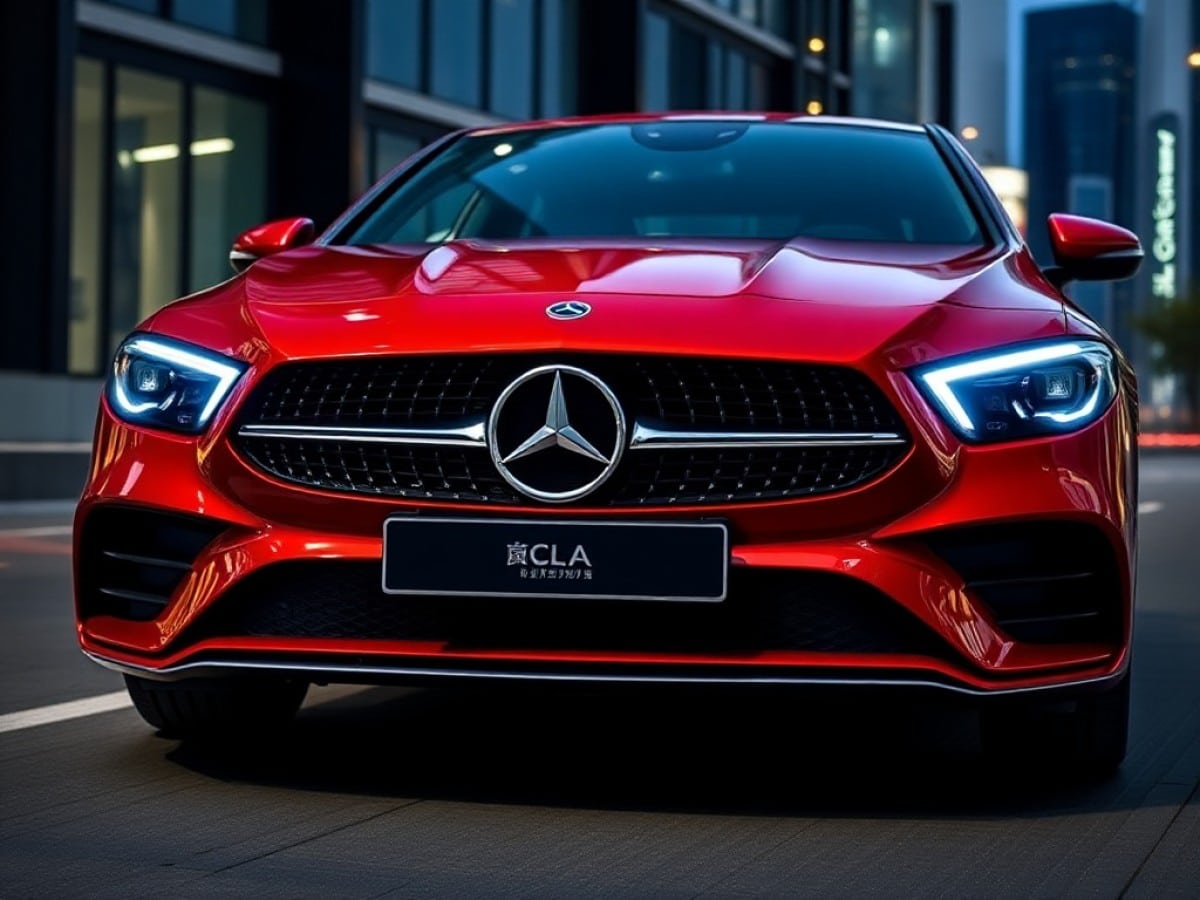
The aesthetic retains Mercedes hallmarks with an illuminated trapezoidal grille adorned with multiple Mercedes stars, including the central emblem. The lighting signature, completed by front and rear lights incorporating star-shaped diodes, clearly asserts its German identity.
This approach is somewhat a middle ground compared to Audi, which adopted a distinct design for its E5 Sportback, also sold exclusively in the Chinese market.
Interior and Habitability
The interior of the CLA 300L represents a synthesis between European refinement and Chinese technological expectations. The triple screen setup (26cm for the instrumentation, 37cm central, optional 26cm passenger) adopts Mercedes design codes while integrating locally developed technologies. For instance, the MB.OS system, powered by a Qualcomm Snapdragon 8295 chip, has been optimized for mapping purposes specific to this vehicle. More on this later.
The voice assistant, developed in partnership with Doubao (a subsidiary of ByteDance), allows for contextual and linguistic localization unachievable with Western solutions. The multilingual system includes French, indicating a potential future export ambition despite the initial focus on China.
Among the features listed by the dealer, noteworthy are the all-leather upholstery from a supplier shared with Louis Vuitton, six synthetic engine sounds for the driving experience, the 16-speaker Burmester audio system with a total power of 800W (optional, standard on the premium version), the curtain-less panoramic glass roof, and a head-up display (HUD) option priced at 820 euros.
The vehicle I tested did not have the HUD, so I was unable to evaluate it.
The 40 mm extended wheelbase primarily benefits the rear passengers, but not exclusively. When I sat in the front passenger seat, I attempted to move my seat back and almost felt like I was moving into the trunk, given the seat’s extensive range of adjustment. This is certainly a compact car in which Victor Wembanyama would find ample legroom at the front. I find this also practical when your passenger has a few bags in the front.
At the Rear
The rear seating allows for comfortable seating with my height of 1.83 meters. The legroom is ample, and the headroom is enhanced by the standard panoramic glass roof. Note that the rear bench is neither reclining nor foldable. Don’t expect to transport bulky items in your Mercedes.
In terms of cargo volume, the CLA 300L matches the E5 Sportback with 405 liters, although it’s significantly less than the 594 liters of the Tesla Model 3. The 300L also has a front trunk with a volume of 101 liters, bringing the total storage volume to 506 liters.
Advanced Technologies: CATL Batteries and 800V Architecture
The rear-wheel drive version of the CLA 300L, the only one available at launch, produces 200 kW (268 horsepower) and accelerates from 0 to 100 km/h in 6.6 seconds. This performance, while measured, prioritizes energy efficiency over sheer power display, a philosophy consistent with the brand’s positioning in the Chinese market. An all-wheel-drive version with 259 kW (349 horsepower, 0-96 km/h in 4.8s) is planned for 2026.
The 85 kWh CATL NMC battery is part of the 800V architecture, which allows peak recharging performances of 325 kW, enabling the recovery of 370 km of range in 10 minutes or a 20 to 80% charge in 15 minutes. Although satisfactory, it does not match the 10C charging rate of BYD nor the 8C level of Zeekr.
The claimed range of 866 km CLTC (approximately 690 km WLTP) positions the CLA 300L among the leaders in this category. This is at least superior to the 830 km CLTC of the recently updated Tesla Model 3, and the CLA 300L also surpasses the Zeekr 007 (up to 825km CLTC) and the Xiaomi SU7 (up to 800km CLTC) in terms of range. The CLTC consumption of 10.9 kWh/100 km attests to this optimization.
Mercedes does not venture into sports car performance but rather focuses on providing a vehicle that targets range. This seems sensible for Mercedes’ traditional clientele, while those seeking more sportiness may opt for an AMG version of another model in the lineup.
AI-Assisted Driving
The CLA 300L’s L2++ assisted driving system, developed in partnership with Momenta, marks Mercedes’ entry into the era of Chinese artificial intelligence. Based on Suzhou startup Momenta’s Flywheel LLM model, this system offers an “end-to-end” approach that can guide the vehicle with or without a map.
The mapping relies on a strategic partnership with Amap, a Chinese navigation leader. Mercedes uses local mapping partners depending on the market: Amap in China, Naver in South Korea, and Google Maps elsewhere. This localized solution provides the necessary data for system-initiated lane changes and overall navigation.
I am impressed by the realism of the map graphics; water bodies are animated, the map is smooth, more detailed than the standard Amap system used by other Chinese manufacturers. The interface also includes a “summary” map indicator in the bottom right of the screen, allowing you to view the remaining route. I would like to see how these graphics and indications are projected on the optional head-up display. Another test of this feature will be necessary.
The NOA (Navigate on Autopilot) function theoretically covers highways, urban roads, and parking maneuvers, but its availability is limited to premium versions. The highway NOA is operational, while the urban NOA (City NOA) is gradually being deployed in major Chinese metropolises. Beijing and Shanghai are the two priority cities, with a goal of covering 100 key cities in China by the end of 2026. However, this is a significant adoption limit compared to competitors who are already at L2++ in urban areas and are considering L3 level by 2026.
Chassis and Suspensions
The CLA 300L adopts a conventional chassis architecture, but optimized for Chinese use, according to our dealer. The front three-link suspension and the multi-link rear suspension offer a balanced compromise between road holding and comfort, without resorting to the pneumatic suspension technologies that some competitors favor in their high-end versions.
The 18-inch wheels, smaller than the 20-21 inches often adopted by Xpeng, Zeekr, or Audi, deliberately prioritize ride comfort over visual performance.
The “one-box” braking system integrates the brake booster and master cylinder into a single unit, a technical innovation aimed at compactness and weight reduction. Mercedes does not disclose braking performance or turning radius information.
We now understand that you are dealing with an entry-level Mercedes; the comfort is there, but do not expect the acceleration or braking performance that characterizes the local competitors. This is not Mercedes’ strategy for CLA 300L customers.
My Road Test
Handling the CLA 300L reveals a “very Mercedes” philosophy in its approach to electric driving. The 268 horsepower feels sufficient without being excessive, favoring progressiveness over the brutal demonstration of instant torque. This measured approach contrasts with the more aggressive calibrations observed in Chinese manufacturers that maximize acceleration sensations.
The chassis confirms European optimization with remarkable stability and overall convincing balance. The suspension, firm yet never harsh, effectively absorbs road imperfections, both on highways and in urban traffic.
The ride comfort is exemplary, the combination of suspensions and tires will likely satisfy most potential customers in this vehicle segment. Mercedes prioritizes everyday usability over sporty looks or flashy effects, a potentially winning bet for its customers and targets in the Chinese market. I would also have liked to spend more time behind the wheel of this 300L to further test the chassis limits.
The braking is effective and progressive, although Mercedes did not detail the system used during our test. ESP modes and traction control were not extensively explored, a limitation due to the controlled test context offered by the manufacturer.
Price and Positioning
The pricing of the CLA 300L reveals an aggressive positioning strategy for a Mercedes. The CLA 300 L Ultra-Long Range Edition starts at 249,000 yuan (€30,220), while the CLA 300 L Ultra-Long Range Intelligent Edition peaks at 299,000 yuan (€36,284). These prices place Mercedes in direct competition with Chinese champions of the premium electric segment, abandoning the traditional premium pricing strategy in favor of a competitive price-performance ratio.
| Competitive Positioning | Price (yuan) | Price (euros) | Range CLTC |
| Mercedes CLA 300L | 249,000 – 299,000 | 30,220 – 36,284 | 866 km |
| Xiaomi SU7* | 215,900 – 299,900 | 26,200 – 36,394 | 700 – 800 km |
| Tesla Model 3 (2025) | 235,500 – 339,500 | 28,540 – 41,199 | 634 – 830 km |
| Zeekr 007 GT | 202,900 – 232,900 | 24,550 – 28,240 | 650 – 825 km |
| Audi E5 Sportback | 235,900 – 399,000 | 28,640 – 48,280 | 618 – 773 km |
*I deliberately exclude the Xiaomi SU7 Ultra priced at 529,900 yuan, which is out of range in our comparison
This pricing policy places Mercedes in an intermediate position against Chinese competition. More expensive than the Zeekr 007 GT (202,900-232,900 yuan) but offering superior range and the premium German image, less expensive than some configurations of Audi or Tesla while providing satisfactory features.
Compared to the aging EQB 260, a cheaper but older Mercedes SUV equipped with 2019 technology and limited to 200 horsepower, the CLA 300L illustrates Mercedes’ technological evolution. This progress reflects the investments made by the German manufacturer to catch up on electrification in China, investments that are beginning to bear fruit with this competitively technological CLA 300L.
Mercedes vs Audi: Two Survival Strategies
The contrasting strategies of Mercedes and Audi in China reveal two opposing philosophies of European adaptation. Audi created the “AUDI” brand without its traditional four rings through its SAIC-Audi joint venture, partially erasing its historical identity to better integrate into the Chinese market. This radical approach allows complete freedom in product development but risks diluting the premium image built over decades.
Mercedes retains its star and visual identity while massively localizing technology. This strategy preserves global brand consistency but imposes more significant development constraints. Paradoxically, both manufacturers converge towards similar technical solutions: Momenta partnership for autonomy, CATL batteries, local production via joint ventures, and dimension adaptation to Chinese expectations.
Verdict: Necessary Pragmatism, Uncertain Success
The Mercedes CLA 300L perfectly illustrates the necessary adaptation of European manufacturers to survive in China. With its 866 km CLTC range, aggressive pricing (259,000-299,000 yuan), and localized technology, this compact sedan meets the expectations of the Chinese market. Mercedes abandons its traditional premium pricing strategy to offer a competitive price-performance ratio against local champions.
However, make no mistake, you are indeed dealing with Mercedes, and you will still pay a certain premium to become a customer of the brand. The 300L is approximately 15 to 25% more expensive than an equivalent model from Zeekr or Luxeed, with a lower level of equipment. And especially, a longer list of options.
But my test also confirms the overall quality of the product, even though I would have liked to see optional adaptable pneumatic suspensions, as well as a rear screen or optional ventilated rear seats.
As of the publication of this article, an entry-level version of the CLA – the CLA 260 L – has been listed for homologation in China. Equipped with a
Similar Posts
- Driving the Xpeng P7+: Experience Tesla Model S Luxury at a Model 3 Price
- Discover the Polestar 4 Electric: A Game-Changing Car Missing One Key Feature!
- XPeng P7+ Review: This Chinese Electric Car Charges Twice as Fast as a Tesla Model 3!
- More Powerful Than a Porsche, Cheaper Than a Tesla: Testing the 1500 HP Xiaomi SU7 Ultra Electric Car
- Tested Zeekr 7GT: Stunning Look, Ultra-Fast Charging, Aggressive Pricing—But Is It Enough?

Maya Singh is a senior editor covering tablets and hybrid devices. Her work explores how these tools reshape digital productivity and learning. She also contributes to feature editorials on emerging tech.