
Scientists confirm: This is the most effective way to get your cat’s attention, according to new research
Elderly Couple Refuses Reserved Seats—Viral Train Standoff Sparks Fiery Debate on Courtesy
When one thinks of Loewe, images of televisions with minimalist lines and exquisite materials immediately come to mind. For nearly a century, the German brand has cultivated an image of excellence, where technology serves impeccable aesthetics. It is with this philosophy, almost a religion of design, that Loewe enters the portable audio market by introducing the Leo, its very first Bluetooth noise-canceling headset. And it’s safe to say that it stands out.
Priced at a prohibitive 1299 euros, it immediately positions itself against competitors like Focal Bathys Mg—and to a lesser extent Bowers & Wilkins Px8—with a simple promise: to deliver the Loewe experience for the ears, a blend of luxury and German engineering.
It should be noted that this is an “affordable” version of the very luxurious Loewe headset made in collaboration with Jacob & Co, which was unveiled in late August.
To justify this elitist positioning, the Loewe Leo showcases a unique design, premium materials, and an intriguing specification sheet. It includes separate amplification technology, a customizable equalizer, spatial audio with head movement tracking, and a host of features through a dedicated mobile app. But in a sector where audio performance and noise cancellation efficacy reign supreme, and where giants like Sony or Bose dictate the rules, can a beautiful object and a prestigious name alone convince?
Loewe LeoTechnical Specifications
| Model | Loewe Leo |
|---|---|
| Format | Wireless Headset |
| Removable Battery | Yes |
| Microphone | Yes |
| Noise Cancellation | Yes |
| Battery Life | 65 hours |
| Connector Type | USB Type-C |
| Weight | 360 g |
| Product Sheet |
This review was conducted with a headset loaned by Loewe.
Loewe LeoThe Object First and Foremost
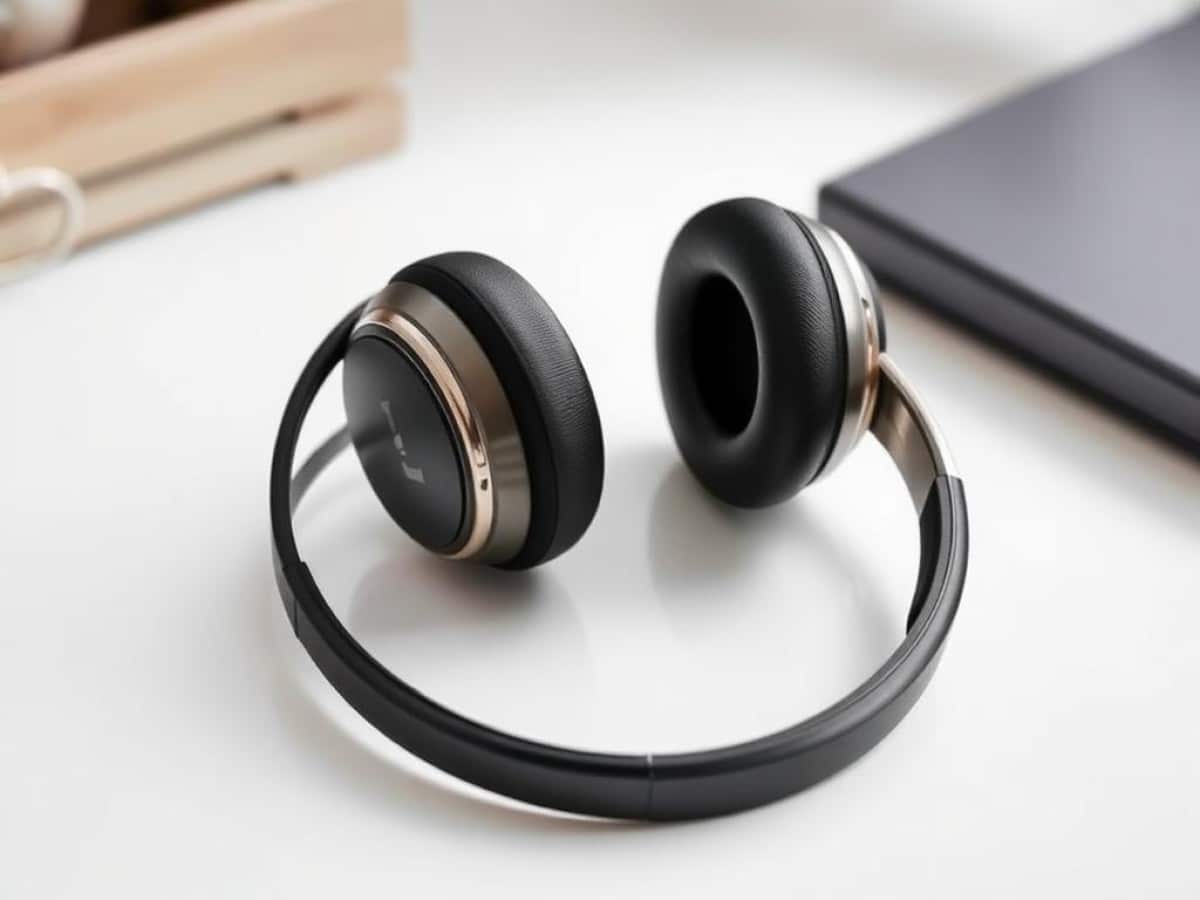
Right out of the box, the Loewe Leo asserts its difference. The experience begins with a well-crafted package and a sturdy carrying case that exudes quality. Inside, the headset rests in a felt-lined case. Where competitors mostly opt for plastics and metals with matte finishes, Loewe takes a radically different approach. The headset sports a shiny silver finish, almost chrome-like, that immediately catches the light and eye. It’s a status object, a fashion accessory meant to be seen, contrasting with the usual discretion of portable headphones.
The ovoid earcups are very plain, only adorned with a central surface stamped with the brand’s stylized heart-shaped logo. The construction is exemplary. The headband, covered in a soft and dense synthetic leather, inspires confidence. It is connected to the ear cups by polished metal arms with a beautiful effect, whose notched adjustment mechanism is both firm, precise, and satisfying to manipulate. Each adjustment is a pleasure, without any play. The pads, also in synthetic leather, are thick, memory foam, and particularly soft to the touch.
The comfort level is very good. The headset weighs its weight (about 340g), but this is well distributed thanks to the width of the headband and the moderate clamping force. It can be worn for several hours without excessive fatigue. The only downside is the marked inertia, and the headset moves when you shake your head.
For controls, Loewe has made a bold and successful choice to move away from all-touch. Each ear cup is encircled by a rotary control wheel. The right one manages the volume with great precision, while the left one allows you to navigate between tracks (a push forward or backward). These wheels, finely notched, offer pleasant haptic feedback and prove much more reliable and practical in use than a touch surface. The left wheel manages playback and call commands, and the right adjusts the volume. Finally, two other discreet buttons are located on the edge of the right earcup for power and noise cancellation control. There is finally a USB-C port for charging and digital audio playback.
Finally, the modular design of the headset allows most elements to be replaced, including the ear pads and battery.
Loewe LeoA Wealth of Functional Richness
The Loewe Leo pairs simply and connects to the Loewe Leo Plus app, available on iOS and Android. This app is a model of functional richness, albeit at the expense of some clarity. There are icons everywhere. The very graphical interface provides access to an impressive array of settings. Of course, it includes the essentials: multipoint management (the headset can be connected to two devices simultaneously), battery status, and noise cancellation settings.
But Loewe goes much further. A five-band graphic equalizer allows you to adjust the sound to your liking, albeit with few frequency bands.
There is also an assistant named Leo AI, which answers questions in English when called upon. Besides the fact that it would have been nice to offer it in French, the relevance of this assistant’s responses is light years away from those of mainstream AI. The personal assistant is offered for one year or 30,000 interactions, then by subscription at 7.99 euros per month.
The headset is also compatible with spatial audio. Three modes are offered: “Off”, “Still” (the audio is spatialized but fixed), and “Motion” (the sound scene adapts to head movements). In the current state of the device’s firmware, the fixed and head movement modes are reversed. Moreover, the spatialization is nothing revolutionary, and the function is more of a marketing argument than an acoustic miracle. As always, the gap with Apple’s Spatial Audio is huge.
The app allows you to customize the action of the buttons and integrate third-party technologies like “Mimi”, which offers to create a personalized hearing profile after a series of tests to adapt the sound to your own hearing abilities. However, the results obtained do not fundamentally change the sound signature of the headset (we will come back to this).
The headset supports multipoint and is compatible with Bluetooth 5.3 LE Audio, as well as SBC, AAC, LC3, and LC3+ codecs.
Loewe LeoNoise Reduction: Effective, But Not At The Top
The Loewe Leo is equipped with hybrid active noise cancellation (ANC). Overall, its performance is good and effectively isolates you in most everyday situations. In public transportation, low frequencies (train rumbling, bus engine) are very well attenuated, creating a noticeable bubble of silence. At the office or in an open space, voices and keyboard noises are also well muted.
However, the Leo does not reach the level of excellence of industry leaders like the Bose QuietComfort Ultra 2 or the Sony WH-1000XM6. Compared to these, it lets through a bit more high frequencies and unpredictable sounds (close conversations, ringing). The attenuation is solid, sufficient for most uses, but those seeking the most absolute silence and near-total isolation will find better options elsewhere. The Transparency mode reproduces surrounding sounds in a clear and fairly natural way, without a marked hissing effect.
Loewe LeoAudio Quality: The Surprise
This is where the real problem lies, and severely so. For a headset at this price, one expects impeccable sound performance, a memorable experience. However, the Loewe Leo offers a bewildering, unbalanced, and ultimately very disappointing sound signature.
The main problem comes from the bass range. It is simply anemic. The bass lacks presence, depth, and impact. Whether it’s on electronic, hip-hop, or rock music, the sensation of a rhythmic foundation is missing. The sound seems light, almost ethereal, but without any base, which is particularly frustrating in modern music. Even when using the equalizer, the results in the low end are very mixed.
The midrange is more interesting. It is rich, full of detail, with a rendering of voices and acoustic instruments that is quite organic and pleasing. However, it is not perfect and suffers from some lack of linearity. On some tracks, one perceives a slightly forced clarity, an acidity in the upper midrange, that can make female voices or electric guitars a bit too prominent, even harsh at high volumes. The highs, on the other hand, are rather successful. They are fine, detailed, and reach high without becoming strident, contributing positively to the sense of space.
Loewe has technically chosen to integrate a dedicated operational amplifier (Texas Instruments OPA1622 SoundPlus), separate from the Bluetooth SoC, to, in theory, offer better amplification. The intention is commendable, but the result is counterproductive. Activating this “Performance” mode (accessible via the app) further unbalances the sound: the bass fades even more, the voices are artificially pushed forward, and listening becomes tiring.
An Unexpected Frequency Response Curve
The provided frequency response curve confirms these impressions. In normal mode (pink curve below), we observe a bass level at least 10 dB lower, at least twice less intense compared to the midrange. A notable peak around 1 kHz reinforces the overall presence while accentuating the perceived imbalance of low frequencies, while the highs are forward and bright.
The blue curve is that of the performance mode, with an anemic bass, a hump in the lower midrange (exactly at the level of the voices), then a dip at 1 kHz (the opposite of the signature of the normal listening mode), and bright highs. This curve is almost unlistenable.
A Spacious Soundstage
Yet, not everything is to be discarded. One must acknowledge a rare quality in the Loewe Leo: the breadth of its soundstage. The stereophonic space is remarkably vast and airy. The separation of instruments is excellent, each element finding its place in a wide and well-populated panorama. This sensation of air is very pleasant and gives a breath to the music.
Unfortunately, this great potential is largely sabotaged by the sound signature. The lack of foundations in the bass prevents the full extent and depth of this vast scene from being felt, and the acidity of the mids can make listening tiring despite the available space. This is all the more frustrating as one can feel that the technical qualities of the transducers are indeed real.
Listening Impressions
- Daft Punk – Get Lucky : The track is listenable but the pressure in the low spectrum is insufficient. Nathan East’s iconic bass line is very recessed. Only Nile Rodgers’ funky guitar and Pharrell’s voice remain, floating in a skeletal assembly.
- Billie Eilish – bad guy : The muffled and powerful impact that characterizes the track is recessed. The track loses its menacing dimension and groove.
- London Grammar – Hey Now : Hannah Reid’s voice is beautifully rendered, with a lot of detail and emotion. However, as soon as the low synth pad enters, you can feel that an essential dimension of the track is missing.
- Miles Davis – So What : The cymbals are chiseled, Miles’ trumpet is precise. The airiness is good, and the instruments are well distinguished. But the lack of warmth from the double bass leaves a cold impression.
- Hans Zimmer – Time : The gradual build-up, based on layers of deep bass, is a failure. The track has breadth, but lacks majesty.
Loewe LeoMicrophone Quality for Calls
In this regard, the Loewe Leo performs well. The integrated microphones capture the voice clearly and intelligibly. In a quiet environment, the conversation is perfectly natural for the interlocutor. In a noisy environment (street, transportation), the ambient noise reduction algorithms do a decent job, isolating the voice without distorting it too much. It’s not the best on the market, but it is perfectly suitable for professional use for calls and video conferences.
Loewe LeoA Light Appetite
Loewe claims up to 60 hours of battery life without noise cancellation, and about 38 hours with ANC activated (and without performance mode). My tests confirm these figures, and if you listen at less than half volume, you can go beyond. This is an excellent performance, placing the Leo among the top contenders. You can go on a trip for several days without worrying about recharging. A quick 15-minute charge via the USB-C port recovers about 6 hours of listening. This is amply sufficient and very comfortable to use.
Loewe LeoPrice and Availability
The Loewe Leo headset is available at a retail price of 1299 euros. This is an extremely high price that places it in the ultra-premium category. And at this level of pricing, the competition is not only fierce but also much more proficient in terms of audio performance. The Bowers & Wilkins Px8 S2 (about 700 euros) and the Focal Bathys Mg (about 1200 euros) are much more balanced and musical.
Mainstream references like the Bose QuietComfort Ultra Headphone 2 and the Sony WH-1000XM6 offer superior noise reduction and a more consensual sound for a fraction of the price. At 1299 euros, purchasing the Loewe Leo is more about an attachment to the brand and its unique design than a rational audiophile choice.
Loewe Leo
at the best price
-
Amazon Marketplace
1 299 €
Similar Posts- Huge Deal Alert: AirPods Max Drop to €497 from €579! Grab Yours Now!
- Sennheiser Momentum 5 Review: Brand’s Best Portable Headset Yet, By Far!
- I Tried the JBL Live 780NC: Experience Precision Sound and Silky Smoothness
- PS5 Wireless Headset Under €100 Tested: Is It a Steal?
- Clam ACE 2 Review: True Quality with Adjustable Sound Signature!

Maya Singh is a senior editor covering tablets and hybrid devices. Her work explores how these tools reshape digital productivity and learning. She also contributes to feature editorials on emerging tech.
Categories
Latest Articles