
Scientists confirm: This is the most effective way to get your cat’s attention, according to new research
Elderly Couple Refuses Reserved Seats—Viral Train Standoff Sparks Fiery Debate on Courtesy
As the baseline model in Google’s new lineup, the Pixel 10 doesn’t shake up the aesthetic norms but is filled with hardware tweaks that could make it quite appealing this year.
Previously the domain of the Pro models since the Pixel 6 Pro, Google has broken tradition. For the first time in the Pixel line, Google has equipped a base model with an optical zoom. This mini-revolution should enhance the photographic experience on this model, priced at 899 euros.
Typically, we were quite satisfied with the results for short focal lengths thanks to Google’s software processing. This year, we can expect much better, especially since it also includes Google’s latest SoC, the Tensor G5.
However, not everything is perfect, unfortunately. It appears that Google has removed Wi-Fi 7 from the Pixel 10’s components, even though the Pixel 9 had it, and this year the ultra-wide-angle seems less impressive on paper. We tested it upon receipt at our editorial office to figure out what the Pixel 10 is capable of in practice.
Technical Specifications
| Model | Google Pixel 10 |
|---|---|
| Dimensions | 72 mm x 152.8 mm x 8.6 mm |
| Manufacturer Interface | Android Stock |
| Screen Size | 6.3 inches |
| Resolution | 2424 x 1080 pixels |
| Pixel Density | 422 ppi |
| Technology | OLED |
| SoC | Google Tensor G5 |
| Graphics Chip | PowerVR DXT-48-1536 |
| Internal Storage | 128, 256 GB |
| Rear Camera |
Sensor 1 : 48 MP Sensor 2 : 10.8 MP Sensor 3 : 13 MP |
| Front Camera | 10.5 MP |
| Video Recording Resolution | 4K @ 60 fps |
| Wi-fi | Wi-Fi 6E |
| Bluetooth | 6.0 |
| 5G | Yes |
| NFC | Yes |
| Fingerprint Sensor | Under the screen |
| Connector Type | USB Type-C |
| Battery Capacity | 4970 mAh |
| Weight | 204 g |
| Colors | Black, White, Blue, Yellow |
| Product Sheet |
Design
If you’ve ever encountered a Pixel 9, you won’t find its successor unfamiliar. Spotting the differences would require a keen eye.
Google has made minimal adjustments to the design of its device. It retains the same dimensions as last year with just a 0.1 mm increase in thickness. However, the weight has gone up to 204 grams. This is still reasonable, especially given the compactness of the unit with its 6.3-inch display.
The screen is still protected by Gorilla Glass Victus 2, ensuring durability, which is also used on the back. Without a case, it can be slippery. The Pixel 10 is also IP68 certified, and its chassis remains aluminum.
The SIM port has been moved to the top of the phone. At the bottom, there are two symmetrical openings, but only one houses a speaker.
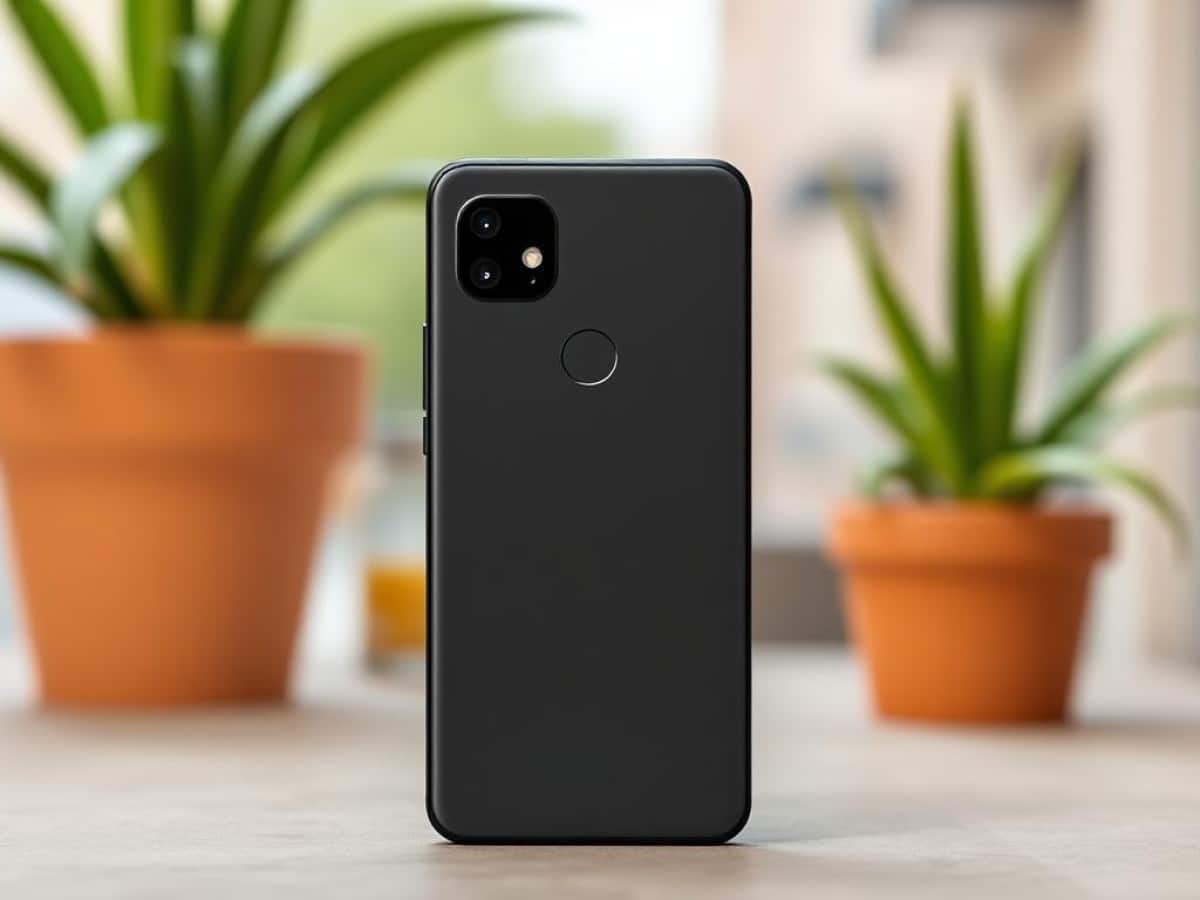
The last difference is at the back, where this year we have a more filled-out camera module with an optical zoom in addition to the wide-angle and ultra-wide-angle lenses.
There are few physical evolutions in this generation, but Google maintains a design identity with its specific photo bar. The Pixel 10 is comfortable to use with its slightly rounded edges. Note that if you want to take advantage of the new Pixelsnap wireless charging technology, you’ll need to opt for a compatible case.
Display
The Pixel 10 reuses a 6.3-inch panel. It is still an AMOLED with a variable refresh rate from 60 to 120 Hz.
Google claims a peak brightness of 3000 nits. Our probe nearly reaches this, as with it and the CalMAN Ultimate software from Portrait Displays, we record a maximum brightness of 2890 nits in HDR and over 2000 in SDR. These are impressive performances since we’re even better off than last year with the Pixel 9.
However, color accuracy is more succinct with average DeltaE values measured at 3.17 in SDR and 6.61 in HDR, where we aim to be below 3 and 6, thresholds under which the human eye no longer sees chromatic aberrations.
Similarly, the temperature is a bit too warm, measured at 6220K for a target of 6500K. It’s still acceptable overall, but better options are available from competitors, including the Nothing Phone (3) and the OnePlus 13R.
Performance
This is the most fundamental novelty of the Pixel 10 range. After years of partnership with Samsung, the Tensor G5 is the first Google chip to be manufactured by the Taiwanese foundry TSMC, using its 3 nm process. This change is crucial, as TSMC is reputed to have a technological lead over its competitor, especially in terms of energy efficiency. For the Pixel 10, this should translate into better battery life and better heat management compared to previous generations.
In this aspect, it performs slightly better than its predecessor. When pushing its SoC to its limits, there is a performance drop similar to the Pixel 9, but with fewer dips. However, we would have appreciated better internal thermal management to fully exploit the potential of the G5.
On the other hand, in terms of external temperature, it is well controlled with just over 37°C at the hottest point.
Regarding the performance of this Tensor G5, it benefits from a completely revised CPU and GPU architecture by Google:
- CPU: The company announces an average performance increase of 34% compared to the Tensor G4. The architecture uses the latest generation ARM cores, including a very high-performance Cortex-X4 core.
- GPU: Google switches from ARM Mali graphics chips to a solution from Imagination Technologies, the IMG DXT. A major change that includes ray tracing, but will only be fully exploitable with the appropriate drivers.
We ran our usual benchmarks and are far from the promised 34%. We observe a gap of about 9%. On a normalized average of AnTuTu, 3DMark, and Geekbench 6 benchmarks.
In practice, however, we have a perfectly functional device that suffers no slowdowns at any time. Better yet, it also performs very well in gaming. In Genshin Impact, with all graphic options at maximum, we oscillate between 48 and 60 fps. It’s perfectly playable.
Software
Android 16 is here! The Pixel 10 range is the first to benefit from the advances of the new version of Google’s software. In addition, we have the new Pixel Experience with its Material 3 Expressive.
One of the flagship features is the arrival of “Live Effects” on the lock screen. You can now apply new dynamic effects to your personal photos to make them stand out and further personalize your phone. After a clipping, you can choose the shape that surrounds the photo and the overall color, even adding snow, rain, or mist.
This visual refresh extends to some Google apps with updated appearances, refreshed color themes, and more expressive typography. Among them are the recorder, camera, Clock, Google Photos (for the editing part), and even Phone with a new answering gesture.
Photo and Video Boosted by AI
The camera software of the Pixel 10 is enriched with several intelligent features:
Buy the new Google Pixel 10 Pro and receive up to €850 in exchange for an eligible device (including a promotional bonus of €250). Offer valid until 11/09.
- Camera Coach: Using the Gemini artificial intelligence models, this function acts as a photography coach. It guides the user to improve framing and composition, offering suggestions and step-by-step instructions. Good on paper, but unless you’re only taking landscapes, you don’t have time to follow these steps when you want to take a spontaneous photo.
- Auto Best Take: to never miss a group photo again, this feature intelligently captures the best moment by analyzing the scene in real-time. And if there isn’t one, the AI automatically creates a merged photo where each person presents their best face.
- Enhanced Panorama: the panorama mode now supports telephoto shots up to x5 on the Pixel 10.
- Low Light Boost on Instagram: In collaboration with Instagram, the Pixel 10 automatically improves the visibility of Stories videos recorded in very dark environments.
- Transparency with C2PA: The Pixel 10 is the first smartphone to integrate the C2PA standard directly into its native photo app. These “Content Credentials” allow you to view the history of modifications (by AI or not) of an image directly in Google Photos.
Intelligence and Productivity in Everyday Life
That’s for the photo part. But Google also spices up its Pixel 10 with new productivity tools, starting with Voice Translate.
This feature eliminates the language barrier during phone calls. It translates in real-time the words of each speaker into the other’s language, while maintaining a voice that resembles the original speaker’s. Conversations remain private as all processing is done on the device. It’s impressive and especially, it’s in real-time, like having an interpreter speaking over the voice they are translating.
On the keyboard, you have access to writing tools that can correct grammar, typing, and punctuation errors. It is also possible to rewrite a text in different styles: reformulated, friendly, professional, or in long or short versions.
More powerful, you can modify a dictated message using natural voice commands, such as “replace [word1] with [word2]” or “delete [word]”. Moreover, rewriting tools can be invoked directly by voice.
Finally, the Recorder app can now transform an audio recording into a musical creation. The AI analyzes the rhythm and musicality of the audio and adds a generative musical layer based on an “ambiance” chosen by the user.
And that’s all for France because the major new feature Magic Cue is unavailable here. This feature acts as a true personal artificial intelligence, always listening to your context and data. It stands out for its ability to offer timely, thoughtful, and personalized suggestions. By connecting your apps, emails, screenshots, notes, and much more, it aims to anticipate your needs and provide you with contextual information, sometimes even before you feel the need to search for them. And all this is done locally, thanks to the power of the Tensor G5’s NPU, ensuring optimal privacy.
A real miss for our market.
To conclude on the software part, the Pixel 10 benefits from 7 years of both security and software updates.
Photo
This year marks a turning point for the base model of Google’s lineup. The Pixel 10 is the first of its kind to feature an optical zoom, a telephoto lens capable of reaching up to x5 optically and x20 digitally. Until now, this was a feature reserved for Pro models.
Despite the power of its algorithms, Google probably saw it fit to give the Pixel 10 a boost to ensure it remains competitive with models in its price range like the Galaxy S25, Nothing Phone (3), and the Poco F7 Ultra, all of which have optical zooms.
However, if we compare it to the Pro models, the Pixel 10 makes some cuts. Its telephoto sensor is smaller at 10.8 MP compared to 48 MP, the same goes for its main sensor, and the most concerning is its ultra-wide-angle sensor which drops from 48 MP on the Pixel 9 to 13 MP here!
- wide-angle of 48 MP (f/1.7) with optical stabilization
- x5 telephoto of 10.8 MP (f/3.1) with optical stabilization
- ultra-wide-angle of 13 MP
- selfie sensor of 10.5 MP (ultra-wide-angle)
While it’s exciting to have a telephoto lens on the Pixel 10, it’s not without concessions. And we’re crossing our fingers that it’s as good as its predecessor in other focal lengths.
Wide-angle
From 50 MP to 48 MP, that’s the price Google pays to offer greater photographic versatility to its Pixel 10 without skyrocketing its price. Comparing it to the Pixel 9
Similar Posts
- Samsung’s Galaxy S26 to Feature Revolutionary Camera Tech: Expect Major Upgrades!
- Hands-On With the Google Pixel 10: Here’s Why It’s Irresistible
- Samsung Galaxy S26 Camera Specs Revealed: Leak Gives Us a Sneak Peek!
- iPhone to Feature 200MP Sensor by 2027: Is This Apple’s Next Big Move?
- Galaxy Z Flip 8 Camera Revealed: What Surprises Does Samsung Have in Store?

Maya Singh is a senior editor covering tablets and hybrid devices. Her work explores how these tools reshape digital productivity and learning. She also contributes to feature editorials on emerging tech.