
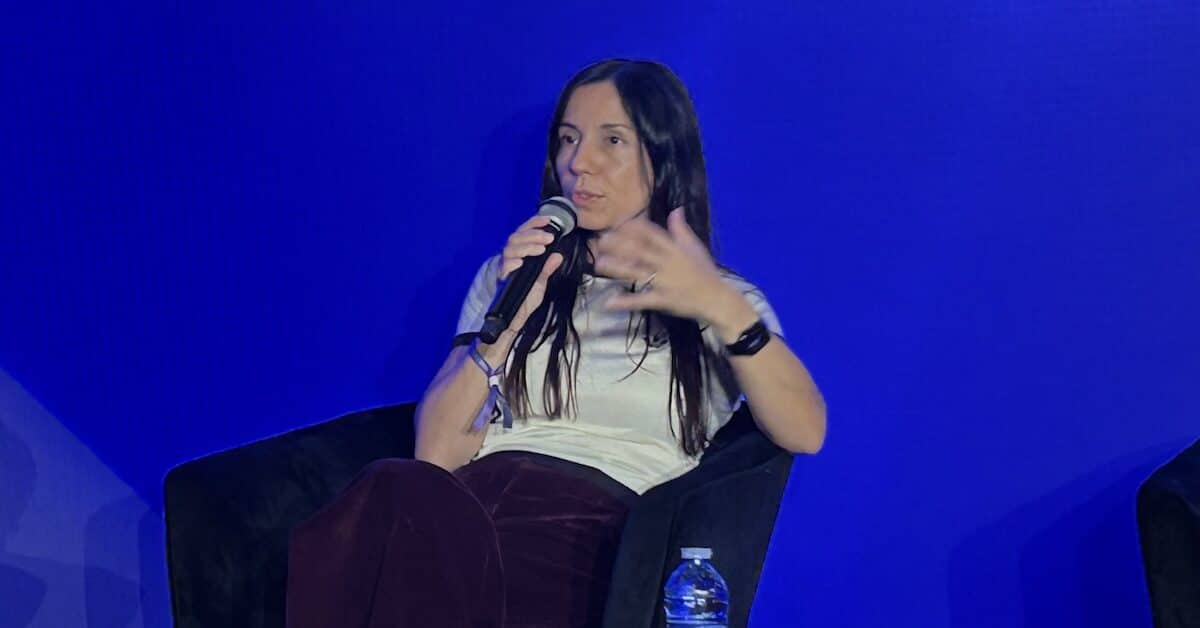
Loredana Crisan, a pianist turned Chief Design Officer at Figma, offers a unique perspective on a profession that is currently undergoing significant changes. This interview explores her thoughts on design, taste, and the human element in her field.
Scientists confirm: This is the most effective way to get your cat’s attention, according to new research
Elderly Couple Refuses Reserved Seats—Viral Train Standoff Sparks Fiery Debate on Courtesy
During Config 2026, its annual conference in San Francisco, Figma redefined its canvas as a fullstack creative space integrating design, coding, and AI agents. Behind these product announcements lies a belief: as AI simplifies production, value shifts towards judgment, taste, and human intention.
Loredana Crisan, who became Chief Design Officer at Figma in September 2025 after spending about a decade at Meta where she led product design and generative AI efforts for Messenger and Instagram, embodies this perspective. A classically trained pianist who shifted to sound engineering before moving to design, she views her profession as both experiencing an identity crisis and a rebirth at the same time. BDM discussed with her how AI alters, or doesn’t alter, design practices.
Transitioning from music to design: what has remained with you?
Several aspects. First, playing the piano taught me the value of learning by doing. It’s a very hands-on approach: it cultivates not just a style of playing, but also a different way of hearing music, feeling, and expressing something. Moving from playing the piano to sound engineering and music production, I shifted from expressing my own music, or that of a composer, to helping others realize the music they envisioned.
Without realizing it, I was already designing, but with sound.
My pivot to design occurred in a startup where I was helping to prototype audio interfaces for a type of voice assistant experience over phone channels. The technology was still nascent, but it was a very natural medium for me to discover what design was. Once I grasped it as a discipline, it was clear that I needed to transition from audio to visual. I already had the foundations: understanding what it means to think about the whole experience.
Speaking about design, you mention an “identity crisis and rebirth.” What is fading away and what is emerging in the field now?
It’s a change of medium. Just as I moved from sound to visual, visual remains a large part of design. However, the natural language of AI is becoming an interface in its own right, and we must learn to design for it. We need to learn not just to build interfaces but to design the systems that generate these interfaces.
At its core, design remains focused on the user experience and on what we enable people to interact with.
The materials are changing: we are moving from pure pixels to code, then to other types of systems like generative workflows, which bring design into a much broader set of tools than before. It’s exciting, but it requires taking hold of these tools. One thing holds true for any discipline, and it was true for me with design: it takes time to master your medium. If we consider AI as a material we are starting to shape, just like code, then we need time to learn about the different models, understand what they do well or not, in order to shape with them rather than just accepting what they give us.
When anyone can create a beautiful visual in seconds, what makes the difference?
For any person, with any medium, the question is whether they see themselves in a creation, whether it feels authentic to them. Much content produced today doesn’t resonate. We produce more and more, and a comparison I like is that of the cheap, store-bought card with a pre-printed message. It’s cute, but incomplete: it lacks what the recipient most cares about, the message from someone important to them.
There is a level of care that must be put into the experience, and that becomes recognizable as the creator’s intention.
In the end, there is a level of care that must be embedded in the experience, making it recognizable as the creator’s intention. If we stop before reaching this point, it feels somewhat hollow.
Is AI leading us to a world where everything looks the same?
I don’t believe this to be a lasting risk, because I have great faith in human creative drive. I don’t think designers will settle for it, and I’m convinced consumers won’t either. Perhaps for a while, as these interfaces begin to proliferate. It’s somewhat akin to writing: AI has helped everyone write, then we began to spot the em dash, the double negatives, all that compresses the diversity of human writing. And we started to work against it.
There will be a period where people notice “that interface with its massive font and italic word”… The hallmarks of an AI-designed experience are already very recognizable, and people feel it’s cheap, not tailored for them.
How can a beginner designer still develop a personal taste?
This will need to remain a combination: working with AI to produce, but also doing things by hand. Much of creativity is embodied. Many of the discoveries we make on the canvas are not anticipated at the outset. The idea of prompting something we haven’t yet discovered doesn’t make sense.
That’s why it’s crucial to be in the medium, to play with the materials, to understand them, rather than letting AI mediate every interaction with what we create.
Then, we also learn to handle AI as a tool. The medium is broader today, but the way to master it remains the same: we dive in, we play, we try to express things, we see what we produce, we have it critiqued by others who tell us what’s good or not. We do this for five years, and then, we’ve gotten somewhere.
Is there a risk of losing the joy of creating with one’s own hands?
That really depends on the person, on how much they want to invest themselves in the experience. My feeling is that we love to create, and we also love to create systems. There’s a real craft in designing the right agentive loops that will produce the right experience. Evaluations and datasets are another way of creating today, and they are as significant as the rest. But there are things we’ll want to continue doing simply because it’s fun, because it allows us to express ourselves differently. It’s inherently motivating.
Does AI threaten the freedom to create?
It’s an interesting question, as there’s a lot of talk about humans moving towards a layer of judgment and taste, which would involve prompting AI and then choosing from the options it produces. But that’s not what a good creative director does: it’s a false equivalence. Much of their work involves cultivating the right team, with the right creative tension between people, to produce surprising results. We already work with a human element. And it’s very different from a situation where everyone has the same AI, converging towards the same directions.
Several research studies show that initially, AI makes us more productive and allows us to explore more possibilities, which makes it very useful. But if we accept these results, or if we just choose among them, the collective range of ideas eventually narrows. More and more of what humans produce ends up being decided by AI. It’s quite ironic: we created AI to bring it as close to human intelligence as possible.
One of the risks is that human intelligence ends up being limited by AI. I believe in people: we won’t stop there.
At Config, you argued that “code is a material, not the enemy of design.” What does this mean for a designer who has never coded?
A lot changes. Moving to code first allows for a much deeper reflection on interactions, and to test several. Previously, we did this with flat layers in prototypes: we’ve always had tools to explore, but now it’s much faster and much closer to the final fidelity.
Then, we can think about systems with their data. It’s important, as more and more experiences we create are based on data, personalized and non-deterministic: often, we don’t know exactly what the system will output.
Having the data behind allows us to explore the different conditions of the experience we are creating.
AI has made solo work easy but complicated teamwork. How do we recreate the collective in this context?
First by sharing our output, which makes it much easier to consume. But also, from our perspective, by sharing the tools that enabled these results, and the prompts that led to them. This creates a virtuous circle where designers learn from each other, where discoveries pile up, rather than remaining isolated on separate machines that are hard to share.
The outputs themselves: we can have a prototype, a rich experience to interact with, but we can also flatten it into all its components. This holistic view enables collaboration, because we know that everyone is considering every state. We have the comments, everyone is online at the same time: the tools we’ve built around design are precisely those people prefer for collaborating. We are at a point where each person rebuilds the same tools every day, with costly tokens, for almost identical results. Standardizing all this will truly leverage the power of AI and move forward together, as a team, more quickly.
If we want speed, we want it for the whole team, not just for the individual.
Figma leverages models from Anthropic and OpenAI, who are also launching their own design tools. How do you navigate the situation where your tech partners are also competitors?
We work with all models. One of Figma’s unique aspects is being able to mobilize all models to create a mix of experiences tailored to their respective strengths. We see ourselves as a company that embraces technology and all tech partners, while doing what we really care about: empowering designers to create. AI is part of this story, but it’s not the only part.
In the new features we’ve just presented at Config, AI was involved at every step: it can set up animations, help build plugins that become shared tools, assist in exploring design directions, or transform designs into posts. But what sets Figma apart is that everything AI produces can be manually reworked. An animation? We take the keyframes and decide where it goes. A plugin? It has all its parameters, and we can play with them. For us, it’s a different mindset: it’s not about having the most tokens possible to produce the best experience. The toolkit designers need is a bit more sophisticated than that.
If AI frees up your time, what do you dream of dedicating it to?
Honestly, music will always be part of my life. I still play the piano, and I make music with my teens. Sound design, in the context of Figma and Motion, might one day overlap… but that’s not a promise (laughs). But much of my time is dedicated to freedom, to cognition, to how people create and think in general. I am passionate about neuroscience and cognitive psychology.
Loredana Crisan, Chief Design Officer, Figma
Loredana Crisan is Chief Design Officer at Figma since September 2025. Before joining the company, she spent nearly a decade at Meta, where she led product design and generative AI efforts for Messenger and Instagram. A pianist by training who transitioned through sound engineering, she advocates a design approach centered on intention and care for the experience.
Similar Posts
- Figma Unleashes AI Agents: Revolutionize Design by Creating and Modifying Components!
- Figma Revolutionizes Creativity: Unites Design, Code, and AI on One Canvas!
- Figma’s Latest Features: AI-Powered Code Generator, Vector Drawing, Website Creation Unveiled!
- Figma Unveils AI Agent in Collaborative Workspace: Revolutionize Your Design Process!
- Figma Fully Available in French: Revolutionize Your Design Experience!

Jordan Park writes in-depth reviews and editorial opinion pieces for Touch Reviews. With a background in UI/UX design, Jordan offers a unique perspective on device usability and user experience across smartphones, tablets, and mobile software.