
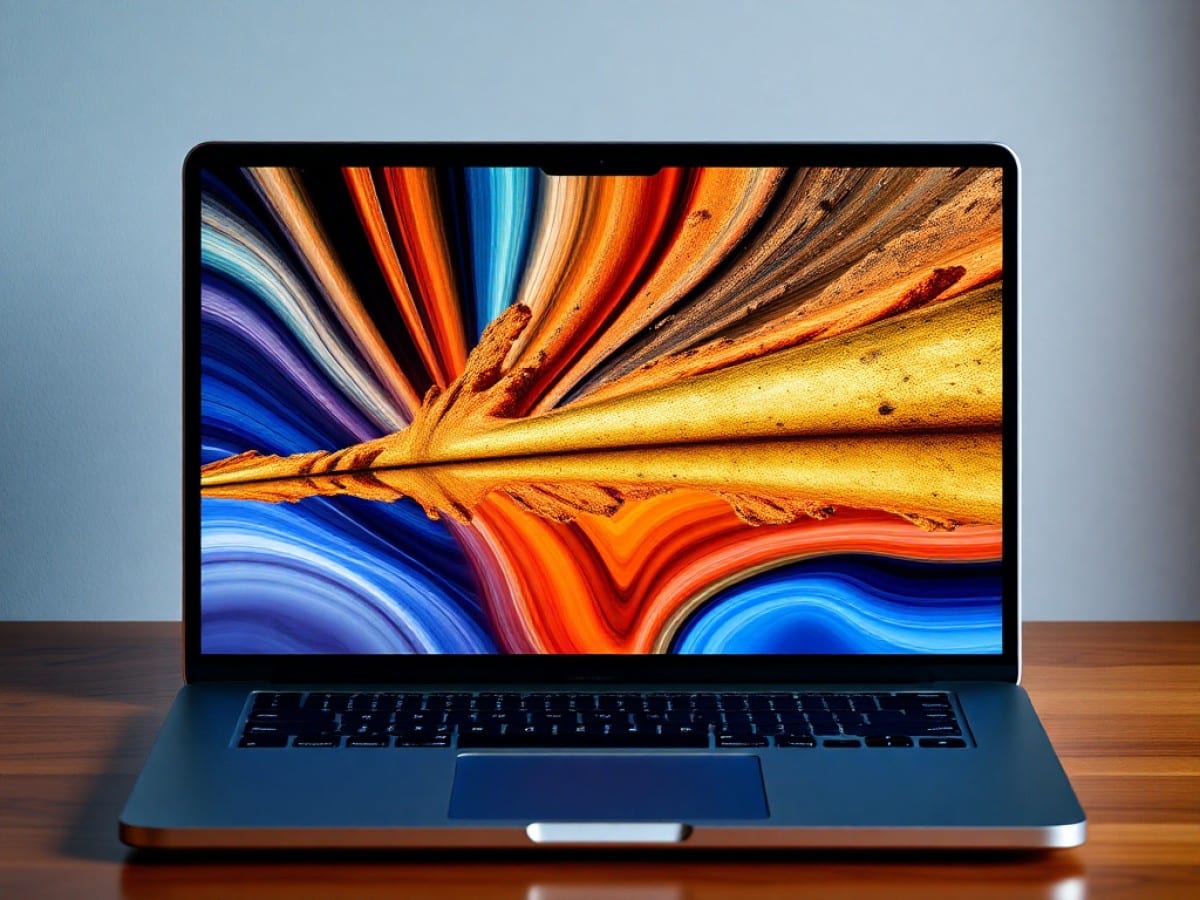
Following the impressive MacBook Pro M5, Apple has introduced the M5 Pro model alongside the M5 Max. While externally identical, it offers a significant performance boost for professionals and creatives, even against its direct competition.
Scientists confirm: This is the most effective way to get your cat’s attention, according to new research
Elderly Couple Refuses Reserved Seats—Viral Train Standoff Sparks Fiery Debate on Courtesy
Apple is adhering to its usual schedule with its MacBook Pro line: we tested the standard M5 model last December, and now the M5 Pro model has been launched simultaneously with the M5 Max.
It’s important to remember that these are machines meant for professionals, essentially mobile workstations with the power (and price) that require a serious investment. However, like the MacBook Pro M5 we reviewed a few months ago, this M5 Pro variant makes us envious of its ultra-contrasted Mini-Led display with ProMotion functionality.
Under the hood, the MacBook Pro M5 Pro also promises significant improvements, not only with its powerful CPU/GPU combo but also through the anticipated integration of its N1 wireless network chip, as well as a much faster internal NVMe SSD.
Fiche technique
| Model | Apple MacBook Pro 14 M5 Pro (2026) |
|---|---|
| Dimensions | 312.6 mm x 15.5 mm |
| Resolution | 3024 x 1964 pixels |
| Display Technology | LCD |
| Processor (CPU) | M5 Pro |
| Graphics Chip (GPU) | Apple GPU |
| RAM | 16, 24, 36 GB |
| Internal Memory | 1024, 2048 GB |
| Appearance | Metal |
| Operating System (OS) | macOS |
| Weight | 1600 grams |
| Depth | 221.2 mm |
| Product Sheet | Available |
Design
Apple has not altered the design and build of its MacBook range for three years now. The MacBook Pro M5 Pro retains the chassis of the standard M5 model and weighs just a mere 5 grams more (1.60 Kg), moving away from the world of ultraportables into a MacBook that is noticeably heavier when traveling, though still designed for mobile use.
In terms of design, the unibody chassis has proven itself time and again, remaining classy, robust, and straightforward. Our space black model pairs a dark gray casing with a deep black keyboard for a striking two-tone effect.
The display features very slim bezels, and we still lament the presence of the notch at the top center of the screen. While it may not be a concern for many users, we believe it’s still worth mentioning in 2026.
Keyboard and Touchpad
Alongside Lenovo, Apple’s MacBook keyboards are among our favorites on the market. Comfortable to the touch, the activation travel is short, but it provides a clear response without any play, making typing a genuine pleasure.
The trackpad, with its tactile feedback, is also very pleasant to use over long sessions, thanks to its ample size. Like many other touchpads of its kind, it provides a clear haptic response when clicked anywhere on its surface.
Connectivity
The MacBook Pro M5 Pro appears to offer the same connectivity as the standard M5 model with one key difference: the standard. The three USB-C ports (two on the left, one on the right) are upgraded to Thunderbolt 5 and USB 4 with a maximum bandwidth of 120 Gbits, ready for the latest peripherals.
The machine can connect up to 3 external displays, including through a single USB-C port (using a daisy chain configuration). An HDMI port is also included. Other connectivity features include an SDXC card reader, a 3.5 mm headphone jack, and a MagSafe 3 port for charging.
It’s worth noting that the M5 Pro finally transitions to Wi-Fi 7 and Bluetooth 6 thanks to the N1 chip. However, a reminder: while it supports the 2.4, 5, and 6 GHz frequency bands, the Wi-Fi part is limited to a frequency width of 160 MHz and therefore does not offer the optimal performance of the standard.
In theory, the throughput is about 20% faster than on older models, but with much lower latency. We hope for a move to 320 MHz in future models.
Webcam and Audio
The webcam of the MacBook Pro M5 Pro remains unchanged, its 12-megapixel sensor still allows for 1080p video streaming under excellent conditions. We still find a certain lack of sharpness, but it is not too bothersome during your meetings.
It is still possible to use the Center Stage feature, which automatically centers the frame on you as you move. The latest version of macOS (Tahoe) adds a new “Edge Light” feature that projects an adjustable light halo using the built-in screen.
The audio system of the MacBook Pro continues to impress, with its 6-speaker setup (four woofers and two tweeters). The sound quality is very convincing for this format, although it very logically lacks many sub-bass frequencies. You will be surprised by its overall clarity and the impressive width of the stage across the spectrum.
An Always Stunning Display
The screen of the MacBook Pro has also not changed this year, featuring the beautiful Liquid Retina XDR display, Apple’s sophisticated name for Mini-Led technology. With its native resolution of 3,024 by 1,964, nearly infinite contrast, and support for ProMotion, we’re looking at the best that’s currently available on a MacBook, pending the arrival of OLED next year.
We measured the screen with our Calibrite Display Plus HL probe using Calman Ultimate software, and the results are as impressive as ever.
Let’s start with the contrast, which exceeds 600,000:1 in our various HDR measurements. In SDR, it exceeds 10,000:1, far above what is typical in LCD IPS, for example. This allows for very deep blacks, even with the nano-textured coating on our model.
The brightness is simply excellent, with a peak measured at 1580 cd/m² up to a 50% window, and 1,135 cd/m² full screen. Watching HDR content on a MacBook Pro is a true delight, with bright details popping from the panel while the Mini-Led contrast helps maintain a vivid overall image, including in dark areas.
In terms of colorimetry, the MacBook Pro M5 Pro’s screen can display 101% of the DCI-P3 space and even 68% of Rec.2020. The former is very useful for video editing and creating HDR content, but also for processing photos in Apple’s wide color gamut “Display P3”, especially for iPhone photos. Rec.2020 remains dedicated to professionals working with HDR content.
Finally, color accuracy continues to be a strong suit for MacBooks. The Delta-E continues to impress us year after year. In HDR, it is 1.57, while in SDR, it reaches an almost unbelievable value of 0.86. As a reminder, a result between 3 and 5 is considered acceptable, while deviations can be identifiable by the naked eye beyond this range. These figures once again demonstrate Apple’s commitment to factory calibration of its displays.
Software
The machine comes equipped with macOS 26 Tahoe, the latest version of Apple’s OS, which notably brings the new Liquid Glass design that has been much criticized. Beyond its appearance, macOS 26 notably allows for better organization of folders by adding emojis or symbols to their icons and offers a brand new experience for Spotlight, its application launcher.
The system is obviously compatible with the new neural accelerators of the M5 chip as well as with the Thunderbolt 5 of the M5 Pro and M5 Max models. Note that a new option allows you to manually set a charging limit (for example, to 80%) to preserve battery capacity if you often use your Mac plugged into the power outlet.
In short, an even more complete OS for professionals, fully exploiting the power of this MacBook Pro M5 Pro.
A Powerhouse
Our test model is a powerhouse. Its M5 Pro chip includes a processor with up to 18 cores (6 “super” cores and 12 regular performance cores) and a GPU with up to 20 cores. The base configuration of the M5 Pro relies on 15 CPU cores and 16 GPU cores.
The main memory has a bandwidth of 307 GB/s, twice as much as the standard M5 chip. The M5 Max model goes up to 460 GB/s. Our machine features 64 GB of unified memory, the maximum that the M5 Pro can support (you can go up to 128 GB with the M5 Max and its 40-core GPU). Finally, the internal SSD storage can be configured from 1 to 4 TB, with no 512 GB configuration available in the Pro range.
The machine is primarily aimed at professionals in video editing, 3D, and AI. Its display clearly targets mobile editing, although its Neural Engine also makes it very suitable for running AI models locally as well as for certain inference tasks.
Benchmarks
In terms of benchmarks, the Cinebench 2024 score is one of the highest we have measured so far at 1692. It is only surpassed by Intel Core Ultra HX gaming processors (275HX and 285HX), but it leads by nearly 100 points over the Snapdragon X2 Elite Extreme of the Zenbook A16 we just tested. Compared to the MacBook Pro M5 (and its non-Pro M5 chip), the gain is massive, around 46%.
On Cinebench 2026, it leads by 1500 points over the Snapdragon X2 Elite Extreme and severely outperforms the Panther Lake chip of the Galaxy Book 6 Ultra with its 8,356 points (compared to 4,950 for the Samsung machine). In short, this is the most powerful chip we have tested on a professional laptop to date.
The GPU part is obviously not to be outdone, with a 3D Mark Nomad Light score of 10,057, the highest we have reached to date on a laptop with an integrated GPU. It thus far outpaces the GPU of the Snapdragon X2 Extreme and offers more than double the performance of the MacBook Pro M5.
According to our measurements, the GPU of the M5 Pro chip offers performance similar to a GeForce RTX 5060 Mobile from a gaming PC. It therefore remains behind the Galaxy Book 6 Ultra and its RTX 5070 mobile for 3D applications and games, the gap measuring between 14 and 17% according to our tests.
Finally, storage takes a giant leap compared to the MacBook Pro M5 Pro with simply staggering read (13.7 GB/s) and write (17.5 GB/s) speeds. In short, this is indeed the powerhouse that was announced.
For Creatives
We tested the MacBook Pro M5 Pro on our PugetBench tool in two scenarios. One for classic photo retouching on Adobe Photoshop 2026 and one for video editing with Premiere Pro. The protocol mixes processing and rendering operations on 4K sequences to give us an overall score.
We still need to enrich our database of tests on this point, but know that it is twice as performant as a MacBook Air M5 on Premiere Pro, 25% more performant than a Galaxy Book 6 Ultra on Premiere Pro.
Cooling and Noise
To cool this much more powerful chip, the MacBook Pro M5 Pro integrates a two-fan configuration. We measured only a minimal difference at full load compared to the standard M5 model: 36 dB at full load and still 25 dB in normal use.
On the surface, the machine can reach 50 degrees at the center of the keyboard in the heaviest applications, when the fans are running at full speed. But with this chassis, it’s hard to notice in use.
Battery Life
This MacBook Pro M5 Pro offers the same battery capacity as the standard M5 model, 72.4 Wh. Logically, one might expect slightly lower battery life, even though Apple’s optimizations continue to work wonders.
- In wireless web browsing, we are at 15 hours of continuous use (screen brightness set to 50%).
- In mixed use between office work and some multimedia activities (video watching, video conferencing, editing), we go down to 12 hours and 30 minutes.
- Finally, during heavy workloads (photo, video, 3D), battery life drops to 5 hours.
The machine does not lose performance once unplugged, but macOS does allow you to activate energy-saving or performance modes according to your needs.
Since last year, the charging adapter is no longer included and must be purchased separately: 65 euros for the 70 W version and 85 euros for the 96 W version.
Pricing and Availability
After a decrease in 2025, the M5 Pro version of the MacBook Pro returns to the launch price of 2,499 euros, 100 euros more expensive than last year. We are therefore back to the price of the M3 Pro, 2,499 euros, while the sector is going through its biggest crisis due to Covid.
We cannot help but directly compare it to the Samsung Galaxy Book 6 Ultra, even though it offers a larger 16-inch screen. The same-diagonal MacBook Pro M5 Pro will remain 500 euros cheaper for the same performance gap (2,999 euros).
Here, we can only regret Samsung’s choice not to offer a 14-inch version of its Galaxy Book for creatives. But we imagine that its current configuration in a smaller chassis would be even less performant, further widening the gap with this M5 Pro.
Similar Posts
- Apple’s A15 Chip Powers Up: Exclusive Peek at the New MacBook Test!
- Budget-Friendly MacBook Rumor: Spring Release Anticipated!
- TSMC’s SoIC Technology Powers Up M5 Pro and M5 Max Chips: What to Expect?
- MacBook Pro 2026-2027 Roadmap Revealed: What’s Next for Apple’s Powerhouse?
- New MacBook Pro Release in March: M5 Pro and M5 Max Chips Expected!

Maya Singh is a senior editor covering tablets and hybrid devices. Her work explores how these tools reshape digital productivity and learning. She also contributes to feature editorials on emerging tech.