
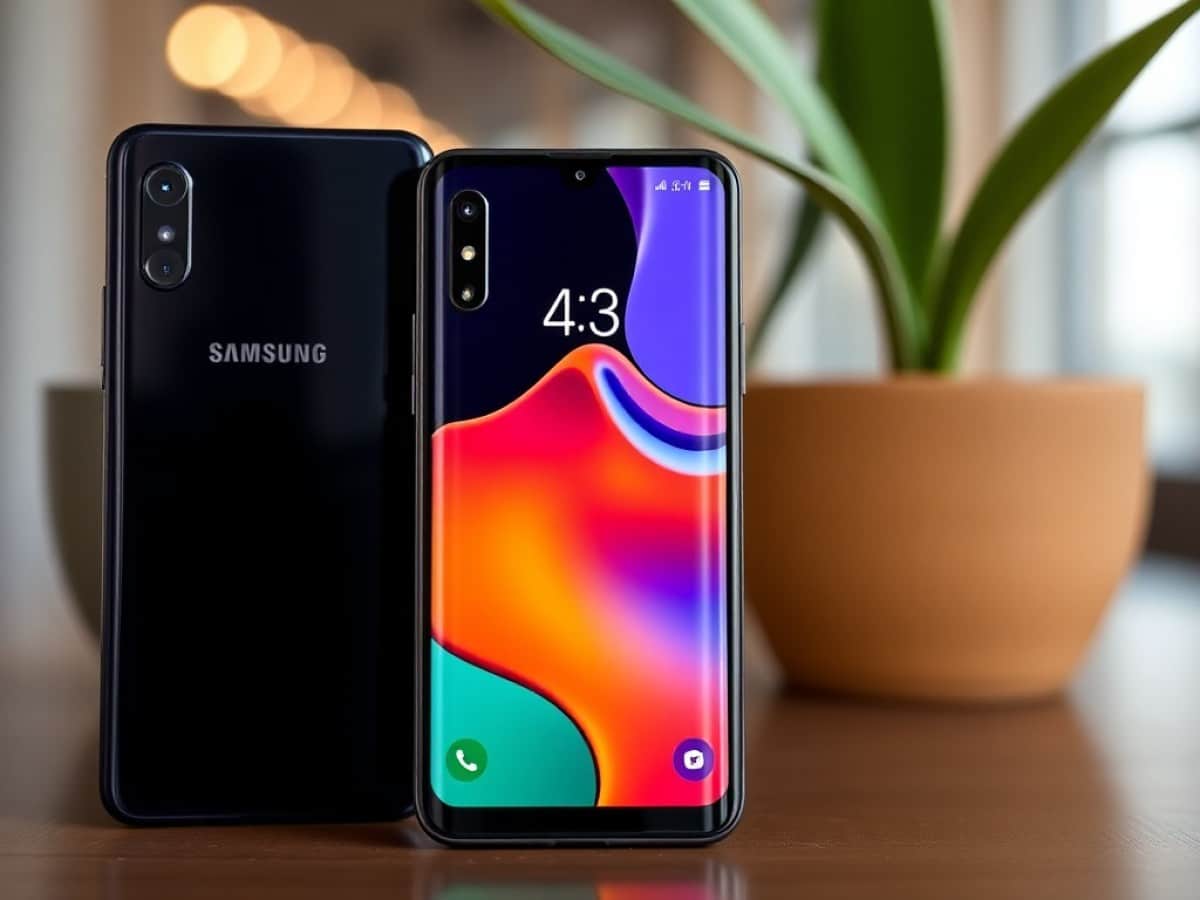
Samsung’s latest mid-range premium smartphone, the Galaxy A57, is the thinnest, lightest, and most powerful in the Galaxy A series. For other features such as display, camera, and battery, the manufacturer has chosen to reuse components from the Galaxy A56.
Scientists confirm: This is the most effective way to get your cat’s attention, according to new research
Elderly Couple Refuses Reserved Seats—Viral Train Standoff Sparks Fiery Debate on Courtesy
Introduction
Every year, following the launch of Samsung’s flagship Galaxy S series smartphones, like the Galaxy S26 Ultra, it is time for the A series mid-range devices to get their spring refresh.
This year, the most advanced smartphone in the A series lineup, the Galaxy A57, replaces the Galaxy A56.
As usual, the upgrades are quite subtle. For 2026, the Korean manufacturer has focused primarily on two aspects: design and performance.
After attempting to attract users with the ultra-thin Galaxy S25 Edge, which turned out to be a commercial failure, Samsung is now refining its mid-range offerings by significantly reducing the thickness of its Galaxy A57. Is this Samsung’s new approach to ultra-thin smartphones?
Specifications
| Model | Samsung Galaxy A57 |
|---|---|
| Dimensions | 76.8 mm x 161.5 mm x 6.9 mm |
| User Interface | One UI |
| Screen Size | 6.7 inches |
| Resolution | 2340 x 1080 pixels |
| Pixel Density | 382 ppi |
| Display Technology | Super AMOLED |
| SoC | Samsung Exynos 1680 |
| Internal Storage | 128, 256 GB |
| Rear Camera | Main: 50 MP, Ultra-Wide: 12 MP, Macro: 5 MP |
| Front Camera | 12 MP |
| Video Recording Resolution | 4K @ 30 fps |
| Wi-Fi | Wi-Fi 6E |
| Bluetooth | 6.0 |
| 5G | Yes |
| NFC | Yes |
| Fingerprint Sensor | Under the screen |
| Connector Type | USB Type-C |
| Battery Capacity | 5000 mAh |
| Weight | 179 g |
| Colors | Purple, Blue, Gray |
Design
The Galaxy A57 has slimmed down to a thickness of just 6.9 mm, 0.5 mm thinner than its predecessor, and weighs only 179 grams. This makes it thinner than the majority of smartphones, which are typically between 7.4 and 7.8 mm thick. Although it is 1.1 mm thicker than the Galaxy S25 Edge (which is only 5.8 mm thick!), its slimness is immediately noticeable.
The design of the Galaxy A57 is quite attractive, featuring slimmed-down screen borders and a tiny punch-hole notch for the front camera.
Additionally, its glossy glass back is available in four colors: navy blue, gray, light blue (almost white), and lavender. It does tend to pick up fingerprints a bit, as was evident on the navy blue model provided by the manufacturer.
The device is IP68 certified, ensuring significant resistance to water and dust. For added durability, both sides of the Galaxy A57 are covered with Corning’s Gorilla Glass Victus+, and they are connected by a metal frame.
Overall, the device is comfortable to hold, although the edges of the smartphone could be slightly chamfered to soften the feel.
The camera module has also been subtly revised, with the two lenses and the flash now protruding ever so slightly. Additionally, it includes a section made of translucent plastic, giving the Galaxy A57 a look very similar to the manufacturer’s high-end smartphones, which is quite flattering.
Display
When it comes to the display, the Galaxy A57 provides the bare essentials. Its 6.7-inch OLED panel displays images at a resolution of 2340 x 1080 pixels, with a maximum refresh rate of 120 Hz.
Even the maximum brightness of this screen is identical to what we measured last year on the Galaxy A56:
– Base brightness of 418 nits (SDR) or 491 nits (HDR)
– Maximum brightness of 1118 nits (SDR) or 1781 nits (HDR), when Adaptive Brightness mode is activated.
Other display characteristics, measured with our probe and CalMAN Ultimate software by Portrait Displays, are not exceptional. The best results were obtained when the Natural display profile was selected:
– Average color temperature of 6292 K (perfectly neutral colorimetry has an average temperature of 6500 K).
– Average Delta E of 4.16 (color fidelity is considered good when this result is below 3).
– Coverage of the DCI-P3 color space at 82% (and 123% for the BT.709 gamut and 56% for the BT.2020 gamut).
Performance
The Samsung Exynos 1680 processor was chosen by Samsung to replace the Exynos 1580 from the Galaxy A56.
While the two models are very close in terms of CPU performance, as measured by the Antutu and Geekbench benchmarks, the Exynos 1680 has the edge when it comes to performing 3D graphic operations.
It is also generally more powerful than the Xiaomi Redmi Note 15 Pro Plus and the recent Nothing Phone (4a) Pro.
However, the Tensor G4 of the Pixel 9a and Pixel 10a remains ahead of it. In this price range, the Chinese Redmagic blows everything away with the 11 Air equipped with a Snapdragon 8 Elite for 499 euros. Powerful, but less versatile.
If the Exynos 1680 allows the Galaxy A57 to offer excellent responsiveness when it comes to carrying out very many everyday tasks (surfing the Web or social networks, viewing photos and videos, GPS guidance, etc.), how does it perform in a playful context?
To find out, we installed Fortnite. And it must be said that it runs under good conditions: up to 60 frames per second with the best possible graphic quality, the High mode in this case. Because selecting the Epic mode inevitably leads to a maximum of 30 frames per second.
On the plus side, the processor’s performance over time does not degrade too much, since throttling is limited to 79%, despite a one-hour session of intensive operations.
Software
The Samsung Galaxy A57 runs on Android 16, enhanced with the manufacturer’s One UI 8.5 interface. According to the manufacturer, it should benefit from updates for 6 years (both for the system and for everything related to security).
That’s one year less than the Galaxy S! However, this ensures a certain longevity for the smartphone, which is interesting for those who do not renew their equipment very regularly.
The Galaxy A57 offers a fairly limited range of AI-boosted functions. Thus, in addition to the magic eraser (whose effectiveness is not optimal, because the area that takes the place of the erased objects is often quite coarse and visible), a so-called remastering function automatically optimizes the colors of photos.
This is complemented by the Best Pose function, which allows you to obtain perfect portrait photos (without closed eyes, for example). But this option only works with photos with movement or photos taken in burst mode.
There is also the possibility of obtaining a transcription of voice recordings and using elements captured on the screen (just by circling them with a finger), with the AI Selection function, accessible (among other things) via the quick access sidebar.
Photo
The lack of originality, or rather audacity, is glaring when reviewing the photographic equipment of the Galaxy A57. Indeed, it is identical in all respects to that of the Galaxy A56, and even to that of the Galaxy A37 (which also exactly copies that of the Galaxy A36):
– Wide-angle lens with 50-megapixel sensor, with optical stabilization system.
– Ultra-wide-angle lens, with 12-megapixel sensor.
– Macro lens, with 5-megapixel sensor (so useful and appreciated by users that many manufacturers do without it altogether).
– Front lens for selfies, with a 12-megapixel sensor.
In short, the manufacturer is starting to fall quite a bit behind, compared to its potential competitors:
– The Xiaomi Redmi Note 15 Pro+: 200-megapixel sensor associated with the wide-angle lens and 32-megapixel sensor for selfies.
– The Nothing Phone (4a) Pro: telephoto lens (3.5x optical zoom) with 50-megapixel sensor and 32-megapixel sensor for selfies.
– The Realme 16 Pro+: wide-angle with 200-megapixel sensor, 3.5x telephoto lens and 50-megapixel sensor for selfies.
Wide Angle
Despite equipment that does not evolve, the Galaxy A57 allows you to obtain good quality shots, in wide-angle mode (focal length of 23 mm), in good lighting conditions.
At night, with the 23 mm focal length, you get quite precise photos. Even in very unfavorable conditions, the sensor manages to collect enough light to generate usable images.
Zoom
As the Galaxy A57 is not equipped with a telephoto lens allowing it to perform optical zoom, digital zoom is imposed when you are a little far from your subject.
In this case, the 2x and 4x magnification factors allow you to obtain good quality shots (in broad daylight, of course!).
And yet! The images generated by the 4x digital zoom begin to lack precision, which is particularly visible on a large screen (but much less on a smartphone screen).
Finally, if you really have to use the maximum digital zoom, i.e. 10x, do not expect stunning precision, and especially avoid looking at the images on a large screen (at the risk of being really disappointed). At best, you can look at them on a small screen.
At night, the digital zoom is still relatively effective, since the loss of precision is hardly visible on a small screen.
And, sometimes, even the 4x zoom can be deceiving.
Ultra Wide Angle
Without offering excellent sharpness, the photos taken in ultra-wide angle mode (focal length of 13 mm) are satisfactory. As often, we note better precision towards the center of the images, while their edges are not always very sharp.
At night, it becomes quite difficult to obtain correct shots, as the images often appear very blurry.
Selfie
On the plus side, selfies taken in broad daylight prove convincing, with perfectly visible details, such as skin pores.
On the other hand, when the light is lacking, these become much less precise. Some can still be used.
Macro
The ability to take photos in macro mode is undoubtedly not a priority for a majority of users. However, for those who want to get extremely close to their subject, it can be useful.
Despite the small definition of the macro sensor (only 5 megapixels), some shots reveal details invisible to the naked eye.
Video
In video, nothing changes. You can still film in 4K at 30 fps or in Full HD at 60 fps. Improvements focus on HDR management and low light.
Audio
The two speakers of the Galaxy deliver rather satisfactory audio quality, with a maximum volume that allows you to listen to music, watch movies and series or play in good conditions.
Network and Communication
The Samsung Galaxy A57 can accommodate two nano SIM cards, or a single card and an eSIM.
Note that the smartphone is compatible with Wi-Fi 6E and Bluetooth 6 standards. During our tests in the Paris region, we encountered no network or GPS problems.
Battery
Another element that stagnates since last year: the battery capacity. It remains the same as that of the Galaxy A56, i.e. 5000 mAh. This is little, compared to many recent smartphones.
This is explained by the fact that the Korean manufacturer still uses lithium-ion technology with a 100% carbon anode, while its Chinese competitors are increasingly using Silicon/Carbon lithium-ion batteries, offering a much larger capacity (from 6500 to 8500 mAh!).
As a result, the endurance of the Galaxy A57 is rather average, or even low, according to current standards. For example, the PC Mark battery life test ran for 11 hours and 27 minutes, with an adaptive display frequency, and 13 hours and 23 minutes, with a fixed refresh rate (60 Hz).
If you can expect one to two days of battery life, depending on the intensity of use, it should be noted that some competing smartphones approach, or even exceed, 20 hours of operation with this benchmark.
On the other hand, if you watch a two-hour movie streaming from Netflix, for example, the battery level drops by 8%. This suggests a total autonomy of about 25 hours in video streaming. Again, that’s not bad, even if other smartphones are much more enduring in this area (between 30 and 50 hours!).
Finally, recharging the battery requires an adapter (preferably Samsung) with a maximum power of 45 W. At first glance, this may seem limited. However, with the manufacturer’s charger, the battery level rises rapidly:
– 37% in 15 minutes
– 67% in 30 minutes
– 88% in 45 minutes
– 96% in 60 minutes
Wireless charging is not supported, which is normal, since the first smartphones that offer this mode are sold from 750 euros.
Pricing and Availability
The Samsung Galaxy A57 is available in two versions:
– With 8 GB of memory and 128 GB of storage space: 549 euros.
– With 8 GB of memory and 256 GB of storage space: 599 euros.
Note that the price of the Galaxy A57 is 50 euros higher than those at which the Galaxy A56 was offered last year!
The manufacturer is – it seems – hit hard by the rise in prices affecting the price of components, such as memory. Too bad, because other manufacturers have made efforts to minimize this rise in prices (or even compensate for it in full, like Apple).
Alternatives to Consider:
– Nothing Phone (4a) Pro: 499 euros (8GB/128GB) and 569 euros (12GB/512GB)
– Realme 16 Pro+: 550 euros (12GB/512GB)
– Xiaomi Redmi Note 15 Pro+: 499 euros (12GB/512GB)
– Redmagic 11 Air: 499 euros (12GB/256GB)
Similar Posts
- Galaxy S25 Edge Design Leaked: Specs & Details Revealed!
- Samsung’s Galaxy S26 to Feature Revolutionary Camera Tech: Expect Major Upgrades!
- Galaxy Z Flip 8 Camera Revealed: What Surprises Does Samsung Have in Store?
- Galaxy Z Fold 8: Major Camera Upgrades Coming, Here’s What’s Changing!
- iPhone 17 Pro Max Leak: 48MP 8x Telephoto Lens Revealed!

Maya Singh is a senior editor covering tablets and hybrid devices. Her work explores how these tools reshape digital productivity and learning. She also contributes to feature editorials on emerging tech.