
Scientists confirm: This is the most effective way to get your cat’s attention, according to new research
Elderly Couple Refuses Reserved Seats—Viral Train Standoff Sparks Fiery Debate on Courtesy
Canon’s hybrid cameras film exceptionally well. The EOS R5 II escalates to 8K with its 45 Mpx stacked sensor, while the R6 III maxes out at 7K using the 32.5 Mpx sensor borrowed from the Cinema EOS C50. Both feature serious Log profiles and some of the best autofocus on the market. However, they are primarily still cameras. This becomes apparent after about twenty minutes of filming when overheating issues arise or when a video function is buried within three menu layers.
Canon began addressing this in September 2025 with the Cinema EOS C50, the first camera body to feature this 32.5 Mpx sensor. A true camera, it comes with EOS Cinema menus, a dual XLR grip, and a price tag close to €4,000.
The EOS R6 V utilizes this sensor, video modes, Log profiles, and active cooling. It packages these in a hybrid body, adds the sensor stabilization absent in the C50, and lists at €2,499. The rest of this review will explore what’s lost in this transition.
From a distance, the body looks like a typical Canon hybrid, missing its electronic viewfinder. Up close, it’s different. The fan takes the place of the viewfinder, controls are rearranged for filming, and Canon has even added a screw thread on the left side for vertical mounting. That’s not something you’d expect on a still camera.
Alongside the launch, Canon introduces a novel lens, the RF 20-50 mm F4 L IS USM PZ. A motorized zoom lens starting at 20mm with corrected focus breathing clearly targets solo content creators, from vertical formats to more ambitious productions.
Between the C50 on one side and a Sony FX3 that has been established for five years on the other, the R6 V must prove it’s more than just a financial decision.
Why You Should Never Reheat These Foods in the Microwave – The Hidden Dangers Experts Warn About
I tried the top 5 guard dogs—here’s what makes these breeds the ultimate protectors
| Canon EOS R6 V | Canon EOS C50 | Canon EOS R6 III | |
|---|---|---|---|
| Sensor | 32.5 Mpx full frame, non-stacked | Identical | Identical |
| 7K Open Gate 3:2 | Yes, 30 fps | Yes, 30 fps | Yes, 30 fps |
| Internal 7K RAW | Up to 60 fps in RAW Light | Up to 60 fps in Cinema RAW Light | Up to 60 fps in RAW Light |
| High frame rate 4K | 120 fps without cropping | 120 fps | 120 fps |
| 2K | 180 fps | 180 fps | 180 fps |
| Profiles | Canon Log 2 and Log 3 | Canon Log 2 and Log 3 | Canon Log 2 and Log 3 |
| Active Cooling | Yes | Yes | No |
| Sensor Stabilization | 7.5 stops reported | None | 8.5 stops reported |
| Electronic Viewfinder | No | No | Yes |
| Mechanical Shutter | No | No | Yes, 12 fps |
| Flash | Not supported | No | Yes |
| Electronic Burst | 40 fps + pre-capture | 40 fps | 40 fps + pre-capture |
| XLR Inputs | Via multi-function shoe, optional | Dual XLR grip included | Via multi-function shoe, optional |
| EOS Cinema Menus | No | Yes | No |
| Vertical screw thread | Yes | No, vertical interface only | No |
| Memory Cards | CFexpress B + SD UHS-II | CFexpress B + SD | CFexpress B + SD UHS-II |
| Base Price | €2,499 | Almost €4,000, grip included | €2,899 |
Canon EOS R6VTechnical Specifications
| Model | Canon EOS R6V |
|---|---|
| Type | Hybrid |
| Sensor Format | Full Frame |
| Sensor Resolution | 34.2 Mpx |
| Image Stabilizer | Mechanical |
| Video Resolution | 7K @ 60p |
| AF-S | 39 FPS |
| Articulated Screen | Yes |
| Weight | 598 g |
| Product Sheet |
This test was conducted with a device lent by Canon.
Canon EOS R6VA Camera Disguised as a Photo Camera
The build quality is beyond reproach. The body is weather-sealed, the grip is deep, and it feels excellent to hold a camera that weighs just 598 grams bare, 688 grams with battery and card. It feels like a tool, not just a display piece.
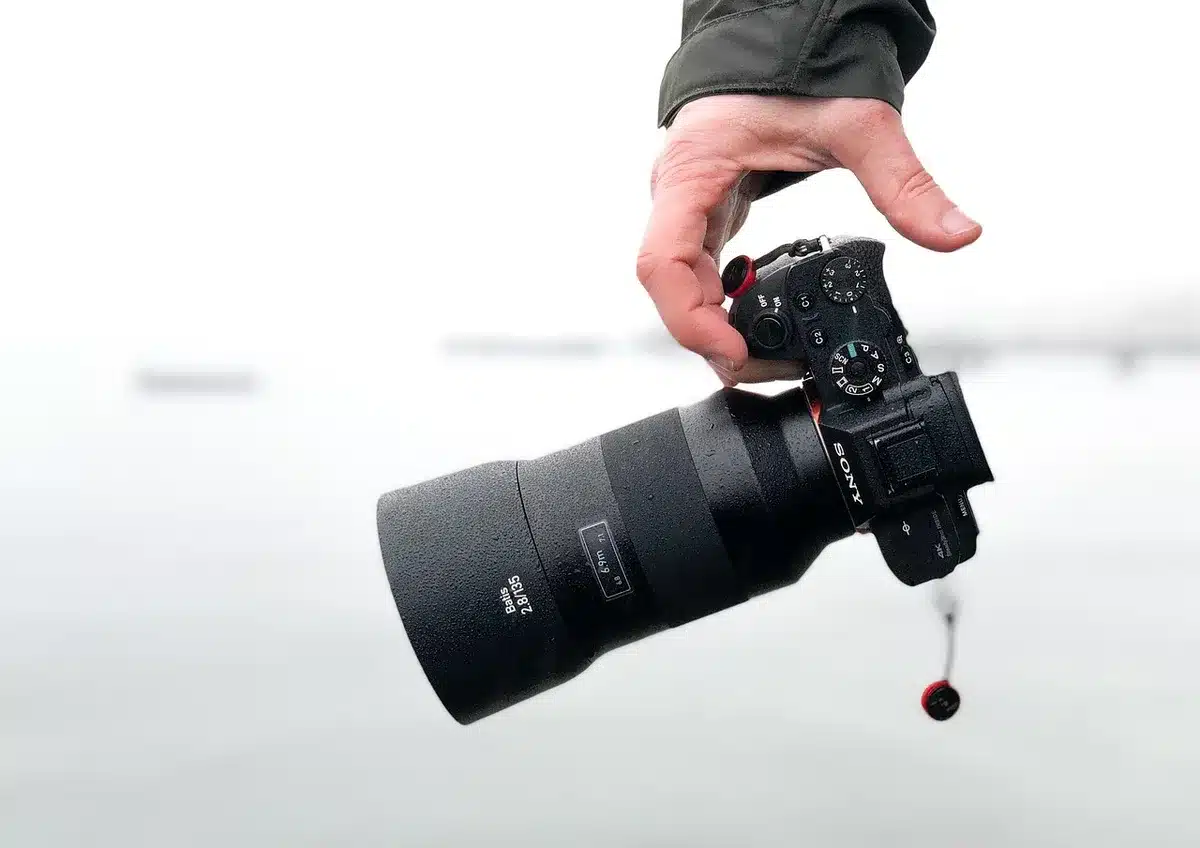
The most noticeable change from the EOS R6 is the absence of an electronic viewfinder, replaced by a cooling unit. You lose eye-level viewing but gain extended recording times not limited by ambient temperature. This trade-off is quickly justified in video production but less so when photographing in bright sunlight, which I will return to.
The arrangement of controls best illustrates Canon’s intention. Six customizable buttons, from C1 to C6, are distributed around the body. I’ve assigned zebra patterns, false colors, and stabilization modes to these. Once set up, you won’t need to open a menu all day.
Importantly, Canon has doubled up on the record button. The first, encircled in red, is positioned under the index finger. The second is located on the front, accessible when filming oneself or when the camera is mounted on a gimbal. A recording indicator light on the front of the body helps avoid the classic mistake of filming nothing for two minutes. These are camera details, not those of a still camera, and they make a difference in the day-to-day.
Around the shutter button, Canon has integrated a zoom toggle. It controls the motorized zoom of the RF 20-50 mm without moving your hand. The main dials remain accessible, the joystick retains its precision, and the large rear dial, a hallmark of the brand, still allows you to adjust exposure without taking your eyes off the subject.
The RF 20-50 mm F4 L IS USM PZ continues the logic with its own controls: a motorized zoom switch, a stabilization switch, and a customizable button under the thumb. The interaction between body and lens works well. You adjust the zoom speed, turn off stabilization, or recall a function, all without changing your grip.
Then there’s the detail nobody expected but proves most useful: a second screw thread on the side. The body mounts vertically on a tripod, and the interface pivots with it. For those delivering vertical format content weekly, this replaces a cage, a bracket, and a lot of patience.
Canon EOS R6VStudio-Level Connectivity
The camera’s connectivity confirms its intended use: spending its days on a film set.
The HDMI output uses a full-size Type A connector. This might seem trivial on a spec sheet but becomes critical when a micro-HDMI disconnects in the middle of a shoot. The output also supports ProRes RAW to an external recorder, and the camera can function as a webcam up to 4K 60p without additional software.
For audio, there’s a headphone jack, a 3.5 mm microphone input, and Canon’s multi-function hot shoe. This accepts Canon’s digital mics and the Tascam CA-XLR2d module, which adds two XLR inputs without cables. The camera records up to four audio channels, allowing for a backup track and a lavalier mic on the same input.
The USB-C port supports 3.2 Gen 2 standards, transferring data at 10 Gbps and powering the camera continuously via a Power Delivery external battery.
The dual memory card slots pair a CFexpress Type B slot, essential for internal RAW, with a second SD UHS-II slot for lighter codecs or simultaneous recording.
Canon EOS R6VSingle Control Point
The 3-inch articulating touch screen boasts 1.62 million dots, a resolution standard for Canon across several generations. As the only control interface on a body without a viewfinder, this screen becomes crucial. It performs adequately in sunlight, but sometimes an external monitor is necessary for critical focus assessment.
FUJIKINA, happening on the next September 4, 5, and 6! Test Fujifilm products and meet guest photographers. Your ticket includes gear loans, Touch & Try sessions, sensor cleaning, exclusive photowalks, and demo studios accompanied by pros.
The articulating mount is the right choice. Whether at chest height, close to the ground, or facing the camera, the screen adapts. And when the camera pivots vertically on its second screw thread, the interface rotates accordingly. Composition markers, exposure, audio: everything is readable in the correct orientation.
The default display covers the essentials: aperture, exposure compensation, white balance, sensitivity, remaining duration, battery life. It also includes filming tools. The waveform monitors exposure, and the status of autofocus, both audio channels, the Canon Log profile, stabilization, the fan, and Wi-Fi are constantly visible. Canon has cleverly placed all this around the edges, never obscuring the subject. After a few hours, you read these indicators without thinking.
Canon EOS R6VAutofocus: Canon Remains a Benchmark
This is an area where Canon continues to excel. The EOS R6 V employs the Dual Pixel CMOS AF II system, supported by the DIGIC Accelerator which handles recognition and tracking of subjects.
The camera identifies people, eyes, animals, and vehicles. It also allows for the registration of ten priority faces, solving the issue of losing a subject as soon as someone crosses the frame. Even when the subject occupies a small part of the image or disappears behind an object, the tracking remains robust.
Focus transitions can be customized in both speed and sensitivity. You can set up a responsive autofocus for sports or smooth, clean transitions for an interview. Focus breathing is also corrected during these transitions, making frame shifts negligible.
The touch screen complements this feature well. A tap on a new subject, and the camera smoothly shifts focus to it. The demonstration mode instantly prioritizes an object presented in front of the lens before returning to the face. Solo content creators will save hours of editing with this feature.
No autofocus system is infallible. In dense vegetation or very low light, the R6 V may hesitate briefly. It’s rare, and it stays below the threshold of what would ruin a take.
Canon EOS R6V
Similar Posts
- Canon PowerShot V1 Review: Bold Compact Camera with Unique Video-Focused Sensor
- Hasselblad X2D II 100C Review: Elevate Your Photography Game to Grand Dimensions!
- Fujifilm X-T30 III Review: Compact Under $1000 Camera Films in 6K Like a Pro
- Nikon Z5 II Review: New Budget-Friendly Full Frame Camera Sets the Standard!
- Fujifilm X-E5 Review: Ultra-Compact, Stabilized – Perfect for Nomadic Adventures

Maya Singh is a senior editor covering tablets and hybrid devices. Her work explores how these tools reshape digital productivity and learning. She also contributes to feature editorials on emerging tech.