
Scientists confirm: This is the most effective way to get your cat’s attention, according to new research
Elderly Couple Refuses Reserved Seats—Viral Train Standoff Sparks Fiery Debate on Courtesy
The NIO ET9 strikes with its boldness. This Chinese electric sedan, which started deliveries in March 2025, openly displays its ambitions: to surpass the Mercedes Maybach S-Class and BMW Series 7. Unlike its European competitors, however, it does not (yet) enjoy the same brand prestige. Instead, it plays a different game, one of unrestrained technological innovation.
| Model | Nio ET9 |
|---|---|
| Dimensions | 5.32 m x 2.02 m x 1.62 m |
| Power (horsepower) | 707 horsepower |
| 0 to 100km/h | 4.3 s |
| Level of autonomy | Semi-autonomous driving (level 2) |
| Max speed | 220 km/h |
| Embedded OS | SkyOS |
| Main screen size | 15.6 inches |
| Car side socket | Type 2 Combo (CCS) |
|
Try it out |
Product sheet |
NIO: The Rise of an Electric Luxury Disruptor
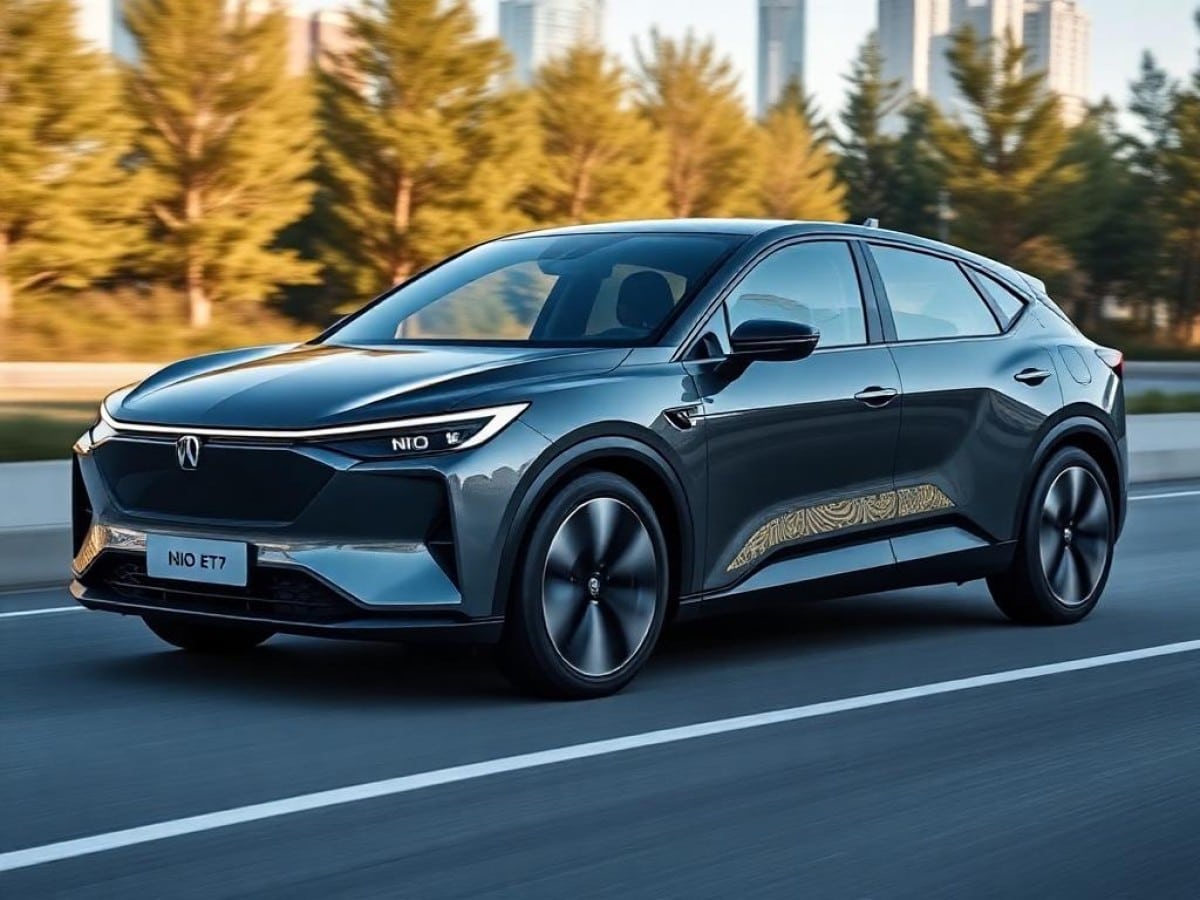
Before diving into the details of the ET9, a brief history of NIO is essential. Founded in 2014 by William Li, this Chinese company positioned itself from the start in the premium segment of electric vehicles, a domain where Tesla was then the undisputed leader. We had previously introduced the ET7 model and the brand’s European strategy in 2023.
With 737,000 vehicles sold since its inception, NIO is a top player in the Chinese premium electric market. The manufacturer has adopted a bold strategy by developing a complete ecosystem around its vehicles.
Its unique global battery swap system allows for swapping a 100 to 150 kWh pack in less than three minutes, avoiding the need to recharge the battery for several tens of minutes at a charging station.
This revolutionary approach is complemented by a network of premium services including NIO Houses, exclusive clubs for owners, and a personalized concierge service.
In Europe, NIO is gradually rolling out its strategy with showrooms in the Netherlands, Germany, and plans to expand its presence to seven new European markets by 2026, including Austria, Belgium, the Czech Republic, Hungary, Luxembourg, Poland, and Romania. The brand currently offers the ET7, an executive sedan, the ET5, a premium compact sedan, and the ES6 and ES7 SUVs, all featuring the latest technological developments for 2025.
The ET9 and Its Revolutionary Chassis
A Chassis That Redefines Standards
The true revolution of the ET9 lies in its SkyRide chassis system, developed in partnership with German suppliers. It is connected to the steer-by-wire system, co-developed with ZF, which eliminates any mechanical connection between the steering wheel and the wheels.
This technology, already present in the Tesla Cybertruck, finds a more refined application here with a variable ratio from 6:1 to 14:1.
Being not mechanically connected to the wheels, the software can theoretically erase almost all road imperfections, which is quite impressive on damaged surfaces because what you see on the road ahead does not get transmitted to the steering wheel. At the rear seats, however, it’s a definite advantage, as you barely feel speed bumps and potholes.
The NIO representative with us during the test confirmed that technically, 100% of road imperfections could be eliminated but that would lead to a peculiar situation where the driver might feel disconnected from their environment. Indeed, this seems quite disconcerting upon reflection.
Hydraulic Suspensions: Bose’s Legacy Reborn
The ET9’s electro-hydraulic SkyRide suspension system was developed in collaboration with ClearMotion, an American company that acquired the active suspension patents from Bose in 2017, and responds in less than a millisecond to road variations.
This technology, which now equips the ET9 and is also of interest to Porsche, eliminates 90% of pitching movements and 60% of roll. While it’s hard to verify these figures – provided by NIO – during our test, this suspension literally transformed the driving experience.
Road imperfections seem to belong to another world, the car moving in a bubble. But again, if the experience is validated as a passenger, it’s a shared feeling when you’re behind the wheel. More information on the Skyride chassis is available in our dedicated article. The essential takeaway: each wheel becomes independent in terms of suspension.
Here are the other technical characteristics of the ET9:
| Specification | Value |
|---|---|
| CLTC Range | 650 km |
| Maximum Power | 520 kW (707 hp) |
| Torque | 700 Nm |
| Acceleration 0-100 km/h | 4.3 seconds |
| Maximum Speed | 220 km/h |
| Battery | 100 kWh |
| Rapid Charge | 325 kW (925 volts) |
| Length | 5 325 mm |
| Wheelbase | 3 250 mm |
| Turning Diameter | 10.9 meters |
Interior: A Unique Front Cabin, But Ultimate Luxury is at the Rear Seats
Rear Seats That Challenge Maybach
The interior of the ET9 reveals a different philosophy from European luxury. While German manufacturers rely on tradition and craftsmanship, NIO favors innovation and technology. The rear seats, true executive armchairs, offer a reclining angle up to 135 degrees and integrate a hot stone massage system with 16 activation points. I can confirm that one could quickly get used to this innovative massage system.
The 2.15-meter executive console naturally divides the cabin into four private spaces. A 360-degree adjustable executive tablet, an 8-liter refrigerator with temperature management from -2°C to 55°C, and a central safe accessible by code complete this premium environment. I particularly appreciate the rotating central tablet that can be used as a workstation or for a snack break.
During our test, we spent a small hour in the rear seats on different roads in Shenzhen, and I can confirm that the comfort level indeed rivals that of a German limousine, but with a more modern approach.
The seats automatically adapt to the morphology, and the 35 speakers of the LYRA 8.2.4.8 audio system create a very high-quality sound bubble.
Total Control by the Rear Entertainment System
The level of control at the rear seats is impressive since one can simply adjust everything: the seats, the quad-zone climate control, the mood lighting, the audio-video system, and also follow the navigation or send a new route to the driver or the autopilot system.
At the Front: Omnipresent Artificial Intelligence
The dashboard is dominated by a 14.5-inch 3K OLED screen running the SkyOS operating system, developed entirely by NIO. NOMI, the intelligent voice assistant, manages all vehicle functions with a good contextual understanding.
Personally, not being a fan of this assistant in the middle of the dashboard, I would remove it from the configuration, which would lower the total price by 500 euros.
If the software functions properly, I think the screen band is better integrated at Xiaomi with their Hypervision technology, which places this band at the bottom of the windshield on the Xiaomi YU7.
Performance and Autonomy: Efficiency at the Service of Luxury
A Mastered Powertrain
With its 520 kW (707 horsepower) and 900 Nm of torque, the ET9 has more than enough power for its 2,700 kg. The 925-volt architecture allows for ultra-fast charging up to 325 kW to 600 kW, theoretically from 10 to 80% in less than 12 minutes. The CLTC range of 650 km with a 100 kWh battery is not the best on the market, and it suggests quite high consumption.
We are a bit disappointed since BYD now does even better, with a recharge from 10 to 70% in only 6 minutes as we witnessed in Shenzhen.
During our dynamic test, we appreciated the progressiveness of the power and the total absence of roll thanks to the active suspensions. The 0 to 100 km/h in 4.3 seconds is performed in an impressive silence, the active road noise cancellation system (ARNC) filtering nuisances up to 1,000 Hz with a peak reduction of 14 dB. The car will therefore be very comfortable for long journeys.
Safety: Technology at the Service of Protection
The ET9 integrates unique predictive safety systems. In the event of an imminent collision, the suspension can raise the vehicle by 50 mm in 0.7 seconds to expose the most resistant deformation zones. The system even manages tire bursts at 170 km/h with a reaction time of less than 0.3 seconds.
Driving Impressions: A Transformative Experience
Behind the Wheel: Technology at the Service of the Driver
Our hands-on test in Shenzhen revealed a surprising car. The steer-by-wire system initially destabilizes, but adaptation happens quickly. The driving sensation fundamentally differs from that of a conventional sedan: no steering wheel vibrations, surgically precise steering, and an instant response to inputs.
The active suspensions completely transform the experience. Road undulations, speed bumps, changes in elevation seem to belong to a parallel universe. The car moves in a mechanical comfort bubble that we had never experienced before, even in the most luxurious German sedans.
Our Test of the Autopilot on the ET9
The Processor Wars
The ET9 inaugurates the first implementation of the Shenji NX9031 autonomous driving chip developed by NIO. Etched at 5 nm, this chip integrates over 50 billion transistors in a 32-core architecture, delivering a power exceeding 1,000 TOPS per unit. The ET9 carries two Shenji chips, offering theoretically more than 2,000 TOPS of raw computing power. In direct competition with the Xpeng G7 and its three Turing AI chips bringing the total power to 2,250 TOPS theoretically.
The two manufacturers have taken different paths since Xpeng decided to drop Lidar in favor of a system based exclusively on cameras and advanced AI algorithms. The ET9 favors redundancy with its Aquila 2.0 system comprising 31 sensors: three LiDAR units, 4D mmWave radars, and high-resolution cameras. Xpeng takes the risky bet of “vision-only,” completely abandoning LiDAR.
Specific Technical Innovations of the ET9
The ET9 introduces the first automotive use of 4D mm Wave radars, capable of measuring elevation in addition to azimuth. This fourth dimension allows for a precise three-dimensional perception of the environment, especially useful for detecting aerial obstacles like bridges or traffic signs.
These 4D radars complement the information from the LiDAR in adverse weather conditions, where optical sensors may be disrupted by rain, snow, or fog. This seems to be a combination that will work even in environments where Tesla’s “vision-only” mode struggles.
The Aquila 2.0 system of the ET9 relies on 31 sensors that generate a massive data stream, processed in real time by the Shenji NX9031 chips. This architecture allows for precise 3D modeling of the environment with a refresh rate of 20 Hz.
More Power, More Sensors, but Some Software Bugs…
With this computing power and array of sensors, one would expect peak autopilot performances. Unfortunately, we were stopped after a few minutes at a red light. The car stopped right in the middle of a crosswalk. I was a bit embarrassed as a driver.
And upon restarting, the car stubbornly took a left turn despite facing a central median. I had to quickly take the wheel to prevent hitting this obstacle… We hope this is just a software issue that will be fixed in an upcoming update.
Positioning and Availability: The Challenge of Prestige
The Challenge of Brand Prestige
As I had pointed out during my test of the Stelato S9, in this luxury-premium category, buyers look not only at technical specifications but also at the badge
Similar Posts
- Driving the Xpeng P7+: Experience Tesla Model S Luxury at a Model 3 Price
- Electric Nio Firefly Under €30K: Stunning Drive, But Two Major Issues for Europe!
- XPeng P7+ Review: This Chinese Electric Car Charges Twice as Fast as a Tesla Model 3!
- We Tried the Volvo ES90: This Electric Car Makes Long Journeys a Breeze!
- I Tried the Electric Mercedes-Benz C-Class: Could This Be the Best Electric Car for Road Tripping?

Maya Singh is a senior editor covering tablets and hybrid devices. Her work explores how these tools reshape digital productivity and learning. She also contributes to feature editorials on emerging tech.