
Scientists confirm: This is the most effective way to get your cat’s attention, according to new research
Elderly Couple Refuses Reserved Seats—Viral Train Standoff Sparks Fiery Debate on Courtesy
The Micro Four Thirds sensor format has been experiencing lean times in recent years. There’s been no major technological boom, no race for megapixels, no revolutionary sensor developments. While manufacturers of full-frame and APS-C mirrorless cameras are ramping up with 40 or 60 megapixels, the Micro 4/3 format still hovers around 20 megapixels, the same resolution for several generations. Panasonic has developed a 25-megapixel sensor, but OM System apparently does not have access to it. It’s sometimes questionable whether the brand will ever get its hands on sensors comparable to those in the DJI Mavic 4 Pro drone, which also uses a 4/3″ format with 100 million native pixels. Such a development would be a welcome boost to rekindle public interest, but for now, we are far from it.
However, OM System has done something smart with the OM-3. Instead of trying to catch up to full-frame in terms of resolution, the brand has equipped its new body with a stacked BSI (back-side illuminated) sensor, a sophisticated technology that really changes the game. This isn’t an ordinary Micro 4/3 sensor. It’s the same component used in the high-end OM-1 Mark II, with all the associated performance benefits in terms of read speed, noise handling, and dynamic range. The result is a camera that holds its own against APS-C and new-generation full-frame bodies in many shooting scenarios.
And then there are the tangible benefits of Micro 4/3 that are too often overlooked. A smaller sensor means smaller, lighter, less bulky lenses. You can carry two or three zooms in a travel bag without ending up with a herniated disc after a day’s walk. The entire system remains highly portable. For a photographer on the move, this is a significant advantage, literally.
OM System OM-3Technical Specifications
| Model | OM System OM-3 |
|---|---|
| Type of Camera | Mirrorless |
| Sensor Format | Micro 4/3 |
| Sensor Resolution | 22.9 MP |
| Image Stabilization | Mechanical |
| Video Recording Definition | 4K@60fps |
| AF-S | 6 FPS |
| Articulated Screen | Yes |
| Weight | 413 g |
| Product Sheet |
This review was conducted with a unit loaned by OM System.
OM System OM-3Design: A Love Letter to the 70s
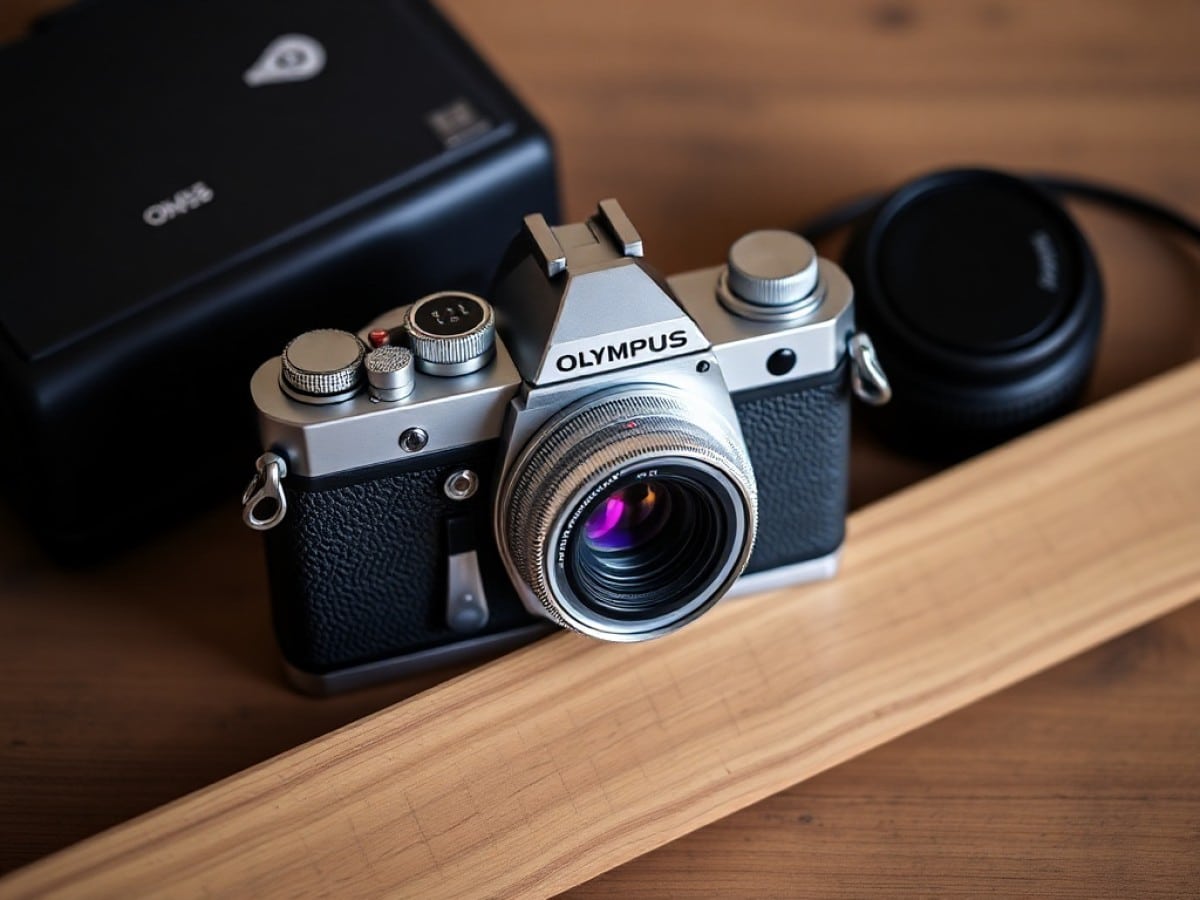
Let’s be clear: the OM-3 is a beautiful object. OM System has drawn from its heritage: the body is directly inspired by the Olympus film cameras of the 1970s, those designed by Yoshihisa Maitani with a sense of compact elegance. The result appears to be a declaration of love to the brand’s past.
The chassis is made of magnesium alloy and the top plate is brushed aluminum. No polycarbonate, no material compromises. The faux leather coating completes the premium impression. In hand, it’s dense, a true tactile pleasure. The dials are precisely machined, their resistance finely tuned.
The design recalls the Olympus PEN-F in some ways, especially due to the creative dial on the front, which is directly inherited from it. But the overall silhouette, with its prominent viewfinder hump and flat front face, more closely resembles the SLRs of the film era.
The dimensions are compact: 139.3 x 88.9 x 45.8 mm for about 496 grams with the battery and an SD card. It’s compact, but not tiny. The OM-3 is not a pocket camera. However, it easily fits into a shoulder bag and is light on the shoulder.
There is an ergonomic downside: the front is completely flat. There is no front grip. With a light lens (such as the 20 mm f/1.4 Pro, the 25 mm f/1.8, the 17 mm f/1.8…), the grip is excellent. But when you mount a somewhat hefty zoom, such as the 12-100 mm f/4 for example, handling could be less comfortable. However, several third-party solutions exist to add a grip. The absence of a joystick for AF point selection might be a regret for some, although navigation is smooth via the touchscreen or the directional pad.
The IP53 certification adds real peace of mind. The OM-3 resists dust, water splashes, and freezing down to -10°C. It can be used in the rain without worry, a real argument if you go out in all weather conditions.
Conventional Connectivity
The OM-3’s connectivity is comprehensive but not exceptional. There is a USB-C port for charging while in use (convenient) and data transfer, a micro-HDMI output for connecting to an external monitor, a 3.5 mm mic jack, and a 3.5 mm headphone jack. Wi-Fi and Bluetooth allow for image transfer to a smartphone and remote control via the OM System app.
The card slot is single, in SD UHS-II format, which makes sense given the device’s target audience (photographers primarily, not videographers).
OM System OM-3Screen and Viewfinder: The EVF Sparks Debate
The OM-3 features a 3-inch LCD screen, mounted on a ball joint, with a resolution of 1.62 million dots. It’s touch-sensitive, well-calibrated, and its articulated construction makes it very versatile. You can frame shots from above holding the camera at arm’s length, from below at ground level, or even film yourself facing the lens and seeing what you’re framing. It’s a real asset for vlogging and creative photography.
The OLED electronic viewfinder displays 2.36 million dots with a magnification of 0.69x. It’s smooth, responsive, and pleasant to the eye. Looking through the viewfinder on the OM-3 is a real pleasure, especially since the interface is clean and readable. However, at this price point, and compared to competitors that offer viewfinders with 3.69 million dots like the Fujifilm X-T5, one might raise an eyebrow. It’s not a bad viewfinder, far from it, but it’s a compromise to note.
Many users won’t really feel it as a limitation, as the image quality is surprisingly good, but pixel peepers might quibble.
OM System OM-3Performance: The Stacked Sensor Makes a Difference
This is where the OM-3 really stands out among M43 cameras. The sensor is a 20.4-megapixel Live MOS Quad Pixel stacked and backside-illuminated (Stacked BSI) model, paired with the TruePic X processor. It’s exactly the same duo as in the OM-1 Mark II.
Benefits of the Stacked BSI Sensor
A stacked sensor places electronic circuits directly under the photodiodes, significantly reducing read delays. The sensor’s scanning speed is extremely fast, resulting in minimal rolling shutter (the image hardly distorts during sudden movements). The backlighting improves the base sensitivity and thus the dynamic range is better in low light.
Practically speaking, at 200 ISO (base sensitivity), the files are clean, detailed, natural. JPEGs come out remarkably well: the colors are soft, precise, and pleasant without retouching. The dynamic range is decent: it’s easy to recover slightly blown highlights, and shadows can be lifted without a flood of noise, likely due to the sensor’s backlighting. It’s a pleasant surprise.
Noise, Grain, and the Format’s Limit
The Achilles’ heel of this small sensor remains ISO performance. It’s structural: a 17.3 x 13 mm sensor captures fewer photons than an APS-C sensor, and far fewer than a full-frame sensor. If you zoom in 100% on a 200 ISO file, you can already see a slight background grain. It’s a light, somewhat filmic grain, so not a deal-breaker… but it’s there. This means that cropping will quickly reveal this texture, and the 20 million pixels might seem insufficient if you’re looking to crop heavily.
At 3200 ISO, the noise is more pronounced but still acceptable, and the camera eliminates it quite well in JPEG mode. At 6400 ISO, post-processing is necessary. Current noise reduction software, with Lightroom leading the pack with its AI-driven algorithms, works wonders: a single pass can recover very clean files, even at high ISOs. Topaz DeNoise AI and the tools integrated into DxO PhotoLab also perform very well on OM System files. However, it is an additional investment.
Autofocus: 1053 Points, Solid Tracking
The autofocus system is one of the OM-3’s strong points. It relies on 1053 cross-type phase detection hybrid points, which cover 100% of the sensor surface.
The AI-driven subject detection recognizes humans and their eyes, dogs, cats, and birds, as well as cars, motorcycles, trains, planes, and even steam trains.
In the field, with the 20 mm f/1.4 Pro and the 12-45 mm f/4 Pro lenses, the autofocus is a real success. It locks on quickly, tracking is solid, you feel confident when pressing the shutter. It doesn’t falter in common situations: portraits, street scenes, animals, scenes with slow movements. For the vast majority of everyday uses, the OM-3 is more than up to the task.
Burst Mode: Mind-Boggling Numbers
The OM-3 can shoot up to 50 frames per second in continuous AF/AE tracking mode and up to 120 frames per second in non-tracking mode with exposure locked (however, only with certain pro lenses and in electronic shutter mode).
It should be noted that in mechanical shutter mode, the burst rate drops to 6 frames per second, which is modest. But once you switch to electronic, the possibilities are wide open. The buffer depth is sufficient for a reasonable burst, even if it’s not unlimited.
The mechanical shutter speed is limited to 1/8000s and the electronic to 1/32000s.
Stabilization: A Reliable Feature
The 5-axis stabilization is one of OM System’s trademarks, and it’s confirmed here. The advertised gain is 7.5 stops, making it one of the best IBIS on the market. Shooting handheld for 1/2 second with short lenses is entirely feasible. This is a decisive advantage for low-light photography, indoor scenes, and night scenes without a tripod.
OM System OM-3In the Field: A Camera That Invites You to Photograph
This may be the most difficult quality to quantify, yet it’s very real. The OM-3 makes you want to go out. It makes you want to have it with you. There’s something in its shape, in its texture, in the sound of its shutter (a creamy click), that makes the shooting experience enjoyable. It’s a detail that won me over.
The science of colors is also a strong point of the camera; they appear generally neutral yet quite powerful in the default JPEG profile. RAW files in post-production are easy to work with, and the OM System profiles integrated into Lightroom provide subtle and convincing results.
The Creative Dial
This is a direct inheritance from the Olympus PEN-F, and it’s one of the features that most distinguishes the OM-3 from its competitors. This dial, placed on the front, gives immediate access to four customizable color profiles, four monochrome profiles, Art Filters (numerous stylized effects), and the Color Creator for entirely custom hues. You switch from one profile to another with a simple click, without entering the menus. Of course, this only works on JPEG files.
The CP Button and Computational Photography
The OM-3 incorporates a button dedicated to computational photography, with advanced digital processing:
Live ND: this mode simulates an ND filter up to ND64 in real time, visible in the viewfinder. Useful for blurring water or a loaded sky without a physical filter, in broad daylight.
Live GND: simulates a graduated neutral density filter, which can be adjusted in position and intensity. Revolutionary for landscapes with strong contrast between sky and ground.
Handheld High-Res Shot: by combining several successive hand-held exposures, the OM-3 produces 50-megapixel files (RAW or JPEG) without a tripod. In tripod mode, it can go up to 80 megapixels. This is a concrete response to the resolution limitation of the sensor.
Live Composite: this mode accumulates light progressively during a long exposure, adding only the areas that light up. Ideal for night photography, light trails, stars. This isn’t a new mode; it has been available for years on Olympus cameras and has already proven its worth.
Focus Stacking: this mode automatically stacks several focus points to achieve total depth of field. It’s very useful in macro photography.
OM System OM-3Interesting Video Stabilization
The OM-3 is not primarily a video-oriented hybrid, but its capabilities are decent for mixed use.
| Mode | Resolution | Frequency | Depth |
|---|---|---|---|
| 4K UHD | 3840 x 2160 | up to 60p | 8 bits or 10 bits (Log/HLG) |
| 4K DCI (C4K) | 4096 x 2160 | up to 60p | 8 bits or 10 bits (Log/HLG) |
| Full HD | 1920 x 1080 |
Similar Posts
 Maya Singh is a senior editor covering tablets and hybrid devices. Her work explores how these tools reshape digital productivity and learning. She also contributes to feature editorials on emerging tech.
Categories Latest Articles |