
Scientists confirm: This is the most effective way to get your cat’s attention, according to new research
Elderly Couple Refuses Reserved Seats—Viral Train Standoff Sparks Fiery Debate on Courtesy
Fujifilm is known for its vintage-inspired camera designs, reminiscent of film camera bodies like the X100 series or the popular Instax. A standout feature of Fujifilm cameras is their proprietary APS-C X-Trans sensors, which employ an unconventional color array to deliver natural, realistic, and cinematic hues—avoiding the overly saturated or artificial look common with other sensors. Fujifilm colors are notably accurate, featuring deep greens and true-to-life skin tones, enhanced by film simulation modes such as Provia and Velvia.
The X-E series, starting with the X-E1 in 2012, targets photographers who prefer a compact, discreet rangefinder-type body without the complexities of a standard hybrid camera. The X-E5 represents a significant upgrade as the first in the series to include five-axis image stabilization (IBIS) and sports a 40-million-pixel sensor in an ultra-compact body (measuring just 124.9 x 72.9 x 39.1 mm and weighing 445 g without a lens). It meets the growing demand for high-quality compact cameras, easily fitting into a pocket or bag, especially with smaller lenses.
Although it can handle larger lenses, it excels with compact prime lenses, such as the new Fujinon 23 mm f/2.8, making it nearly as portable as an X100VI.
Fujifilm X-E5Technical Specifications
Why You Should Never Reheat These Foods in the Microwave – The Hidden Dangers Experts Warn About
I tried the top 5 guard dogs—here’s what makes these breeds the ultimate protectors
Fujifilm X-E5
9/10
Read the review
-
Amazon
-
Boulanger
-
Fnac
€1,549
The best cameras
All Fujifilm cameras
This review was conducted with a device loaned by Fujifilm.
Fujifilm X-E5Compactness and Optical Modularity
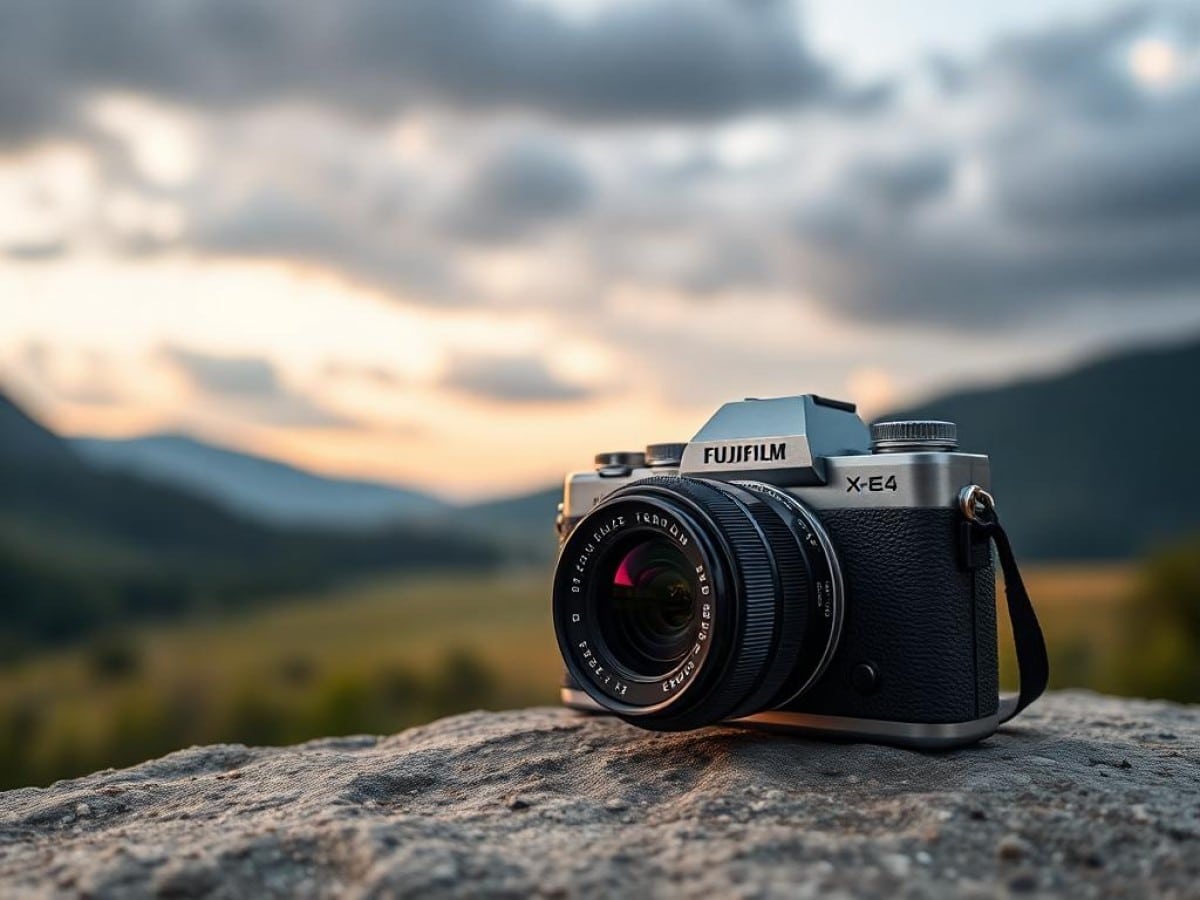
The Fujifilm X-E5 is slightly larger than its predecessor, the X-E4 (121 x 73 x 33 mm, 365 g), a slight increase likely due to the integration of the image stabilization system. Compared to the compact X100VI (128 x 75 x 55 mm, 521 g with a fixed lens), it is slightly heavier but offers the flexibility of an interchangeable mount. Aesthetically, it sports Fujifilm’s signature retro look, with a robust magnesium alloy chassis, available in black or silver.
Ergonomically, the X-E5 is very similar to the X100VI, an iconic camera often out of stock due to limited production and high popularity. The grip is comfortable for such a compact device, with a slightly less pronounced front grip than on the X100VI, making it ideal for one-handed use with light lenses.
However, it is not designed for “heavy glass”: tested with the Fujinon XF 90 mm f/2 (540 g) or the Viltrox 75 mm f/1.2 (even heavier), it requires two hands for optimal stability, as the grip does not provide enough support for lenses exceeding 300-500 g. On the other hand, with compact prime lenses like the Viltrox 27 mm f/1.7 AIR (about 200 g) or the new Fufjinon 23 mm f/2.8 (84 g), the balance is perfect, and, most importantly, the camera remains discreet for street or documentary photography.
- Front face: A minimalist grip, a clickable dial, a lever with a button, and the X mount for interchangeable lenses.
- Top face: A simple shutter speed dial (unlike the dual ISO/speed dial of the more premium X100VI), and a threaded shutter release. Aperture adjustment must be made via the lens or the screen.
- Rear face: Well-positioned buttons (AF joystick, customizable Fn keys), a 3-inch tiltable LCD screen (flippable forward but not swiveling), an OLED electronic viewfinder, and a new dial dedicated to film simulations (Provia, Velvia, etc.), a real plus for quick access without menus.
The connectivity is comprehensive for such a compact device: a USB-C port (for charging and transfer), a micro HDMI (4K video output), and a 3.5 mm mini-jack for microphone input. No dual SD slot, but a single UHS-II.
Fujifilm X-E5A Rather Precious Viewfinder
The X-E5 features a 2.36 million-dot OLED electronic viewfinder, with a 0.62x magnification and refresh rate up to 100 fps—specs identical to those of the X-E4, but inferior to the hybrid viewfinder of the X100VI (3.69 million dots optical/electronic, 0.66x). Unlike the X100VI, which offers a hybrid (Galilean optical + EVF) viewfinder, the X-E5 is purely electronic, making it simpler but still very pleasant to the eye, despite a lower resolution.
The colorimetry of the EVF is flattering, with slightly saturated tones that make you want to frame scenes extensively—a real pleasure for composition. While the EVF does not match the comfort of some larger hybrids, the accuracy is sufficient to visually confirm the focus area. And, as we will discuss, this is a crucial point.
The 3-inch LCD screen (1.04 million dots) is touch-sensitive and tiltable vertically (up to 180° upwards, 90° downwards), but it does not swivel sideways. Compared to the X100VI (similar screen but with a better EVF magnification), it is functional, with decent touch responsiveness for focusing. However, be careful: in intensive use, you might accidentally touch the screen, triggering a focus or an unexpected photo—a minor issue to watch out for. In bright sunlight, the brightness is not exceptional, and the focus indicators (green squares) can be difficult to see. In such cases, the EVF saves the day. Overall, it’s a viewfinder/screen duo that prioritizes the pleasure of eye-level viewing, perfect for traditional photographers.
Fujifilm X-E5Fujinon XF 23 mm f/2.8 R WR, the Ideal Pancake Lens
The X-E5 is available either body-only or in a kit with a brand new lens, the Fujinon XF 23 mm f/2.8 R WR, a 35 mm equivalent pancake lens (ideal for street photography). With an optical formula of 10 elements in 6 groups (including 2 aspherical elements), it is weather-resistant, unlike the camera body itself. Compact (23 mm long, 39 mm filter), it makes the setup as portable as the X100VI with its fixed f/2 lens.
In terms of quality, it competes with the integrated lens of the X100VI (23 mm f/2), but opens at f/2.8 (slightly less bright) and offers superior sharpness from wide open: precise at the center and good at the edges, peaking at f/5.6 for maximum sharpness. The bokeh is soft and pleasant for a 35 mm lens, although not its strong suit (ideal for street or landscapes, not for isolated portraits). Chromatic aberrations and vignetting are corrected in JPEG by the camera, or in post-processing for RAWs (Lightroom or Capture One handle Fuji profiles well). Flare handling is quite good: you can shoot against the sun without significant loss of contrast.
Regarding handling, the aperture ring is clicky (melodic click) and smooth, with an auto mode lock via a solid button. The manual focus ring is accessible and fluid. The only downside: autofocus is noisy at close focus distances (30 cm to 1 m), more so than on the X100VI, making it less suitable for vlogging. Overall, it’s an excellent little lens, the most compact 23 mm in Fuji’s lineup, and we highly recommend it for fully exploiting the compactness of the X-E5.
Similar Posts
- Panasonic Lumix FZ82D Review: Capture the Impossible with Affordable 60x Zoom Bridge Camera
- Fujifilm X-T30 III Review: Compact Under $1000 Camera Films in 6K Like a Pro
- Canon PowerShot V1 Review: Bold Compact Camera with Unique Video-Focused Sensor
- OM System OM-3 Review: Micro Four Thirds Still Packs a Punch!
- Fujifilm X Half Review: Digital Tech Meets Analog Fun!

Maya Singh is a senior editor covering tablets and hybrid devices. Her work explores how these tools reshape digital productivity and learning. She also contributes to feature editorials on emerging tech.