
Scientists confirm: This is the most effective way to get your cat’s attention, according to new research
Elderly Couple Refuses Reserved Seats—Viral Train Standoff Sparks Fiery Debate on Courtesy
Marshall is a name that hardly needs an introduction. Yet, it’s worth mentioning that the brand, long associated in the public imagination with guitar amps and stage stacks used by legends like Hendrix, Clapton, or Angus Young, has, over the past decade, ventured into bringing its signature sound into our living rooms and backpacks. Headphones, earphones, and especially a growing range of Bluetooth speakers including Emberton, Willen, Middleton, Tufton, Woburn, Stanmore… and now, the Stockwell.
The Stockwell III fits between the Emberton and Middleton in terms of size. Unlike these models, it features a vertical, rather than horizontal, design. It shares the same strengths—robust sound, battery life, weather resistance—but sports a more refined appearance.
This third version is more than just a cosmetic update. It brings a host of new features.
Marshall Stockwell IIITechnical Specifications
| Model | Marshall Stockwell III |
|---|---|
| Dimensions | 15 cm x 7.2 cm x 18.1 cm |
| Weight | 1300 grams |
| Protection Rating | IP55 |
| Product Details |
This review was conducted with a speaker loaned by Marshall.
Marshall Stockwell IIIDesign and Handling
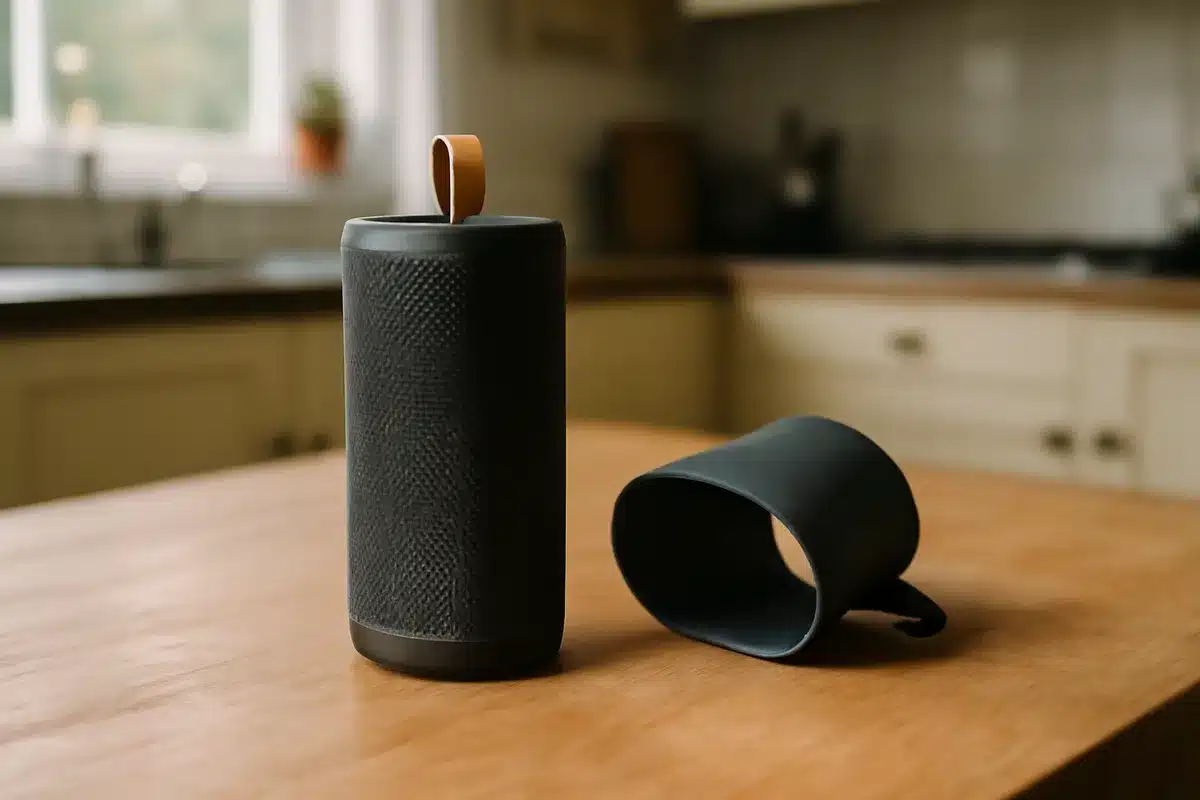
Right out of the box, it’s impressive. Truly. The Stockwell III is the kind of object you unbox and place on the table while exclaiming, “oh wow, that’s something.” The design is vertical, compact, snug. It embodies Marshall’s DNA: the front is covered with a metallic grille behind which the speakers are visible, the Marshall logo stands out in brass-colored letters, and it’s all framed with a textured silicone sleeve that can be removed—yes, it’s removable, and it’s evident, it’s intentional. It’s clean, it’s sleek, it screams “carefully crafted product.”

At the top, there’s a small brushed aluminum plate with notched dials: volume, bass, treble. These dials have an old-school feel, a well-balanced resistance. It’s quintessentially Marshall, and it’s a pleasure to use.
The speaker is rated IP55: it withstands water splashes and dust. You can take it on picnics, by the pool, or hiking without worry. It feels robust enough to handle, with a chassis more durable than its predecessor. It’s dense, it’s solid, it doesn’t sound hollow.
Marshall includes a synthetic leather strap inspired by guitar straps, lined with red felt on the inside. It’s very stylish, adds a nice vintage touch, and above all, it’s practical: you can carry the speaker like a small bag, hang it on a hook, a branch, or a backpack. Just a small note: the red felt, while very attractive, doesn’t seem suited to withstand heavy liquid splashes.
The Stockwell III emits sound from both sides: a metallic grille on the front and one on the back. Marshall calls this the True Stereophonic 360, a front-to-back broadcast in reality, more like 180°. We’ll get back to this in the audio section, but it’s a smart choice for a speaker you place in the middle of a group.
The little guitar riff at startup and shutdown is still there, but now linked to the user-selected volume. If you’ve lowered the volume, the sound will play very softly.
Connectivity: Simple but Adequate
Under the small rubber cap at the back, you’ll find:
- A 3.5 mm auxiliary input. You can connect a portable player, a small portable radio, any analog source. Useful for giving some oomph to a pocket radio or an old MP3 player.
- A USB-C port for charging the speaker, playing music from a smartphone or computer, and it also acts as a power bank. You can plug your smartphone into it to give it some extra juice. The Stockwell III turns into a handy battery pack. Not a bad idea.
All buttons are solid, well-fitted, with no play. The build inspires confidence.
Marshall Stockwell IIIWhat Lies Beneath the Grille
Let’s talk tech. The Stockwell III employs a configuration well-known to Marshall for its portable speakers:
- A front-mounted 8 cm active bass speaker.
- A passive radiator on the back. This radiator is a simple diaphragm that vibrates from the air pressure generated by the active transducer and produces very low sounds.
- Two approximately 4 cm high-frequency speakers, one on the front, the other on the back. They are used to emit the finest, highest sounds that the 8 cm transducer cannot accurately reproduce.
The advantage of the front/back duo is that the speaker emits high frequencies, those that provide texture, clarity, presence, from both sides. If you place it on a table in the middle of a group, everyone hears the same thing, not a clear sound on one side and a muffled one on the other.
In terms of amplification, it’s powerful: 65 watts for the woofer, and two 31 watt amps, one for each high-frequency speaker.
Marshall Stockwell IIIAn Evolving App
As always with Marshall, there’s no need for an app to adjust the speaker’s tone—the dials on top are there for that.
However, the Marshall app is far from useless. It features:
- A parametric equalizer to play with several frequency bands and create a personalized sound profile, which you can assign to the small M button on top of the speaker. A press, and the preset is recalled.
- Placement optimization: this is Marshall’s sound system heritage at play. The brand knows that placing a speaker in a corner of a room, on the edge of a piece of furniture, or in the center of a table changes everything, especially the bass. The app allows you to select your setup (near a wall, in a corner, on the edge of furniture, in the center…) and the speaker automatically adjusts its tone.
- Sound stage widener: a small slider that slightly broadens the spatialization. It alters the original signal a bit, but it gives a bit more breadth, a bit more air around the instruments. It’s a really good idea, and it shows that Marshall continues to improve its products with useful little features.
Bluetooth: Classic and Modern
In terms of transmission technologies, the Stockwell III supports:
- SBC and AAC codecs, quite sufficient.
- LC3: the latest generation low-energy codec, part of Bluetooth LE Audio. If your smartphone is recent enough to support it, you gain a bit in energy efficiency.
No high-definition codecs like LDAC or aptX. It stays pragmatic. For a speaker of this size and at this price, it makes sense.
Auracast is also supported. As a reminder, this technology allows joining an ongoing audio broadcast. For example, someone is publicly streaming their music from their smartphone, and you can connect your Stockwell III to their broadcast. It also works with public broadcast points or with some TVs.
Marshall Stockwell IIIMeticulous Sound with Great Bass Extension
The first thing that strikes you is the sound volume. The speaker is compact, vertical, fits in a backpack, yet it fills a room effortlessly. At reasonable volume, the bass is generous, round, almost surprising for the size.
If you crank up the volume, the electronics do their job: they gradually limit the output of low frequencies to protect the amplifier and prevent the woofer’s diaphragm from moving too violently. This is standard, it’s common to all compact speakers, but it’s good to know: at low volume, you get a full, deep bass; at very high volume, this bass thins out. It maintains impact and power in its upper part, but it loses depth. It’s not a design flaw, it’s a physical constraint.
A Sound Balance Consistent with Other Marshall Speakers
The tonal balance is warm, pleasant, attractive. The midrange is detailed, precise, present. Voices have body, substance. The treble is slightly bright, never becoming harsh. In sum, the signature is balanced. It sounds good with all styles—rock, pop, electronic, jazz, hip-hop: nothing sounds off. It’s an easy-going speaker that doesn’t demand much effort.
If we look at the measurements, at moderate volume (blue curve), the bass extends down to about 50 Hz. In other words, the speaker produces a deep bass, which is remarkable given its size.
However, at very high volumes (pink curve), the 50-60 Hz range noticeably drops compared to the rest of the spectrum. The bass loses depth, even though it retains some punchiness and impact in its upper range. In short: at full blast, you still have punch, but you lose the depth of the kick drum or bass guitar.
The midrange tones are balanced, with a presence peak around 300 Hz to support voices, which stand out particularly well. The upper midrange is subdued, so as not to fatigue the ear, and the treble extends high, without excess.
Objectively, there’s nothing to fault this sound signature for, which, at moderate volume, is almost perfect. However, at very high volumes, the reduced bass deprives the speaker of this beautiful balance. It’s something to be aware of.
Sound Stage: Mono, but Not Ridiculous
It’s a compact speaker, with one channel emitted per side. The sound stage is narrow. That said, the widening mode in the app brings a noticeable improvement: it adds a bit of air, a bit of space around the instruments. It’s not miraculous, but it’s better than nothing.
Listening Impressions
A few tracks to illustrate all this:
Espresso, Sabrina Carpenter. The beat is round, the synthetic bass has body as long as you don’t push the volume too high. The voice is well separated, precise, slightly forward. The treble on the cymbals and the little production effects is bright without being piercing.
Birds of a Feather, Billie Eilish. A more airy, more subtle production. The Stockwell III handles it well: the little production details, the breaths, the light reverberations are audible. The bass is controlled, discreet, it supports without overpowering. The sound stage widener adds a little something here, giving a bit more space to Billie’s voice.
A Bar Song (Tipsy), Shaboozey. More rhythmic, more energetic. The kick hits well, the bass has impact. At high volume, you feel that the bass loses some depth compared to listening at mid-volume, but the energy is there, it remains very engaging.
Marshall Stockwell IIIBattery Life: Over 40 Hours, Double That of the Stockwell II
This is one of the major improvements in this third iteration. Marshall claims over 40 hours of battery life, roughly double what the Stockwell II offered, which capped at just over 20 hours. This places the Stockwell III among the most enduring compact Bluetooth speakers from the brand.
In practice, at 30-50% volume, without excessively pushing the bass dial, you indeed approach these 40 hours. It’s comfortable for a day of listening, and even more than that: you can head out for a weekend, or even a whole week, without needing to bring the cable.
At very high volume, with more bass: the battery life significantly decreases, of course, and without having conducted the test, one can reasonably estimate about 4-5 hours.
The good news is that the speaker charges via USB-C Power Delivery and accepts up to 30 watts of charge. Even better: you can charge it while using it. If you bring along a small USB-C PD external battery, you can connect the Stockwell III to it and keep it running all night at nearly full power. Useful for maintaining a festive atmosphere all night long.
Finally, and importantly: the battery is replaceable. And it’s not the only modular part: the front and rear grilles, the silicone sleeve, and the strap are also replaceable. If in three or four years the battery loses its capacity, a quick service visit can have it replaced. It’s a product designed to last, and that’s commendable.
This modularity isn’t coincidental: starting in 2027, European regulations on batteries will require manufacturers to design devices with batteries that can be easily removed and replaced. By making the Stockwell III disassemblable today, Marshall is not only ahead of this requirement but also enhances its sustainability argument.
Marshall Stockwell IIIPrice and Competition
The Marshall Stockwell III is priced at 229 euros, available since August 18, 2026. This is a premium positioning for a portable compact speaker. At this price, it competes with:
- JBL Charge 6 (around 149 euros): more affordable, a bit more demonstrative sound, shorter battery life (up to 28 hours with Playtime Boost mode) but a cylindrical format and no physical tone control, no auxiliary input. The Marshall stands out with a more classic design.
- Sony ULT Field 5 (around 199 euros): a balanced sound, more powerful bass at high volumes, good battery life, the Sony is designed for outdoor parties with its integrated light show. A different philosophy.
The Stockwell III justifies its higher price with its iconic design and tone controls via dials.
Similar Posts
- Marshall Bromley 750 Review: Meet the New Queen of Party Nights!
- Loewe We. Hear Pro Review: Discover the Power and Elegance of This Portable Speaker!
- Sonos Play Review: Discover the Ultimate Portable Speaker That Delivers on All Fronts!
- Marshall Milton ANC Review: Style Over Sound! Discover the Fashion-Forward Headset
- Tested: Sony ULT Tower 7 – The Ultimate Party Speaker with Unmatched Power and Sound!

Maya Singh is a senior editor covering tablets and hybrid devices. Her work explores how these tools reshape digital productivity and learning. She also contributes to feature editorials on emerging tech.