
Scientists confirm: This is the most effective way to get your cat’s attention, according to new research
Elderly Couple Refuses Reserved Seats—Viral Train Standoff Sparks Fiery Debate on Courtesy
For a long time, Sonos was synonymous with home audio. Its speakers were tethered to power outlets and reliant on home Wi-Fi networks. But with the introduction of the Roam and then the Move, the brand has shifted its approach: now featuring integrated batteries, Bluetooth, and portability. The Sonos Play takes this evolution further, offering a more compact and accessible format than the Move 2, the brand’s first significant portable speaker.
This shift is significant, not just for portability. Sonos now competes directly with brands like JBL and Sony, but with a unique advantage: a consistent and popular sound identity built around a woofer and a tweeter. A Sonos speaker sounds like any other Sonos speaker, with only the size affecting the sound’s breadth and power.
The Play offers a compact residential and portable speaker directly derived from the larger Move 2. However, there are some acoustic trade-offs. Here’s the detail.
Sonos Play Technical Specifications
Why You Should Never Reheat These Foods in the Microwave – The Hidden Dangers Experts Warn About
I tried the top 5 guard dogs—here’s what makes these breeds the ultimate protectors
Sonos Play
-
Amazon
348,95 € -
Son-Vidéo.com
349 € -
Boulanger
349,99 €
The best Bluetooth speakers
All Sonos bluetooth speakers
This review was conducted with a speaker provided by Sonos.
Sonos PlayDesign: The Little Sister of Move 2
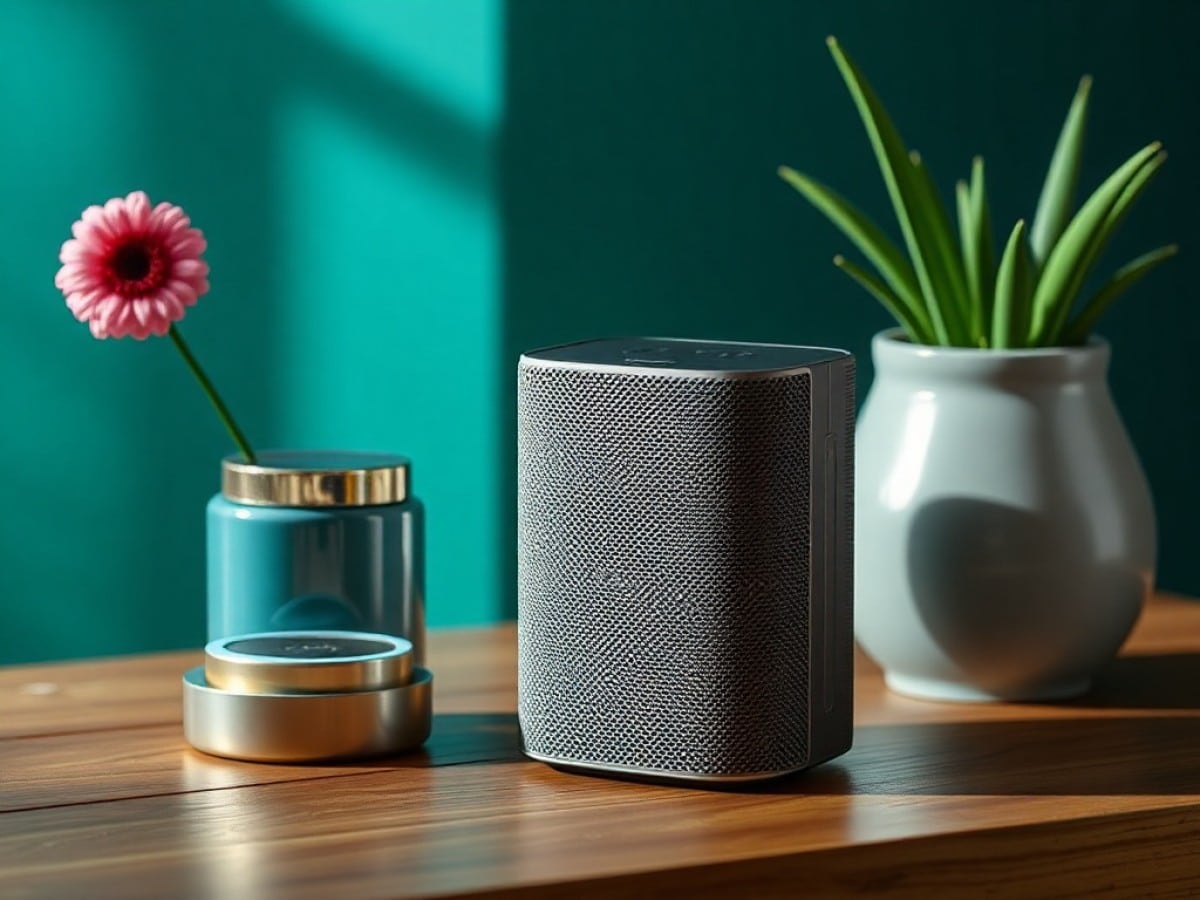
In terms of appearance, the Play is unmistakably Sonos. Its design clearly derives from the Move 2. It shares the same flattened cylindrical silhouette, the same construction logic, the same micro-perforated grille, the same meticulous finish. While the Move 2 is substantial: 2.4 kilograms, 24 cm tall, the Play is in a different league: 19 × 11 × 7.6 cm for 1.3 kg. It fits in one hand, slips into a bag, and can be hung anywhere thanks to a small silicone loop.
It is available in two colors, black and white, in matte shades. The base of the speaker is made of soft silicone: it grips well on all surfaces, does not slip, and does not scratch furniture.
The integrated strap on the top is also made of silicone. It is pleasantly flexible, unfolds and stows effortlessly, and supports the speaker’s weight without bending. It can be used by hand, around the wrist, or attached to any support: a branch, a hook, a tent pole.
At the back of the casing, there is a power button, another for Bluetooth pairing, as well as the USB-C port, which allows for direct charging and also accepts a line audio input with the appropriate adapter (sold separately). Just next door, a small switch turns off the integrated microphone. This mic is used for voice commands and for automatic Trueplay. Disabling it ensures that the speaker no longer continuously captures conversations (although TruePlay calibration continues to function).
The control buttons for play/pause and volume are grouped on the top.
For charging, there are two options. The wireless charging base is included in the box: you place the speaker on it, a magnet automatically centers it, and that’s it. This base connects via USB-C and requires a compatible Power Delivery charger (not included). The phone charger usually works in most cases. For outdoor use with an external battery, direct USB-C charging on the speaker is more practical: no base to carry, no risk of sand or moisture in the connector.
The IP67 certification ensures resistance to immersion up to one meter for thirty minutes and complete protection against dust.
Sonos PlayInternal Design: Sealed Enclosure Does the Job
Sonos has built its speakers with a sealed enclosure from the start. It’s a defining choice, and it’s worth understanding the logic behind it to grasp what it changes in listening and the reproduction of low frequencies.
The majority of portable speakers on the market use a bass-reflex system: a port, a calibrated tube that opens the internal volume to the outside. This tube resonates and boosts the response downward, more than the transducer alone could achieve. In practice, this resonance introduces a delay in the reproduction of low frequencies: part of the bass is produced by the port with a delay relative to the direct wave from the speaker. The result is sometimes a bass that lacks punch, that drags a bit.
A sealed enclosure, on the other hand, closes the internal volume. No port, no tube, no resonance. The woofer works against the pressure of the air trapped inside the casing, which naturally dampens its movement and preserves the quickness of transients. The bass goes down with less volume in low frequencies than a good bass-reflex, but it is more precise, more controlled, and completely indifferent to the position of the speaker. Whether it’s standing, lying down, or hanging: the sealed enclosure does not change its behavior.
On the Play, a woofer handles the low and mid frequencies. It is paired with two tweeters for the high frequencies, angled towards the sides and slightly spaced apart from each other. Two spaced tweeters naturally create a separation in the highs that widens the soundstage, even with a single speaker. For someone listening from the side, the coverage of high frequencies is also improved.
Finally, three digital amplifiers, one per transducer, drive the system.
Sonos PlaySoftware: The Sonos Ecosystem with a Limitation to Note
The initial setup of the speaker takes less than five minutes. You create or log in to a Sonos account, add the Play to the Wi-Fi network, and the speaker is ready to go. The app interface is clear, without too many submenus.
Sonos’s Wi-Fi multiroom capability is what the brand has always done best. Multiple speakers can be synchronized, grouped, or assigned to different rooms with separate sources. The synchronization is precise, without any audible delay.
Stereo pairing between two Plays is possible, but with a significant limitation to note: it requires Wi-Fi. Both speakers must be connected to the same network to function in stereo pair, even when the audio source is Bluetooth. Outdoors, away from a known Wi-Fi network, stereo pairing is not possible. Only one Play will work in standalone Bluetooth mode; the second will be inaccessible. If the main use is portable, away from home, bringing two Plays is not very beneficial.
Trueplay is Sonos’s automatic acoustic optimization function. We’ve seen it on other speakers from the brand. The integrated mics and accelerometer continuously analyze the acoustic environment and adjust the frequency response without user intervention. You move the speaker to a different room, or place it on a shelf rather than on a table: Trueplay recalculates. In practice, the tonal balance changes slightly: a bit more bass, a bit more treble, depending on the level of ambient noise.
Sound equalization is possible, but it is limited to two sliders, bass and treble. That said, the sound signature of the Play is well-calibrated enough that you generally won’t need to touch it.
A loudness option is also available: it boosts the extreme frequencies at low volume, and this boost gradually diminishes as you increase the volume. The goal is to maintain a coherent perceived frequency balance regardless of listening intensity.
Finally, the Sonos Play is compatible with the Sonos voice assistant for starting music, as well as with Alexa.
Sonos PlayAudio: Pure Sonos Sound
The Sonos sound is recognizable from the first few seconds. No aggressive coloring, no inflated bass for effect, no artificially bright highs. The Play clearly follows this line.
The overall impression is of a balanced, homogeneous sound that doesn’t try to impress in the first few seconds. It’s a speaker that convinces over time, not one that seduces with a demonstration effect. That said, it seduces immediately.
The bass is a major success. The sealed enclosure does its job: transients are clean, percussions have punch without dragging, bass lines remain legible even at high levels. You don’t look for sub-bass that shakes the ground with a speaker of this size, and the Play doesn’t pretend to offer it. The depth stops around 60 to 70 Hz, which is still generous for this format and preserves the impression of body and density in the bass. Portable speakers that go too low on paper often pay for it in precision: not the case here.
The mids are clear, detailed, without notable coloration. Voices come through well, acoustic instruments have their texture, harmonics are legible. This is where the quality of the transducers is most apparent, and it shows.
The highs are present and detailed without being bright.
The dynamics are good for the format. The Play gets loud without compressing until about 70 to 75% of the maximum volume. Beyond that, compression kicks in to protect the transducers, but this behavior is well-managed and does not severely degrade the listening pleasure.
Soundstage: Narrow Alone, Top-notch in Pairs
In solo configuration, the soundstage is logically limited in width. The two spaced tweeters expand the horizontal dispersion to about 180 degrees and give air to the highs, but the bass and mid remain mono and some sounds stay centered. This is normal.
What is surprising, however, is the layering of sound planes. Voices are clearly distinguished from instruments. Bass lines do not mask the mids. Highs do not overlap the main instruments. Clearly, the transducers and integrated
Similar Posts
- Sonos Sale Alert: Discounts on Speakers, Soundbars, Subwoofers & Headphones!
- Sonos and Ikea End Speaker Collaboration: What’s Next for Tech and Furniture Giants?
- Loewe We. Hear Pro Review: Discover the Power and Elegance of This Portable Speaker!
- Bose Lifestyle Ultra Speakers Review: Small Size, Big Ambition!
- Marshall Bromley 750 Review: Meet the New Queen of Party Nights!

Maya Singh is a senior editor covering tablets and hybrid devices. Her work explores how these tools reshape digital productivity and learning. She also contributes to feature editorials on emerging tech.