
Scientists confirm: This is the most effective way to get your cat’s attention, according to new research
Elderly Couple Refuses Reserved Seats—Viral Train Standoff Sparks Fiery Debate on Courtesy
Following the footsteps of Denza, Omoda, and Jaecoo, Geely has now made its move into France. The Chinese conglomerate already owns several brands in Europe such as Volvo, Polestar, Lotus, and Lynk & Co. It was only a matter of time before the parent company itself made its mark in Europe and France.
Enter Geely, arriving with two SUVs: a plug-in hybrid and a fully electric model, the Geely E5, which I had the chance to test drive.
Technical Specifications
| Model | Geely E5 |
|---|---|
| Dimensions | 4.62 m x 1.90 m x 1.67 m |
| Power (HP) | 218 HP |
| 0 to 100 km/h | 6.9 s |
| Autonomy Level | Semi-autonomous driving (level 2) |
| Top Speed | 175 km/h |
| Main Screen Size | 15.4 inches |
| Car-side Plug | Type 2 Combo (CCS) |
| Entry-level Price | 37,990 euros |
|
Try it |
Product sheet |
A Simple Design
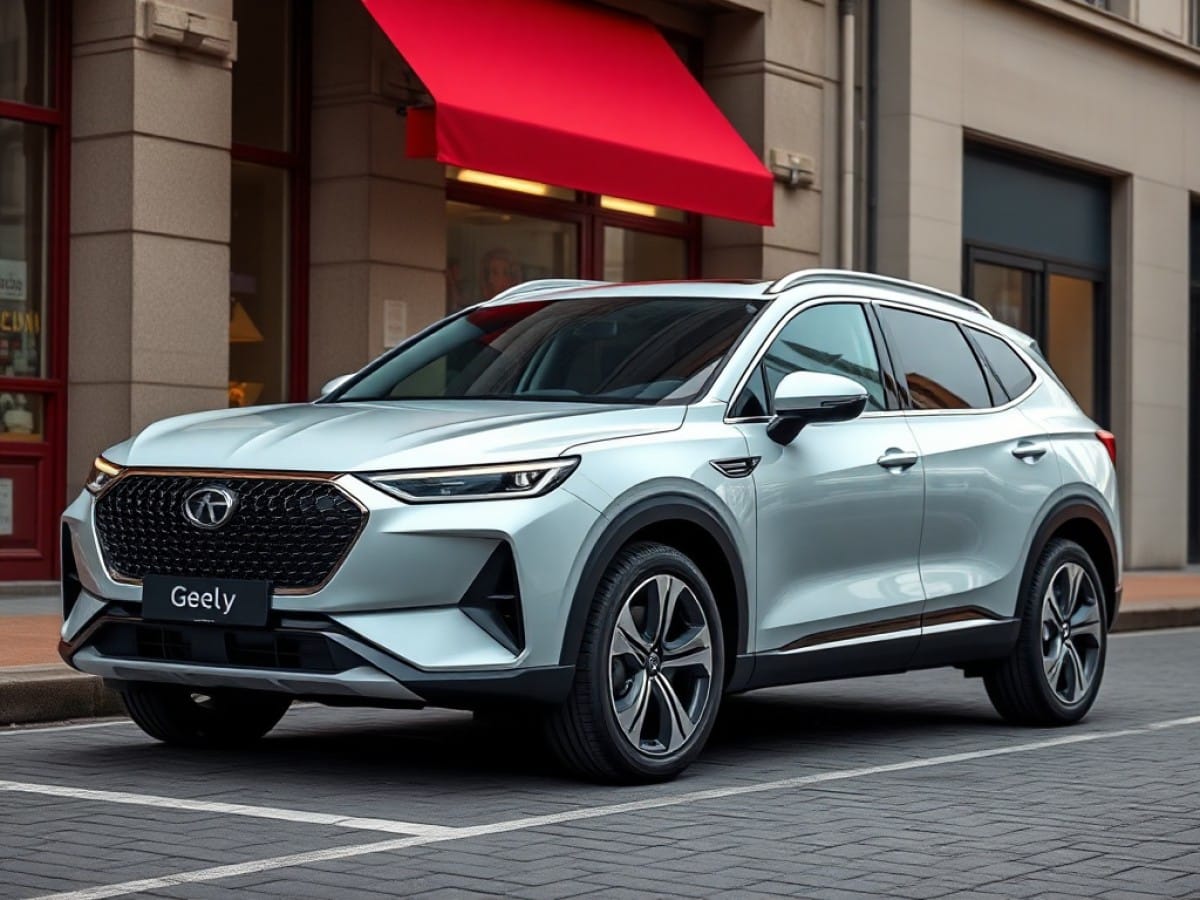
The Geely E5 didn’t exactly steal my heart at first glance, and indeed it didn’t. The design of the E5 is minimalist. It features no front grille, sharp headlights, and a rather low-set logo on the bumper.
From the side, the only notable features are the body-integrated door handles, which automatically extend as you approach the vehicle, a more convenient feature than those on the Tesla Model 3 and Model Y.
The rear design is similarly straightforward, featuring a red illuminated strip across the tailgate and the model designation at the bottom right of the tailgate. Unfortunately, there’s no logo on the tailgate. The Geely inscription is next to the model name. This might not be a bad thing, as the Geely logo isn’t well-known in Europe, even less so than the brand name. Only those who are well-informed know that Geely has a 40-year history and is a leading automaker in the Chinese market.
In terms of size, the Geely E5 measures 4.61 m long, 1.90 m wide, and 1.67 m tall, slightly larger than a Peugeot E-3008, which will be a serious competitor.
Spaciousness: Room for the Whole Family
With a length of 4.61 m and a wheelbase of 2.75 m, there’s plenty of room for everyone. The front passengers are greeted with faux leather upholstery, and those in the rear have ample leg and headroom. The rear bench is also adjustable.
Front passengers will appreciate the fully reclining seats for napping during charging stops. There’s even a leg rest that unfolds like in a Mercedes S-Class sedan.
However, this seating extension seems superfluous, as I can’t use it without having my feet in the dashboard. Geely heavily promoted these electrically extendable seats as standard equipment, but I didn’t find them particularly essential. More appealing are the standard heated or ventilated seat functions and the massage feature, which comes with the upgraded trim level.
The build quality is decent. It’s not quite up to European manufacturers’ standards in terms of presentation, and some materials feel a bit lower-end, but Geely has made an effort to use pleasant materials to the touch. The assemblies seem solid.
The high, floating central console includes an armrest with storage, an induction phone charger, and two cup holders. Underneath this central console, there’s an open storage space, which, like all such spaces, may let items fly out during a sharp turn.
The trunk, accessible via an electric tailgate, offers 451 liters of storage space, expanding to 1,877 liters with the rear bench folded down. There’s no frunk under the hood of the Geely E5, but there is a handy drawer under the rear bench for storing, for example, children’s toys.
Overall, the spaciousness of the Geely seems to be a strong point!
Why not let a robotic lawnmower take over your lawn care? Currently, Mammotion is offering a 100 euro discount on the LUBA mini 2 AWD 1000: precision performance for perfectly neat edges.
Infotainment: It’s All About the Screen
Inside the Geely E5, there are few physical controls, with most functions managed through screens. There’s a relatively basic 10.2-inch display for the instrument cluster and a 15.4-inch touchscreen for the infotainment system.
Regrettably, Geely has opted to eliminate many physical controls. There is a huge volume dial on the central console, reminiscent of designs from a decade ago, along with four other physical buttons for the climate control (standard heat pump): Auto, defogging, air recirculation, and Off.
Missing, for instance, are buttons for quickly changing the driving mode, activating the heated seats, or controls for opening the sunroof or its shade. Fortunately, you can activate these functions using voice commands by saying “Hey Geely,” but a few more physical controls wouldn’t hurt, especially since Geely has them in its parts bank, as the Geely Starray EM-i has a physical button for the sunroof.
For connectivity, there’s a USB-C and a USB-A port under the floating console. The induction charger isn’t ventilated, so be cautious about using Apple CarPlay or Android Auto wirelessly, which could overheat your phone when combined with induction charging. A route planner is also included.
Driving Aids: Just What You Need
The Geely E5 comes equipped with a level 2 semi-autonomous driving system capable of slowing down if a car is ahead and staying centered in the lane when the markings are clear. I didn’t notice any significant bugs during my test drive. It also includes all the aids required by GSR II regulations, such as lane departure warning, speed limit detection, and perpendicular traffic alert when reversing.
While it’s comprehensive, turning off certain intrusive functions isn’t straightforward. Geely offers a favorite driver profile, in which you can choose to deactivate some aids, but I couldn’t find how to activate it quickly using the shortcut on the steering wheel, as described by the brand.
Speaking of steering wheel controls: it’s unclear what they correspond to since nothing is labeled. There are no pictograms to indicate whether you’re activating the cruise control or changing the music. So, half the time, you might switch tracks instead of engaging the cruise control.
I’m aware that owners will eventually memorize the position of the controls, but initially, it’s frustrating. Also, I couldn’t figure out how to resume my set speed on the cruise control after hitting the brake pedal. Moreover, the cruise control seems to adjust only in increments of 5 km/h.
Route Planner: Comprehensive but Overly Optimistic
Having not had the chance to take the Geely E5 on a long journey like I did with the Citroën ë-C5 Aircross from Nice to Paris, I can’t say exactly how the route planner performs.
However, it seems comprehensive in the options it offers. You can, for example, request not to schedule charging stops beyond a certain percentage of battery life, not to plan stops at a charging station until reaching a certain percentage of battery life, and to plan for arrival at your destination with a specific percentage of battery remaining. If you’re worried about running out of power, you could ask it to reach the charger with 20% battery life and arrive at your destination with 50% if you know charging options there are limited.
I attempted to simulate a route from Vannes to Nice. The planner recommends four charging stops, each about 270 to 280 km apart, for a charge from 10% to 80%. For a car with a claimed 475 km range under the WLTP cycle, this seems a bit ambitious because using 70% of the battery between charges provides about 330 km based on the WLTP consumption, and considering the extra consumption from highway driving, a fifth stop might be necessary, reducing the distance between stops. Either way, the car will automatically recalculate the charging stops based on actual consumption and battery discharge.
You can also choose to favor certain charging station brands, which is handy if you have a subscription, for example, with Electra. The cost of each charge is estimated by the planner.
Lastly, I should mention that the planner is very optimistic about charging times. While the brand claims a 30% to 80% charge in 20 minutes, the planner thinks it can schedule stops for a 10% to 80% charge in just 13 minutes, nearly as fast as an Xpeng G6.
In short, I wouldn’t rely too heavily on the route planner to announce your arrival time to friends or family; they might start worrying if you’re running late.
Driving: Smooth Handling
When I first sat behind the wheel of the Geely E5, I must admit I couldn’t find a truly comfortable driving position. The steering wheel and seat are adjustable, but it was mainly the short seat base that made it difficult to find my ideal driving position.
Leaving the test drive parking lot, we took the secondary roads of Brittany before realizing that the car was set to a very soft suspension setting. It’s far from the stiffness of a European car’s chassis, and even softer than a Japanese one. This is a drawback when driving dynamically on winding roads, but an advantage in the city, as it handles speed bumps without any issues.
But if you’re looking for some driving dynamics, you’ve chosen the wrong vehicle. The Peugeot E-3008 offers a much better balance. You can switch the vehicle to Sport mode, which makes the accelerator pedal more responsive and the steering assistance heavier. However, this doesn’t change the steering ratio: you still need to turn the steering wheel a lot to achieve a little turn.
The 218 horsepower from the electric motor is sufficient to make the accelerations of this approximately 1,800 kg SUV lively. The 0 to 100 km/h time is stated as 7.4 seconds. However, the power delivery after pressing the accelerator isn’t abrupt.
I was able to test the car at 110 km/h on a fast road, and the noise level inside the cabin is reasonable, allowing you to enjoy the Flyme Sound 16-speaker audio system included in the Prime trim.
During driving, the lack of physical controls is noticeable: for example, you have to navigate through menus to change the intensity of regenerative braking without going as far as the One-Pedal mode. Steering wheel paddles or a button on the central console would have been more appropriate.
Autonomy, Battery, and Charging
The Geely E5 features a single 218 horsepower motor on the front axle across the range. However, there are two battery options available: 60.2 kWh and 68.4 kWh.
Thus, the range reaches 430 km or 475 km WLTP with a consumption claimed at 16 kWh/100 km. This is a fair figure for the category, but its rivals generally carry much larger batteries, capable of offering ranges up to 700 km.
As for charging, despite a communicated power of just 100 kW (with a peak at 130 kW), going from 30% to 80% of battery life takes “only” 20 minutes, suggesting a 10-80% charge would take around 25 to 30 minutes. This is also average for the category.
During my test drive, mainly on secondary roads, I recorded a consumption of 14.9 kWh/100 km. This is a rather flattering figure but not representative of mixed use: the test did not include fast roads or urban areas.
Price, Competition, and Availability
The Geely E5 starts at 37,990 euros and is unfortunately not eligible for the ecological bonus, as it is imported from China. The top-of-the-range version we tested is priced at 41,990 euros.
For comparison, a Peugeot E-3008 starts at 45,090 euros with a 526 km range and is eligible for the ecological bonus, just like the Tesla Model Y Propulsion starting at 40,990 euros for 534 km of range, also with the ecological bonus deductible from the price.
Geely’s conquest of Europe is unlikely to be spearheaded by the E5. This is the Chinese manufacturer’s first offering in Europe, but the products will need to be improved to gain competitiveness and align with European expectations.
Geely offers a warranty on the battery as well as the entire vehicle for 8 years and 200,000 km.
Similar Posts
- I Drove 1000 km in a Polestar 2: Here’s Why It Beats the Tesla Model 3
- Tested Zeekr 7GT: Stunning Look, Ultra-Fast Charging, Aggressive Pricing—But Is It Enough?
- I Tested the DS N°7 Electric SUV: A Game-Changer with 740 km Range for the Brand’s Future!
- This Electric Car Might Just Outdo My Tesla: Testing Smart #5’s Fastest Charge in France
- I Tested the MGS6 EV: Here’s Why It Falls Short on Long Journeys Compared to Tesla Model Y

Maya Singh is a senior editor covering tablets and hybrid devices. Her work explores how these tools reshape digital productivity and learning. She also contributes to feature editorials on emerging tech.