
Scientists confirm: This is the most effective way to get your cat’s attention, according to new research
Elderly Couple Refuses Reserved Seats—Viral Train Standoff Sparks Fiery Debate on Courtesy
Zeekr, a Chinese brand and a member of the Geely group (which includes Volvo, Polestar, and Smart), made its European debut in 2023 but only reached France in 2026.
Zeekr arrived with three electric models: the Zeekr X, the 001, and the 7X. Now, they’ve added the 7GT, a shooting brake that directly targets the German luxury market.
The brand emphasizes dynamic driving and driving pleasure while maintaining Zeekr’s strengths: cutting-edge technology, a 13-minute recharge capability, and competitive pricing.
Could this car be love at first drive? To find out, we took the Zeekr 7GT for a spin in Andalusia to get a first impression of this extraordinary electric vehicle.
Zeekr 7GTTechnical Specifications
| Model | Zeekr 7GT |
|---|---|
| Dimensions | 4.82m x 1.91m x 1.46m |
| Power (hp) | 421 hp |
| 0 to 100km/h | 5.3 s |
| Level of autonomy | Semi-autonomous driving (level 2) |
| Max speed | 210 km/h |
| Main screen size | 15 inches |
| Car side plug | Type 2 Combo (CCS) |
| Entry-level price | 45,990 euros |
|
Try it out |
Product sheet |
This test was conducted during a press trip organized by the brand.
Zeekr 7GTA Design That Stands Out
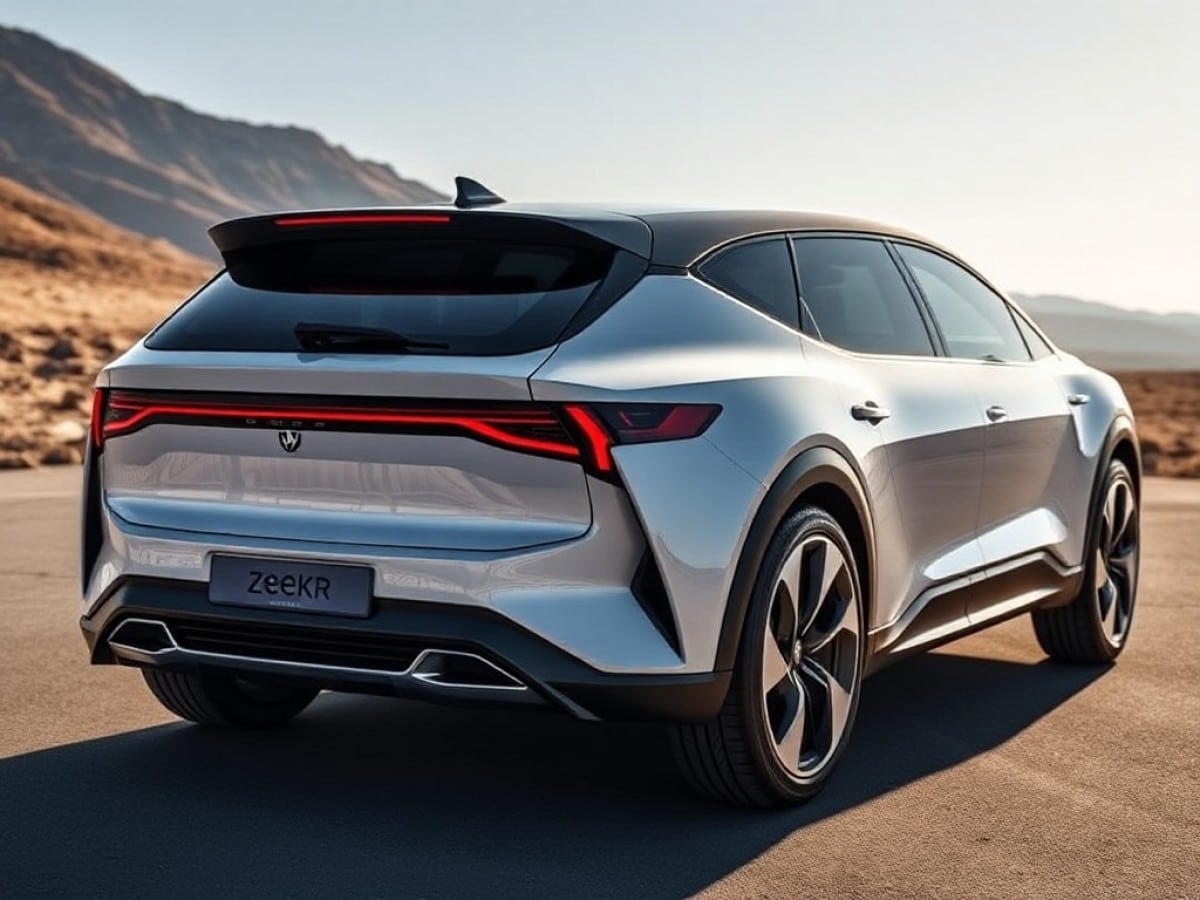
Think Chinese electric cars are just shapeless SUVs? The Zeekr 7GT is here to dispel that myth. Measuring 4.82m long, 1.91m wide, and 1.46m tall, this shooting brake commands presence.
Designed in Gothenburg, Sweden, the vehicle sports an intriguing look, featuring a lot of character while simplifying design lines: the hood extends over the fenders, the window seals are hidden, there’s no visible antenna, the doors are frameless, and the handles are concealed. This gives the car a very contemporary appearance.
At the front, attention is drawn to the large black band. While the Chinese versions feature a huge customizable LED panel known as Stargate, this feature was not included for the European models. Instead, an ultra-thin light signature hides below, with the matrix headlights occupying a minimal area in the lower indent.
The sharply sloping roofline adds dynamism to the profile, supported by wheels ranging from 19 to 21 inches depending on the version. The slim light signature is also present on the tailgate, and the lack of a rear windshield wiper is noteworthy—Zeekr claims that the angle of the rear window makes it unnecessary.
Overall, aerodynamic work (airflow management, active grille, paneled undercarriage, etc.) achieves an air penetration coefficient (Cd) of 0.25, which is quite commendable.
Zeekr 7GTA Spacious and Well-Designed Interior
A Familiar Presentation
As the name suggests, the 7GT is closely derived from Zeekr’s 7X, the brand’s large SUV. This is evident in the overall presentation and dashboard, which is largely shared with its bigger sibling.
Is that a bad thing? Not really: the architecture, materials, and assembly show significant effort. It’s very tech-focused, with a large central screen and some gadgets (the upper trims have automatic doors with integrated radar to avoid hitting nearby obstacles), but it’s also quite premium—some physical buttons even make an appearance.
The leather is genuine, the upper materials are padded, highlighting the hard plastics in the lower part. However, the Germans do not do better, especially considering the price of the 7GT.
Room for Five, but Limited Trunk Space
The generous wheelbase of 2.90 meters hints at it: the Zeekr 7GT is welcoming for its passengers. In the front, the seats are very comfortable, adjustable in multiple ways, and can be heated, ventilated, and massaging.
The real surprise is the space for rear passengers. Despite the car’s low height, the seating position is quite natural, with the ability to slide one’s feet under the front seats—the backrest angle is electric.
The headroom is good, and the width comfortably accommodates three people; the center seat is surprisingly not inhospitable for once.
Ventilation ducts, storage pockets, and USB-C ports make for a better ride. The only regret is that if the outer seats can be heated, they must be adjusted via the front screen. Unfortunately.
The trunk space, however, is limited to 456 liters—the front trunk (frunk) does exist, but its 65 liters (or 32 liters for the four-wheel-drive version) capacity will not hold much more than a charging cable.
For comparison, the Mercedes-Benz CLA Shooting Brake offers an identical rear volume but a frunk of 101 liters, even though it is 10 cm shorter.
Zeekr 7GTAn Infotainment System That May Be Too Comprehensive
As is common with Chinese vehicles, the Zeekr 7GT consolidates nearly all its controls into the central screen—a 15-inch OLED panel in this case.
The interface is quite generic: it doesn’t particularly feel premium, but it shares the same gestures and information hierarchies as its compatriots.
This means it’s easy to get lost in menus and sub-menus to find the right setting, with some frustrating decisions (the management of driving modes or the intensity of regeneration would have been better suited to physical controls), but Zeekr handles it better than others.
Indeed, the 7GT adds numerous customizable shortcuts at several levels: a dedicated screen that appears by swiping from top to bottom, a column on the left of the screen, and two customizable physical buttons on the steering wheel and central console.
To assist the driver, Zeekr offers a particularly comprehensive 13-inch digital instrument cluster with customizable display.
Finally, an XXL head-up display (35.5 inches!), also very comprehensive and bright, is available on mid-range and high-end versions, projecting driving information into the driver’s field of vision.
A final note on the sound system, which includes 23 speakers, a subwoofer, and is capable of producing 2,160 watts. The default settings did not impress us much, but the range of adjustments is vast (it’s possible to adjust each speaker individually), allowing for a suitable setup.
A Pessimistic Route Planner?
As a modern electric vehicle, the 7GT comes standard with navigation that includes a route planner calculating recharge stops on long journeys.
The foundation is solid, with extensive settings (preferred networks, minimum charge level at destination, etc.), but we noted some pessimism regarding recharge stops.
It did not hesitate to predict about 30 minutes to go from 10% to 80% on fast chargers (350 to 400 kW), while Zeekr announces 16 minutes for the same exercise. Nothing that a good update couldn’t fix.
Zeekr 7GTDriving Aids That May Be Too Intrusive
It’s become a habit with Chinese brands to include a full suite of driving aids in their models; the Zeekr 7GT is no exception.
In addition to the suite made mandatory by the European GSR-2 regulation (overspeed alert, lane departure warning, driver attention alert, etc.), Zeekr includes everything needed for a level 2 semi-autonomous driving system (adaptive cruise control, active lane keeping, and semi-automatic overtaking) and some extras, like a 360° rearview camera or automatic parking.
This should set your mind at ease… before you quickly become frustrated with the calibration of these aids. The adaptive cruise control will excessively slow the car at the slightest curve, while the lane departure warning is overly zealous, refusing to disconnect on several test cars—a bug, according to spokespeople.
It’s a pity, because the rest is rather pleasant: the lane keeping is effective, as is the semi-automatic overtaking. In short, remote updates will be welcome to make the aids more tolerant… even if we shouldn’t expect miracles.
Zeekr officials warn us: the 7GT was designed to achieve five stars in the 2026 EuroNCAP tests, which are even tougher than before—this explains, according to them, the braking in curves. We’ll have to test other competitors that meet the same standards to be sure.
Zeekr 7GTDriving: GT, Not Sporty
Two Engine Options
For its 7GT range, Zeekr keeps it simple. Based on the SEA3 platform (Sustainable Electric Architecture, like the Zeekr 7X and Smart #5), it is available in two motorizations.
The first is a rear-wheel-drive, with a rear motor of 310 kW (421 hp) and 440 Nm of torque, capable of accelerating from 0 to 100 km/h in 5.3 seconds and reaching up to 210 km/h.
At the top is a dual-motor version, offering all-wheel drive. The power increases to 475 kW (646 hp) for 710 Nm, shortening the 0 to 100 km/h to 3.3 seconds; simultaneously, it gains an improved braking system (fixed calipers with four pistons) and an active pneumatic suspension.
Finally, Zeekr’s development teams, based in Gothenburg (Sweden) and Frankfurt (Germany), focused on the 7GT’s cradle. Patrik Nord, chief engineer of European vehicles at the Geely Technology Center, detailed the specifics, including technical modifications (specific shock absorbers and silent blocks) and a different calibration of the pedals and steering.
More Comfortable Than Sporty
These impressive figures, combined with Zeekr’s emphasis on the 7GT’s dynamism, are tantalizing: could this shooting brake unsettle the German heavyweights? Can this car genuinely be called a sports car?
In a word: hardly. Yes, the accelerations are brisk, and the overtaking is done in a blink, but the overall behavior isn’t quite in sync. The steering, extremely light in “Normal” mode, becomes a bit heavier in “Sport” without necessarily gaining in precision.
As for the chassis, while never dangerous, it cannot claim to be the most agile: the front axle will often gently widen the trajectory when pushed a bit too hard for its liking. In short, it’s not quite there for thrills.
However, the 7GT honors its Grand Touring badge: onboard comfort is high-level. The pneumatic suspensions (a privilege of our four-wheel-drive version) soften the bumps in the road while avoiding pumping phenomena.
Simultaneously, they allow lowering the body by up to 20mm at high speed (to benefit consumption) or raising it by 35mm if there are doubts about the path ahead.
The soundproofing is impressive, and the braking management is particularly successful, with a natural, consistent, and reassuring brake pedal feel. A vehicle for long journeys, indeed.
Zeekr 7GTBattery, Range, and Consumption: Quick Charging, Some Thirst
Two Distinct Batteries, Ultra-Fast Recharges
Zeekr also offers a choice between two batteries. The entry-level model features a 75 kWh LFP (lithium iron phosphate) battery, promising a range of 519 km according to the WLTP cycle, including losses at recharge, with a consumption of 16.6 kWh/100 km.
Its strong point? Charging, thanks to an 800-volt architecture and a maximum power of 450 kW, promises to go from 10% to 80% in just 13 minutes. Xpeng’s figures are close.
For more versatility, another pack, this time NMC (nickel-manganese-cobalt) of 100 kWh is also available. The range increases to 655 km WLTP for the rear-wheel-drive version and 558 km WLTP for the all-wheel-drive version.
The charge also reaches 450 kW, allowing to go from 10% to 80% of the battery in 16 minutes. A time still less than that of a Porsche Taycan (18 minutes).
For both batteries, a generous 22 kW charger is provided as standard, allowing for quick recharging on public stations (4.5 hours for the smaller battery, 5.5 hours for the larger one).
A Consumption That Seems Non-Competitive
You may have noticed: despite the sizable batteries, the Zeekr 7GT does not offer the best ranges in the segment—an Audi A6 e-tron avant, also equipped with a 100 kWh battery, can travel up to 740 km WLTP between charges.
Our short test loop in the heights of Malaga, Spain, did not allow us to make real consumption readings, but we recorded an average consumption of 22.7 kWh/100 km on our onboard computer after a 145 km route mostly performed on mountain roads
Similar Posts
- Mercedes-Benz CLA Shooting Brake Review: Discover the Ultimate in Style and Performance!
- I Test-Drove the Aito 8: Why This Impressive Chinese Electric Car Will Lose Its Edge in Europe
- Tested: New Mercedes CLA Shooting Brake – Stunning Electric Wagon, Nearly Perfect But Flawed!
- Tested: The Exclusive Mercedes CLA Electric for China – Here’s Our Verdict!
- Discover the Polestar 4 Electric: A Game-Changing Car Missing One Key Feature!

Maya Singh is a senior editor covering tablets and hybrid devices. Her work explores how these tools reshape digital productivity and learning. She also contributes to feature editorials on emerging tech.