Scientists confirm: This is the most effective way to get your cat’s attention, according to new research
Elderly Couple Refuses Reserved Seats—Viral Train Standoff Sparks Fiery Debate on Courtesy
When Apple unveiled two new watches in September, the changes visible at first glance were subtle. On paper, the Apple Watch Series 12 and Ultra 4 bring only incremental updates compared with the Series 11 and Ultra 3. But how do those differences play out in real life?
Between the redesigned heart-rate sensor, the new recovery-focused features, improved battery life and the S11 silicon, I spent time testing the Apple Watch Ultra 4. Below is my complete hands-on review.
Apple Watch Ultra 4Technical specifications
| Model | Apple Watch Ultra 4 |
|---|---|
| Dimensions | 49 mm x 44 mm x 12 mm |
| Wi‑Fi standard | Wi‑Fi 4 (n) |
| Screen resolution | 422 x 514 pixels |
| Panel | OLED |
| Internal storage | 64 GB |
| Weight | 63 g |
| Accelerometer & electronic compass | Yes |
| Sleep tracking | Yes |
| Ambient light sensor | Yes |
| Ingress protection | IP6X, MIL‑STD‑810H |
| Product page |
The unit used for this review was supplied by the manufacturer.
Apple Watch Ultra 4A robust look that hasn’t changed much
At a glance, the Ultra 4 doesn’t radically depart from the Ultra 3 — nor from the original Ultra design, if you look back to the first generation. Apple has largely kept the same visual language for its Ultra lineup.
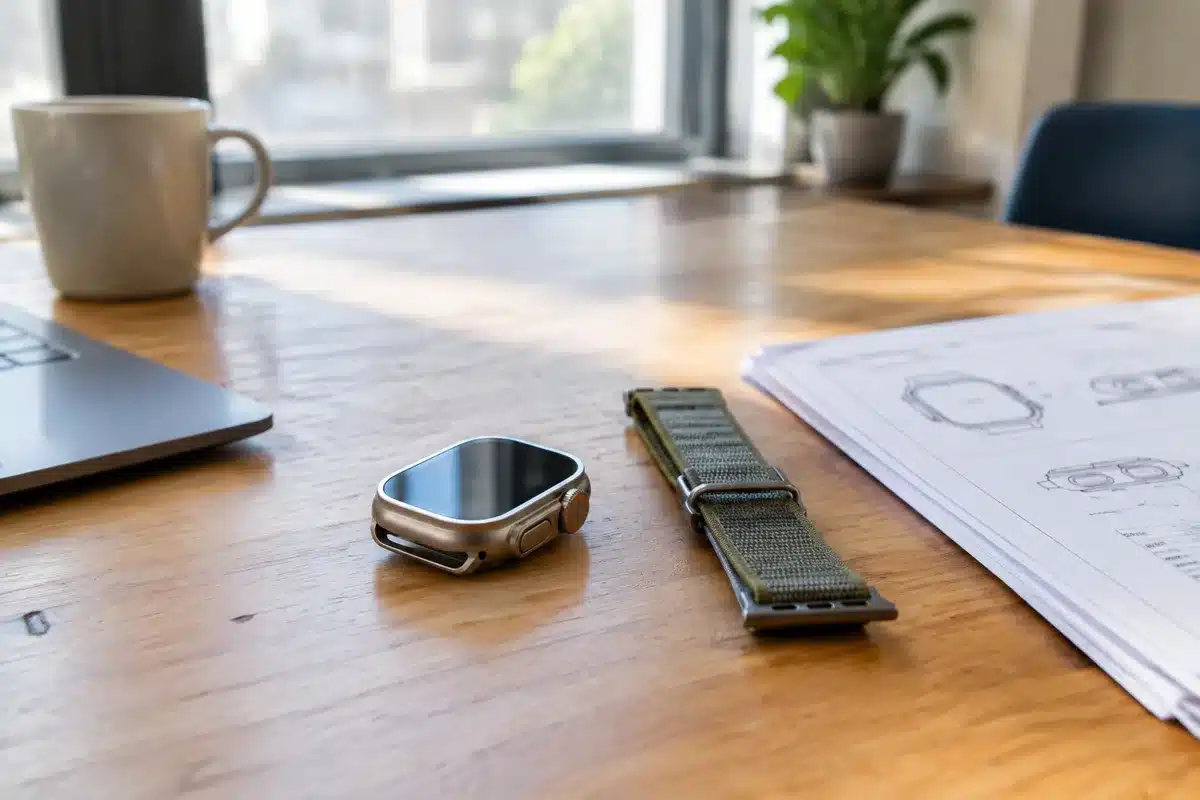
Since the Ultra family launched in 2022, Apple has kept the same case design. The only notable cosmetic tweak came with the Ultra 2 in 2024, when a black finish was introduced. So it’s no surprise to find the same silhouette on the Ultra 4.
The watch continues to present a rugged, adventure-oriented aesthetic, with pronounced bezel guards that slightly overhang the touchscreen to protect it from knocks and scratches. The display itself sits under a sapphire crystal for added protection.
The Ultra 4 still uses a single-piece titanium case measuring 49 x 44 x 12 mm, offered in two finishes: natural titanium and black titanium. Titanium remains a good compromise: more scratch-resistant than aluminum and lighter than stainless steel.
That said, it’s not a lightweight watch. The case alone weighs a substantial 63 grams. For context, here are weights of competing connected and outdoor-focused watches (case only):
| Watch | Weight without strap |
|---|---|
| Apple Watch Ultra 4 | 63 grams |
| Samsung Galaxy Watch Ultra 2 | 61 grams |
| Garmin Fenix 9 Pro 47 mm | 56 grams |
| Garmin Fenix 9 47 mm | 53 grams |
| Amazfit T‑Rex 3 Pro 48 mm | 52 grams |
| Coros Apex 4 46 mm | 44 grams |
| Google Pixel Watch 4 45 mm | 37 grams |
| Oppo Watch X3 | 43 grams |
| Suunto Race 2 (titanium) | ≈ 50 grams |
Compared to these, the Ultra 4 sits at the heavier end of the spectrum. Some rivals achieve much lower wrist weight — for example, Coros uses a reinforced polymer case with a titanium bezel to shave grams while keeping strength.
In daily use, the Ultra 4 becomes easy to forget after the first few minutes on the wrist. For this review I tested it with the “Trail Loop” strap, whose velcro-style closure allows very precise tightening, reducing any bounce during workouts.
The case layout mirrors previous Ultra models: a rotating crown at top-right, a back button at bottom-right, and the signature customizable Action button — bright orange — at bottom-left.
As always with Apple watches, Ultra 4 straps are proprietary: you can only use bands designed for Apple Watch. Standard watch straps with quick-release spring bars are not compatible.
On toughness and water resistance, the Ultra 4 continues to be reassuring. With a titanium case, sapphire glass, IP6X dust resistance and MIL‑STD‑810H compliance, it’s rated to 100 meters water resistance and is actually approved for diving down to 40 meters in practice. In short, it’s a rugged piece of kit.
Apple Watch Ultra 4A display that’s familiar rather than revolutionary
If the case hasn’t changed, the screen hasn’t either: Apple keeps the same OLED panel used on the Ultra 3.
The watch features a 2.04‑inch display with a 422 x 514 pixel resolution and Apple’s “Retina” density of 326 pixels per inch.
Where it lags behind some competitors is peak brightness. Apple continues to rate the Ultra 4 at a maximum of 3000 cd/m². Several rivals push higher: the Coros Pace 4 Pro and Huawei Watch Ultimate 2 claim 3500 cd/m², Garmin’s Fenix 8 Pro microLED reaches 4500 cd/m² and Samsung’s Galaxy Watch Ultra 2 tops out around 5000 cd/m².
This isn’t to say the Ultra 4’s screen is unreadable outdoors — far from it — but in very bright, exhausting outdoor workouts, the extra brightness of some competitors can make quick glances at metrics more comfortable.
At the other end of the scale, the panel can dim down to about 1 cd/m², which is pleasant for night use when you don’t want to be blinded checking the time. An ambient light sensor adjusts brightness automatically to suit surroundings.
The Ultra 4 supports an always‑on display so the time and complications remain visible continuously. Beyond aesthetics, that’s practical for a quick glance at time, weather or heart rate without needing to raise your wrist noticeably.
Apple also launches new watch faces with each generation. This year there’s a “Siri Modular” face that highlights intelligent scrolling and Siri integrations. A variety of faces can be downloaded from the Apple Watch app, but Apple still does not allow third‑party developers to publish custom watch faces — a missed opportunity for many users.
Apple Watch Ultra 4Software updates, but no breakthrough AI features (yet)
Like every Apple Watch, the Ultra 4 is intended to be used with an iPhone. Native Android compatibility is not supported, even though some brands talk about partial interoperability.
The Ultra 4 debuts Apple’s new S11 chip for watches, derived from the A20 Pro found in the iPhone 18 Pro and 18 Pro Max. The S11 brings a 4‑core neural engine, an always‑on low‑power processor, a faster dual‑core main CPU and a GPU with improved bandwidth. The watch includes 64 GB of internal storage.
Apple has slightly adjusted navigation gestures this year. From the watch face, the actions are:
- swipe up / rotate crown up: access to Smart Scrolling
- swipe down / rotate crown down: notifications
- single press of the crown: open recommended apps list
- long press of the crown: launch Siri
- single press of the side button: open Control Center
- double press the side button: Apple Wallet
- long press the side button: power menu
- single press the Action button: customizable shortcut
- long press the Action button: action button functions menu and siren trigger
The additional Action button remains a differentiator for Ultra models. It can launch a chosen app (for example, Workout), toggle through functions like lap marking, drop a waypoint or return to start during an activity.
The Ultra 4 ships with watchOS 27, bringing a few features not available on older hardware. The crown’s single‑press now opens a curated list of seven recommended apps instead of the full grid — you can access the complete app list by scrolling or using the crown. This is handy if you repeatedly open the same handful of apps.
Apple also added a new gesture: in addition to the double pinch for scrolling menus and wrist‑twist to go back, you can now use a single pinch to confirm a choice. That makes the watch easier to operate when your hands are occupied.
However, there is a noticeable absence: Siri AI features and the Audio Intelligence suite are not present in France at launch.
While watchOS 27 introduces AI features such as Siri AI, Live Rewind and Siri Recap, these enhancements are not available in France and therefore do not appear on the Ultra 4 for now. Apple may expand availability later, but at the moment you shouldn’t count on these AI capabilities. Without them, the software additions on this generation feel incremental rather than transformative.
Otherwise, the Ultra 4 behaves like other Apple Watches: you can make and receive calls (via eSIM or Bluetooth), pay with Apple Pay, install third‑party apps from the App Store, and use satellite connectivity to call emergency services when out of cellular range.
Apple Watch Ultra 4Comprehensive health and recovery tracking
The Ultra 4 keeps the sensor suite found on previous models, with some internal upgrades. It includes an optical heart‑rate sensor, skin temperature sensor, pulse oximeter (SpO2), gyroscope, compass, depth gauge, barometric altimeter, ECG capability and GPS tracking chip.
GPS accuracy on the Ultra 4
One of the Ultra family’s distinguishing features is multi‑constellation GNSS support coupled with dual‑frequency GPS, and the Ultra 4 continues this. Dual‑frequency reception should improve positioning accuracy in challenging environments such as urban canyons or dense forest.
To test GPS reliability I wore the Ultra 4 on multiple runs — in town, in a park and on a track — and compared its distance and traces against a high‑end sports watch, the Garmin Fenix 8.
| Run | Garmin Fenix 8 | Apple Watch Ultra 4 | Difference |
|---|---|---|---|
| Run 1 (park) | 12.380 km | 12.690 km | +2.50 % |
| Run 2 (city) | 7.360 km | 7.390 km | +0.41 % |
| Run 3 (track) | 8.974 km | 8.930 km | −0.49 % |
| Total | 28.714 km | 29.010 km | +1.03 % |
Overall, Apple’s tracking is fairly close to Garmin’s. Curiously, the largest discrepancy occurred during the park run — typically an easier environment to track — even though the actual GPS traces looked similar between the two devices.
In practice, the Ultra 4 delivers solid GPS performance in urban environments, but there are items to note. The park session showed an unexpectedly large distance gap, which may be due to it being the first run with the watch — though the plotted path itself seemed accurate. On the track, Apple’s automatic lap detection behaved as usual, but the watch sometimes misassigned lane positions: although I ran only in lane 1 and lane 6, the Ultra 4 did not always place me correctly, inflating distance slightly.
Also worth mentioning: unlike many dedicated sports watches (Garmin Fenix 9 Pro, Coros Pace 4 Pro, Suunto Race 2), Apple’s Workout app still does not provide local onboard maps. If you want turn‑by‑turn or preloaded route guidance, you’ll need Apple Maps or a third‑party app such as AllTrails, Komoot or Strava. For a watch that bills itself as outdoors‑focused, this limitation remains frustrating.
Heart‑rate accuracy on the Ultra 4
Beyond software tweaks in watchOS 27, the most significant hardware change this year is the updated optical heart‑rate sensor.
Until now, Apple’s Ultra watches used the same heart sensor introduced with the Series 6. The Ultra 4 (and Series 12) introduce a new optical heart‑rate module — Apple’s first major sensor update in six years.
Apple hasn’t published detailed technical gains for the new sensor, but says it improves accuracy and increases sampling frequency: resting heart‑rate measurements can be taken every five seconds rather than every five minutes. That’s an improvement, but many competitors have offered continuous per‑second heart‑rate sampling for years.
To check accuracy I wore the Ultra 4 for several running sessions — steady efforts and interval work at 10K pace and VO2 max sets — and compared results to a reference chest strap, the Garmin HRM‑600, which measures via a single‑lead ECG.
| HR measurement | Chest strap | Apple Watch Ultra 4 | Average difference | Avg difference after 10 min |
|---|---|---|---|---|
| Average HR | 141 bpm | 140 bpm | −0.25 % | −0.06 % |
| Max HR | 150 bpm | 149 bpm |
| HR measurement | Chest strap | Apple Watch Ultra 4 | Average difference | Avg difference after 10 min |
|---|---|---|---|---|
| Average HR | 143 bpm | 143 bpm | −0.19 % | −0.11 % |
| Max HR | 150 bpm | 149 bpm |
| HR measurement | Chest strap | Apple Watch Ultra 4 | Average difference | Avg difference after 10 min |
|---|---|---|---|---|
| Average HR | 154 bpm | 153 bpm | −0.30 % | −0.21 % |
| Max HR | 182 bpm | 180 bpm |
For steady runs the Ultra 4’s heart‑rate curves closely matched the chest strap. But during intense interval sessions (1,000 m and 200 m repeats), the Apple watch showed a slight lag compared to the strap and tended to clip peak values, reporting lower max heart rates than the chest strap recorded.
A positive is that the Ultra 4 supports connecting external Bluetooth sensors such as chest straps or armband monitors, like many sports watches do. This flexibility is still not common on many general-purpose smartwatches.
Sport and health features
The Ultra 4 incorporates multiple sensors to monitor fitness, health, activity and recovery throughout the day.
Of course, it retains the core functions from prior Apple Watches: single‑lead ECG for atrial fibrillation alerts, sleep tracking with a sleep score and sleep apnea detection, SpO2 monitoring, skin temperature for menstrual cycle tracking, Activity rings and the Vital Signs app to warn if physiological metrics drift from your baseline. It also offers high and low heart‑rate notifications.
On the Vital Signs front, Apple added daytime vital analysis in addition to nocturnal analytics: daytime heart rate and heart‑rate variability (HRV) recovery metrics are now considered.
The headline feature tied to the new optical sensor is a much higher sampling rate for resting heart rate (every five seconds rather than every five minutes). That increase enables Apple’s new “Readiness” app.
The Readiness score ranges from 0 to 10 and considers three factors: recent activity load, Vital Signs data and sleep score. If the watch determines you’re rested, under‑trained recently and your vitals are normal, it will nudge you to train. Conversely, poor sleep, elevated nocturnal heart rate or a heavy recent training load will prompt recommendations to prioritize recovery.
For workouts, Apple continues to allow customization of on‑screen fields and interval settings for many sports. Unlike Series models, Ultra owners can start an exercise immediately without a countdown once GPS fix is confirmed — a practical advantage for some athletes.
Apple Watch Ultra 4Better battery life — for an Apple Watch
As usual, Apple doesn’t reveal the battery capacity. The company claims improved endurance: up to 50 hours of typical use compared with 42 hours on prior models. It also mentions 84 hours in Low Power mode, 18 hours of use recovered in a 15‑minute charge and up to 45 hours in extended workout mode.
For this review I enabled the most battery‑intensive settings: always‑on display (9:00–23:00), continuous monitoring of sleep, SpO2 and heart rate, and sleep‑apnea notifications. With that configuration the watch ran for 3 days and 19 hours (91 hours) before the battery depleted — well beyond Apple’s 50‑hour claim. My usage during that period was mostly health monitoring and occasional menu use, with two running sessions totaling 2 hours and 3 minutes of GPS tracking. Your mileage will vary, but the Ultra 4 clearly extends uptime compared with other Apple Watches.
Apple supplies a USB‑C cable with a magnetic charging puck. The company says 80% charge is achievable in 45 minutes and that 15 minutes of charging provides roughly 18 hours of use.
Using a PD 3.0 power bank capable of up to 100 W, I observed 18% charge after 15 minutes, 51% after 45 minutes and a full 0→100% charge in 2 hours and 2 minutes.
Apple Watch Ultra 4Calling and connectivity
Like previous Ultras, the Ultra 4 ships exclusively in a GPS + Cellular configuration. It retains Bluetooth 5.3 for phone connection and for pairing external sensors such as chest straps or power meters for cycling.
With three microphones and two speakers, the Ultra 4 can handle phone calls over Bluetooth or cellular (via eSIM). It also supports Wi‑Fi for app and update downloads.
As already noted, the watch benefits from dual‑frequency multi‑GNSS for precise positioning on outdoor workouts.
Like the Ultra 3, the Ultra 4 offers satellite connectivity to contact emergency services and send messages when out of mobile range. You can also share your location via Find My.
Finally, the watch includes NFC for contactless payments with Apple Pay and a UWB chip to help locate your iPhone or U1‑enabled accessories.
Apple Watch Ultra 4Price and release date
The Apple Watch Ultra 4 has been available in France since Friday, September 18. It comes in two titanium finishes: natural titanium and black titanium.
It is sold only in the GPS + Cellular configuration, starting at €899 depending on the chosen strap. That’s the same starting price Apple charged for last year’s Ultra 3.
best price
At launch, major retailers list the Ultra 4 from €899. Availability and promotional pricing may vary between merchants.
Similar Posts
- Apple Watch Series 11 and Ultra 3 Battery Life Boost: Here’s What You Need to Know!
- Huawei Watch Fit 4 Review: Precision Meets Affordability in This Smartwatch!
- Apple Watch Series 11 Review: Discover the Evolutionary Leap!
- Realme Watch 5 Review: Ultra Design Meets Budget-Friendly Smartwatch!
- Samsung Galaxy Watch 8 Classic Review: A Smartwatch That Packs a Punch!

Maya Singh is a senior editor covering tablets and hybrid devices. Her work explores how these tools reshape digital productivity and learning. She also contributes to feature editorials on emerging tech.