
Scientists confirm: This is the most effective way to get your cat’s attention, according to new research
Elderly Couple Refuses Reserved Seats—Viral Train Standoff Sparks Fiery Debate on Courtesy
In any family, there are always favorites, or let’s say, stars—to put it mildly so as not to offend anyone. At Mercedes-Benz, the spotlight today is on the GLB, which Frandroid has previously introduced.
This compact SUV has managed to attract about 20,000 customers since its launch in France in 2019. This has earned it a prestigious spot in the top sales rankings of the German brand, surpassing other family members like the B-Class minivan or the E-Class sedan. So why not continue to pamper and evolve it?
Forget the name “EQB,” a bit too tame for its electric version. In no time, the automaker has returned the star to the center stage by introducing the new generation that can accommodate up to 7 passengers, dubbed the Mercedes-Benz GLB EQ.
The successful formula of the initial version is retained, but now it boasts features from the new CLA sedan and its Shooting Brake variant, including the MMA. We’re not referring to the insurance commercial or the combat sport! Instead, it’s the new Mercedes Modular Architecture, a multi-energy platform that accommodates both fully electric and mild-hybrid powertrains.
It’s worth noting that the GLB is the only premium compact model capable of seating seven, whether in its combustion or electric versions. Consequently, both aesthetically and in terms of driving experience, there are changes. Longer, more technologically advanced, and still capable of carrying the whole family, the new GLB positions itself as the ultimate trendy tool for families. Let’s take it for a spin.
Technical Specifications
| Model | Mercedes-Benz GLB |
|---|---|
| Dimensions | 4.73 m x 2.03 m x 1.69 m |
| Power (horsepower) | 272 horsepower |
| 0 to 100km/h | 7.4 s |
| Autonomy Level | Semi-autonomous driving (level 2) |
| Top Speed | 210 km/h |
| Embedded OS | MB.OS |
| Car Side Plug | Type 2 Combo (CCS) |
| Entry-level Price | 55900 euros |
|
Try it |
Product sheet |
Design: The Mercedes GLB Steps Up
The GLB has undergone a transformation, and with a new iteration comes a new stature. Forget the “compact” size that felt a bit cramped: the 2026 model stretches 10 cm longer than its previous combustion engine version and 5 cm longer than the former EQB electric version, now measuring 4.73 m.
It’s nearly as long as a Tesla Model Y and a Peugeot e-5008 (4.79 meters). It also widens by 3 cm to measure 1.86 m across. And it shows. This growth spurt directly benefits its architecture, especially since its silhouette is more pronounced: the mirrors might have shrunk under the designer’s pen—slightly small for such a size—but the GLB is instantly recognizable with its horizontal bonnet and vertical boot.
At the front, the small electric SUV, slightly rugged, softens with some curves and features an expanded full grille, adorned with 94 illuminated stars surrounding the large three-pointed logo. To enhance aerodynamics, integrated door handles are included.
The rear end surprises even more, with a cubic effect clearly visible, emphasized by a new light signature that spans the length of the tailgate. This bears a resemblance to the Smart #5… It’s worth noting that Geely and Mercedes are already collaborating on the Smart brand.
Spaciousness: A Nearly XXL 7-Seater Format
Speaking of the rear, the vertical boot remains a model of practicality. If you don’t need the two additional seats in the third row (the 7-seater version is optional), the space becomes enormous: 540 liters in a five-seater configuration and 470 liters as a seven-seater. With the rear seats folded, the volume expands to between 1,605 and 1,715 liters.
And a nice touch: Mercedes has finally included a “frunk” (front trunk) of 127 liters. Sure, you can’t fit a carry-on suitcase, but it’s the perfect spot for storing charging cables that usually clutter under the luggage.
Let’s touch on the spaciousness of this new iteration.
The wheelbase has been extended by 6 cm. And since it’s redesigned, the straight roofline enhanced with a panoramic roof, adds more headroom, increasing it by 6.4 cm in the second row.
Rear passengers will be quite comfortable on the 40/20/40 split bench thanks to a very generous legroom. With the adoption of the MMA platform, the person sitting in the center will be more comfortable in the absence of the central tunnel needed for combustion engines.
Infotainment: The Electric GLB Puts on a Show, No Filters?
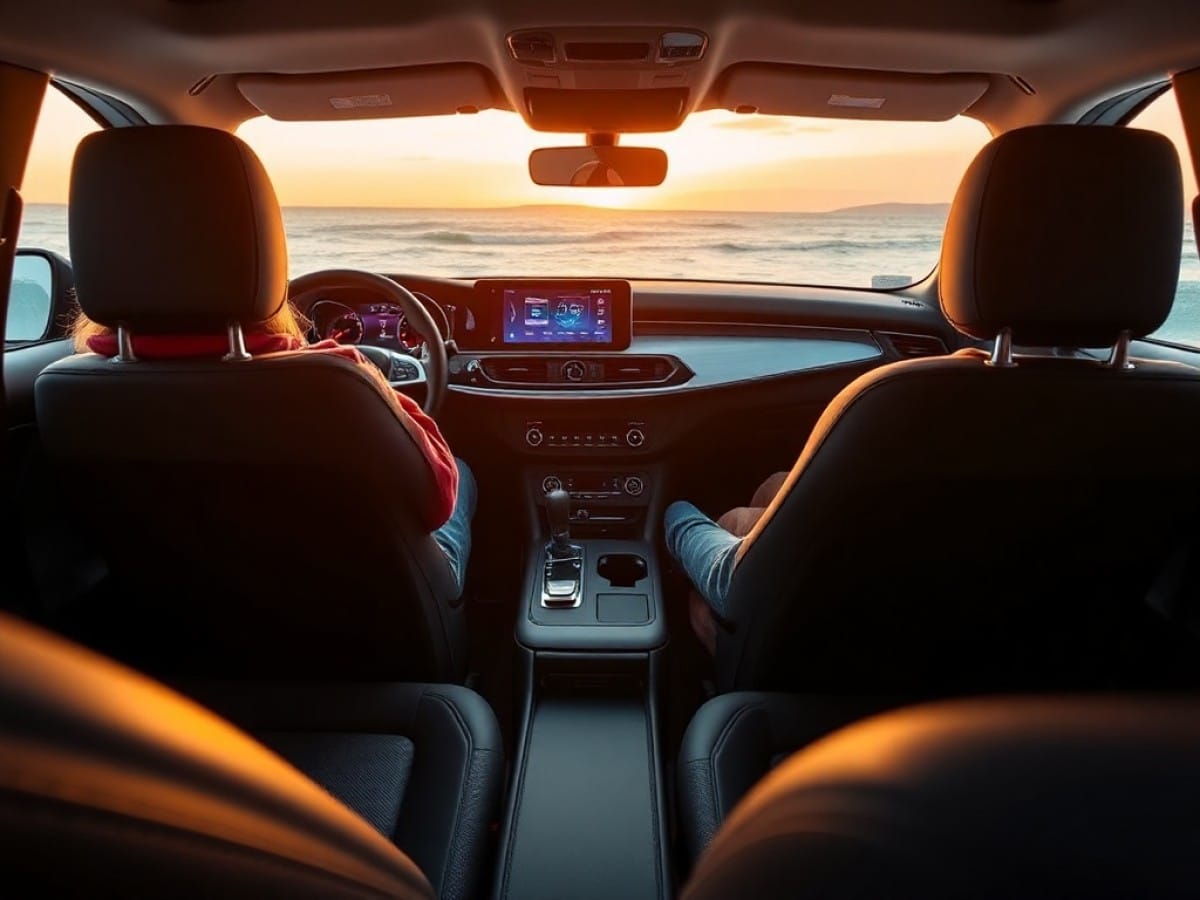
Stepping behind the wheel of the electric GLB, one is immediately struck by the “Superscreen”, derived from the new CLA. The interior is nothing like the previous generation. It’s sleek, fluid, and even the passenger gets their own streaming platform (YouTube, Netflix…).
The dashboard consists of three screens. The digital cluster, positioned behind the steering wheel, spans 10.25 inches, while the central touchscreen measures 14 inches.
Optionally, you can also have a third 14-inch touchscreen installed in front of the front passenger. It’s quite a spectacle.
MB.OS, the latest operating system from Mercedes compatible with wireless Apple CarPlay and Android Auto, offers a user interface similar to that of a smartphone, equipped with multiple connected services as expected at this level of sophistication. It includes, for example, Google navigation with route planning.
Of course, AI plays a big role in this infotainment system: the virtual assistant MBUX integrates Bing (Microsoft), Gemini (Google), and ChatGPT, each vying to respond best to the driver’s requests.
A minor “geek” gripe: the screen doesn’t seem to have a very effective privacy filter. Mercedes claims to comply with regulations by offering a system that cuts off the image after 3 seconds if the driver looks too far to the right. But 3 seconds is a long time at 110 km/h.
Because the front passenger can show off! They have access to Disney+, can start a karaoke session on YouTube, or play Angry Birds. The co-pilot can even take a selfie with the driver from their touchscreen. It’s all fun and games!
Another critique, at night, it’s necessary to manage the brightness of the Superscreen in addition to the cabin ambiance to avoid eye strain. At a stop, the light seemed quite harsh. But it’s true that this high-tech driving post will make many envious.
Driving: A Somewhat Soft SUV
It’s time to drive. Frankly, we had limited time behind the wheel, just about three hours on the streets and mountain passes of Palma de Mallorca.
We hit the road with the electric Mercedes GLB in its 4Matic version in the AMG Line trim with two 354 horsepower motors and all-wheel drive.
It uses the same 85 kWh NMC batteries paired with a two-speed gearbox as the electric CLA.
A 272 horsepower 250+ variant is also available, while a “smaller” 58 kWh battery with a 224 hp motor has been introduced, making the GLB eligible for an ecological bonus.
Settled in plush, extended-seat upholstery, we enjoyed absolute comfort on 20-inch wheels with controlled suspension. Road irregularities were well smoothed out, and the weight of the batteries was kept in check. The car didn’t sag in the corners. However, the steering was somewhat artificial, a common flaw in modern cars: it’s smooth in the city, but on winding roads, the feel is a bit vague and requires readjusting the steering angle in curves.
The regenerative braking (4 levels) is effective. We found ourselves appreciating the intelligent mode, which anticipates obstacles ahead at intersections and roundabouts to brake smoothly on its own. The Sport mode adds artificial noise and more responsiveness, but on such a large vehicle, it seems somewhat superfluous. Note that the GLB does away with steering wheel paddles, opting instead for shift toggles and a volume roller on the steering wheel.
As for acoustic comfort, Mercedes has managed it quite well. Despite having only single-pane glass (surprising at this level of service), the soundproofing is controlled. Even at speeds over 100 km/h, wind noise is almost nonexistent.
Then there’s the crystal-clear head-up display and augmented reality navigation, which are truly enjoyable. At every intersection, the camera projects the actual street image with blue arrows: it’s impossible to miss your exit from the roundabout.
And let’s take a moment to talk about a small but significant driving aid, the surprisingly generous panoramic roof. It’s a source of light. Let’s not overdo it, but the gadget-loving driver will be served with its glass surface that can become opaque at will in a few seconds or when a cluster of 158 colored stars shines at night. The kids will love it in the back, perhaps to the annoyance of the parents in front!
Range, Battery, and Charging: Quick and Efficient
Under the hood of our GLB 350 4MATIC, there are two motors producing 354 hp and 260 kW along with 515 Nm of torque. This system is paired with an 85 kWh battery and adopts the 800-volt electrical architecture of the CLA, allowing for a rapid recovery of 260 km in just 10 minutes of fast charging (320 kW of continuous power DC and 22 kW at home with an 11 kW onboard charger). The 10 to 80% charge is completed in 22 minutes on paper for this large battery, and 20 minutes for the 58 kWh battery.
And a major new feature, following customer feedback, Mercedes offers an optional 800-400V converter, allowing the vehicle to charge up to 100 kW at stations not compatible with very high power levels. Very handy for charging on Tesla Superchargers, still at 400 volts in mid-2026.
Don’t forget the SUV’s compatibility with the V2H and V2G bidirectional charging systems.
The model we tested claims a record range in its category of up to 631 km (WLTP), with a WLTP consumption of 15.8 kWh/100 km. This efficiency is made possible by the two-speed gearbox.
Compared to the 792 km promised by the similarly powered CLA, which, being lower, naturally has an aerodynamic advantage.
The 58 kWh battery allows Mercedes to announce a WLTP range of 430 km.
On a mixed route of more than 150 km, with many twists and turns in the mountains, the consumption of our Mercedes GLB 350 4Matic during this test (where the front motor automatically disengages to reduce consumption), or rather during its first hands-on, ended up at 17.7 kWh/100 km.
Quite respectable for such a size, but let’s be honest, this figure isn’t very representative of typical electric car use, as we couldn’t experience all driving conditions in just 3 hours. So, take this consumption figure with a grain of salt.
Price, Availability, and Competition
Our test model is already available for order, starting at 61,100 euros for the 350 4MATIC all-wheel-drive variant. The 250+ electric version starts at 55,900 euros.
If you’re not willing to spend that much, consider the new option recently promised by the manufacturer: a GLB 200 variant with a 58 kWh battery under the floor. You won’t go as far with it, with a range of 430 km, but it’s cheaper, at 46,950 euros excluding ecological bonus.
In terms of competitors, the Tesla Model Y is an obvious mention, less premium but offering a very interesting price/quality ratio. The Smart #5 also competes with the Mercedes GLB, with even faster charging and more technologies, but with a slightly less premium feel.
Also noteworthy are the upcoming Skoda Peaq, the 7-seater Peugeot 5008, and the DS N°7.
Similar Posts
- I Drove 600 km in a Mercedes-Benz CLA: An Electric Car Journey Without Stress
- Tested: New Mercedes CLA Shooting Brake – Stunning Electric Wagon, Nearly Perfect But Flawed!
- I Tried the Electric Mercedes-Benz C-Class: Could This Be the Best Electric Car for Road Tripping?
- XPeng P7+ Review: This Chinese Electric Car Charges Twice as Fast as a Tesla Model 3!
- 300km in the Mercedes CLA Electric: Is This Tesla Model 3’s First Real Rival?

Maya Singh is a senior editor covering tablets and hybrid devices. Her work explores how these tools reshape digital productivity and learning. She also contributes to feature editorials on emerging tech.