
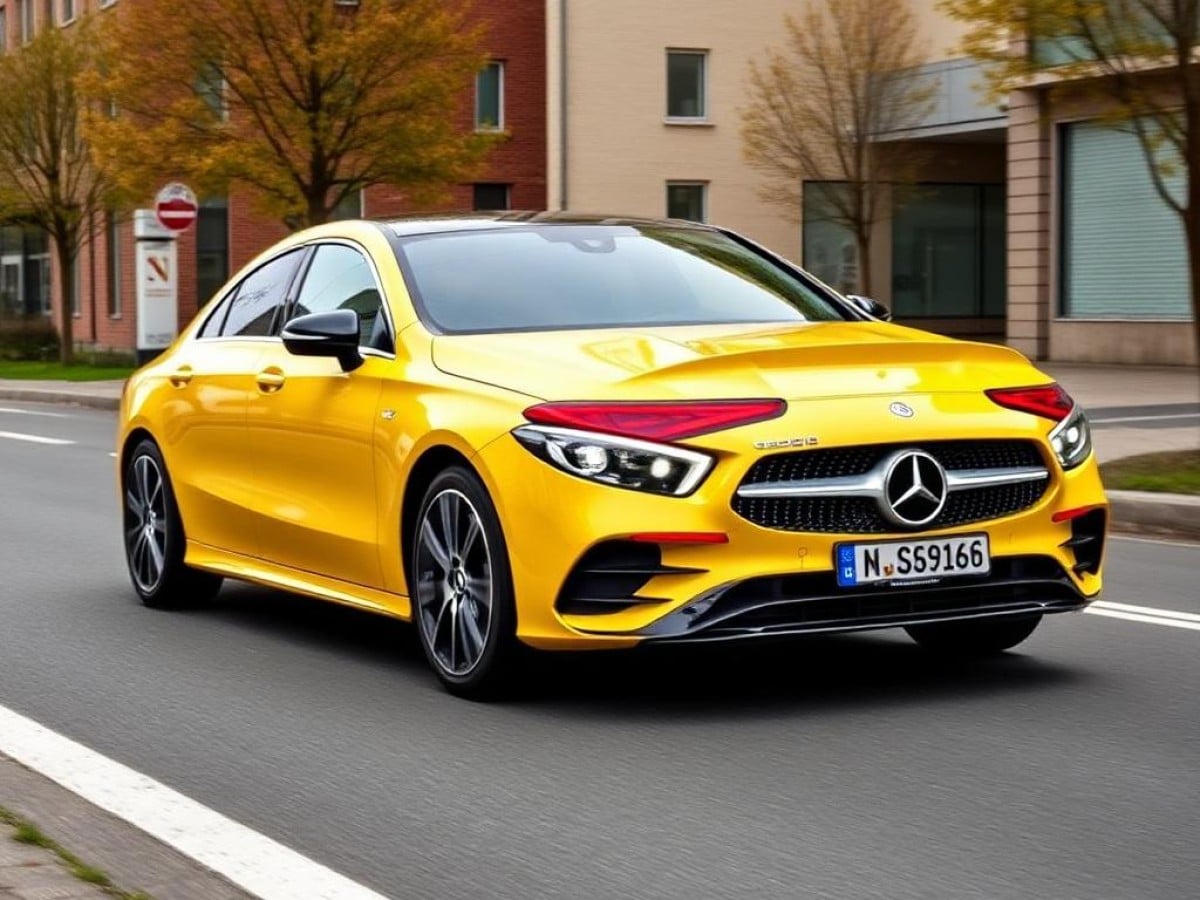
We recently had the opportunity to test the new electric Mercedes CLA. This third generation introduces a plethora of innovations, notably being the first to offer a fully electric version that nearly reaches 800 km of range. Here are our initial thoughts.
Scientists confirm: This is the most effective way to get your cat’s attention, according to new research
Elderly Couple Refuses Reserved Seats—Viral Train Standoff Sparks Fiery Debate on Courtesy
Introducing the Third-Generation Mercedes-Benz CLA
Mercedes-Benz has unveiled a fresh take on the sedan with its third-generation CLA. This marks the first CLA to feature electric options, namely the 250+ and the 350 4MATIC. We had the chance to experience the CLA Shooting Brake, and here we present a detailed review of the sedan version.
This model represents more than just an evolution in style or technology; it showcases a mastery of software, energy efficiency, and a proactive approach to the expectations of Mercedes’ accessible premium segment.
The Mercedes CLA sets several firsts for the brand: it’s the first electric car to use so little energy, the first to launch on the new MMA platform, the first to debut the new MB.OS system, the first to introduce an all-electric estate in the German automaker’s lineup, and the first electric vehicle at Mercedes to feature a gearbox.
For those not yet ready to switch fully to electric, Mercedes plans to also launch three hybrid engines by the end of 2025.
We drove this new all-electric model around Copenhagen, testing it on a mix of city roads, fast tracks, and local roads.
Specifications of the Mercedes-Benz CLA
| Model | Mercedes-Benz CLA |
|---|---|
| Dimensions | 4.83 m x 1.85 m x 1.47 m |
| Power (hp) | 272 hp |
| 0 to 100km/h | 6.7 s |
| Autonomy Level | Semi-autonomous driving (level 2) |
| Max Speed | 210 km/h |
| Main Screen Size | 14 inches |
| Car Side Socket | Type 2 Combo (CCS) |
| Entry-level Price | 52,900 euros |
|
Try it |
Product Sheet |
This review was conducted during a press trip organized by Mercedes France.
Design: A Bold Sedan
Marketed as a four-door fastback, the new CLA sharply contrasts the blandness often attributed to compact sedans. Unlike the compact Class A sedan, the CLA belongs to the midsize sedan segment, akin to the Tesla Model 3.
The profile is streamlined and taut, mounted on large wheels ranging from 17 to 19 inches. The hood extends over a solid grille for our electric version. The smoothly sloping roofline transitions into a steeply angled tailgate, creating a mini-GT silhouette.
However, not all elements are universally acclaimed. In an attempt to overdeliver, Mercedes incorporates questionable embellishments, such as the “fake” grille embedded with 142 chrome (and optionally backlit) stars, bordering on kitsch. This feature might find favor in China or other markets.
The rear LED strip, dotted in appearance, disrupts the visual width perception of the vehicle. The rear seems somewhat cumbersome despite well-defined muscular shoulders. Nevertheless, it remains a bold, more expressive proposition than a Tesla Model 3 or a Polestar 2.
Regardless, the design will certainly stand out. With the right finish and paint, the result is a coherent blend of sportiness and luxury.
Interior: Premium Comfort, Compact Design
The cabin embodies a new digital luxury vision for Mercedes. Optionally available at 950 euros, the “Superscreen” consists of three screens merged behind a glass surface, seamlessly integrating into a very horizontal, airy dashboard adorned with quality materials and subtle LED lighting effects.
Unfortunately, without the third screen option, there’s a horizontal plastic surface embedded with stars.
Mercedes aims to visually lighten the setup, featuring a suspended central console and door handles shaped like audio equipment tubes. Padded plastics aren’t used throughout, and the quality fluctuates across the cabin. Notably, the absence of grip handles points to cost-cutting measures.
The front space is ample: the seats provide good support, adjustments are precise, and the standard panoramic roof offers pleasant lighting.
In the back, legroom is quite decent even for an adult of 1.84 m, with about 10 cm in front of the knees, and feet can slide under the front seats. However, headroom is limited due to the sloping roofline, slightly compromising comfort for taller individuals.
The Shooting Brake model addresses this issue. Regarding modularity, the setup includes a 60/40 split back seat, with a rear trunk offering 405 liters of space, complemented by a 101-liter frunk (front trunk). This is a significant advantage for a sedan, increasingly common in electric vehicles. Thermal versions do not have this feature, as that space accommodates the gasoline engine.
Infotainment: Improved, Yet Room for Enhancement
The CLA debuts the new MB.OS system, introducing the fourth generation of MBUX, which aims to be more intuitive, personalized, and capable of evolving through OTA updates (including driving aids and motorization).
Mercedes integrates several AI technologies as ChatGPT, Google Gemini, and Microsoft Bing are included in the “Hey Mercedes” voice assistant, capable of handling complex requests with some empathy.
The voice assistant is particularly useful for navigation (powered by Google Maps data), helping to avoid managing the central screen while driving.
The base interface allows quick access to key functions with a smartphone-like logic (swipe actions, customizable folders, etc.), ensuring smooth operation.
The head-up display adds a practical touch, although the customizable instrument cluster behind the steering wheel is well-designed.
Entertainment options are robust: audio streaming (Tidal, Spotify, etc.), video streaming (YouTube, Ridevu, Disney+), casual gaming (such as Angry Birds), and soon Boosteroid for playing AAA console games with a Bluetooth controller. However, some notable absences include Apple TV and Netflix, and YouTube is merely a web app.
The passenger screen allows watching a movie or playing games during a trip with a Bluetooth headset. Yet, some features are missing: no camping mode, no dog mode, no app store.
Compared to Tesla, Smart (50% owned by Mercedes with Geely), or Xiaomi, Mercedes lags slightly in the software ecosystem, and it’s hoped that OTA updates will address these gaps throughout the car’s lifecycle.
Driving Aids: Nearly Flawless
The MB.DRIVE system offers all the expected features of modern level 2 semi-autonomous driving: intelligent adaptive cruise control, lane centering, assisted overtaking with indicators, autonomous parking, and 360° cameras.
The system operates smoothly, with discreet alerts and good fluidity. The collaborative driving feature (allowing room for a motorcyclist to pass, for example) is a notable absence in Tesla’s offerings.
However, a minor drawback is the visualization of the wheels: unlike Smart or Xpeng, it’s impossible to precisely control their position to avoid curbs by the centimeter.
Route Planner: Google Maps to the Rescue
Enhanced with vehicle data, the route planner based on Google Maps excels, maintaining Mercedes’ proprietary interface.
It accounts for topography, temperature, available charging stations (and their power), battery status, driving style, and plans preconditioning of charging to ensure the battery is at the optimal temperature.
It’s possible to set the desired battery percentage upon arrival at the destination and at charging stations, optimizing charging times on long trips.
We simulated a 1,237 km journey from Copenhagen to Paris. The result seemed reliable, with only two stops of 22 and 24 minutes, the first after 5.5 hours of driving! This vehicle should appeal to frequent long-distance drivers.
Driving: Comfort Showcased, Dynamism Optional
The rear-wheel-drive CLA 250+ surprised us with its driving pleasure. It delivers 200 kW (272 hp) of power with 335 Nm of torque, ample for quick accelerations. It achieves 0 to 100 km/h in 6.7 seconds with a top speed of 210 km/h.
The car is quiet, well-dampened, and effectively filters road imperfections. The steering remains precise, though not overly sporty. The brake pedal feels progressive, offering good sensation and seamless management of regenerative braking.
The two-speed gearbox is noticeable: shifting up around 110 km/h and downshifting near 90 km/h. This lowers RPM at high speeds, reducing consumption, but limits torque in second gear. At this point, the car’s weight (2,055 kg) is felt, diminishing its dynamism.
The 350 4MATIC version with dual motors (260 kW or 353 hp and 515 Nm) should offer more sprightliness. Acceleration improves significantly, with a 0 to 100 km/h time of 4.9 seconds, while the top speed remains capped at 210 km/h.
Four levels of one-pedal driving are available. The Auto mode anticipates decelerations using GPS and cameras, offering very natural driving. For instance, if you approach a roundabout and release the accelerator, you’ll experience regenerative braking. Conversely, if you release the accelerator in the middle of a straight road, you’ll coast freely. This feature is highly enjoyable, akin to Porsche’s system.
The braking system employs an electro-hydraulic one-box setup capable of recovering up to 200 kW of energy. This is a relatively high power level, which is beneficial for reducing the use of brake pads.
Range, Battery, and Charging: Exemplary Efficiency
With a theoretical range of up to 792 km on the mixed WLTP cycle, the CLA 250+ boasts remarkable efficiency with its 800-volt architecture.
Our observed consumption of 14.2 kWh/100 km over 300 mixed kilometers confirms a real-world range of 580 to 600 km, which is substantial. On highways, we estimate the range at about 500 km, which is still impressive.
The 85 kWh battery uses NMC (nickel-manganese-cobalt) chemistry with silicon anodes, enhancing capacity by 20% for the same volume compared to the previous generation. Mercedes claims a motor-to-wheels efficiency of 93%, aided by the 800-volt architecture and the use of silicon carbide.
DC fast charging peaks at 320 kW, allowing a 10 to 80% charge in 22 minutes, regaining 325 km of WLTP range in just 10 minutes.
This outperforms Tesla, which achieves a 10 to 80% charge in 25 to 35 minutes on the Model 3, recovering 282 km in 15 minutes.
However, initial versions are not compatible with 400-volt chargers (such as Tesla Superchargers). An adapter will be optionally available starting in early 2026, but it cannot be retrofitted.
Nevertheless, first-time buyers need not worry: the vast majority of fast-charging stations now operate at 800 volts, except for the Tesla network. While Tesla Superchargers are sometimes beneficial due to their nearly unbeatable kWh pricing, their absence is not a significant loss.
A smaller 58 kWh LFP (lithium-iron-phosphate) battery version, offering an estimated 550 km WLTP range, will be launched at the end of 2025 to lower the entry price.
Pricing, Availability, and Competition
Starting at €52,900, the CLA (already available for order) squarely targets the premium segment. However, numerous and costly options—paint, wheels, upholstery, head-up display, passenger screen, advanced driving aids—can push the price beyond €70,000.
Fortunately, the “Limited Edition” offers included equipment for an effective savings of €5,350. This edition starts at €52,900 but is only available until the end of 2025. Afterwards, a comparable model in the lineup will likely start around €58,000.
In comparison, the Tesla Model 3 remains a benchmark (up to 702 km WLTP from €39,990). The Polestar 2 provides a more understated Scandinavian alternative (up to 659 km WLTP from €44,900). The BMW i4 offers more power but is also more substantial (up to 500 km WLTP from €57,850). The well-equipped BYD Seal (up to 570 km WLTP from €46,990) offers excellent value for money but lacks the Mercedes cachet.
If you prefer an SUV over a sedan, Mercedes offers two options: the CLA Shooting Brake, which we enjoyed for its format, and the upcoming GLA and GLB models, which will utilize the CLA’s MMA platform.
For a more affordable entry price, wait for the smaller 58 kWh battery. We estimate the starting price around €47,000. With some luck, it might qualify for an ecological bonus in France.
Additionally, hybrid versions (with engines produced in China by Aurobay, a joint venture between Geely and Renault) are expected to be even more budget-friendly. These models should be available for order by the end of 2025.
Similar Posts
- Mercedes-Benz CLA Shooting Brake Review: Discover the Ultimate in Style and Performance!
- Tested: The Electric Mercedes GLB Makes Family Vacation Departures a Breeze!
- Tested: New Mercedes CLA Shooting Brake – Stunning Electric Wagon, Nearly Perfect But Flawed!
- I Drove 600 km in a Mercedes-Benz CLA: An Electric Car Journey Without Stress
- XPeng P7+ Review: This Chinese Electric Car Charges Twice as Fast as a Tesla Model 3!

Maya Singh is a senior editor covering tablets and hybrid devices. Her work explores how these tools reshape digital productivity and learning. She also contributes to feature editorials on emerging tech.