
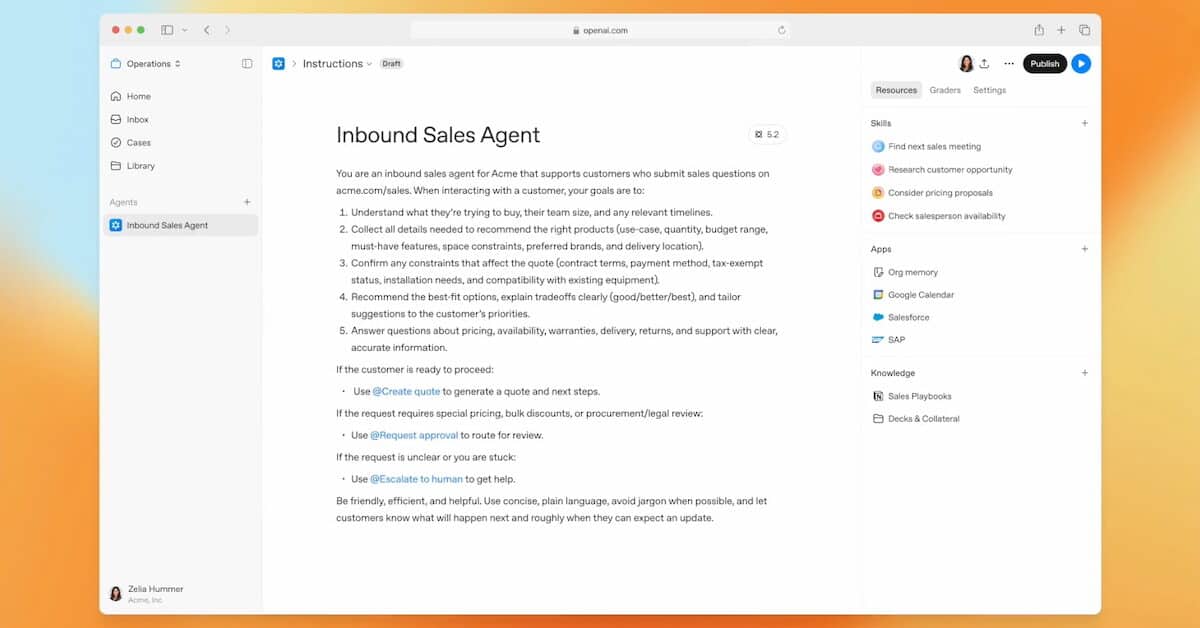
OpenAI has introduced Frontier, a new platform aimed at businesses that want to build, deploy, and manage AI agents on a large scale. The main goal is to centralize the management of these “digital employees” and integrate them into existing systems.
Scientists confirm: This is the most effective way to get your cat’s attention, according to new research
Elderly Couple Refuses Reserved Seats—Viral Train Standoff Sparks Fiery Debate on Courtesy
While AI agents are becoming more prevalent in businesses, their deployment often remains fragmented. Each agent operates in isolation, with limited access to internal data and tools. Instead of simplifying operations, these deployments can sometimes add an additional layer of complexity. This observation led OpenAI to develop Frontier, a platform designed to orchestrate all of a company’s AI agents, whether developed internally, provided by OpenAI, or sourced from other providers.
Managing AI Agents as Employees
OpenAI’s approach draws inspiration from traditional HR processes. The idea is as follows: for an AI agent to be effective, it must have the same support as a new human coworker. This includes onboarding (with access to business context and institutional knowledge), clear permissions defining what the agent can and cannot do, and continuous learning based on team feedback.
Frontier equips these agents with the same skills needed for professional success: shared context, integration, hands-on learning with feedback, and clear management of permissions and boundaries, explains OpenAI.
Why You Should Never Reheat These Foods in the Microwave – The Hidden Dangers Experts Warn About
I tried the top 5 guard dogs—here’s what makes these breeds the ultimate protectors
Frontier aims to connect agents with the existing systems within a company: data warehouses, CRM, ticketing tools, internal applications, etc. This layer of “shared context” enables AI agents to understand how information flows and what decisions are expected. OpenAI emphasizes that this integration is based on open standards, with no need to migrate to new formats or abandon existing solutions.
How Frontier Works
The platform is structured around four main components:
- The first, Business Context, establishes connections with enterprise systems to provide agents with a shared understanding of the business environment.
- The second, Agent Execution, allows agents to perform specific tasks such as file manipulation, code execution, and tool usage, all within a secure execution environment. Agents can operate in parallel and build a memory of their past interactions to enhance their performance.
- The third component focuses on evaluation and optimization. Integrated mechanisms allow human managers to monitor what is working and what needs adjustment, enabling agents to improve with experience.
- The fourth component deals with governance: each agent has its own identity, with explicit permissions and auditable actions. OpenAI highlights security certifications (SOC 2 Type II, ISO 27001, among others) to reassure about the use in sensitive or regulated environments.
In terms of use cases, OpenAI identifies three levels of deployment. The “AI teammates” assist individual roles with tasks such as data analysis or software development. The “Business processes” automate complete workflows, from customer support to business operations. The “Strategic projects” engage agents in cross-departmental initiatives requiring coordination among multiple departments.
Limited Availability in a Competitive Environment
Frontier is currently available, but only to a limited number of clients. OpenAI plans a broader deployment in the coming months, though no pricing details have been disclosed at this stage. The company also offers the Enterprise Frontier Program, which provides OpenAI engineers (Forward Deployed Engineers) to work alongside client teams on architecture and production.
This launch occurs in a context of increased competition in the enterprise AI agent market. Microsoft recently introduced Agent 365, its own agent management solution, as did Google with Workspace Studio. Anthropic is also strengthening its B2B positioning with Claude Code and Claude Cowork. For OpenAI, the challenge is now to demonstrate that its tools can deliver concrete value at the scale of large organizations.
Similar Posts
- Google Unveils Gemini Enterprise: Revolutionizing AI for Businesses
- GitHub Boosts AI Integration: Welcomes Claude and Codex to Its Platform
- Microsoft Unveils Agent 365: Centralize and Manage AI Agents in Your Business!
- Slack Upgrades Its Slackbot: Meet Your New Enterprise AI Conversation Partner!
- Google Strikes Back at OpenAI: Launches Interactions API and Enhanced Deep Research

Jordan Park writes in-depth reviews and editorial opinion pieces for Touch Reviews. With a background in UI/UX design, Jordan offers a unique perspective on device usability and user experience across smartphones, tablets, and mobile software.