

Scientists confirm: This is the most effective way to get your cat’s attention, according to new research
Elderly Couple Refuses Reserved Seats—Viral Train Standoff Sparks Fiery Debate on Courtesy
The Bowers & Wilkins Px8 was not just an expensive headset. It represented a commitment to delivering genuine, pure sound within an elegantly crafted technological package. Two years later, challenged by competitors like Focal and Bang & Olufsen, the British brand has upgraded this ultra-premium headset, building on the strengths of the well-received Px7 S3 released a few months earlier, but pushing performance to the max. What’s the outcome? Find out in this detailed review.
- Price and Availability
- Design and Controls
- Audio Quality
- Interactivity and App Features
- Battery Life and Charging
- So, Should You Buy It?
- Comments
Why You Should Never Reheat These Foods in the Microwave – The Hidden Dangers Experts Warn About
I tried the top 5 guard dogs—here’s what makes these breeds the ultimate protectors
In June 2025, we reviewed the Px7 S3, a headset developed by Bowers & Wilkins. Priced around 400 euros, this model seriously competes with several iconic headsets, including Bose’s QuietComfort Ultra, Sennheiser’s Momentum 4, and Sony’s XM6. At this price point, one might think the Px7 S3 is Bowers & Wilkins’ most expensive headset, but that’s not the case.
Also read – Review of Nothing Headphone (1): A headset that holds its own against the competition
Above the Px7 S3 is the Px8 range, and the price tag is significantly higher: over 700 euros. This range was introduced in 2023 with the original Px8 aiming to push all performance metrics to their limits, both in audio quality and design. By the end of September 2025, Bowers & Wilkins unveiled the successor to this high-end headset, simply named the Px8 S2.
Although it takes cues from the Px7 S3, the Px8 S2 maintains its focus on supreme sound quality. However, we expect more than just flawless audio from a product at this price point. What else does it offer? What’s new? All will be revealed in this comprehensive review.
Price and Availability
The recommended retail price for the Bowers & Wilkins Px8 is 729 euros, which is a 30-euro increase from its predecessor, the Px8. Importantly, the Px8 S2 crosses the symbolic 700-euro threshold. For comparison, the Px7 S3, which rivals Sony’s XM6, is priced at 429 euros—300 euros less. To justify this price difference, the Px8 S2 needs some compelling features.
The main competitors of the Px8 S2 are few. The top two are Focal’s Bathys MG and Bang & Olufsen’s Beoplay H95. The former was first released in 2022 at 799 euros, with an “MG” version launched in 2025 for 1200 euros. The latter has been available for five years, starting at approximately 800 euros (and has since increased in price). It is now joined by the Beoplay H100, which approaches 1500 euros. Just below 600 euros, you’ll find Apple’s AirPods Max at 579 euros.
The Px8 S2 was released in France at the end of September 2025. It is available in two colors: black (our review model) and white (which we tried at launch). In the box, the headset comes with a USB-C to USB-C cable, a USB-C to 3.5 mm jack cable, and a carrying case. The case, made of fabric, is identical to that of the Px7 S3; it’s high-quality but somewhat bulky in a backpack.
Design and Controls
Let’s start this review with a look at the design. The Px8 S2 retains the general ergonomics of the Px8 and Px7 S3. We’re dealing with an over-ear headset: the ear cups fully cover the ears, and the pads press against the head. The arms are adjustable, of course. Controls remain physical: buttons are distributed across both ear cups. On the left, you find the power and pairing button. On the right, volume controls and a multifunction button for ANC and playback. Simple and effective.
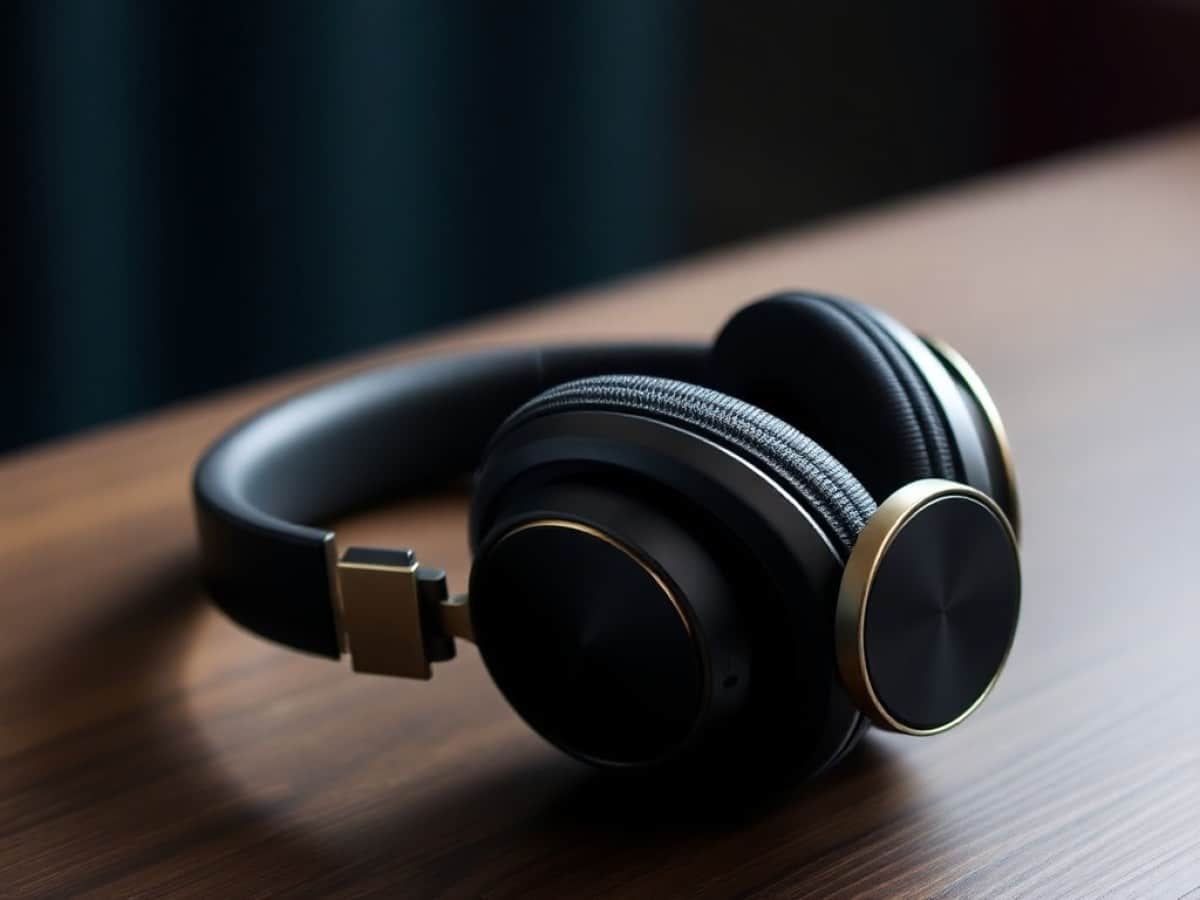
Design is one of the strong points of the Px8 S2, whether compared to its predecessors or direct competitors. The most notable feature is the new metal branches. These are hollowed out to allow the connection cable to pass through. This design element is not only visually striking but also protects the cable, which is encircled with nylon, and reduces the headset’s weight by 10 grams (to 310 grams). It’s heavier than Sony’s XM6 but lighter than Focal’s Bathys.
Like its predecessor, the Px8 S2 uses premium materials: brushed or anodized aluminum for the arms and the outer shell of the ear cups, and nappa leather for the padded foam ear pads, the headband, and part of the ear cup trim. Even the buttons are metallic, with one featuring a textured coating to make it easier to identify by touch. The fabric placed between the ear cup and the ear is very soft. Bowers & Wilkins has included some plastic elements for the grilles and trim, but these are very subtle.
The arms are, of course, articulated to perfectly adjust the headset to the head and to lay flat in the case. The Px8 S2 also benefits from the ergonomic work done on the Px7 S3. Compared to the Px8, the buttons have been repositioned for easier use, and the ear cups are less bulky.
Once on the head, the headset is very comfortable to wear, with well-balanced weight distribution. The tension of the headband is just right (neither too tight nor too loose). The feel of the nappa leather is very pleasant, though it does warm up a bit and is less breathable than a mesh fabric, like that of the AirPods Max. So be aware.
Audio Quality
We previously noted that Bowers & Wilkins reduced the thickness of the Px8 S2’s shells, similar to the Px7 S3. At the announcement, we were concerned this might negatively affect the audio quality, as reducing the shell size also reduces the volume of air available to create sound. Fortunately, this is not the case. The distinctive sound signature of Bowers & Wilkins is still very much present, and the listening experience remains delightful.
The 40 mm driver is back, featuring a carbon membrane that is both rigid and light. Bowers & Wilkins has made some physical tweaks. The membrane has been slightly redesigned. The driver has been angled closer to the ear. The magnets have been upgraded, and the suspensions are stiffer to prevent overflow. A dedicated DSP and DAC have been added. As a result, the Px8 S2 has improved precision, and the volume is well controlled.
We find all the dynamism of the British brand in the Px8 S2. The bass is still very present, but more dynamic. The highs are well detailed, sometimes a bit too powerful, bordering on sizzling. The mids are slightly recessed here to avoid overcrowding. The soundstage is wide and immersive, although some might be frustrated by the slight imbalance in the mids. Like the Px7 S3, the Px8 S2 offers a “spatial sound” option that simulates two speakers placed in front of you. A very personal interpretation of spatial audio…
The Px8 S2 supports Bluetooth 5.3 (with a range of about 10 meters). This connectivity supports the usual codecs: AAC and SBC. Thanks to its Snapdragon Sound processor, you can add the aptX suite (HD, Adaptive, and Lossless) to this list. And with a firmware update, the headset also supports LE Audio, including the LC3 codec and Auracast function. While this set is more suited to use with Android devices, the connection to an iPhone is also good.
Thanks to its USB-C port and the provided cables, you can connect the headset to a USB-C audio source for an end-to-end digital stream, or to a 3.5 mm jack source for an analog-to-digital stream. In both cases, the headset must be powered on to function: there’s no 100% passive mode, as with the XM6, for example. The downside is that the headset must be charged to be used with a 3.5 mm jack. The advantage is that the audio quality is not degraded. Bowers & Wilkins’ choice here is quite logical.
Due to its design and the materials of its ear cups, the Px8 S2 offers very good passive isolation. But the headset also benefits from active noise cancelling. The ANC is essentially the same as that of the Px7 S3, with eight microphones distributed around the shells and the driver. Most noises are muffled, but certain frequencies are not stopped to avoid affecting the audio quality. On an airplane, there is still some background noise. In an open office, some voices are sometimes perceptible. In a subway, the screeching of the wheels on the tracks remains bothersome. We are generally a notch below the AirPods Max and the XM6.
Fortunately, these new microphones also improve call quality and isolate the voice very well while reducing ambient noise. And even in a crowded environment where the user’s voice becomes very slightly metallic. Another plus.
Interactivity and App Features
To finely control the Px8 S2, you need to use the Bowers & Wilkins Music app. We’ve already tested this app with the Px7 S3 and found it quite elegant, even if it’s not the richest in features. It’s available on iOS and Android, and there’s no ergonomic difference between the two versions. And that’s a good thing.
This app relocates some of the usual headset controls, notably the activation of the ANC. You’ll also find a menu to customize the behavior of the headset’s ANC button (it can be used to call up a voice assistant, like Siri or Gemini). And the app is used to update the headset’s firmware. All this is standard.
In this app, you also find a five-band frequency equalizer to adapt the audio profile of the Px8 S2 to your tastes. This equalizer does not include pre-set profiles for musical styles, such as “Rock,” “Classical,” or “Jazz.” A pity for novices.
Like the Px7 S3, the Px8 S2 supports Google Fast Pair, for quickly connecting the headset to an Android smartphone, and can connect to two devices simultaneously (iOS, Android, macOS, etc.). However, the headset does not seem to support Swift Pair: it is therefore not possible to switch from one device to another automatically, as AirPods might between an iPhone and a MacBook, for example. To change the source, you must use the app or disable the currently used device.
The Px8 S2 is obviously equipped with a wear sensor. This sensor pauses the music when you remove the headset, to improve both its battery life and that of the paired phone. More responsive and more precise than that of the Px7 S3, the wear sensor of the Px8 S2 is not perfect either, with a few misses. You can increase or decrease the sensor’s sensitivity in the app. And you can even disable it.
Battery Life and Charging
The final part of this review is the battery. On this front, the Px8 S2 shares the specifications of the Px8 and Px7 S3. We again find a 740 mAh battery with a brand-claimed battery life of 30 hours with ANC and volume at 50%. In practice, this has proven to be quite accurate. During our tests, we measured a battery life slightly over 30 hours, noting that the volume was at 50%, the audio source used the AAC codec, and the active noise cancellation was functioning. And this was with a more energy-intensive configuration due to a new dedicated DSP.
Note that the Px8 S2 is equipped with an automatic sleep function that can be activated or deactivated from the app. It allows the headset to automatically turn off after 15 minutes of non-use. This is very useful to avoid unpleasant surprises. However, the sleep mode does not work if the wear detection is disabled and the music continues to play…
To recharge the headset, there is only one option: wired charging using the supplied USB-C cable. With a smartphone charger (like that of the P60 Pro offering 80 watts of power), we fully recharged the Px8 S2 in about two and a half hours. There’s a quick charge function that allows you to gain 7 hours of battery life (about 30% of the battery) in 15 minutes. Lastly, you can listen to music while charging the Px8 S2.
So, Should You Buy It?
The Px8 S2 is an “extraordinary” headset in every sense of the word. First, it offers a precise and high-quality audio experience, suitable for all types of listening. The bass is very present (perhaps too much for some). The highs are sparkling and detailed, without being sizzling. The soundstage is wide. And the overall performance is very dynamic. Then, the construction is stunning, with its hollowed-out branches allowing the cable to pass between the two transducers. Finally, the battery life remains very good, despite the integration of more energy-consuming technical elements.
Of course, the Px8 S2 is not flawless. Somewhat heavy. Not very breathable. Not always very comprehensive in terms of interactivity (no Swift Pair, for example). At its price, we are indeed more demanding. While the Px8 S2 is technically and visually superior to the Px7 S3, the price difference is not entirely justified. It’s a bit like the garments from a high-end designer.
-
Fnac729€
-
Darty729€
- Nacon’s RIG R5 Pro HS Review: A Top-Tier PlayStation Headset for Gamers!
- Bowers & Wilkins Px8 S2 Review: British Luxury Meets Tech Innovation in This Headset!
- Logitech G522 LightSpeed Review: Experience Comfort and Superior Sound Quality!
- PS5 Wireless Headset Under €100 Tested: Is It a Steal?
- HyperX Cloud Jet Dual Wireless Review: Affordable Gaming Headset Impresses!
Categories
Latest Articles