
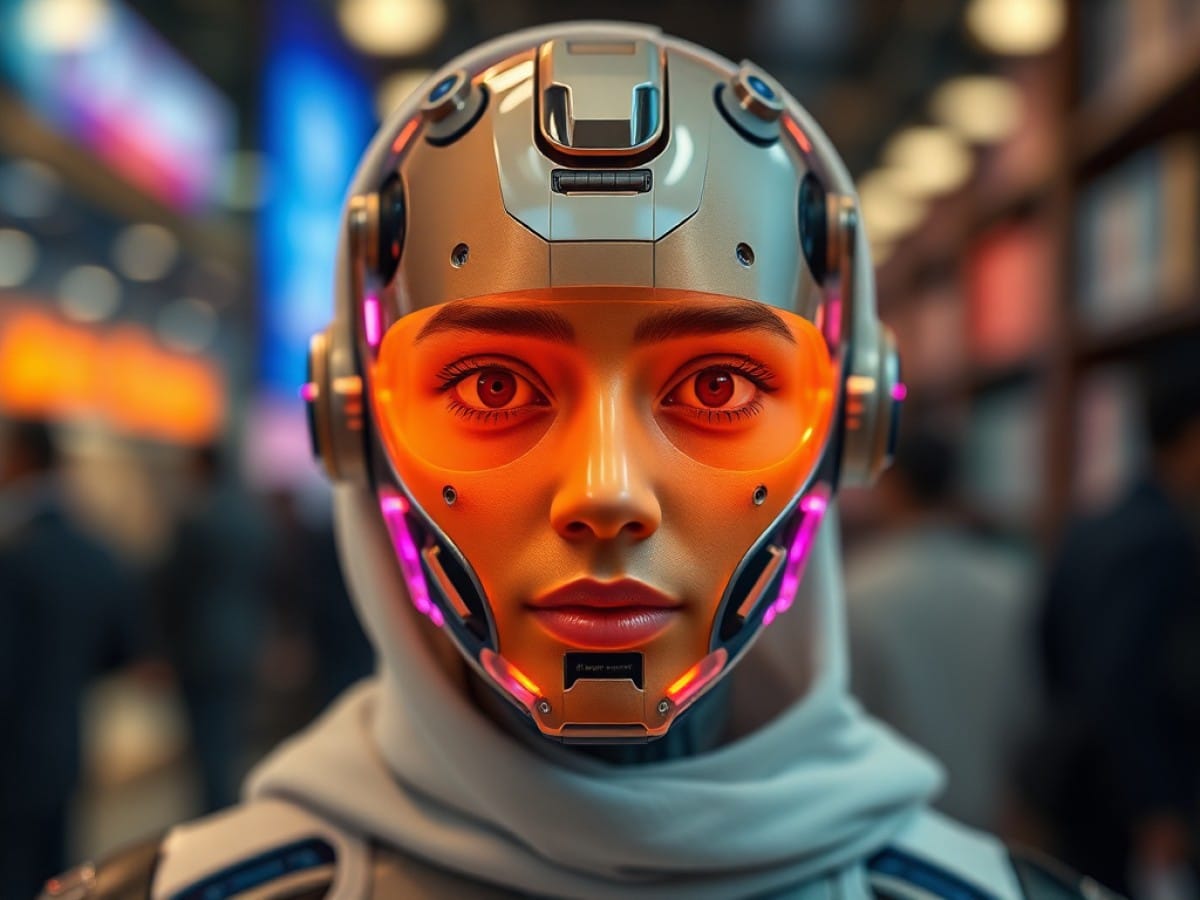
Artificial Intelligence (AI) is more than just a technological advancement; it is reshaping global power dynamics. Political scientist Asma Mhalla discusses these issues and how tech leaders can respond.
Scientists confirm: This is the most effective way to get your cat’s attention, according to new research
Elderly Couple Refuses Reserved Seats—Viral Train Standoff Sparks Fiery Debate on Courtesy
What lies behind the recent hype, or even “hysteria,” as termed by Asma Mhalla, a political scientist specializing in Tech Policy, surrounding artificial intelligence? What geopolitical stakes are emerging with the rise of these technologies?
“AI is a term thrown around like a block, very intimidating… and it prevents thinking,” states Mhalla, who reminds us that since its coinage in 1956, the term has been used as a “pitch concept” designed to attract funding. This original ambiguity around a field that was initially interdisciplinary and fundamental explains the current confusion around a sector that is much broader than its name suggests.
Demystifying the Magic
Why You Should Never Reheat These Foods in the Microwave – The Hidden Dangers Experts Warn About
I tried the top 5 guard dogs—here’s what makes these breeds the ultimate protectors
Mhalla immediately emphasizes the diversity of technologies grouped under the term AI. “There isn’t one AI; there are plural algorithmic systems.” Recommendation, biometrics, generative, predictive… each category involves different political and industrial challenges. Despite the recurring narratives of breakthroughs since Deep Blue or DeepMind, she notes: “Every ten years, they announce the end of everything…”
For her, one of the main misunderstandings about AI stems from how it is portrayed. Media focus is often on the most visible applications, like ChatGPT, Claude, etc., but these are just the latest links in a heavy industrial chain. She points out that the explosion of ChatGPT is primarily a result of massive adoption: “The breakthrough with ChatGPT is a usage breakthrough, not a technical one.” The models, in fact, had existed for several years.
She then lays out an AI roadmap rarely shown to the public: uses, applications, models, talent, chips. Each level is a strategic battleground. The upcoming introduction of the Chinese model DeepSeek in early 2025 exemplifies this dynamic: “You have two models, with ChatGPT, relatively equivalent.” The competition is as much about strategy (closed or open-source, frugal or not) as about political posturing.
The Invisible Chains of AI
Tracing the value chain, Mhalla explains, helps understand where the real power dynamics lie. In the realm of models, there are patent battles. Regarding talent, she is definitive: “Attracting brains is geopolitical.” The movement of researchers between OpenAI and Meta is indicative, as is the brain drain affecting Europe despite its high-quality scientific education.
Further up the chain, the battle shifts to semiconductors. Again, Mhalla challenges simplistic views: “Chip, that means nothing.” GPU, TPU, levels of refinement… the dependencies vary, but their strategic importance is the same. This is where big tech and nations directly clash, with the United States, for example, under Joe Biden, attempting to relocate part of the semiconductor production from TSMC in Taiwan to Arizona, in response to Chinese aggression in the region.
US/China: A Clash of Visions
The technological duel between Washington and Beijing is just the tip of a deeper confrontation. “What is at play here are strategies of empire,” describes Mhalla. The United States is trying to maintain its technological leadership, while China seeks to redefine the world order. Donald Trump, despite his style, is seen by her as continuing a legacy of American power: “He continues the American pursuit of power.”
In this landscape, AI takes on a crucial military importance. Superiority is no longer just about weapons but about speed and responsiveness: collection, analysis, reaction. “Here, AI is not seen as a magical instrument, but as a process of acceleration.” On a battlefield, she says, “data only has value if its possessor can capitalize on it quickly,” meaning the speed of action.
Europe: A Reluctant Power?
Where does Europe stand in this scenario? Mhalla notes a “defensive normative sovereignty.” DSA, DMA, AI Act are regulations that frame big tech but do not make up for the lack of a structured industrial strategy. She also dismantles a frequent false dilemma: “Without regulation, you end up with oligopolistic actors,” meaning a market dominated by a few players effectively exempt from competition rules.
The issue, according to her, is that Europe is still seen just as a market. “For the United States, Europe is a zone of influence. A market.” The episode of the trade agreement signed last summer by the EU and Ursula von der Leyen, immediately followed by a direct threat from Donald Trump, illustrates this power dynamic. She summarizes the situation: “We have no industrial strategy.” For true sovereignty, Europe should identify priority sectors and invest with a “30-year vision.”
A Message to Companies: “A Technical Choice Is a Geopolitical Choice”
The conclusion is directed at participants at the Tech.Rocks Summit, where Asma Mhalla’s conference took place: CTOs, tech leaders, product and data managers. “The technical choices you make are geopolitical choices.” The question isn’t about being pro-American or pro-Chinese, but about ensuring strategic continuity. She offers simple advice: “What’s my plan B? What’s my redundancy solution when I no longer have access to American or Chinese technologies?”
According to Mhalla, power has shifted: “Power has moved from the public… It’s in your hands.” Companies, through the technological architectures they choose to adopt or reject, become direct actors in sovereignty. It’s a role they must now be aware of.
Similar Posts
- James Kynge : “If it want to, China could impact American and Western lifestyles like we never seen before”
- Digital Sovereignty: Can Europe Break Free from US Tech Dominance?
- Foxconn Invests $1.5 Billion in India: Trump Threatens 25% Tariff on Apple Products
- TikTok Update: Donald Trump Reveals Potential Buyers’ Names
- EU Bends to US Pressure: GDPR and AI Act Regulations Relaxed

Jordan Park writes in-depth reviews and editorial opinion pieces for Touch Reviews. With a background in UI/UX design, Jordan offers a unique perspective on device usability and user experience across smartphones, tablets, and mobile software.