
Scientists confirm: This is the most effective way to get your cat’s attention, according to new research
Elderly Couple Refuses Reserved Seats—Viral Train Standoff Sparks Fiery Debate on Courtesy
Some of you might already be familiar with Genesis, though perhaps without knowing much about it. And that’s perfectly fine. Although the company was established in 2015 and has been selling cars in its home country and the US, it hasn’t been widely available in Europe. Until recently, only three countries in Europe – the United Kingdom, Germany, and Switzerland – had access to Genesis since 2021. France, however, was not among these markets until now.
In February, Hyundai’s premium division finally launched in France, bringing with it three electric models. Among these are two SUVs and a sedan, named GV60, GV70 Electrified, and Electrified G80, respectively. We had the opportunity to explore all three models, which directly compete with established brands like Tesla, Mercedes, Audi, and BMW.
After a preliminary look at the GV60, we took it for a spin. This compact SUV, positioned as the entry-level model of the brand, boasts impressive features on paper. But how does it perform on the road? We spent several days driving the GV60 and here’s our detailed review below!
Specifications
| Model | Genesis GV60 |
|---|---|
| Dimensions | 4.54 m x 1.89 m x 1.58 m |
| Power (HP) | 318 HP |
| 0 to 100km/h | 5.5 s |
| Autonomy Level | Semi-autonomous driving (level 2) |
| Max Speed | 200 km/h |
| Main Screen Size | 27 inches |
| Car Side Socket | Type 2 Combo (CCS) |
|
Try it |
Product sheet |
Design: Sleek yet Distinctive
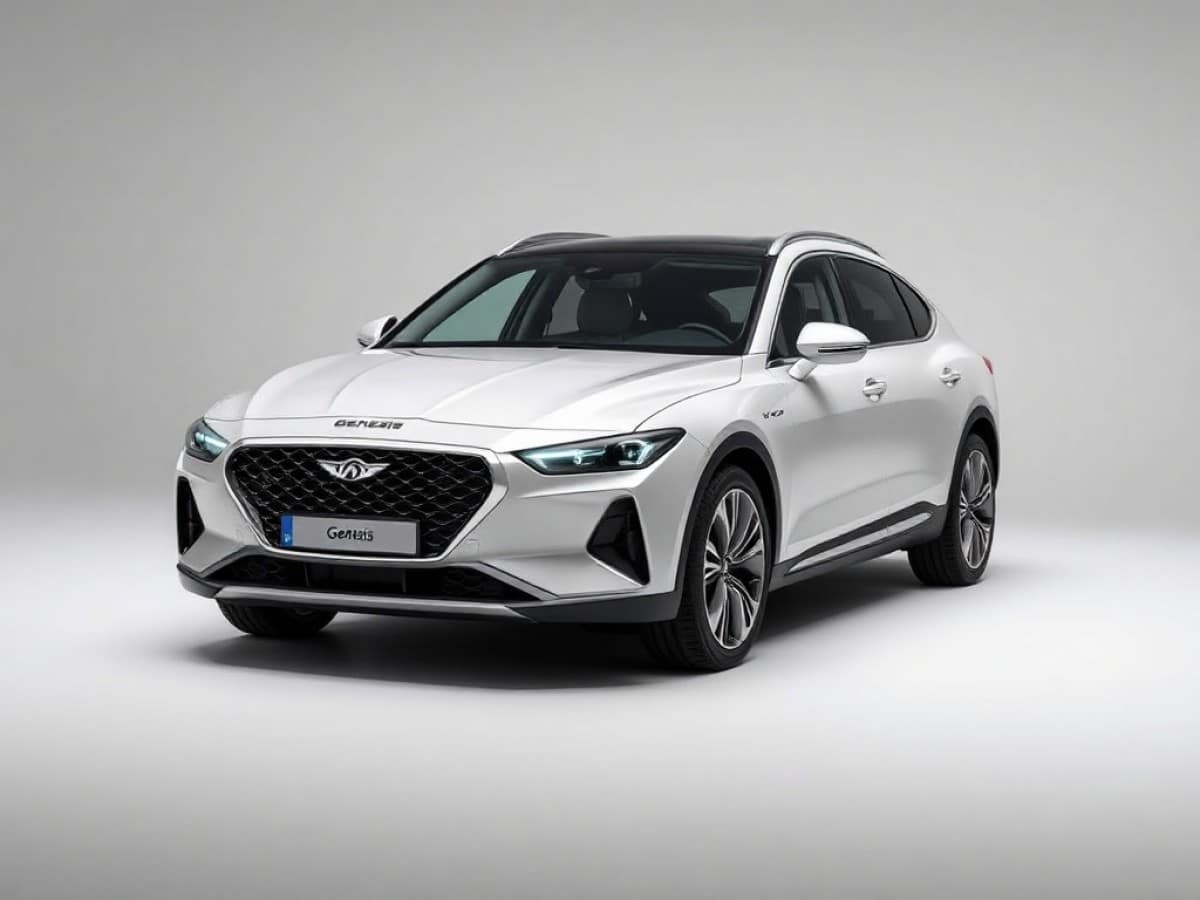
The Genesis GV60, serving as the entry point for the brand in Europe, has been available in its home market since 2021. The electric SUV retains its design unchanged from the Asian model.
The vehicle features a rounded silhouette with notably sleek lines, especially visible at the front with a closed grille designed to optimize aerodynamics, despite a drag coefficient of 0.28 – some competitors like the Tesla Model Y boast a lower 0.23.
There’s also an open bumper complemented by air intakes on each side. Above these, the car displays a two-tier light signature that is instantly recognizable. A unique aspect is the “shell” hood design which integrates the fenders, visually lightening the profile which is already quite minimalistic.
The back is a fastback type, characterized by a steeply sloping roof and rear window. The compact dimensions, at 4.55 meters long, allow it to directly compete with the likes of BMW iX1 and Audi Q4 e-tron, among others. It offers a choice of wheel sizes from 19 to 21 inches and ten body colors.
Despite its SUV classification, the Genesis GV60 has a ground clearance of just 16 centimeters and skips lateral body protection for a cleaner look. The rear continues the double light theme from the front as a signature element, complemented by a small black lacquered spoiler and similarly treated bumper.
Spaciousness: Ample Room and Premium Features
Stepping inside the Genesis GV60, it’s clear that it aims for a high-end market position, as expected from Hyundai’s luxury division.
The cockpit is accessible via fingerprint recognition—a novel feature in the automotive world. Once inside, a high-tech setup greets the driver, which we’ll detail further below.
The brand has deliberately avoided an all-touch interface, a welcome move as physical buttons make a comeback. The cockpit is intuitive and ergonomically designed, with actual buttons for air conditioning and other functions. But the real surprise comes with the vehicle’s high-quality finishes. Depending on the trim, you can opt between vegan leather and Nappa upholstery. During our test, we experienced black synthetic upholstery paired with a multifunction leather steering wheel.
The generous wheelbase of 2.90 meters provides ample legroom, though headroom might be tight for taller individuals.
The rear bench is comfortable, with door-mounted cup holders. A panoramic glass roof enhances cabin brightness, while the seats are electrically adjustable, heated, and ventilated.
The trunk space is average for its segment at 432 liters, expandable to 1,460 liters with the rear seats down. There’s also a frunk in the front offering an additional 53 liters of space.
Infotainment: An Impressive Offering
Let’s delve into the infotainment system and onboard technology of the Genesis GV60. The large OLED touchscreen is particularly striking, boasting a 27-inch diagonal. Unlike many other automakers, the screen is a single piece and differs from Hyundai’s typical layout.
The graphics are simple and modern, with a clean but user-friendly interface. The system is highly responsive, taking only minutes to become familiar with, organized into customizable widgets for easy access to various functions.
The car includes integrated route planning and supports wireless Apple CarPlay and Android Auto. Additionally, vehicle startup is enabled through facial and fingerprint recognition—another first.
Updates are delivered OTA (over the air), ensuring the latest features are always available. The Genesis GV60 also features a digital instrument cluster seamlessly integrated with the touchscreen display.
This display is clear and provides essential information such as speed and remaining range. It is paired with a head-up display available only on the top-tier Luxury trim, which was not included in our test vehicle.
Passengers also benefit from USB-C ports at both the front and rear, along with an inductive smartphone charging pad on the central console.
Driving Aids: Comprehensive from the Start
The Genesis GV60 promises a premium experience, evident in its extensive array of technology. Even the base Pure trim is well-equipped.
All models include driving aids mandated by the European GSR2 standard, effective from July 2024. These include traffic sign recognition, speed limit alerts, and lane-keeping assistance, among others.
While some aids can be intrusive, the latter two can be easily disabled with a button on the steering wheel—a feature also found in Hyundai and Kia vehicles. When the turn signal is activated, the blind-spot view is displayed on the digital cluster. The car comes standard with a comprehensive suite of additional aids.
These include active blind-spot intervention and collision avoidance assist. Moreover, the SUV features level 2 semi-autonomous driving, dubbed “highway driving assistant.” The top Luxury trim offers an even more advanced system. Overall, the system performs well on highways.
The vehicle also includes a driver-facing camera, front and rear parking sensors, and a rear-view camera as standard. The 360-degree vision, however, is reserved for the Luxury trim without extra cost.
Optional packs add features like Micro Lens Array (MLA) headlight technology and remote active parking assistance.
Driving Experience: Versatile and Balanced
The Genesis GV60 is built on the well-established E-GMP platform, used across Hyundai and Kia’s electric lineup, from the Ioniq 5 to the EV6 and the new EV2.
The SUV is available in multiple configurations, with power ranging from 229 to 490 horsepower. We tested the mid-range Premium all-wheel drive variant.
This version features two electric motors, delivering 100 and 218 horsepower respectively, for a total torque of 605 Nm. It accelerates from 0 to 100 km/h in 5.5 seconds in Boost mode, reaching a top speed of 200 km/h.
While not expressly sporty, the SUV is surprisingly dynamic, especially in our test model with adaptive suspension. This system adjusts to the selected driving mode, significantly affecting the ride.
The steering provides just the right amount of feedback, and the vehicle handles curves well. Despite weighing 2.18 tonnes, its handling isn’t overly cumbersome thanks to the low ground clearance and the battery positioned in the floor, lowering the center of gravity. The body roll is well controlled, though still present. The Genesis GV60 is primarily tuned for comfort, which is especially noticeable on speed bumps and in urban settings.
The vehicle is versatile and exceptionally well-rounded. Furthermore, soundproofing is meticulously engineered to reduce both air and road noise. An optional active road noise reduction system is also available. However, the turning radius is somewhat large, which may hinder some urban maneuvers.
Range, Battery, and Charging: Exceptionally Fast Charging
While the Genesis GV60 offers a range of power options, the battery choices are more limited. Currently, there is only one available, with a capacity of 84 kWh, regardless of the trim level. This provides a range of between 501 and 561 kilometers on the mixed WLTP cycle, depending on the version.
Our all-wheel-drive Premium model achieves 512 kilometers per the WLTP cycle, extending up to 696 kilometers in purely urban use.
However, consumption is relatively high, averaging around 22 kWh/100 kilometers during our tests, despite primarily urban driving with some highway travel. The manufacturer’s official average is 16.7 kWh/100 km.
Fortunately, the SUV is equipped with regenerative braking, complete with steering wheel paddles, and features one-pedal driving that can bring the vehicle to a complete stop. But where the car truly excels is in charging capability. Thanks to its 800-volt architecture—common in high-end models—the GV60 can charge from 10 to 80% in just 18 minutes using direct current, at a maximum power of 350 kW.
Our test model also supports optional bidirectional charging (V2L), allowing it to power external electrical devices directly from the charging port. Lastly, alternating current charging is capped at 11 kW, requiring 7 hours and 35 minutes on a home wallbox.
Price, Competition, and Availability
It’s good news for potential buyers: the pricing for the Genesis GV60 has just been announced. The electric SUV starts at 54,200 euros in France, which excludes it from the CEE bonus due to its assembly in South Korea.
Our test model primarily competes with the BMW iX1, starting at 46,990 euros (before bonuses for a 516-kilometer WLTP range and 204 HP), the Audi Q4 e-tron (from 46,990 euros for a 568-kilometer WLTP range and 285 HP), and the Volvo EX40 (from 46,950 euros for a 477-kilometer WLTP range and 238 HP).
Of course, the Tesla Model Y must also be mentioned, despite its more advantageous pricing. The American SUV starts from 39,990 euros in its Propulsion version, with a 534-kilometer WLTP range, but lacks the premium pedigree of the Genesis.
Last but not least, the Xpeng G6 could also be a competitor for the GV60. It starts at 42,990 euros in its RWD Standard Range version, offering a 470-kilometer range and up to 250 horsepower from a single rear axle motor.
Similar Posts
- Exploring the Genesis GV60: Why This Electric SUV is a Must-See as It Hits France!
- Genesis Electrified GV70 Reviewed: Why It May Struggle Against German Rivals
- Discover the Polestar 4 Electric: A Game-Changing Car Missing One Key Feature!
- Skoda Epiq Review: Discover Volkswagen’s Most Affordable SUV Starting at €25,000!
- Dacia Spring Review: Is France’s Cheapest Electric Car Still Overpriced?

Maya Singh is a senior editor covering tablets and hybrid devices. Her work explores how these tools reshape digital productivity and learning. She also contributes to feature editorials on emerging tech.