
Scientists confirm: This is the most effective way to get your cat’s attention, according to new research
Elderly Couple Refuses Reserved Seats—Viral Train Standoff Sparks Fiery Debate on Courtesy
In 2024 and 2025, Sony made a notable comeback in the party speaker market with the massive ULT Tower 9 and Tower 10 models—impressive systems that are not very convenient to haul around for an impromptu gathering.
In September 2026 the Japanese brand expanded the range with three redesigned models: the ULT Tower 5, ULT Tower 7 and ULT Tower Max. With these additions, Sony aims to regain ground in the highly competitive Bluetooth party speaker segment.
To stand out from rivals (notably JBL), Sony has chosen an acoustic layout built around a single large woofer instead of two medium-sized drivers. A larger diaphragm moves more air and delivers bass you can feel, which is crucial for party-focused speakers.
The Tower 5 differs from its excellent sibling, the Tower 7, by adopting a two-way architecture rather than a three-way system. It also drops the 360° dispersion since it lacks rear-facing tweeters, yet it still offers attractive lighting effects and surprisingly powerful sound.
Sony ULT Tower 5Technical specifications
Why You Should Never Reheat These Foods in the Microwave – The Hidden Dangers Experts Warn About
I tried the top 5 guard dogs—here’s what makes these breeds the ultimate protectors
| Model | Sony ULT Tower 5 |
|---|---|
| Dimensions | 35.8 cm x 28 cm x 53.4 cm |
| Audio power | 300 watts |
| Advertised battery life | 20 h |
| Bluetooth version | 5.3 |
| Weight | 12,700 grams |
| Ingress protection | IPX4 |
| Product page |
This review was carried out with a speaker provided on loan by Sony.
Sony ULT Tower 5A rugged design that stands up to splashes
The ULT Tower 5 follows the visual language of the Tower 7: a perforated front grille that reveals the drivers, rounded corners and carrying handles on each end for easier transport.

Its footprint is 53 cm tall, 36 cm wide and 28 cm deep. It’s a substantial unit, but at 12.7 kg it remains quite portable for moving between rooms or taking to an outdoor gathering.
The front panel houses a combined volume knob and mode selector that cycles through different EQ presets. The ULT emblem is backlit by multicolor LEDs, configurable in the Sound Connect app. The entire front perimeter is rimmed with colored LEDs that create a subtle halo effect.
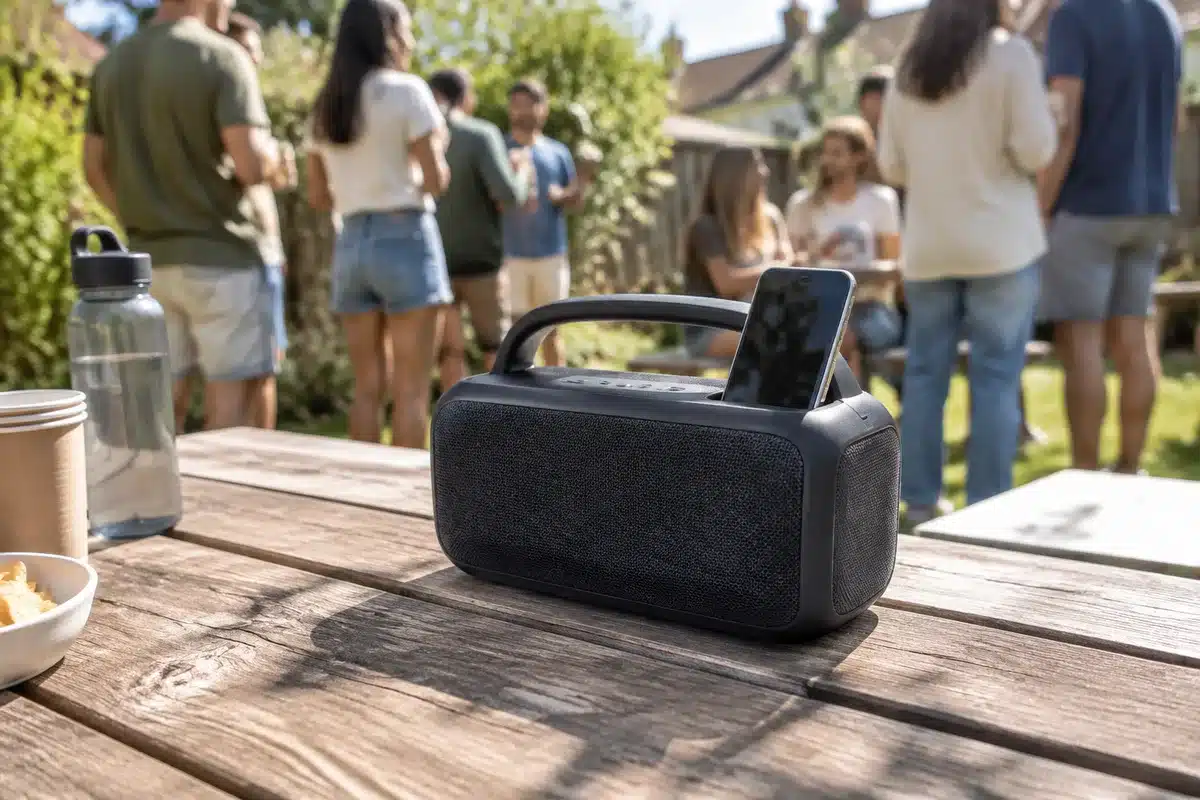
The top plate has only three buttons (power, Bluetooth and play/pause), also backlit but only in white. That leaves a generous flat area to place items on top without obstructing controls; there’s even a wide groove toward the rear to hold a phone or tablet.
Most of the additional controls are on the rear: a source selector, a Bluetooth pairing button for chaining multiple ULT speakers, a stereo-pairing switch (again for a second ULT unit), power-saving mode, lighting mode change, an echo effect for karaoke, and a tone control for a connected microphone.
The ULT Tower 5 carries an IPX4 rating, meaning it is splash-resistant and can handle light rain when upright—note the certification applies only in the vertical position. It is not waterproof, so dunking it or exposing it to heavy spray is out of the question.
Sony ULT Tower 5Physical connections
All the physical ports are hidden behind a flap on the back. The speaker offers five connection options:
- Bluetooth: supports SBC, AAC and LDAC, Sony’s proprietary codec that enables higher bitrate audio (up to 990 kbps, still compressed) when used with compatible Android phones or PCs; iPhones do not support LDAC.
- USB-C: for direct digital playback from a smartphone or computer, which also charges the connected device while playing.
- USB-A: to play music files from a USB stick (MP3, WAV, FLAC, etc.).
- Line inputs (RCA and XLR): for analog sources like portable players or CD decks. The XLR input accepts long cable runs, and with an XLR output also present you can daisy-chain the speaker into a larger setup (Sony or third-party).
- Microphone input (6.35 mm jack): to connect a mic for karaoke or announcements.
The Tower 5 can be linked over Bluetooth to another ULT Tower 5 for a true stereo pair, or integrated into a wireless Party Chain via Auracast to stream to up to 100 compatible Sony speakers. Note that this Party Chain implementation is not compatible with older Sony speakers that use the legacy Party Connect protocol.
Sony ULT Tower 5Internal layout
Inside, the design is solid and conventional. Sony equips the Tower 5 with a 23 cm low-frequency driver paired with two 6 cm tweeters. That results in a two-way system: the large driver handles the bass, while the tweeters take care of the highs (and some mids).
The woofer is ported via a bass-reflex design. A tuned port connects the enclosure to the outside and reinforces targeted low frequencies, helping to boost bass output without forcing the driver or amplifiers to work excessively. The port exits at the base so the floor helps reflect and unify the bass response.
The tweeters are relatively large for their role since they reproduce highs and some midrange detail that the big woofer cannot render precisely. They are angled outward and placed in short waveguides to increase their projection—useful when the speaker is used outdoors or placed at a distance from listeners.
Sony quotes a peak output of 300 watts. That number is a peak figure, and should be considered in context: the speaker’s measured power draw tops out at around 79 watts. Still, as you’ll read below, the Tower 5 is capable of producing very high sound levels.
Sony ULT Tower 5Sound Connect: control and party features
Remote control of the Tower 5 is handled through the Sound Connect app. The interface is straightforward, with a main page for basic controls and a secondary menu for advanced settings.
Here you’ll find the equalizer options if you want to alter the default tonal balance. A 10-band EQ is available for precise tuning.
The Party Pad feature stands out: it lets you layer party sounds onto the music—robotic voice effects, crowd noise, brass hits or vocal samples. The app also includes voice isolation and modulation effects (flanger), so you can play DJ and add live effects to the mix.
The animated front-panel lighting can be customized with a color wheel in the app.
The Tower 5 supports Bluetooth 5.3.
Multipoint is supported as well: two source devices can remain paired concurrently, simplifying switching between phones without re-pairing.
Sound Connect also manages stereo pairing and the Party Chain features mentioned earlier.
In short, the system is scalable: you can start with solo listening and expand to a fuller sound setup for bigger events.
Sony advertises a wireless range of roughly 30 meters.
Sony ULT Tower 5Sound power that matters
In the portable party speaker category, the ULT Tower 5 plays louder in our measurements than its direct competitor, the JBL PartyBox 130. The overall loudness gap is modest, but Sony’s advantage becomes much more noticeable in the bass. For a party-oriented speaker, low-frequency performance is essential, and the decision to use a 23 cm woofer pays off here.
The frequency response indicates Sony didn’t try to push extension down to the ultra-subsonic range. The Tower 5 isn’t optimized for the deepest 40–50 Hz content; instead Sony emphasized response around 60–70 Hz, a practical region that delivers weight, punch and perceived depth. That approach has a practical benefit: even at very high volumes, the speaker keeps its bass impact rather than collapsing when attempting to reproduce extremely low notes, which would overwork the driver and amplifier.
We recorded peaks of up to 103 dB at one meter in the bass region, where playback demands the most energy. Versus the JBL PartyBox 130 (review forthcoming), the Sony shows about 5 dB more output in the bass band around 60–70 Hz. For context, a 6 dB increase doubles sound pressure; perceived loudness roughly doubles with about a 10 dB rise.
Midrange and treble are well controlled, offering clarity and detail that hold up when levels go up. Vocals remain intelligible, instruments are well defined, and the highs provide air without sounding harsh. From a sonic-quality standpoint, the Tower 5 impresses both with its power and with its restraint.
Quasi-stereo presentation
Don’t expect a vast, immersive soundstage from a single cabinet. Most of the energy comes from the speaker itself, although the pair of outward-aimed tweeters spreads the high frequencies more broadly than many rivals whose tweeters point straight ahead.
Unlike the ULT Tower 7 and larger models, there are no rear-facing tweeters, so the Tower 5 does not deliver 360° sound. Projection is primarily forward-focused.
Whether used indoors or outside, the Tower 5 delivers very powerful, balanced sound with generous bass that holds together at high volumes—there’s clarity, no harshness, and an impressively wide sense of stage for a single speaker.
Sony ULT Tower 5Battery life: 20 hours, but dependent on volume
Sony claims up to 20 hours of battery life—this figure is measured at about 30% volume with the lights off. With illumination active the company lists around 12 hours. Under party conditions, with volume pushed to 80%–max, ULT mode engaged and LEDs on, real-world runtime falls to roughly 2 hours 30 minutes to 3 hours. That’s expected given the aggressive amplification required at such levels.
Sony also includes a useful fast-charge feature: 10 minutes on mains power yields about 100 minutes of playback at moderate volume.
If you want to keep the party going all night outdoors at very loud levels, the practical solution is to connect the speaker to a portable power station (EcoFlow, Bluetti, DJI and similar), as the Tower 5 can operate while charging. From empty, a full charge on mains power takes about 3 hours if the unit is turned off.
Finally, the battery is user-replaceable: it sits behind a panel secured by a screw so it can be swapped out if capacity declines over years of use.
Sony ULT Tower 5Price and rivals: deeper bass than the JBL PartyBox 130 at the same price
Priced at around €399, the Sony ULT Tower 5 directly targets the JBL PartyBox 130 (listed at €399.99). On the compact party speaker front, Sony’s offering delivers stronger bass performance according to our tests.
JBL retains advantages such as a hot-swappable battery and more flamboyant lighting patterns, but in sheer output the Tower 5 elevates the bar. In the low end, our measurements show roughly a 5 dB lead in the critical bass band—almost a doubling of acoustic pressure—so the Sony genuinely plays louder in that range.
On paper, the PartyBox 130 (launched May 2026) advertises up to 15 hours of runtime versus Sony’s 20, and reports 80 minutes playback from a 10-minute charge compared to Sony’s 100 minutes. Note that JBL sells replacement batteries separately.
Another alternative is the Marshall Bromley 450, which appeals with its retro styling and analog knobs on the front. It is priced at €649, about €250 more than Sony’s model. In return, Marshall claims up to 40 hours of battery life, 360° dispersion and an IP55 rating that offers stronger protection than the Tower 5’s IPX4.
Sony ULT Tower 5
at the best price
<button type="button" role="radio" aria-checked="true" tabindex="0" data-state="active" data-value="new" class="relative z-1 inline-flex items-center
font-fontFamilySecondary font-semibold text-font-body
whitespace-nowrap cursor-pointer
bg-transparent border-none rounded-full
disabled:opacity-50 disabled:cursor-not-allowed
switcher-option___J271O
switcher-option-boxed___1mFEg switcher-option-boxed-active___xPSGS justify-center conditionOption___Hm6iZ”>New7<button type="button" role="radio" aria-checked="false" tabindex="-1" data-state="inactive" data-value="renewed" class="relative z-1 inline-flex items-center
font-fontFamilySecondary font-semibold text-font-body
whitespace-nowrap cursor-pointer
bg-transparent border-none rounded-full
disabled:opacity-50 disabled:cursor-not-allowed
switcher-option___J271O
switcher-option-boxed___1mFEg justify-center conditionOption___Hm6iZ”>Refurbished1
-
Amazon249,00 €
-
Son-Vidéo.com249,00 €
-
Fnac249,99 €
-
Darty249,99 €
-
Boulanger249,99 €
Similar Posts
- Tested: Sony ULT Tower 7 – The Ultimate Party Speaker with Unmatched Power and Sound!
- Marshall Bromley 750 Review: Meet the New Queen of Party Nights!
- Loewe We. Hear Pro Review: Discover the Power and Elegance of This Portable Speaker!
- Breaking: Sony’s Newest Noise-Cancelling Headphones: Better Than Ever & Coming Soon!
- Sonos Play Review: Discover the Ultimate Portable Speaker That Delivers on All Fronts!

Maya Singh is a senior editor covering tablets and hybrid devices. Her work explores how these tools reshape digital productivity and learning. She also contributes to feature editorials on emerging tech.