
Scientists confirm: This is the most effective way to get your cat’s attention, according to new research
Elderly Couple Refuses Reserved Seats—Viral Train Standoff Sparks Fiery Debate on Courtesy
The Qrevo Curv S5X and Edge S5A build on the solid technical foundation of their namesake models, known for their cost-effectiveness and high performance, while tweaking the specifications slightly to reduce costs.
They naturally retain the multifunction station, which allows for hot water washing and automatic drying of the mops. Moreover, the station can empty the dustbin into a dedicated bag, reducing the need for daily maintenance.
The robot itself remains quite similar, featuring an extendable mopping pad to clean along walls and into corners. However, to make the S5X/S5A models more accessible, they do without some features. For instance, the camera-based obstacle recognition has been replaced by a more basic structured light system.
The battery life and capacity are also slightly reduced, which is nearly imperceptible in daily use
Similarly, there is no onboard voice assistant or the AdaptLift Chassis, which allows crossing higher thresholds. However, these omissions are hardly a handicap in daily use, as the Qrevo Curv S5X and Edge S5A are still very well equipped for daily floor maintenance.
Why You Should Never Reheat These Foods in the Microwave – The Hidden Dangers Experts Warn About
I tried the top 5 guard dogs—here’s what makes these breeds the ultimate protectors
Roborock
Product details
Available at €739
Roborock
Product details
Available at €699
Design Choices
The main difference between the Roborock Qrevo Curv S5X and Qrevo Edge S5A is in their design, particularly the design of the station.
The Curv S5X, as the name suggests, features a curved design. Its station has smooth, rounded lines with a glossy white plastic that blends discreetly into a modern interior. It is hard to differentiate it from the original Qrevo Curv’s station, as the design is identical. The Curv S5X’s station is slightly wider than the Edge’s but less tall. Access to the dust bag is from the top, through the same hatch as the two water tanks. The front is devoid of a hatch and rounded, giving it a shape reminiscent of an egg or a 90s toy. This marked aspect has a small advantage, allowing it to cover almost the entire robot for more discretion in your interior and also to prevent it from collecting too much dust.
The Edge S5A takes a different approach with a more angular and vertical design. The station is taller and less wide, with a striated facade adorned with a gray panel that gives it a more pronounced look. This format may be more suitable for confined spaces, such as an entrance or a narrow hallway. The water tanks are directly accessible from the top, without being hidden by a hatch. The dust bag is accessible from the front, under the removable panel on the facade. Finally, the robot is much more visible, which is less aesthetic but more practical, as the access ramp is removable and therefore easier to clean.
Functionally, both stations share an identical architecture. They integrate three main tanks: a clean water tank of 4 liters, a wastewater tank of 3.5 liters, and a dust bag compartment of 2.7 liters.
These volumes ensure several weeks of autonomy for suction and several washing cycles without manual intervention. Both versions feature a removable washing board, on which the mops rest during automatic cleaning.
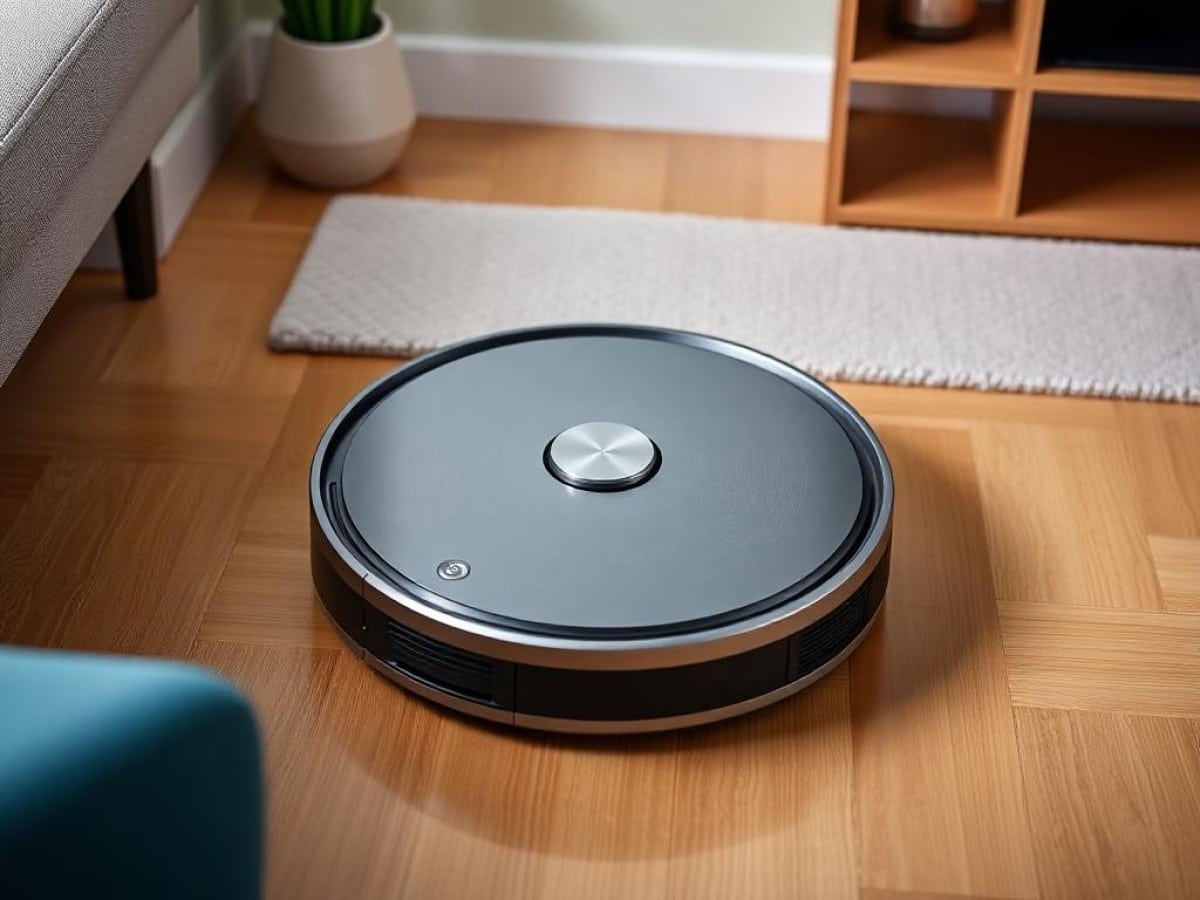
The robot model is the same for both versions. The chassis measures about 35 cm in diameter and 9.7 cm high, with a LiDAR dome on top. The front of the robot is equipped with sensors to avoid collisions, and a cushioned bumper on the front. Under the robot, there is the DuoRoller main brush, consisting of two hybrid rollers, designed to prevent hair and pet fur from tangling.
Two rotating mops provide wet cleaning, one of which can extend to clean along skirting boards and into corners. The FlexiArm side brush is present, allowing for dust collection along walls and in angles.
Your choice between the two models will mainly depend on your space constraints and aesthetic preferences. I personally prefer the unique aesthetic of the Qrevo Curv S5X, but I must admit that the Qrevo Edge S5A is more practical on a daily basis.
A Comprehensive App
The Roborock app remains one of the most comprehensive and accessible on the market. From the first launch, the robot performs a mapping of your home using its LiDAR system. This map is then editable and customizable at will: you can merge or divide rooms, rename them, or indicate no-go zones or virtual walls not to cross. The app accepts up to four different floors, with automatic recognition if the robot moves from one level to another.
Roborock
Download for free
During cleaning, the interface offers real-time tracking of the route, with visualization of the robot on the map and the path it takes. Detected obstacles are also indicated on the map by a plot, although the robot is not able to determine the type.
The core of the application is based on a very detailed and customizable management of the settings. You can adjust the suction power, water flow, number of passes, or the cleaning order according to your preferences. For example, you can set two passes for the kitchen with high water flow, while one room can be vacuumed without mopping. If these manual settings are too time-consuming, an intelligent AI SmartPlan mode is also available to automatically adjust the settings.
Similarly, you can also adjust the water temperature for washing the mops, the frequency of their cleaning, the drying time, etc.
The application also integrates the classic but expected functions for this type of high-end product: weekly planning, Do Not Disturb modes to avoid noise disturbances in the evening or at night, and compatibility with voice assistants like Alexa, Google Assistant, or Siri. You can therefore start a cleaning by voice or via third-party automations, despite the fact that the robot does not have an onboard voice assistant.
Finally, both models are compatible with Matter, offering simple and advanced integration into a home automation ecosystem.
Effective Cleaning
The Qrevo Curv S5X and Edge S5A offer particularly convincing cleaning performances, both for suction and mopping. Roborock retains its proven formula here, relying on high suction power of 18,500 Pa, coupled with a double main brush and an extendable side brush, while the mopping part employs two rotating pads washed with hot water, one of which can extend and clean along the baseboards.
In terms of suction, the robots perform very well and manage to deal with everyday dust and debris, from crumbs to pet hair. On hard floors as well as carpets, the robot automatically adjusts its intensity thanks to surface detection, and manages to extract dirt even from deep within. The two rollers not only ensure effective collection but also limit hair tangling, a real plus for easing robot maintenance. The combined action of the rollers sucks up without pushing the dirt away, and contributes to a uniform cleaning even along the baseboards thanks to the extendable side brush.
The mopping part is ensured by two rotating mops that exert slight pressure on the floor while spinning at high speed. They are washed with hot water before, during, and after each cleaning cycle. Although the station does not have a dedicated detergent tank, it is entirely possible to add a small amount of it to the clean water, to tackle the most stubborn stains. Coupled with hot water, this approach helps to remove ingrained stains, well beyond a simple wet pass. During my tests, I deliberately spilled soda and tomato sauce on the tile, before letting them dry to test the robot’s effectiveness. After its pass, the effectiveness of the cleaning is there: the stains have disappeared and there is no trace of my mess. However, the Qrevo Curv S5X and Qrevo Edge S5A are not capable of detecting spilled liquids and therefore run over them without turning off the suction or lifting the main brush. In my specific case, I found tomato sauce on the side brush and the main roller. However, the robots are able to detect particularly dirty areas and can intelligently initiate a second pass for complete cleaning.
Moreover, unlike the classic versions, the S5X/S5A cannot lift their side brush or the main brush. This may seem unnecessary, but this feature can be problematic if the robot has to clean up tomato sauce, for example. Indeed, since it is not able to recognize it, it will suck it up and mop it up at the same time. This means that it may then spread it along its path, especially if it has to cross over a carpet to return to its base.
On the other hand, when it detects a carpet, the robot automatically lifts its mops to avoid wetting it. In practice, the carpets remained dry, just like the hard floors that it did not need to clean along the robot’s path.
Edge management is also a strong point, particularly thanks to the deployment of the side brush and the right mop to reach angles and areas along the walls.
Finally, the autonomy is in the good average, with a 5200 mAh battery that offers about 2hr 30min of cleaning in standard mode, or even more if the power level is reduced. On a full charge, the robot can cover between 180 and 250 m² depending on conditions. And if it runs out of energy during a cycle, it automatically returns to recharge before resuming exactly where it left off.
In terms of noise, the robot remains discreet in normal use, with about 60 dB in standard mode. It becomes almost inaudible in silent mode, and remains bearable even at full power. The mopping mode alone is particularly quiet. The station, on the other hand, is heard during emptying or washing phases, but this only lasts a few seconds, especially since it is possible to set times during which the robot will not empty itself, thus limiting the noise disturbances related to this step.
Reliable Navigation, but Watch for Small Obstacles
Navigation is provided by a high-performance LiDAR system, which analyzes the environment and constructs a precise cleaning plan. The robot then opts for logical zigzag trajectories, after circling each room.
The S5X/S5A navigate methodically, continuously adjusting their trajectory to encountered elements. The robot correctly identifies thresholds, transitions between floors, small constrictions, and can adjust its behavior in case of a narrow space, such as under a low table or between two chair legs. However, it has occasionally failed to properly assess the height of a hanging trash can, and bumped its LiDAR dome by mistake, before backing up.
In terms of obstacle detection, Roborock relies here on Reactive Tech technology, a system based on structured light sensors, a cushioned bumper at the front, and shape analysis from the laser. It is not advanced object recognition via camera, but this system has proven to be very effective in a typical domestic environment. The robot automatically slows down when approaching objects, avoids sudden collisions, and circumvents most objects, such as slippers, toys, or furniture, without difficulty.
If an obstacle is detected, it slows down, adjusts its trajectory, and marks the area on the map. The Reactive Tech system, although less sophisticated than a camera with object recognition, proves to be largely sufficient to avoid shocks and blockages in most domestic situations. However, it shows its weaknesses when faced with small objects, such as cables or backpack straps, which it struggles to detect. It has happened several times that it has attempted to suck up cables or wires, requiring human intervention.
Simple Maintenance
Like their predecessors, the Qrevo Curv S5X and Edge S5A benefit from a multifunction station that takes care of most of the maintenance. Once the work is done, the robot returns to its base where the contents of the dustbin are sucked into a 2.7-liter bag. Its large size allows it to last several months without needing frequent replacement.
The station also takes care of the maintenance of the mop pads, which are washed at 75 ºC, while being scrubbed on the spikes of the washing board, before being dried at 45 ºC to prevent mold and bad odors. This maintenance cycle is effective enough for the pads to come out clean, even after several washes. The washing board on which the mops rest is also removable, which facilitates its cleaning and limits the appearance of persistent deposits.
The two integrated water tanks at the station guarantee several days of operation without intervention. They are easy to remove, with well-thought-out handles and wide openings for splash-free filling or emptying. In practice, you need to fill the clean water tank and empty the wastewater tank every three to five cycles, depending on the cleaned surface. Unfortunately, neither of the two models includes a detergent tank, which requires manually adding detergent to each refill of the clean water tank.
The robot itself requires very little attention. The DuoRoller main brush resists hair tangling well and hardly needs any maintenance, just like the side brush.
Maya Singh is a senior editor covering tablets and hybrid devices. Her work explores how these tools reshape digital productivity and learning. She also contributes to feature editorials on emerging tech.
