
Scientists confirm: This is the most effective way to get your cat’s attention, according to new research
Elderly Couple Refuses Reserved Seats—Viral Train Standoff Sparks Fiery Debate on Courtesy
Wireless robotic mowers are becoming increasingly popular, but the most advanced models, especially those equipped with LiDAR sensors, are still generally designed for large gardens, with the size and price tag to match. With the ViAX range, Mova offers an accessible option, helping to popularize robotic mowers. This line includes three models, the ViAX 250, 300, and 500, designed to handle lawns up to 250, 300, and 500 square meters, respectively, as indicated by their names.
About the brand: Mova is a branch of Dreame, a Chinese specialist in robotic vacuums, and aims to be the global leader in LiDAR robotic mower sales by 2025. With the ViAX range, it leverages this expertise into a more affordable segment, focusing on camera vision rather than LiDAR, at least for its entry-level models. The ViAX 500, however, retains a 360° LiDAR.
Mova unveiled the ViAX range at CES 2026 in early January, followed immediately by its release in France, just in time for the 2026 mowing season.
We are testing the most modest version here, offered for under 600 euros. Let’s see if, at this price, it offers an experience worthy of the brand, or if it has made too many concessions to attract the market with an appealing price.
Technical Details
This test was conducted with a product provided by the brand
Compact and Basic Design
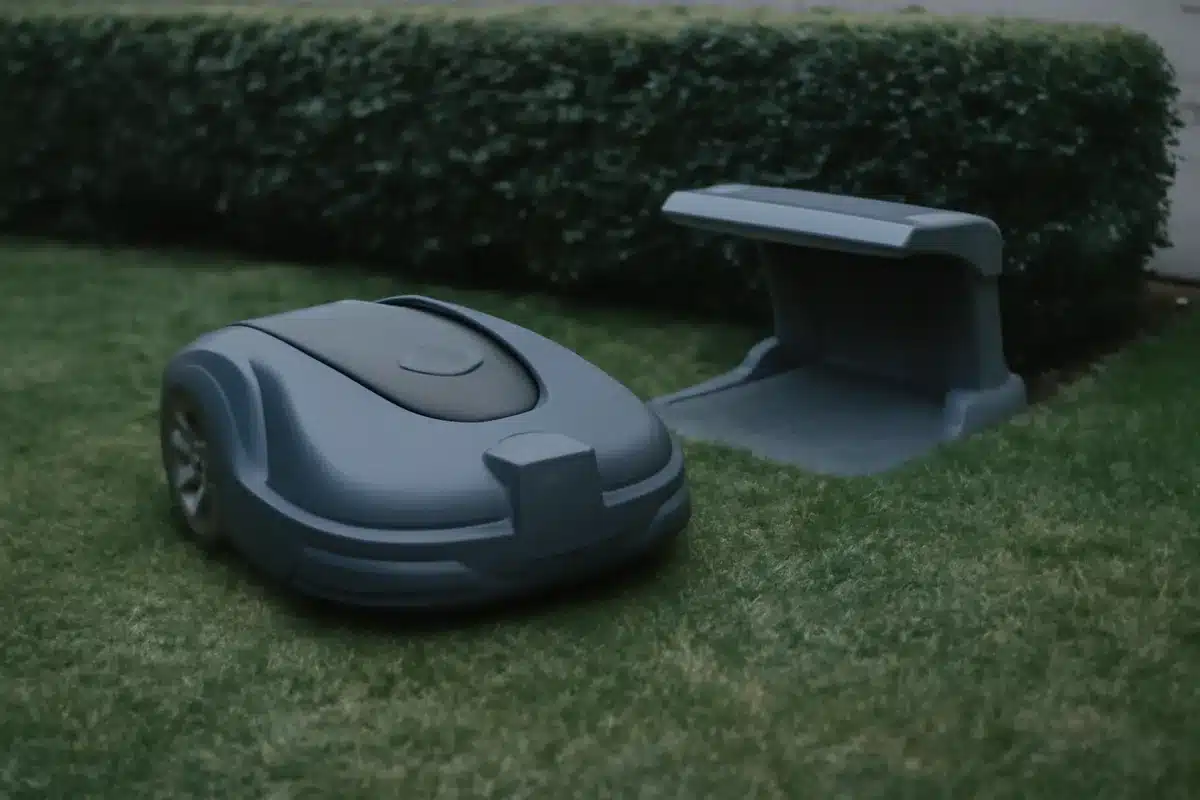
Measuring 59.5 cm long, 38 cm wide, and 27.2 cm high, the ViAX 250 maintains reasonable dimensions. Its weight of 9.4 kg is also moderate for a robotic mower, especially since an integrated handle makes it easy to move. The size is well-suited for its intended environment: small gardens, narrow passages, and plots where a larger machine would be more cumbersome than useful.
The physical controls are grouped under the top cover. They allow you to start mowing, send the robot back to its station, or unlock it, while a large Stop button remains immediately accessible. A dial also allows you to adjust the cutting height from 20 to 60 mm.
Beneath the chassis, a single floating disc with three small pivoting blades offers a cutting width of 20 cm. It’s a classic design, less impressive than the double decks of high-end models, but consistent with the targeted surface area.
The drive is provided by the two front wheels, complemented by a free wheel at the rear. Positioning relies on a dual camera module mounted at the front of the robot for better visibility.
In terms of finishes, don’t expect a premium product. The plastics are a rather dull gray, the design more practical than aesthetic, and the finishes are just adequate. However, at this price level, one cannot expect much more, and the Mova ViAX 250 already performs well in terms of overall ergonomics.
Intuitive Application Rich in Features
Setting up and operating the Mova ViAX is managed through the brand’s app, with Bluetooth and Wi-Fi connectivity.

During the map creation, the mower can automatically detect the lawn edges using its onboard cameras, similar to a robotic vacuum. Of course, you can also manually guide the robot along the lawn edges if you prefer, which is often more precise for curved borders.
It is important to note that choosing the correct version is essential, as the mower categorically refuses to save the map if the lawn exceeds 250 m².
Once the map is created, the options are numerous. The app manages multiple zones, forbidden areas, linking paths, and up to two independent maps. It also offers complete mowing, zone-based mowing, localized mowing, manual mowing, or edge-only mowing, as well as scheduling according to a plan you can set.
The app provides many customization options, such as adjusting the mowing angle, as well as managing the edges. You can ask the robot to shift by 5 to 15 cm to overlap the edges and mow them efficiently, provided there is a clear passage around the edges.
Mova goes even further with surveillance functions using the robot’s front camera. You can display a video feed or launch a patrol in the garden using the robot’s cameras.
During mowing, the app displays the robot’s route, the mowing direction, and annotates the map with any obstacles encountered. Offering such options at this price level is particularly remarkable, considering that other, more expensive models do not display obstacles on the map.
Impressive Mowing with Minor Flaws
To cut the grass, the ViAX 250 uses a 20 cm cutting disc with 3 blades, with a manually adjustable cutting height of 20 to 60 mm.
Once the blades are activated, the ViAX 250 is very convincing. The cut is clean, even, and sufficiently uniform to quickly give a neat appearance to the lawn. The robot moves in parallel back-and-forth passes and creates neat stripes, particularly visible when alternating the orientation between two cycles.
The overlap between passes is generally well managed. It avoids the thin lines of grass that some robots leave between two too widely spaced trajectories. The narrow cutting width does not prevent a neat result. On the areas it actually covers, there is little to fault with the ViAX 250.
Edge management, however, depends heavily on their nature. Faced with a flat and crossable limit, like a terrace or tiles at the same level as the lawn, the robot can overlap the edge. Its disc then passes over the grass and cuts the perimeter correctly, with very little retouching needed. The ViAX 250 is understandably more cautious near shrubs and flower beds. It then avoids overlapping the limit, which protects the plantings but sometimes leaves a small margin. The result deteriorates further along a wall, a fence, or any vertical border. Since the disc is placed in the center of the chassis, the machine physically cannot come to cut at the edge of the obstacle, leaving an uncut strip of about 15 to 20 cm in this configuration. The use of a trimmer remains essential if the lawn is framed by high walls. This is not unique to the ViAX 250, but the absence of a lateral disc or offset deck is clearly felt. The robot reduces the chore of mowing, but does not eliminate the need for finishing touches.
The mowing is performed in a particularly disconcerting silence, with about 50 dB measured during mowing, probably the lowest value we have seen on a robotic mower.
As for battery life, it remains modest with about 50 minutes of mowing announced and 45 minutes of recharge for the 2.5 Ah battery. The mowing speed is about 60 m²/h in standard mode, but can be accelerated to about 90 m²/h in efficient mode, with slightly less neat results.
Cautious, Adaptive Navigation but Sometimes Puzzling
For navigation, the Mova ViAX does not use an RTK antenna or LiDAR. Instead, Mova relies on two HDR cameras and algorithms capable of differentiating the lawn from its surroundings. This architecture allows for creating virtual boundaries without burying cables and recognizing common obstacles. However, it also imposes some constraints: the machine must be able to clearly read the terrain and have sufficient light to position itself correctly.
A limitation to keep in mind: without onboard lighting, the ViAX 250 is blind in the dark and cannot mow or patrol at night. Its cycles must therefore be scheduled during the day – which, given its quiet operation, deprives it of a nighttime use that would have made sense.
Overall, the results are good, especially in good light. The robot can make impeccably aligned back-and-forth passes, but can sometimes behave surprisingly. Indeed, it may interrupt the back-and-forth to cross the entire lawn and go finish a small isolated portion at the other end. The task is generally covered, but the route seems unnecessarily long and sometimes gives the impression that the machine is improvising its plan as it goes.
The obstacle detection prioritizes caution. During our tests, the ViAX 250 maintained about 10 cm around certain objects and also bypassed some passable portions without identifiable reason. This margin limits contacts, but becomes annoying when it creates an island of intact grass without a visible obstacle. The robot fortunately knows how to reassess the situation. When we removed an object, it returned to mow the area it had initially avoided. In this specific case, the avoidance was therefore temporary and not recorded as a permanent exclusion. Furthermore, the dual camera system proves reliable on many types of obstacles, perfectly detecting a watering can, a hose, and even a small Jack Russell that fortunately was not mowed by the robot.
Furthermore, the ViAX 250 can officially climb slopes of up to 40% and cross obstacles of 4 cm, although it is better to stay under 25% slope to achieve the best results, especially on wet or fragile lawns.
Similar Posts
- Eufy E15 Robot Mower Tested: Anker Transforms Lawn Care with Vacuum Tech Magic!
- Dreame A3 AWD Pro 3500 Review: Powerful 4-Wheel Drive, Trims Edges to 3cm!
- Mammotion Luba Mini AWD Review: A Game-Changing All-Terrain, Precision Robot Mower!
- Husqvarna Automower 410XE Nera Review: Revolutionary Robotic Mower with Built-in Edger!
- Segway Navimow X4 Review: The Ultimate 4WD Robot Mower for Large Lawns!

Maya Singh is a senior editor covering tablets and hybrid devices. Her work explores how these tools reshape digital productivity and learning. She also contributes to feature editorials on emerging tech.