
Scientists confirm: This is the most effective way to get your cat’s attention, according to new research
Elderly Couple Refuses Reserved Seats—Viral Train Standoff Sparks Fiery Debate on Courtesy
In recent years, OneOdio has carved out a unique place in the audio landscape. Established in 2013, the brand has carved out a niche among amateur DJs and content creators, offering semi-professional products at prices that established brands like Audio-Technica and Sennheiser can’t match. With the Studio Max 2, OneOdio is taking an even bolder gamble: democratizing wireless low latency at a time when DJs and producers are increasingly demanding the freedom of wireless headphones without sacrificing the precision of wired ones.
The key feature lies in a proprietary chip coupled with a small 2.4 GHz USB transmitter. Plugged into an audio interface or PC, this dongle establishes a connection separate from traditional Bluetooth and reduces latency to 9 ms, compared to 20 ms on the original Studio Max released two years earlier. It’s worth noting that the threshold for perceiving an audio delay is generally between 20 and 30 ms for most listeners.
Reducing latency to 9 ms brings it into the realm of the nearly imperceptible, fundamentally changing the value proposition of a wireless headset. The collaboration with KSHMR, an American producer of Indian descent who has become a cult figure on the global electro circuit, adds a creative endorsement to the product. However, as we will see, the DJ’s influence on the sound signature raises some questions.
OneOdio Studio Max 2Technical Specifications
| Model | OneOdio Studio Max 2 |
|---|---|
| Type | Circumaural headphones |
| Driver Diameter | 45 mm |
| Headphone Weight | 350 g |
| Product Sheet |
OneOdio Studio Max 2An Unboxing with Impact
Notably, before diving into the design of the headphones, the performance of the app, the audio quality, and the battery life, it’s important to discuss the carry case. The unboxing sets the tone. The packaging features a double box system, where an outer sleeve is removed to reveal the main box. It’s intentionally flashy, and it works quite well initially, even if it feels a bit too eager to impress after the first few moments.
Inside, however, it’s hard to complain about emptiness. In addition to the headphones folded into their hard thermoplastic polymer case, there’s the M2 transmitter, a USB-C charging cable, a straight 3.5 mm cable with a screw-on 6.35 mm adapter, and a three-meter coiled cable, essential for direct connection to a mixing console.
OneOdio also included a jack on each side of the ear cups, allowing for chaining multiple headphones, useful for DJ classes, for example. The whole setup is truly designed for professional use.
The only misstep: the oversized hard case. It takes up as much space as a dictionary in a backpack, making it incompatible with truly nomadic use. For a headset that also dreams of being a travel companion, it’s a questionable choice.
OneOdio Studio Max 2Design: Unapologetically Studio, Room for Improvement in Finish
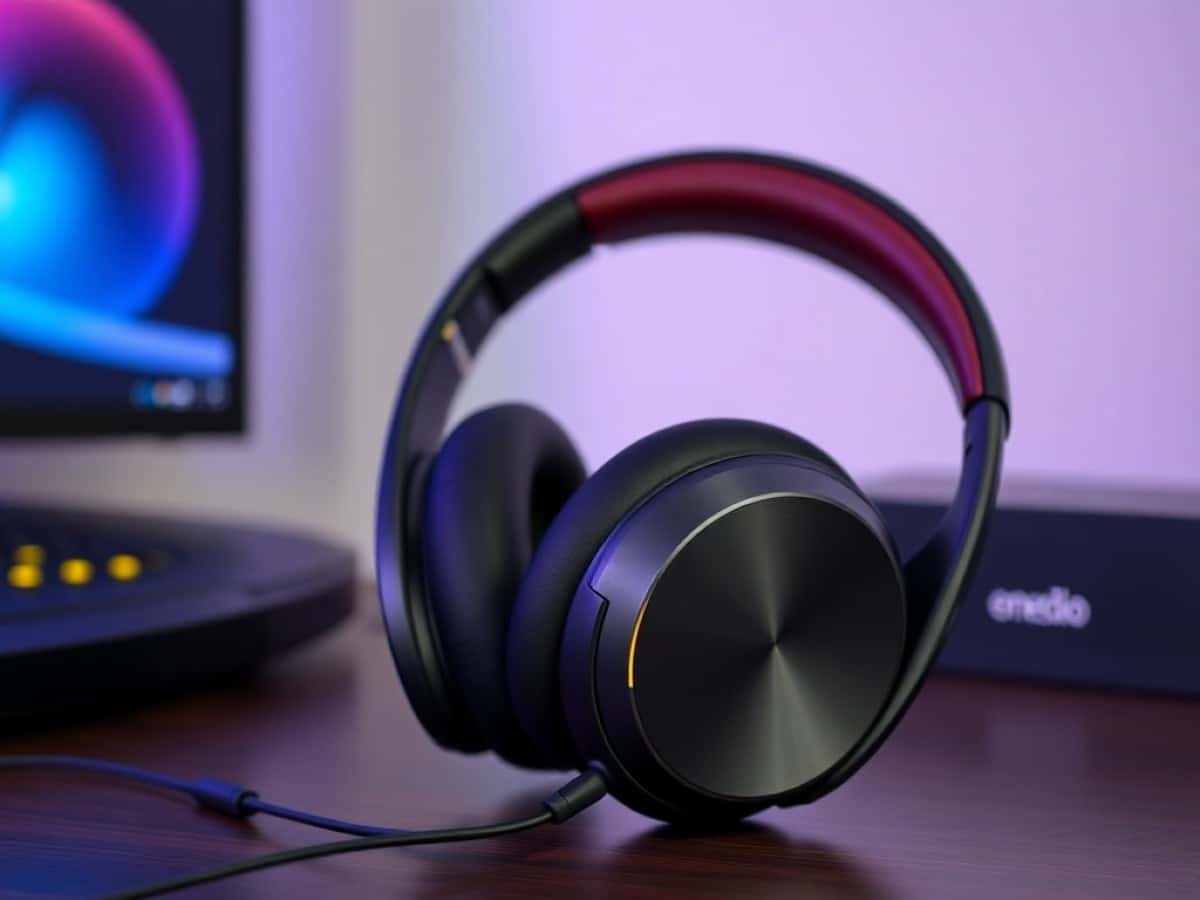
The Studio Max 2 fully embraces its DJ headphone aesthetic. Large, black, with closed circumaural ear cups that rotate 180° with a flick of the wrist—the one-ear monitoring that DJs favor during sets—it ticks all the genre’s boxes with true visual coherence. Worn on the head, it commands a physical presence that’s impossible to ignore. The headphone is not subtle, and it doesn’t try to be.
Where things fall short is in the details of construction. The build is entirely in matte plastic, and the mold lines are visible on the shells as well as on the headband. This level of finish, acceptable on an €80 headset, becomes hard to excuse on a product approaching €190.
The headband does incorporate a reassuring metal frame for durability, but its protective foam is too thin for long sessions—I’ll come back to this.
The ear pads are the most refined part of the chassis. Made of faux leather with memory foam, they are generous, enveloping the ear with genuine softness.
The exterior of the ear cups likely nods to vinyl records with a circular groove, creating a quite attractive effect.
The right ear cup houses all the control buttons: the textured button to turn it on and, on either side, those for managing the volume; the push button to switch from Bluetooth mode to ULL (Ultra Low Latency) mode and the USB-C port to recharge the battery.
The ergonomics are well thought out, especially with the texture of the power button, which is easy to locate by feel.
Comfort: Starts Strong, but Endurance Lacks
The memory foam ear pads offer a relatively comfortable fit. The ear is well wrapped, the lateral pressure is measured, and it’s clear that OneOdio has made significant efforts here. However, when wearing the headphones for more than an hour, things get a bit more complicated. Weighing about 350 grams, the headphones are not lightweight, and the headband’s foam, being too thin and not very compressible, eventually creates a slight pressure point on the top of the skull that’s hard to ignore during extended sessions.
For a headset aimed at sound professionals or long-session DJs, this is the main area for improvement in the next generation. However, it’s also fair to note that a DJ might need to frequently remove the headphones or move them to the side of one ear to capture the live ambiance and their mix.
The passive isolation is quite consistent for a closed circumaural model. But if you’re really demanding, you might expect such a headset to protect your ears from the ambient noise of a stage, monitors, or an audience. However, the Studio Max 2 lets in quite a bit of surrounding noise—mechanical keyboards, nearby conversations. Clearly, OneOdio optimized the ear pads for immediate comfort, at the expense of true acoustic isolation one might expect at this price range. It’s worth noting that the headset has no active noise cancellation feature.
OneOdio Studio Max 2Application and Connectivity: Rich, but with Blind Spots
In terms of connectivity, the Studio Max 2 is one of the most versatile headsets I’ve tested in recent months. Bluetooth 6.0 with SBC, AAC, and LDAC codecs up to 990 kbps, low-latency mode via the 2.4 GHz M2 dongle, or simply wired via the 3.5 mm and 6.35 mm jacks on each ear cup: the options are there, ready to adapt to any work environment. Modes are switched via a small physical selector on the right ear cup, whose click could have been a bit firmer, but it gets the job done.
The OneOdio app, available on Android and iOS, offers more features than one might expect at this price point. A ten-band equalizer, three presets (Music, Bass Boost, Monitoring), stereo balance adjustment, volume limiter, and even a “Find My Headset” feature. There’s also a prolonged wear reminder (to send you a notification when you’ve worn the device for too long) and an automatic power-off mode. The LDAC switch forces you to choose between dual pairing (multi-point Bluetooth) and high resolution.
The connection is immediate, as is the playback start via Bluetooth. Note that the voice prompts are only available in Chinese or English.
OneOdio Studio Max 2Latency: The True Innovation of the Product
This is where the Studio Max 2 plays its trump card, and it’s a significant one. The M2 transmitter uses the 2.4 GHz band to establish a connection outside the Bluetooth protocol, achieving a latency of 9 ms that I verified across several setups: as a monitoring return on an audio interface, during playback on a DAW, and in video gaming. In all three scenarios, the delay was imperceptible to the ear. For a wireless headset, this performance is almost unsettling.
By comparison, Bluetooth still introduces several tens of milliseconds of inherent delay, regardless of component quality. For a DJ in the midst of a set or a producer monitoring their voice in real time, this difference is not just cosmetic—it concretely changes the way they work. Compared to the Studio Max 1 and its 20 ms, the improvement is clear, especially since the data rate also jumps from 160 to 400 kbps, benefiting the fidelity of the sound in low-latency mode.
However, it’s worth mentioning that I experienced rare micro-cuts during extended sessions. They occur mostly beyond six to seven meters from the source, or in areas with dense Wi-Fi traffic: in a city apartment saturated with networks, the phenomenon is more frequent than in a rural setting. It’s not a deal-breaker, but it slightly nuances the experience.
OneOdio Studio Max 2Sound: A Signature That May Divide
While latency is a strong point for this headset, the audio part is more debatable for a good reason: the Studio Max 2 doesn’t sound like most headphones in its class. KSHMR’s choice is a pronounced V-shaped signature on the high end, tailored for the high-energy electronic textures of dance music.
In this specific domain, the output is genuinely exciting as I noticed that synthesizers soar with almost surgical clarity, hi-hats snap with precision that mass-market headphones often smooth over, and the layering of frequencies in an EDM build gains a readability that may surprise.
But as soon as you move out of the producer’s intended range, cracks begin to show. On a track by Massive Attack, for example, the vocals recede behind a muddled low-midrange layer and get lost in a poorly defined stereo space. On acoustic jazz, I found that the piano lost its natural roundness, and the double bass its body. On some symphonic metal tracks, I even felt that the cymbals literally drowned out the rest of the mix, turning a well-crafted production into a wall of highs that’s hard to bear. The app’s equalizer allows for some correction of these excesses, but a headset at this price shouldn’t require adjustments to sound right.
In wired mode, the Studio Max 2 sounds significantly better. The bass gains definition, the mid stabilizes, and the whole regains a coherence that can be considered for approximate monitoring of a demo. It’s in this mode that the (large) 45 mm drivers reveal their true potential—somewhat unfortunate for a headset that primarily sells itself on wireless. Finally, it’s worth noting an abnormally high minimum volume, even at the lowest setting, but perhaps this is intentional given the environment in which it is meant to perform: clubs and other parties. Otherwise, I appreciated the passive isolation provided by the ear pads.
Frequency Curve: What the Measurements Say
The frequency response curve I measured is eloquent, confirming what one feels from the first seconds of listening. Thus, the response remains within a relatively contained range of variation, about plus or minus 5 dB over most of the spectrum from 80 Hz to 10 kHz, which might suggest a balanced reproduction. Yet, it’s in the details of this curve that one sees the sound philosophy of the headset.
The sub-bass, below 60 Hz, lacks energy: the deep bass lacks foundation, resulting in a physical presence that’s hard to feel on kick-heavy tracks. The bump around 80 to 100 Hz, quite present, provides an impact in the low-bass that gives the illusion of a “powerful” sound on certain genres, but lacks definition. The midrange, between 300 Hz and 1 kHz, shows a slight dip that pushes back vocals and acoustic instruments in the stereo perspective.
Finally, the rise in the upper-mids and the presence zone beyond 5 kHz is pronounced: it’s what gives the headset its sharp, sometimes aggressive character, typical of the KSHMR signature. A lot of air, a lot of detail on transient phases, but auditory fatigue sets in quicker than one would like in a long mixing session.
OneOdio Studio Max 2Calls: It Does the Job
Despite its “studio” label, the headset can of course serve as a hands-free kit. For this, it is equipped with two microphones with environmental noise reduction (ENC), and the experience is decent without being outstanding. In the quiet of an office, my callers heard me clearly, without any “down-the-tunnel” effect or choppiness.
However, once outside, the capture shows its limits: the voice remains intelligible, but the treatment lets some traffic noise through and trims the nuances, giving the speech a slightly compressed grain.
Nothing shameful for a headset that never claimed to compete in the specialists’ league, but far from the clarity of a consumer headset optimized for calls. At most, it’s a convincing stopgap for a call between tracks since it’s not the tool one would choose for a string of professional video calls on the move.
OneOdio Studio Max 2Battery Life: So Huge You Forget the Charger
OneOdio claims 120 hours in Bluetooth mode and 50 hours in low-latency mode. These figures might seem like science fiction, but they match the reality of use: on several occasions during the test, I forgot to recharge the headset for several days of consecutive use without the battery indicator panicking.
In practice, you end up not thinking about it, which is precisely the goal for a work tool. However, it’s important not to forget to charge not only the headset but also the transmitter. In the first case, count about 2.5 hours and about 2 hours for the second element. Fortunately, rapid charging allows for about 9 hours of listening after just 5 minutes of charging.
OneOdio Studio Max 2Release Date, Price, and Competition
Available at €189.99, the Studio Max 2 finds itself in an uncomfortable price zone. Indeed, it costs more than the wired references for monitoring like the Audio-Technica ATH-M50x and the RØDE NTH-100, two headphones with a much more neutral signature, better construction, and a long-established reputation as work tools—but which leave you tied to your cable. In other words, no one does exactly what OneOdio does at this price, and perhaps that’s where it seeks to stand out.

Maya Singh is a senior editor covering tablets and hybrid devices. Her work explores how these tools reshape digital productivity and learning. She also contributes to feature editorials on emerging tech.