
Scientists confirm: This is the most effective way to get your cat’s attention, according to new research
Elderly Couple Refuses Reserved Seats—Viral Train Standoff Sparks Fiery Debate on Courtesy
Having already made its mark in the premium segment with the ET7 and ET9 sedans, and having popularized family vehicles with the Onvo L90, Nio is now venturing into the urban landscape with Firefly, its third brand.
| Model | Nio Firefly |
|---|---|
| Dimensions | 4.00 m x 1.78 m x 1.56 m |
| Power (horsepower) | 141 horsepower |
| 0 to 100km/h | 8.1 s |
| Level of autonomy | Assisted driving (level 1) |
| Top speed | 150 km/h |
| Main screen size | 13.2 inches |
| Car-side socket | Type 2 |
| Entry-level price | 29,900 euros |
|
Try it |
Product sheet |
This vehicle was introduced at the Shanghai Auto Show, and now we bring you our road test from China. To understand the Firefly concept, it’s important to recognize that Nio sees itself as a direct competitor to BMW or Volvo, rather than a mass-market manufacturer like Peugeot or Toyota.
Thus, Firefly is aimed directly at competitors like the Mini Cooper and Smart #1. However, this market is challenging, especially in Europe where local brands have enjoyed public trust and loyalty for over a century, notably through their connections with BMW (Mini) and Mercedes (Smart).
Nio has embarked on designing a car brand specifically for the European markets: Firefly. This brand was initiated by Kris Tomasson, also Vice President of Design at NIO, who played a major role in NIO’s project to transcend traditional car and battery replacement business to become a full-fledged lifestyle brand.
NIO has built its success on a unique offering: a 3-minute battery swap. This infrastructure becomes the common DNA across the group’s three brands. Firefly therefore inherits this disruptive technology but adapts it to the constraints of an accessible urban car. However, implementation remains to be seen, as we will discuss later in this article.
Design: When the Firefly Lights Up Urban Mobility
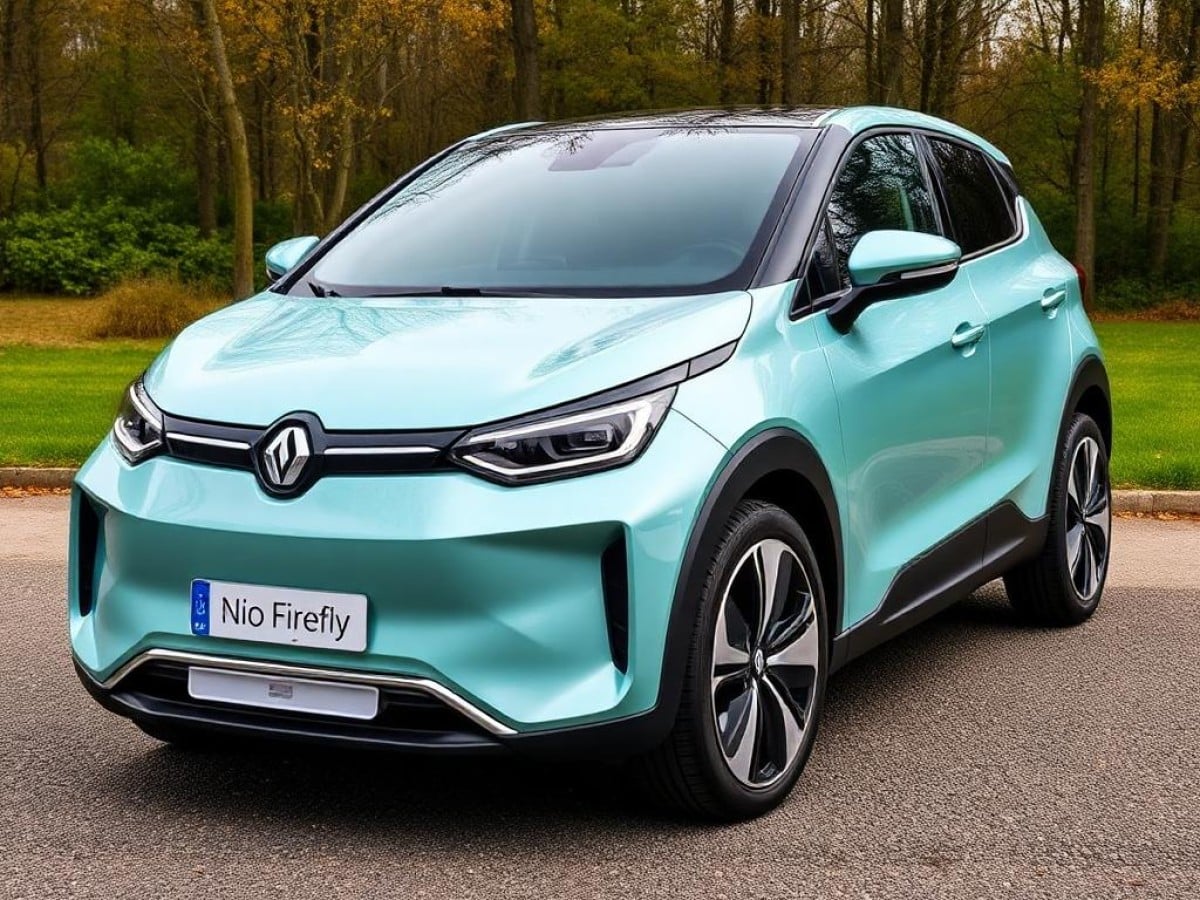
Measuring 4.003 meters long, 1.781 meters wide, and 1.557 meters high, the Firefly positions itself squarely against segment benchmarks like the Mini Cooper SE, Smart #1, and Fiat 500e. Its 2.615-meter wheelbase optimizes space within a compact format. The design breaks away from traditional NIO elegance, opting instead for a youthful and quirky aesthetic. Available colors include white, gray, pastel blue, and pastel yellow.
The front “bug eyes” lights and dynamic light signature create a distinctive personality, further enhanced by a modern hatchback silhouette with sharp lines. This deliberate approach clearly targets an urban clientele with a taste for uniqueness. Personally, I love its look.
Powered by a 42.1 kWh (gross) battery, it offers a range of 330 kilometers according to the European WLTP cycle, costs about 14,500 euros in China, and features smart and innovative software functionalities. Being rear-wheel drive also adds a bit of fun to the driving experience.
Platform and Motorization: Prioritizing Agility and Efficiency
Technically, the Firefly opts for a rear-wheel-drive architecture with a rear electric motor of 105 kW (141 horsepower) producing 200 Nm of torque. This setup prioritizes efficiency and habitability (flat floor) over raw performance.
The 42.1 kWh LFP (lithium-iron-phosphate) battery promises a CLTC range of 420 km (about 330 km WLTP), placing it in the upper average for its segment. This less expensive but more durable chemistry is also perfectly suited for urban use, with daily charging cycles that are less stressful than long-distance ones. This car will likely be recharged at home or at workplace parking lots.
Battery Exchange: The Urban Revolution… Starting in 2026
A competitive advantage of the Firefly is its ability to swap batteries. Like the Nio and Onvo, its 42.1 kWh battery should be replaceable in 3 minutes. However, this isn’t quite functional yet: the shape and standard of the Firefly’s battery differ from those of the Nio and Onvo vehicles. Nio plans to upgrade a number of stations (and build new ones) to accommodate the Firefly’s battery, starting in late 2025 in China.
The BaaS (Battery as a Service) program hasn’t even been announced for the Firefly in Europe yet. This could be a competitive edge, especially for users without private parking or professionals (ride-hailing, deliveries, etc.).
Comfort and Habitability: Best Suited for Short Trips
Here is an area where the Firefly does not excel as much, the interior space is minimal with front seats that may not comfortably accommodate users over 1.90 meters tall. The headroom is excellent but legroom is cramped, especially in the rear seats.
There’s also no central armrest in the back, no pronounced lumbar support, so it’s best used for short journeys unless you want to hear complaints from your passengers. However, this aligns with the urban nature of the car, though it’s still worth comparing to the rear seats of the Fiat 500 and Mini Cooper, which I’m less familiar with.
Front Bench Concept: A Novel Use Innovation
The interior of the Firefly surprises with its avant-garde approach. The “front bench” concept replaces traditional individual seats with a continuous seat, allowing easy movement from one side to the other—handy for parking in tight spots or exiting on the curb side.
This solution comes with a perfectly flat floor, maximizing the “sense of space.” The materials are pleasant to the touch, particularly the door panels covered in faux Alcantara and a foamed plastic that demonstrates a sustainable approach without sacrificing the premium feel Nio values.
Storage Spaces
The Firefly excels in optimizing space. Its front trunk (frunk) of 95 liters is among the most generous in its segment and is a rare feature on a compact electric car. Equipped with integrated hooks, it can be compartmentalized and is even washable thanks to a drain plug, making it particularly handy for groceries or wet items (I’m thinking of beachside cities).
The main trunk offers 404 liters, expandable to 1,253 liters with the rear seats folded down (40/60). The “clamshell” opening of the tailgate ensures optimal access despite a reduced sill height, and requires the installation of these original light reminders on either side. It’s a legal requirement, but always makes an impression.
Infotainment: Dual Screens and Connectivity
The driver’s station adopts a minimalist approach with two screens: an LCD instrument cluster and a floating central screen for infotainment. This balanced configuration avoids visual overload while preserving ergonomics. It’s simplistic but compelling. Advanced connectivity and OTA (Over-The-Air) updates keep the vehicle up-to-date. Nothing really new here.
Onboard Technologies: Premium Features in a Compact Package
The infotainment screen is more than just an aesthetic gadget. The Firefly I tested had already been translated into English, allowing me to explore all the system’s features without needing a translator. It’s one of the best interfaces I’ve ever used.
Menu control is also done by finger swipes, such as for volume or air conditioning.
The touch interface may not please everyone, but most drivers wouldn’t need CarPlay if the underlying system were powerful enough that they wouldn’t need to pull out their phone. I think this one is capable because its design is very coherent, in harmony with the interior and exterior aesthetics of the car, without being too complicated to use.
However, in the quest to reduce costs, physical controls disappear in favor of a software interface, and on the Firefly, headlight control is now performed through the screen. I don’t like this, and I believe that global standards should be updated to mandate physical controls for safety functions: headlights, turn signals, hazard lights, etc. Euro NCAP ratings will evolve to include such topics.
Safety: Aiming for 5 Stars
NIO designs to meet the 5-star Euro NCAP and C-NCAP requirements, with up to 9 airbags depending on the version. The front central airbag prevents collisions between occupants, while the ultra-long side curtains effectively protect rear passengers.
The all-aluminum battery structure incorporates a reinforced cooled plate and anti-collision beams. The driver assistance systems, up to 30 functions depending on the version, cover the essentials of modern active safety.
Driving Sensations: Urban Agility and Smoothness
Indeed, the car is responsive and agile due to its small size, but from the first few turns, I’m quite disappointed with the very stiff suspension which makes you feel every speed bump. For urban use, where cities equip roads with speed bumps and other obstacles, this does not seem to be the most appropriate setting. Those with sensitive backs should steer clear.
Eco, comfort, and sport modes mainly affect acceleration and regenerative braking. There’s no air suspension here. Note that in sport mode, the car’s 141 horsepower manages to give a fun character to this rear-wheel drive. I was able to time the 0 to 100 km/h at 8 seconds, which will have to do.
Also, in comfort mode, acceleration remains lively up to 80 km/h, then seems slightly restricted, perhaps for safety reasons or to reduce energy consumption. The light steering and reduced turning radius (9.4 meters) make urban maneuvers easier. I also appreciate the auto-parking, which successfully completed the two parallel parking tests in the trial.
In conducting some research on the car, it appears that the engineers responsible for the Firefly’s chassis studied the Mini and the Fiat 500 to adjust the vehicle’s dynamics. While the steering is responsive, I maintain that its suspension is too stiff for a market that prioritizes urban driving.
The Firefly does not have a full autopilot, but it does have driving aids that are only activatable on highways: emergency braking assistance, adaptive speed limiter, and intelligent speed adaptation. Thus, it’s classified as level 1 in China, with Nio not communicating these functions for marketing in Europe.
Facing the Competition: Originality and Technology
Identified Competitors in the European Market
A Renault 5 E-Tech starts at 24,990€ in France (excluding ecological bonus), it’s not as fast, doesn’t offer as many options but is probably more spacious and offers better comfort in the rear seats. At least that’s what I deduce from the numerous tests on the R5 which show that it is generally a versatile car that is ahead of its time.
A Mini Aceman costs about 34,990€ in its base version; its battery is slightly smaller, but it’s more powerful. The Fiat 500e also starts from 34,900€ with its iconic Italian style. Finally, we can mention the Opel Corsa-e starting from 31,650€, even though the brand’s positioning isn’t similar.
It should be noted that the Firefly also integrates a voice assistant named Lumo, a function not necessarily found on all cars in this segment.
Arrival in Europe: Schedule and Strategy
In the Netherlands and Norway, deliveries have been underway since August 14, 2025. The Firefly is marketed from 29,900€ in the Netherlands, and in Norway, where taxes are more lenient (outside the European Union), it starts at about 26,570€.
At this price, it faces well-established competitors like the Renault 5 or the Mini, which benefit from better notoriety. Marketing in the UK is announced for October 2025. No date available for a launch in France.
The European success will depend on the deployment of exchange stations in dense urban areas. NIO is currently evaluating strategic locations to create the necessary infrastructure. The brand will also need to adjust its pricing strategy to European realities while maintaining its competitive edge. The price of 29,900€ seems a bit high.
Conclusion: The Firefly Aiming to Illuminate the Urban Future
By targeting the Mini Cooper, Smart #1, and Fiat 500e, NIO is entering a difficult market to conquer, especially in Europe where local brands have enjoyed public trust and loyalty for over a century. The Firefly will not go unnoticed with its front and rear optics featuring 3 rings and a cabin that will appeal to children while maintaining a neat finish.
By combining original design, advanced technologies (battery exchange), and an accessible price, it offers an alternative to established segment benchmarks. Its holistic approach—vehicle, infrastructure, services—could attract new users of electric city cars. Faced with more expensive Mini Cooper SE and Smart #1, the Firefly’s price/equipment argument seems relevant.
If we judge by the sales results in China to gauge the performance of this first vehicle, then we must applaud NIO’s victory since the product is not available in inventory and there is a 4 to 5 week wait to pick up the vehicle after ordering. This may seem short compared to Xiaomi’s 60 weeks, but in this segment, many manufacturers in China hoped to have this success by selling all they produce.
My Verdict
The Firefly succeeds in democratizing certain NIO technologies in an urban format. While I appreciate its originality and finishes, the suspension should offer more flexibility, and it should be avoided if you are a large build.
Similar Posts
- Electric Nio Firefly Under €30K: Stunning Drive, But Two Major Issues for Europe!
- I Test-Drove the Aito 8: Why This Impressive Chinese Electric Car Will Lose Its Edge in Europe
- First BYD Designed for Europe Tested: Here’s the Verdict on the Dolphin G DM-i
- Huawei’s Aito M8 SUV Conquers China: Will It Captivate Europe Too?
- This Electric Car Might Just Outdo My Tesla: Testing Smart #5’s Fastest Charge in France

Maya Singh is a senior editor covering tablets and hybrid devices. Her work explores how these tools reshape digital productivity and learning. She also contributes to feature editorials on emerging tech.