
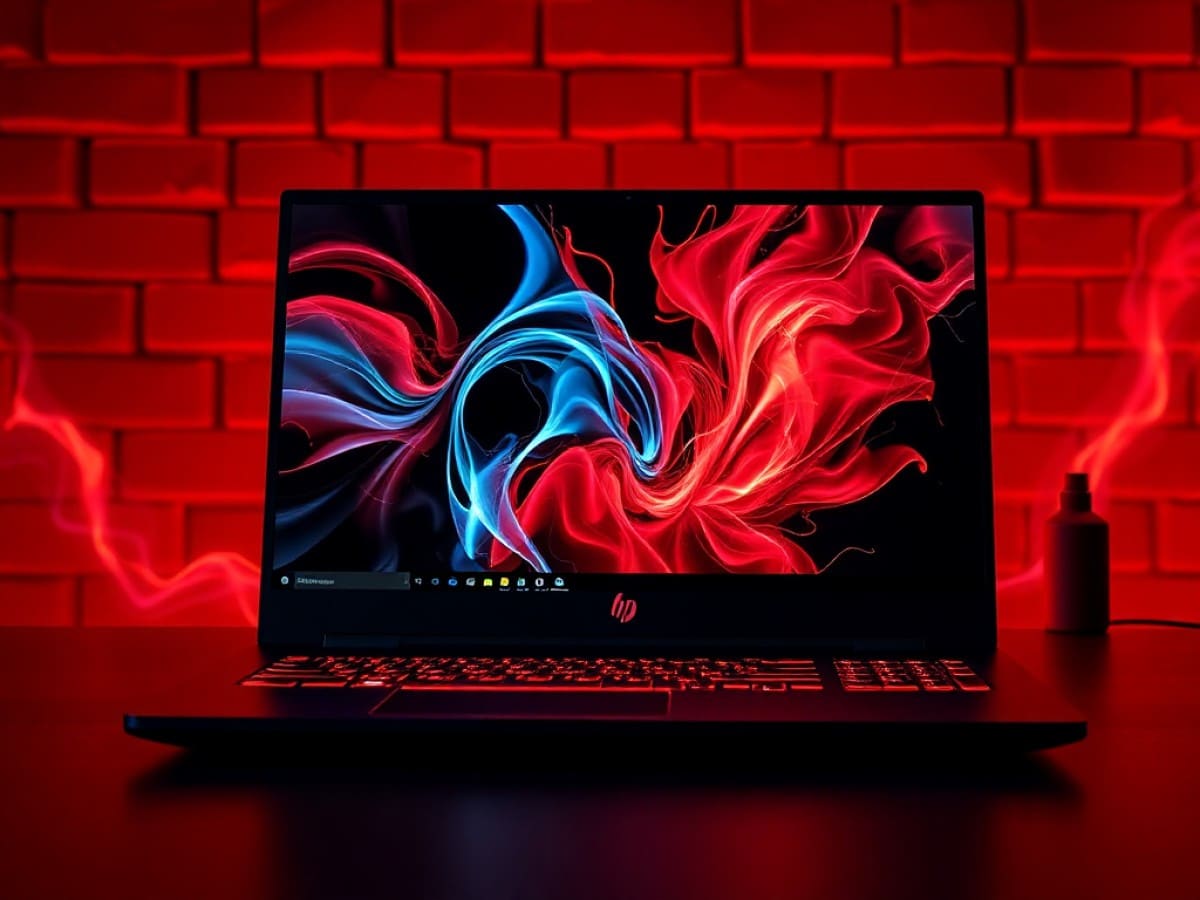
While HP’s Omen series has impressed us on multiple occasions, the Victus line continues to fall short, particularly with the 2025 Victus 15. Here’s a detailed look at why.
Scientists confirm: This is the most effective way to get your cat’s attention, according to new research
Elderly Couple Refuses Reserved Seats—Viral Train Standoff Sparks Fiery Debate on Courtesy
The HP brand’s journey into the gaming sector has been inconsistent. While certain models from the HP Omen series have caught our fancy, even earning our accolades, the Victus range has consistently been a letdown.
Unfortunately, 2025 doesn’t seem to be the year when HP’s entry-level gaming PCs capture our hearts. Even worse, this Victus 15 model carries the same flaws we’ve highlighted in past years. Let’s delve into the details right away.
Technical Specifications
| Model | HP Victus 15-fb3003nf |
|---|---|
| Dimensions | 357.9 mm x 23.5 mm |
| Resolution | 1920 x 1080 pixels |
| Display Technology | LCD |
| Touch Screen | No |
| CPU | Ryzen AI 5 340 |
| GPU | NVIDIA GeForce RTX 5060 |
| RAM | 16 GB |
| Internal Storage | 512 GB |
| Material | Plastic |
| Operating System | Microsoft Windows 11 |
| Weight | 2290 grams |
| Depth | 255 mm |
Design
While we won’t necessarily criticize HP for its design, the 2025 HP Victus 15 is not the most attractive PC in its class or on the market, but it is perfectly adequate with its entirely plastic chassis that maintains very standard lines. It has a somewhat old-fashioned gamer aesthetic, not particularly modern, but utterly typical.
Expect a PC that is relatively thick at 2.35 centimeters and quite heavy at 2.3 kilograms. While the trend is towards rounded shapes and an ever-more understated style, even in gaming, the 2025 HP Victus 15 retains the same pronounced features of a gaming PC from 5-6 years ago. At least it seems sturdy and ready to withstand even the less careful gamers.
Keyboard and Touchpad
The keyboard is classic with fairly standard laptop switches. They are quite stable, with a generous spacing, especially considering the inclusion of a numeric keypad, but the activation distance meets a very soft return, which doesn’t offer a particularly precise typing feel.
The touchpad, slightly offset to the left to accommodate the numeric keypad, has a slightly grippy plastic surface and a comfortable size. Its click is a bit plasticky and hollow, but not bad overall. Again, the design feels dated.
Connectivity
On the left, there’s a classic barrel charging port, a USB A 3.0 port, and a combo jack. On the right, you’ll find an HDMI 2.1 port, another USB A 3.0, an RJ45 1Gbps, and a USB-C 3.1 port.
Nothing groundbreaking here. While no port offers modern bandwidth, it’s also worth noting that the absence of USB 2.0 is a welcome update on this type of machine. The HP Victus 15 from 2025 can easily adapt to different environments and uses, without offering anything extra.
Webcam and Audio
The unit features a standard 1080p sensor with Windows Hello compatibility for facial recognition. The webcam itself provides a satisfactory output, without being exceptional.
As for audio, the two speakers located at the bottom of the chassis are far from providing a satisfying sound, comparable more to entry-level smartphone speakers. Plug in your headphones if you want to distinguish any detail between the highs and mids, as the bass is missing. They are just serviceable, without any real pleasure.
Display
In our test version, the HP Victus 15 of 2025 features a 15.6-inch IPS LCD screen with a resolution of 1920 x 1080 pixels, an old 16:9 ratio. This panel is anti-glare treated and promises a maximum refresh rate of 144 Hz.
Under our testing with Portrait Displays’ CalMAN software, we found a coverage of 57% of the sRGB space and 38% of the DCI-P3 space. As stated by the brand, which only claims a now meager coverage of the NTSC space.
The maximum brightness is measured at 337 cd/m² with a very low contrast ratio of 906:1 for IPS LCD. The average color temperature is found at 6076, a bit too warm, with an average delta e00 measured in sRGB of 6.06 with a huge maximum deviation of 23.7, typical of NTSC.
Let’s be clear: the biggest disappointment in the Victus range is still here. HP makes no effort with these panels, and it’s hard to understand how they still manage to stock them when well-calibrated IPS LCDs are plentiful and inexpensive on the market. In 2025, like in 2024, these specifications at this price are unacceptable.
Software
The usual pre-installed advertising software, along with a plethora of HP software taking up too much space in our Start menu upon startup. Typical HP traits, in addition to the OMEN software whose philosophy is good — to find one’s library and gamer settings in one place — but the execution suffers from a lack of focus.
Performance
In our test configuration, the HP Victus 15 of 2025 is powered by an AMD Ryzen AI 5 340 SoC with 6 cores and 12 threads that can turbo up to 4.8 GHz. It is paired with 16 GB of DDR5 RAM at 5600 MT/s, and 512 GB of storage on PCie Gen 4.
Importantly, we find the NVIDIA GeForce RTX 5060 mobile graphics card here, scaled down to a TGP of 80W from a maximum of 110W. A reduction that’s hard to justify since the chassis of the HP Victus could comfortably support this chip at its maximum. It seems the engineers were aiming for a thinner form factor.
Benchmarks
Under Cinebench 2024, we find a multi-core score of 667 points and a single-core score of 113. Expected performance from the chip, which is not the most aggressive, but is quite convincing for its category.
In 3DMark, we find scores of 2529 points under Speed Way and 2207 points under Steel Nomad. The mobile RTX 5060 normally performs better, reminding us more of the mobile RTX 5050 at its highest TGP.
Finally, regarding the SSD, we are essentially on the early generation performance of the now outdated PCIe Gen 4. But especially, the storage memory emits an audible and annoying whine when running at full power; HP made a real compromise here.
In-Game
| 1080p | Black Myth Wukong | Cyberpunk 2077 |
| PT ON, DLSS4 Balanced, FG x4 | 114 FPS | 135 FPS |
| PT ON, DLSS4 Balanced, FG x0 | 34 FPS | 42 FPS |
| PT ON, DLSS OFF | 17 FPS | 18 FPS |
| RT OFF, DLSS4 Balanced, FG x4 | 121 FPS | 254 FPS |
| RT OFF, DLSS4 Balanced, FG x0 | 37 FPS | 97 FPS |
| RT OFF, DLSS OFF | 28 FPS | 79 FPS |
With only a few rare differences, we are really seeing the performance of an RTX 5050 here. HP’s decision to lower the TGP of the RTX 5060 is even more difficult to understand here, as the manufacturer seems to gain nothing from it.
For Creatives
It’s essentially the same on the creative side. While the HP Victus 15 of 2025 offers commendable performance, nothing justifies the integration of the RTX 5060.
Cooling and Noise
At least, the manufacturer fully controls its heating, and the fans, while audible, do not go into combat helicopter mode. But is this really a logical sacrifice for a gamer config, whose DNA is to seek power above all?
Battery Life
The HP Victus 15 of 2025 features a 70 Wh battery, which is charged via a 200-watt power supply. This block will be necessary to draw maximum performance from the configuration, which can otherwise be recharged via a Power Delivery block.
In office use, with brightness set to 50%, we find a battery life between 7 and 8 hours. Quite good considering the gamer chassis, but it highlights the lack of identity in the configuration settings.
Pricing and Availability
The HP Victus 15 of 2025 that we tested is sold at an official price of 1399.99 euros, but is often found on sale for 900 euros.
-
Seller: Boulanger
Price: 1000 €
-
Seller: Rakuten
Price: 1000 €
Similar Posts
- Asus TUF Gaming A18 (2025) Review: Is It Too Big for the RTX 5050?
- Asus ROG Zephyrus G14 (2025) Review: Small Size, Big Power!
- Asus TUF Gaming A18 (2025) Review: Is It Too Big for an RTX 5050? Find Out Now!
- MSI Titan 18 HX AI A2XW Review: Stunning Display Meets Unmatched Power
- Alienware 15 (2026) Review: Affordable Gaming Laptop Falls Short in Competitive Edge

Maya Singh is a senior editor covering tablets and hybrid devices. Her work explores how these tools reshape digital productivity and learning. She also contributes to feature editorials on emerging tech.