
Scientists confirm: This is the most effective way to get your cat’s attention, according to new research
Elderly Couple Refuses Reserved Seats—Viral Train Standoff Sparks Fiery Debate on Courtesy
Just months after the EVO-X2, which had set a benchmark in local AI thanks to its 128 GB of unified memory, GMKtec is back with the EVO-X3. The chip is exactly the same: an AMD Ryzen AI Max+ 395 with 16 Zen 5 cores and 32 threads, paired with its Radeon 8060S iGPU containing 40 compute units. Meanwhile, the Ryzen AI Max+ PRO 495 is on the horizon, offering slightly more bandwidth and up to 192 GB of RAM.
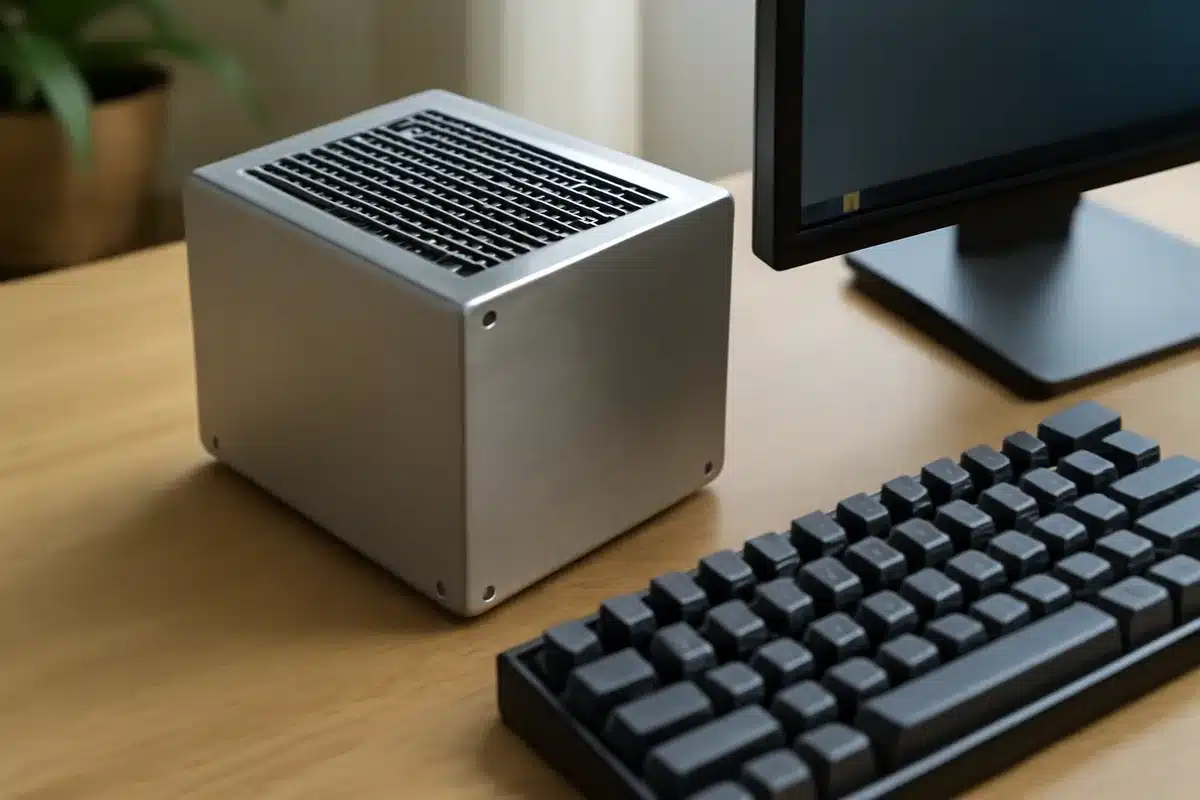
What changes is everything surrounding it: a completely redesigned casing, larger and longer, all in metal, featuring a massive ventilation grid on top and a significantly more developed fan system.
This design choice is not merely aesthetic. On an APU like the Strix Halo, where the CPU and GPU share a common power envelope, the chassis’s ability to dissipate heat directly affects sustained performance. With a configurable TDP of up to 140 W, the EVO-X3 allows the Radeon 8060S to perform where most mobile GPUs are limited by their energy budget. This is precisely what I wanted to verify on the bench, comparing it to the EVO-X2, the Minisforum MS-S1 Max, and other Strix Halo machines I’ve tested like the Framework Desktop.
Tested configuration here: 128 GB of LPDDR5X-8000 with 64 GB allocated as VRAM, 2 TB Crucial E100 SSD on PCIe Gen5, Wi-Fi 7, all for €3,499.99. Here’s the feedback, I hope you find it comprehensive enough.
Technical Specifications
| Specifications | GMKtec EVO-X3 (tested config) |
|---|---|
| Processor | AMD Ryzen AI Max+ 395 (Strix Halo, Zen 5, 16C / 32T, up to 5.15 GHz, AVX-512) |
| Integrated GPU | AMD Radeon 8060S (40 CU RDNA 3.5) |
| NPU | AMD XDNA 2 (50 TOPS) |
| RAM | 128 GB LPDDR5X-8000 (8 channels, Micron, soldered) |
| Allocated VRAM | 64 GB (BIOS carveout), up to 95.8 GB addressable by iGPU under Vulkan |
| Storage | Crucial E100 2 TB NVMe PCIe 5.0 |
| Wired Network | 2.5 GbE |
| Wireless Network | Wi-Fi 7 (MediaTek RZ717, negotiated link 2.9 Gbps), Bluetooth 5.4 |
| TDP | Configurable, up to 140 W (package) |
| Power Consumption at Wall | 14 W at idle, approximately 185 W under load |
| Chassis | All metal, console format, large top ventilation grill |
| BIOS | V1.01 (Balanced and Performance modes) |
| System | Windows 11 Pro |
| Price of tested config | €3,499.99 |
This test unit was provided by GMKtec.
Why You Should Never Reheat These Foods in the Microwave – The Hidden Dangers Experts Warn About
I tried the top 5 guard dogs—here’s what makes these breeds the ultimate protectors
Design: A Metal Gaming Console
Placed on the desk, the EVO-X3 doesn’t look like any other mini PC. It immediately recalls a living room gaming console: a casing that’s quite slim in height but wide and especially long, significantly more imposing than the EVO-X2 or typical cubic mini PCs. This is no longer a “mini” PC in the strict sense; it’s a compact computer in a console format that stands out with presence.

The build is robust and the finishes are excellent. The casing is entirely metal, with precise assembly, no gaps or creaking, and a surface quality that stands out from the plastic used by many competitors. The top features a very large ventilation grill, the central element of the design, which hints at the generous cooling system installed underneath. It’s beautiful, understated, and very well-made. On a machine sold close to €3,500, this is the least expected, but GMKtec delivers.
This format is not just a stylistic whim. On the EVO-X2, the compact chassis required staying in Balanced mode to manage noise and heat.
On the EVO-X3, the additional volume and much more developed ventilation allow for a much more aggressive power budget while staying cool and quiet. The chassis is even cool to the touch even under load: heat is expelled through the grill, not the casing. This is the real differentiator for this machine, and we’re going to measure it.
Teardown: Two Accessible SSD Slots, and a Laptop-Like Design
Good news on the storage front: the EVO-X3 is easy to open. Eight Torx screws, one plate to remove, and you directly access two M.2 2280 slots on PCIe 4.0 x4, one occupied by the original Crucial SSD (topped with a heatsink) and a second free for adding a disk.
This is particularly welcome as, as we will see later, the SSD provided as standard deserves to be replaced or supplemented for intensive use. Beyond storage, there’s obviously nothing else to do inside: the memory is soldered to the processor package, a constraint inherent to the Strix Halo platform.
The teardown mainly shows a surprising design. Two large fans flank the motherboard, connected by a set of large heat pipes that snake along the entire length of the chassis.
It quite literally resembles the interior of a gaming laptop, with its flat motherboard and heat pipe and radial fan cooling system, but positioned in a vertical console format.
Cooling: The EVO-X3’s True Strength
Some context first. The Ryzen AI Max+ 395 is an APU: its CPU and large iGPU Radeon 8060S share a single power envelope. When one draws power, the other gives up some of the budget. Mobile GPUs are generally heavily limited by this envelope, which explains why the same Strix Halo delivers different results depending on the chassis hosting it. With a maximum TDP of 140 W, the EVO-X3 gives the Radeon 8060S a margin that few machines of this format can match.
| Thermal and Acoustic Measurement | Value |
|---|---|
| SoC Temperature at Idle | 56 °C |
| SoC Temperature under Sustained CPU Load | 67 °C |
| SoC Temperature under Combined CPU + AI Load | 66 °C |
| SoC Temperature under AI / GPU Load | 70 °C |
| CPU Throttling | None (flat plateau at 126% of base) |
| Noise at Cold / Short Load (1 m) | 32.4 dB |
| Noise under Sustained CPU Load, Hot Machine (1 m) | 48.6 dB |
| Noise under CPU + iGPU Load (1 m) | 44.7 dB |
| Chassis to the Touch under Load | Cold |
The numbers speak for themselves, but let’s discuss them. A SoC peaking at 67 °C under sustained load, on a Strix Halo that commonly reaches 85 or 95 °C elsewhere, is cool. The delta between idle and load is only about 14 °C: the thermal margin is huge. The throttling is perfectly flat; the frequency never drops, the limit comes from the power envelope and not the temperature.
A methodological note, as I spent time on this topic: the CPU probe (Tctl) is blocked by Secure Boot (which I disabled) on this machine, the temperature read is from the SoC VR sensor, a reliable proxy on this APU. The exact CPU die is probably a bit hotter, but unreadable here.
Regarding noise, the behavior follows the thermal state. Cold or under a short load, the machine remains at 32.4 dB, almost inaudible. Under a heavy prolonged load, once the APU is saturated with heat, the fans go up to 48.6 dB: a clear ventilation hum, but a hum, not a whistling. Under combined CPU + iGPU load, it even drops to 44.7 dB. For context, the EVO-X2 ran at 47 dB with a less aggressive BIOS profile. The EVO-X3 handles more power while staying in the same sound range, and it’s much quieter on short loads. The large metal chassis shaped like a console does exactly the job it was designed for.
CPU: The Best Processor in Our Comparison
The same chip as the EVO-X2, but with a newer BIOS and a Performance mode that the chassis finally allows to be fully exploited. The result places the EVO-X3 at the top of all the machines I’ve tested.
| CPU Metric | GMKtec EVO-X3 | GMKtec EVO-X2 | Minisforum MS-S1 Max |
|---|---|---|---|
| Geekbench 6 Single | 2 979 | 2 939 | 2 925 |
| Geekbench 6 Multi | 23 114 | 22 009 | 21 133 |
| Geekbench 7 Single | 2 742 | not measured | not measured |
| Geekbench 7 Multi | 26 370 | not measured | not measured |
| Cinebench 2026 Single | 461 | 451 | 461 |
| Cinebench 2026 Multi | 7 819 | 7 042 | 6 314 |
| AES Encryption | 38 220 MB/s | 37 989 MB/s | 37 980 MB/s |
| LZW Compression | 3 649 MB/s | 3 546 MB/s | 3 851 MB/s |
In multi-threading, the EVO-X3 scores 7,819 points on Cinebench 2026, 11% better than the EVO-X2 and 24% better than the Minisforum MS-S1 Max, although equipped with the same APU. On Geekbench 6 multi-core, it scores 23,114 points, 5% above the EVO-X2. In single-core, the three machines are neck-and-neck (461 on Cinebench, 2,979 on Geekbench 6): a single core alone does not saturate the power envelope, so the chassis makes no difference in responsiveness.
I precisely measured the contribution of the BIOS Performance mode compared to the Balanced mode, on the same machine: +5.5% on Cinebench multi-threading (7,408 to 7,819) and +4.1% on Geekbench 6 multi-core (22,212 to 23,114), with single-core rigorously flat.
This means that the Performance mode is worth it for sustained loads (rendering, compiling, encoding, AI), but brings nothing for office work or responsiveness.
Memory, Storage, and GPU: A Caveat About the SSD
| Memory | GMKtec EVO-X3 | GMKtec EVO-X2 | Minisforum MS-S1 Max |
|---|---|---|---|
| RAM Bandwidth | 72.3 GB/s | 73.8 GB/s | 72.8 GB/s |
| Memory Frequency | LPDDR5X-8000 | LPDDR5X-8533 | LPDDR5X-8000 |
The 128 GB of LPDDR5X in 8 channels delivers 72.3 GB/s, on par with the other two Strix Halo machines. One small difference to note: the EVO-X3 uses memory at 8,000 MT/s whereas the EVO-X2 went up to 8,533 MT/s. This slight retreat explains the few percentage points lost on the GPU and AI, both bandwidth-hungry. An interesting bonus under Windows: with the Vulkan backend, the iGPU accesses 95.8 GB of memory, well beyond the 64 GB carveout. Thus, very large models fit on the GPU.
| NVMe Storage | GMKtec EVO-X3 | GMKtec EVO-X2 | Minisforum MS-S1 Max |
|---|---|---|---|
| SSD | Crucial E100 2 TB (Gen5) | AirDisk 2 TB (Gen4) | Kingston OM8 (Gen4, slot x1) |
| Sequential Read | 5,430 MB/s | 6,785 MB/s | 2,183 MB/s |
| Sequential Write | 4,033 MB/s | 6,207 MB/s | 5,192 MB/s |
| Random Read 4K | 48,618 IOPS | 595,378 IOPS | 302,148 IOPS |
| Random Write 4K | 49,577 IOPS | 469,556 IOPS | 95,767 IOPS |
This is the dark spot of the test. The 2 TB Crucial E100, advertised as PCIe Gen5, has sequential speeds (5,430 MB/s read, 4,033 MB/s write) that fall short of what we expect from this interface, and especially its performance in random 4K access collapses: 48,600 IOPS in read and 49,600 in write, versus 595,000 and 470,000 on the EVO-X2. A factor of 10. Everything indicates an SSD without DRAM cache, very modest in random performance. For office tasks or sequential AI model loading, it won’t be noticeable. For databases, heavy multitasking, or virtualization, it’s a handicap. On a machine priced at €3,500, replacing this SSD with a true high-end NVMe is an expense to consider for intensive uses.
| GPU | GMK
Similar Posts
 Maya Singh is a senior editor covering tablets and hybrid devices. Her work explores how these tools reshape digital productivity and learning. She also contributes to feature editorials on emerging tech.
Categories Latest Articles |
|---|