
Scientists confirm: This is the most effective way to get your cat’s attention, according to new research
Elderly Couple Refuses Reserved Seats—Viral Train Standoff Sparks Fiery Debate on Courtesy
The high-end mini PC market has transformed significantly in recent months. Where we once tested configurations with 32 GB of RAM and a modest iGPU, we now see machines equipped with the AMD Strix Halo platform, originally designed for professional laptops and compact workstations. The GMKtec EVO-X2 is one of those machines that pushes the boundaries of what a mini PC can do.
Inside, an AMD Ryzen AI Max+ 395 features 16 Zen 5 cores and 32 threads, paired with a Radeon 8060S iGPU with 40 RDNA 3.5 compute units. This setup is equivalent to a mid-range entry-level graphics card integrated into the processor. It is supported by 128 GB of unified LPDDR5X-8533 memory, with 64 GB allocable as dedicated VRAM for the GPU. It’s this memory that changes the game for local AI, and it’s exactly what I wanted to test thoroughly.
Other machines share the same Strix Halo platform. I’ve already tested the Minisforum MS-S1 Max and the Framework Desktop, which incorporate the same APU. The competition will therefore be on integration, cooling, BIOS settings, and target. I spent several days on the EVO-X2 running Windows 11 and Linux/SteamOS, with a rigorous testing protocol focused particularly on local AI. Here’s everything you need to know.
Technical Specifications
| Specifications | GMKtec EVO-X2 |
|---|---|
| Processor | AMD Ryzen AI Max+ 395 (Strix Halo, 16 cores / 32 threads, up to 5.1 GHz) |
| CPU Architecture | Zen 5, TSMC 4 nm FinFET etching |
| L3 Cache | 64 MB (80 MB total) |
| Integrated GPU | AMD Radeon 8060S (40 CU RDNA 3.5, up to 2.9 GHz) |
| NPU | AMD XDNA 2 (50 TOPS) |
| Total AI Power | 126 TOPS (CPU + GPU + NPU) |
| RAM | 128 GB unified LPDDR5X-8533 (soldered, 8 channels, 256-bit bus) |
| Dedicated GPU VRAM | Up to 64 GB (configurable in BIOS) |
| Storage | 2 TB NVMe PCIe 4.0 (AirDisk) |
| Storage Expansion | 1 free M.2 2280 PCIe 4.0 slot (up to 16 TB total) |
| Wired Network | 1 × RJ-45 2.5 GbE |
| Wireless Network | Wi-Fi 7, Bluetooth 5.4 |
| Connectivity | 2 × USB4, USB-A, HDMI 2.1, DisplayPort 1.4, 3.5 mm jack |
| Display | Up to 4 simultaneous screens |
| TDP | 45 to 120 W (up to 140 W in boost) |
| Cooling | 3 heat pipes + dual Max3.0 fan |
| System | Preinstalled Windows 11 Pro (compatible with Linux/Ubuntu) |
| Power Supply | 230 W external block |
| Warranty | 12 months |
| Price (64 GB + 1 TB) | €1,899.99 (with promo code) |
| Price (128 GB + 2 TB) | Higher, on request |
This test unit was provided by GMKtec, configured with 128 GB of RAM and 2 TB SSD.
Design, Cooling, and Disassembly
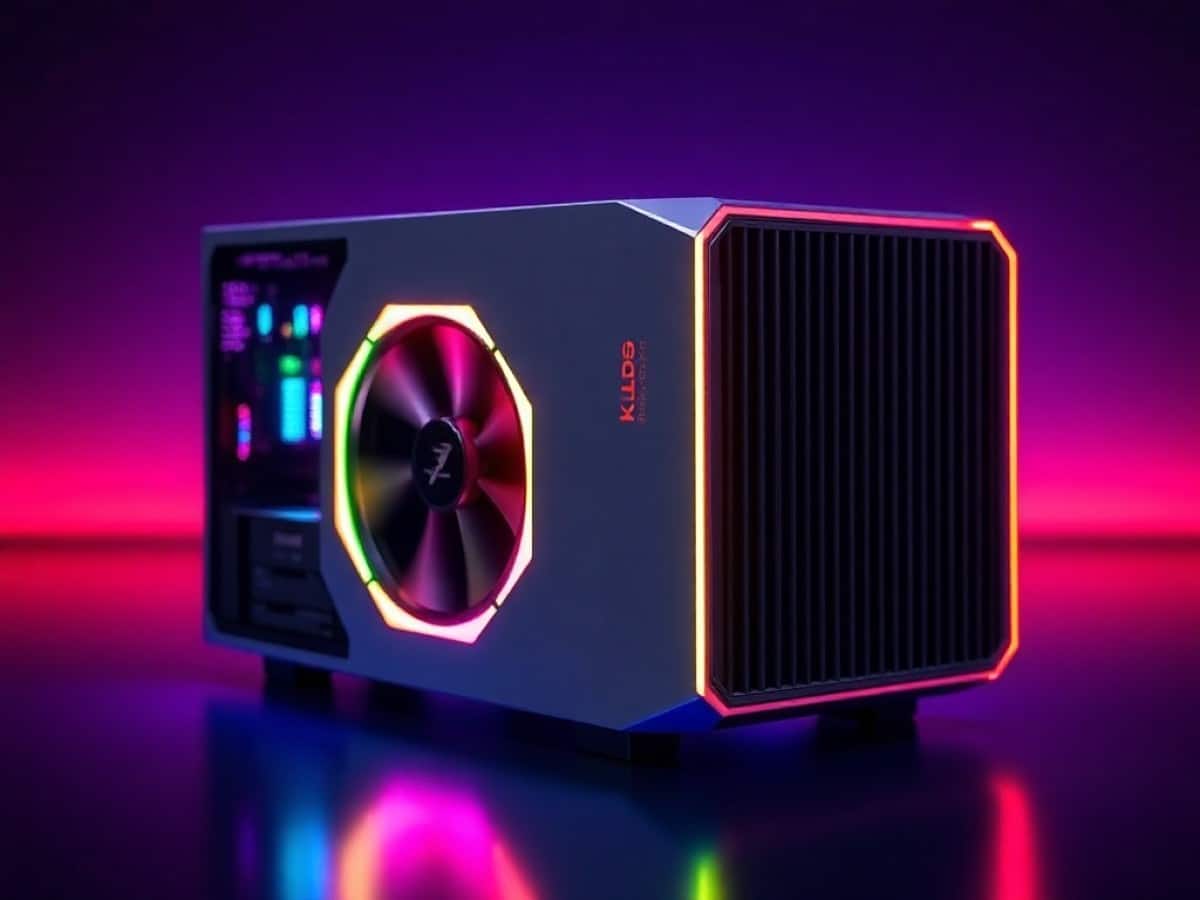
The EVO-X2 remains compact despite the embedded power. The aluminum chassis with a touch of bronze gold on the sides suggests a laptop casing, only denser. The finish is meticulous, without excessive RGB, just discreet lighting on the fans with a dedicated button on the front to change the lighting mode and access ventilation profiles. Overall, it’s understated and well thought out for a professional workstation.
Why You Should Never Reheat These Foods in the Microwave – The Hidden Dangers Experts Warn About
I tried the top 5 guard dogs—here’s what makes these breeds the ultimate protectors
In terms of connectivity, GMKtec has taken care in the design. On the front, there are USB-A 3.2 Gen 2 ports and a USB4 (40 Gbps, DP Alt-Mode, Power Delivery). At the rear, two additional USB4 ports, HDMI 2.1, DisplayPort 1.4, a 2.5 GbE Ethernet port, and the power input. This is sufficient to manage up to four simultaneous screens. Unfortunately, there’s no OCuLink here, unlike the EVO-T2S. For those wanting to connect an eGPU to this machine, it will have to be done via USB4.
The external power supply is robust, 230 watts, equivalent to a gaming laptop charger. It’s not something that would fit in a case, but it’s consistent with a machine that can pull up to 140 W at peak. A VESA mounting kit is included for those who want to tuck the machine behind a display.
Disassembly: Not Immediate, but Accessible
Accessing the interior isn’t as straightforward as with the EVO-T2S. Several screws must be removed, some of which are located under the rubber pads, which can be a bit annoying as the pads are glued and may deform during peeling. Once the case is removed, however, a well-thought-out design and a particularly ambitious cooling system are revealed. Here’s a look:
Inside, we find a system named Max3.0 by GMKtec: three copper heat pipes, two sizable CPU fans, and a third fan dedicated to cooling the M.2 SSDs (equipped with RGB and controllable from the front button).
The main fan is noticeably larger than those found in most mini PCs, and that’s critical. A large fan spinning slowly moves more air while making less noise than a small fan at high speed.
This is evident in the sound measurements further on: despite the power, the machine remains acoustically controlled.
In terms of expandability, you can access the two M.2 2280 PCIe 4.0 slots which can accommodate up to 16 TB of storage (2 × 8 TB). However, the RAM is soldered. This is a characteristic inherent to the Strix Halo platform and there’s no way to change it. It’s not really limiting here: at 128 GB, it’s well beyond the needs of ordinary users, even for AI.
Raw Performance: A Mini PC that Competes with Workstations
I tested the EVO-X2 using the same protocol as other mini PCs, with a particular focus on the AI part which largely justifies the existence of this machine. A methodological note on these figures. The CPU and GPU benchmarks below were conducted in Balanced mode from the BIOS, not in Performance mode. In maximum Performance mode, the figures should rise by another 5 to 10% on multi-core. Keep this in mind as a baseline rather than a ceiling.
Benchmark Summary
| Benchmark | Score Obtained |
|---|---|
| Geekbench 6, Single-Core | 2,939 |
| Geekbench 6, Multi-Core | 22,009 |
| Geekbench 6, Vulkan (iGPU) | 102,798 |
| Geekbench 6, OpenCL (iGPU) | 98,874 |
| Cinebench 2026, CPU Single | 451 |
| Cinebench 2026, CPU Multi | 7,042 |
| winsat, AES256 Encryption | 37,989 MB/s |
| winsat, LZW Compression | 3,546 MB/s |
| winsat, Memory Bandwidth | 73.8 GB/s |
| NVMe, Sequential Read | 6,785 MB/s |
| NVMe, Sequential Write | 6,207 MB/s |
| NVMe, Random Read 4K | 595,378 IOPS |
| NVMe, Random Write 4K | 469,556 IOPS |
| Wi-Fi 7 (iperf3 TCP) | 1.26 Gbps |
| Noise at Full Load (1 m) | 47 dB(A) |
| Idle Power Consumption | 16.6 W |
| Maximum Combined Power Consumption | 128.9 W |
CPU: 32 Threads That Make a Difference
The Ryzen AI Max+ 395 features 16 Zen 5 cores and 32 threads thanks to Simultaneous Multi-Threading (SMT), where Intel’s Panther Lake chips have only one thread per core. This difference weighs heavily in multi-threading.
| CPU Bench. | GMKtec EVO-X2 | Minisforum MS-S1 Max | Ratio |
|---|---|---|---|
| Geekbench 6 Single | 2,939 | 2,925 | 1.00× |
| Geekbench 6 Multi | 22,009 | 21,133 | 1.04× |
| Cinebench 2026 Single | 451 | 461 | 0.98× |
| Cinebench 2026 Multi | 7,042 | 6,314 | 1.12× |
| AES256 Encryption | 37,989 MB/s | 37,980 MB/s | 1.00× |
| LZW Compression | 3,546 MB/s | 3,851 MB/s | 0.92× |
In Geekbench 6, I scored 22,009 points in multi-core, compared to 15,665 for the Core Ultra X7 358H and 11,282 for the Minisforum M2, representing a massive gain over Intel’s Panther Lake machines. In Cinebench 2026, I scored 7,042 points in multi-core, nearly 1.6 times more than the X7. For tasks like compilation, 3D rendering, massive transcoding, or containers, the EVO-X2 has a clear advantage.
However, in single-core performance, it’s a closer race. Geekbench measures 2,939 points, nearly equal to the X7 (2,789). In Cinebench single-core, AMD is even slightly behind (451 vs 487). Panther Lake chips retain a slight advantage on single-thread tasks, which impact office responsiveness and some games. But for parallel loads, the Ryzen AI Max+ 395 is in a different league.
Regarding endurance, the thermal behavior is healthy. Under sustained 32-thread load for 90 seconds, the frequency stabilizes on a perfectly flat plateau around 123% of the base frequency, with no thermal drop-offs. The sensor reads around 39 °C, a credible figure for this platform. The Max3.0 cooling handles the 124 W from the chip without flinching.
Radeon 8060S GPU: A Real GPU in a Mini PC
The Strix Halo stands out for another major feature: an iGPU with 40 RDNA 3.5 compute units, where most competing iGPUs stop at 12 or 16. The table below summarizes the results against the Minisforum MS-S1 Max, equipped with the same APU.
| GPU Metric | GMKtec EVO-X2 | Minisforum MS-S1 Max | Ratio |
|---|---|---|---|
| Geekbench Vulkan | 102,798 | 89,919 | 1.14× |
| Geekbench OpenCL | 98,874 | 102,008 | 0.97× |
The Radeon 8060S scores 102,798 points in Geekbench Vulkan, about 1.6 times more than the Arc B390 of the EVO-T2S, and over 5 times the iGPU of the Minisforum M2. The iGPU delivers performance comparable to a mobile RTX 4060 in many scenarios, a positioning confirmed by GPU benchmark databases.
We measured 11,289 points on 3DMark Time Spy, over 60 fps on Spider-Man 2 in 1440p Very High (FSR Quality), Doom The Dark Ages in 1440p High with FSR Balanced at over 60 fps, and Cyberpunk 2077 in 1440p Ultra (FSR Quality) at an average of 74 fps. With FSR3 frame generation activated, the most demanding games exceed 120 fps without difficulty. For an integrated GPU in a mini PC, this is an unprecedented level.
Similar Posts
- GMKtec EVO-X3 Review: Console-Style Case Hits 140W TDP – Strix Halo Comfortably Unleashed!
- Minisforum MS-03 Review: Panther Lake Unleashed: Triple 10 GbE & Dedicated GPU Slot!
- GMKtec EVO-T2S Review: Powerful Panther Lake Mini-PC with a Real GPU!
- Minisforum AI X1 Pro-470 Review: Is This the Ultimate Mac Mini Killer?
- We Tested the Acemagic RX16: Are Cheap Chinese Laptops Worth Your Time?

Maya Singh is a senior editor covering tablets and hybrid devices. Her work explores how these tools reshape digital productivity and learning. She also contributes to feature editorials on emerging tech.
Categories
Latest Articles