
Scientists confirm: This is the most effective way to get your cat’s attention, according to new research
Elderly Couple Refuses Reserved Seats—Viral Train Standoff Sparks Fiery Debate on Courtesy
Just weeks after reviewing the Minisforum M2 featuring the Core Ultra 7 356H, we now explore the “beefed-up GPU” variant of Panther Lake. While retaining the same 16-core / 16-thread CPU architecture, Intel has equipped this chip with a far more ambitious iGPU: the Arc B390 with its 12 Xe3 cores.
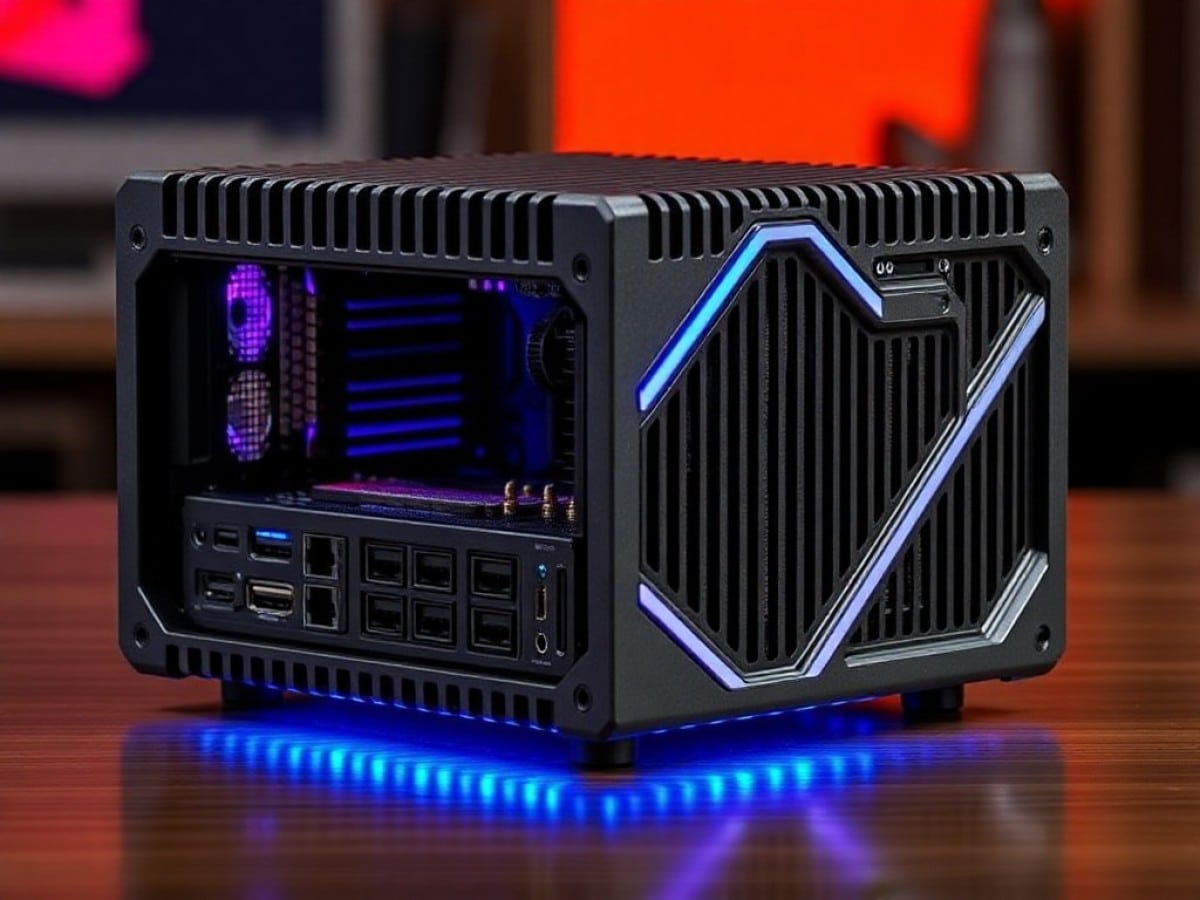
The GMKtec EVO-T2S leverages this platform and supplements it with 64 GB of LPDDR5X at 8,533 MT/s in an 8-channel configuration, a Gen5 NVMe PCIe SSD, Wi-Fi 7, an OCuLink port for external GPU connection, and a dual-fan cooling system. On paper, it stands as one of the most comprehensive mini PCs currently available, blurring the lines between a mini-PC and a true compact tower.
I spent several days testing the X7 358H configuration with 64 GB of RAM and 1 TB SSD, conducting thorough benchmarks on the CPU, memory, Gen5 NVMe storage, Arc B390 iGPU, and local AI capabilities.
Technical Specifications
| Specifications | GMKtec EVO-T2S (alias NucBox EVO-T2) |
|---|---|
| Processor | Intel Core Ultra X7 358H (Panther Lake, 16 cores / 16 threads, up to 4.8 GHz) |
| CPU Architecture | 4 P-Cores + 8 E-Cores + 4 LP-E (Intel 18A) |
| Integrated GPU | Intel Arc B390 (12 Xe3 cores, up to 2.5 GHz, 96 XMX engines) |
| NPU | 50 TOPS dedicated |
| Total AI Power | 180 TOPS (CPU + GPU + NPU) |
| RAM | 64 GB LPDDR5X-8533 (soldered, 8 channels, non-expandable) |
| Storage | 1 TB NVMe PCIe 5.0 x4 (M.2 2280) |
| Storage Expansion | 1 free M.2 2280 PCIe 4.0 x1 slot |
| Wired Network | 1 × RJ-45 10 GbE + 1 × RJ-45 2.5 GbE |
| Wireless Network | Wi-Fi 7 (Intel RZ717, up to 2.9 Gbps), Bluetooth 5.4 |
| Front Connectivity | 1 × USB4 (40 Gbps, DP Alt, PD 100 W), 2 × USB-A 3.2 Gen 2, 1 × USB-A 2.0, 3.5 mm jack |
| Rear Connectivity | 1 × HDMI 2.1, 1 × DisplayPort 1.4, 1 × USB4, 2 × USB-A 2.0, 1 × OCuLink (PCIe Gen4 x4), 2 × RJ-45, DC-In, 3.5 mm jack |
| Display | Supports up to 4 simultaneous 4K displays |
| Configurable TDP | 35 / 45 / 54 W (up to 60 W in boost) |
| Cooling | Vapor Chamber + dual fan |
| System | Windows 11 Pro pre-installed |
| Dimensions | Compact chassis in aluminum and plastic |
| Power Supply | ~148 W external block |
| Warranty | 36 months |
| Price (64 GB / 1 TB) | 1,699.99 euros |
This test unit was provided by GMKtec.
Why You Should Never Reheat These Foods in the Microwave – The Hidden Dangers Experts Warn About
I tried the top 5 guard dogs—here’s what makes these breeds the ultimate protectors
A Stylish and Well-Designed Case
My first impression of the EVO-T2S was quite positive. The case combines a bronze aluminum shell with plastic panels and a neatly designed ventilation cutout.
The finish is high-end, understated, with subtle RGB accents around the fans for enthusiasts. The unit can be placed flat on a desk or mounted behind a monitor using the provided VESA kit.
The range of connections is extensive. The front features a USB4 port (40 Gbps, DisplayPort Alt-Mode, Power Delivery 100 W), two USB-A 3.2 Gen 2 ports, a USB-A 2.0 port, and a combo jack.
The back is a veritable treasure trove: a second USB4, an HDMI 2.1, a DisplayPort 1.4, two USB-A 2.0 ports, an OCuLink port (PCIe Gen4 x4) for connecting an external GPU, and notably two Ethernet ports including a 10 GbE—unprecedented for a mini-PC at this price point. The 2.5 GbE complements this nicely, making it suitable for uses such as a NAS, software router, or server without any network limitations. Note that the power supply is external, and not as bulky as one might expect.
The OCuLink is a strong selling point: it offers a PCIe Gen4 x4 (64 Gbps) throughput that exceeds USB4 (40 Gbps), allowing you to connect an external GPU, such as an RTX 4060 or 4070, without the usual USB bottleneck. For those who want to maintain a mini-PC form factor while keeping the door open for serious gaming, this is a significant advantage.
Disassembly: One of the Simplest on the Market
Accessing the interior is exceptionally well thought out. Simply unscrew the four pads under the case to release the external aluminum shell, which slides off easily.
This exposes an internal plastic chassis, secured by two screws on each side. This second stage of disassembly provides access to all components within seconds.
Inside, the design is meticulous. The cooling system combines a vapor chamber with two fans, one of which is quite large. The larger the fan, the slower it needs to spin to move the same amount of heat, resulting in quieter and more efficient operation. This is confirmed by noise measurements later in the review.
In terms of expandability, you have access to two M.2 2280 slots (one occupied by the main PCIe 5.0 SSD, the other PCIe 4.0 free for an additional SSD), and the Wi-Fi module, which can be replaced.
However, the RAM is soldered to the processor’s package, a characteristic inherent to Panther Lake, making it impossible to upgrade beyond the original 64 GB. While rarely limiting at this capacity, it’s something to be aware of before purchasing.
The AQUAFORGE Gaming PC offers an excellent balance between performance and versatility, with a modern configuration ideal for playing in Full HD under excellent conditions.
Performance: Panther Lake Finally Unleashes Its Full Potential
I tested the EVO-T2S using the same protocol as the Minisforum M2, with the BIOS set to Performance mode. It’s important to note that this setting is crucial for this platform. In Balanced mode, the X7 slightly underperformed compared to the M2 in sustained rendering (4,043 points in Cinebench multi). In Performance mode, it excels in all areas. All the figures below correspond to Performance mode being enabled.
Benchmark Summary
| Benchmark | Score |
|---|---|
| Geekbench 6 – Single-Core | 2,789 |
| Geekbench 6 – Multi-Core | 15,665 |
| Geekbench 6 – Vulkan (iGPU Arc B390) | 63,857 |
| Cinebench 2026 – CPU Single | 487 |
| Cinebench 2026 – CPU Multi | 4,345 |
| winsat – AES256 Encryption | 17,500 MB/s |
| winsat – Memory Bandwidth | 153.1 GB/s |
| NVMe Gen5 – Sequential Read | 7,847 MB/s |
| NVMe Gen5 – Sequential Write | 7,936 MB/s |
| NVMe Gen5 – Random 4K Read | 456,918 IOPS |
| NVMe Gen5 – Random 4K Write | 407,264 IOPS |
| Local LLM 3B (generation, iGPU) | 47.1 tok/s |
| Local LLM 3B (prompt eval, iGPU) | 74.2 tok/s |
| Wi-Fi 7 (iperf3 TCP) | 1.39 Gbit/s |
| Noise at Full Load (1 m) | 37 dB(A) |
| Idle Power Consumption | 16.1 W |
| Maximum Combined Power Consumption (CPU + GPU) | 70.1 W |
CPU: Panther Lake Pushes Frequencies
The Core Ultra X7 358H shares the Panther Lake architecture of the M2 but reaches higher frequencies (4.8 GHz compared to 4.7 GHz) and likely benefits from a thermal envelope better exploited by the dual-fan chassis.
On Geekbench 6, it scored 2,789 points in single-core and 15,665 points in multi-core. The multi-core score represents a 39% gain compared to the Minisforum M2 and its 11,282 points, a considerable margin for two chips sharing the same architecture.
In Cinebench 2026, the competition is tighter: 487 points in single and 4,345 points in multi, which are +1% and +5% compared to the M2, respectively. These benchmarks heavily utilize the memory subsystem, where the difference in thermal envelope is less evident. The AES256 encryption measured by winsat outputs approximately 17,500 MB/s, nearly identical to the M2.
In terms of endurance, the thermal behavior is exemplary. Under a sustained 16-thread load for 90 seconds, the frequency stabilizes on a perfectly flat plateau, with no drops. There’s no thermal throttling; the cooling system handles it without any issue. This is reassuring for continuous use.
Arc B390 GPU: The True Generational Leap
This is the primary argument for choosing the EVO-T2S over the Minisforum M2. The Arc B390 contains 12 Xe3 cores compared to just 4 on the iGPU of the Core Ultra 7 356H, providing three times more graphic execution units. On Geekbench 6 Vulkan, it scores 63,857 points compared to 20,150 on the M2, a factor of 3.17. This is a category jump: from a basic display solution to a genuine iGPU capable of gaming at 1080p, creative acceleration, and serious AI computation.
The iGPU allows pushing beyond 1080p on some titles. I even recorded an average of 76 fps on Red Dead Redemption 2 at 1440p Medium, over 103 fps on Forza Horizon 5 at 1440p High, and around 58 fps on Cyberpunk 2077 at 1440p High with XeSS Quality. With Intel XeSS multi-frame frame generation activated, this last figure climbs beyond 130 fps. In 1080p, online games (Rainbow Six Siege, CS2, Apex Legends, Fortnite) easily exceed 120 fps on medium to high settings.
It’s still far from the performance of a dedicated high-end graphics card. GMKtec claims graphic performance comparable to a mobile RTX 4050: a flattering comparison that our in-game benchmarks make credible, while initial synthetic benchmarks placed the Arc B390 closer to a mobile RTX 3050. For an integrated GPU, it’s an unprecedented level. If that’s not enough, the OCuLink allows connecting an eGPU with full PCIe Gen4 x4 bandwidth.
Memory and Storage: The 8-Channel LPDDR5X Makes All the Difference
In terms of memory bandwidth, the difference from the M2 is considerable. The 64 GB of LPDDR5X-8533 in an 8-channel configuration delivers 153.1 GB/s, 2.5 times the bandwidth measured on the M2 (60.3 GB/s in DDR5-5600 single-channel).
This bandwidth directly feeds the iGPU and local AI, which rely closely on memory throughput to function properly. This is the other reason the EVO-T2S so clearly dominates in graphical and neural loads.
As for storage,
Similar Posts
- Minisforum MS-03 Review: Panther Lake Unleashed: Triple 10 GbE & Dedicated GPU Slot!
- GMKtec EVO-X2 Review: AMD Strix Halo Power, 128GB RAM, iGPU Rivals RTX 4060!
- Acer Swift 16 AI (2026) Review: Experience the Best of Intel and Acer in One Product!
- Dell XPS 14 (2026) Review: Still Good, But No Longer Remarkable
- Samsung Galaxy Book 6 Pro Review: A Vision Fulfilled!

Maya Singh is a senior editor covering tablets and hybrid devices. Her work explores how these tools reshape digital productivity and learning. She also contributes to feature editorials on emerging tech.