
Scientists confirm: This is the most effective way to get your cat’s attention, according to new research
Elderly Couple Refuses Reserved Seats—Viral Train Standoff Sparks Fiery Debate on Courtesy
DJI continues to enhance its most popular series, the ultralight drones that can be flown without extensive training. Now leading this line is the Mini 5 Pro, a powerhouse of technology that follows the highly accomplished Mini 4 Pro. It stands as the flagship of the Mini range, a magical category of drones weighing less than 250 grams. Equipped with omnidirectional obstacle sensing systems, intelligent subject tracking capabilities, and professional photo and video features (RAW, D-Log M 10 bits), the Mini 5 Pro is a formidable device that nearly rivals its larger siblings in the Air and Mavic series. Its compromises? A single lens and understandably less powerful motors to meet the weight constraint.
The Mini 5 Pro embodies the essence of a compact and lightweight drone. For this new model, DJI has risen to the challenge of improving what seemed already near perfection, while still keeping under the crucial 250 grams mark. This featherweight status classifies it as a C0 drone, a major regulatory advantage that exempts it from training and allows its use in more flexible scenarios, such as flying over residential areas or people (with caution).
The most spectacular new feature is undoubtedly the integration of a new 1-inch CMOS sensor. Larger, better defined and paired with a 24mm equivalent lens, it promises a significant leap in quality. To support it, a dual LiDAR sensor has also been introduced, enabling precise obstacle detection even in near-total darkness. The motor system has also been upgraded, providing increased power and wind resistance, while slightly improving battery life. On paper, the promise is immense. Let’s delve into the details.
Technical Specifications
This review was conducted with a drone provided by DJI.
Attention to Detail
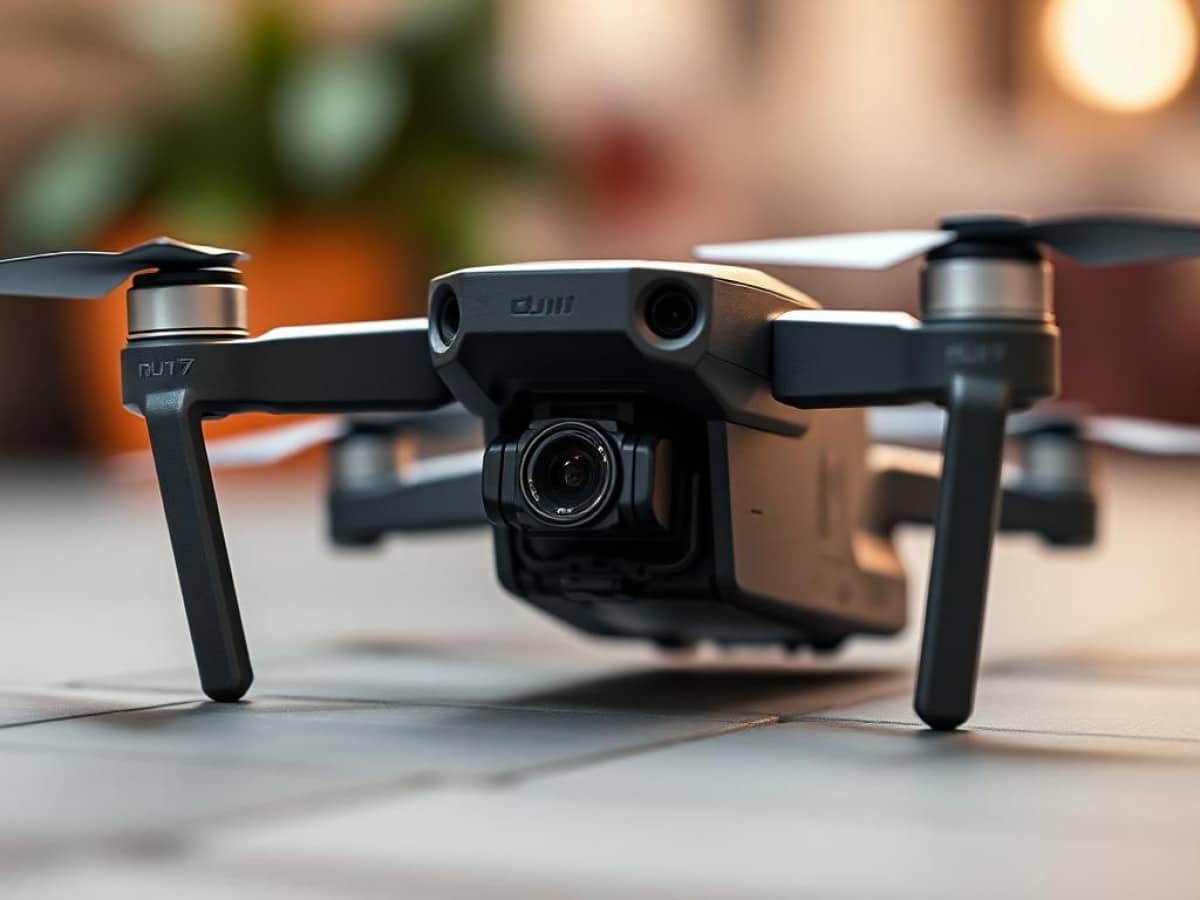
At first glance, the Mini 5 Pro closely resembles its predecessor. However, upon closer inspection, several subtle yet significant improvements can be noted. The front of the drone is slightly bulkier, a direct result of the new, larger gimbal housing needed to accommodate the 1-inch sensor and its larger optical assembly. This gimbal retains its ability to rotate 90° for native vertical shots, a major plus for content creators on social media. The gimbal even tilts to intermediate angles, broadening the possibilities for framing shots.
Flying safety, a DJI obsession, is ensured by a suite of sensors. In addition to the fisheye cameras for obstacle detection at the front, rear, and under the drone, which provide 360-degree vision, there are now front-mounted LiDAR sensors. Derived from more upscale models like the Air 3S or the Mavic 4 Pro, this technology uses lasers to map the environment in 3D. Its advantage is that it works perfectly in low light, even at night, where traditional optical sensors fail. Thus, the drone can avoid frontal obstacles with increased reliability under challenging flying conditions.
The real strength of the Mini 5 Pro remains its compactness. Once its arms are folded, it measures only 157 × 95 × 68 mm and literally fits in the palm of your hand. It slips into any camera bag, or even a large jacket pocket, without being noticeable. This is a decisive advantage over an Air 3S or a Mavic 4 Pro. It can be taken anywhere, anytime, which greatly increases the opportunities for capturing images.
On the drone’s body, essential elements are found. The on/off button, located on the top, follows the DJI ritual: a short press to check the battery status, then a long press to turn the device on or off. DJI has endowed its Mini 5 Pro with a feature previously reserved for high-end models: the drone powers on automatically when its arms are unfolded and turns off just as simply when they are folded back. This small detail streamlines the experience and enhances its premium feel.
At the rear, a hatch protects the USB-C port, used for recharging and file transfer, as well as the microSD card reader. A very welcome new feature is the increase in internal storage to 42 GB. This is a real safety net: forgetting a memory card no longer means a ruined flying session. You can record several minutes in 4K without a problem before the internal memory fills up.
An Enhanced Sensor from the Air 3S
Here is where the Mini 5 Pro truly distinguishes itself from its predecessors and much of the competition. The switch from the 1/1.3-inch CMOS sensor of the Mini 4 Pro to a 1-inch model is a small revolution. This sensor, which seems directly borrowed from the Air 3S, changes the game in terms of light gathering, dynamics, and color rendering.
Coupled with a bright lens (f/1.8) with a 24 mm equivalent focal length, it provides a wide field of view, perfect for landscapes, very similar to that of modern smartphones. This 50-megapixel sensor works by default in “pixel binning” mode. Essentially, it combines four adjacent pixels into one “super pixel” to produce 12.5-megapixel images. This technique, also used in video, drastically reduces digital noise in low light and significantly increases the dynamic range of the image. The result is striking: the drone captures an impressive amount of information in both bright highlights and the densest shadows.
Of course, it is possible to switch off this mode to exploit the full 50-megapixel resolution in photos, especially in RAW (DNG) format. In this mode, the Mini 5 Pro is noticeably superior to its predecessor, with cleaner images that show fewer artifacts and chromatic noise when examined at 100%.
But the most remarkable improvement is probably the color rendering. The color reproduction is richer, more accurate, and more natural than on the Mini 4 Pro. Gone are the sometimes overly saturated or artificial green hues; grass, foliage, skin tones, and blue skies are rendered with remarkable fidelity, reducing the need for touch-ups.
The image processor has also been updated. It now supports recording in 4K up to 120 frames per second (compared to 100 fps for the Mini 4 Pro), resulting in even smoother and more detailed slow-motion footage. At normal speed, the maximum definition remains 4K60p, which is more than sufficient for almost all applications. Finally, the high resolution of the sensor allows for a digital zoom of up to 3x in video with very contained quality loss, a creative flexibility that is always appreciated for getting closer to a subject without moving the drone.
Ease of Use Comes First
If you’ve never handled a drone before, the Mini 5 Pro is probably the best tool to start with. By default, all safety systems are activated. The drone will not take off until it has acquired a sufficient GPS signal, and its omnidirectional obstacle detection system (APAS 5.0) makes it a virtual flying fortress. It is capable of braking, stopping, and even intelligently navigating around obstacles that appear in its path.
The initial apprehension, especially when flying over water or near trees, quickly dissipates, giving way to the joy of flying. In case of signal loss or low battery, the advanced “Return to Home” (RTH) function takes over, safely bringing the drone back to its starting point while avoiding obstacles on the return path.
As usual, DJI offers several remote control options.
- The DJI RC-N3: This is the basic controller, included in the standard pack for 799 euros. It lacks a screen and requires connecting your smartphone, which serves as the video feed through the DJI Fly app. This is a cost-effective solution but comes with some constraints. You need to ensure you use a phone with a very bright screen to maintain good visibility in direct sunlight, and some models may reduce their brightness if they overheat, which can be problematic.
- The DJI RC-2: This is the controller to opt for, included in the most expensive Fly More pack. It features its own 5.5-inch LCD screen, which is very bright and maintains its performance. The experience is incomparable: it’s ready to use immediately, starts up in less than a minute, and is more comfortable to hold. Better balanced, it has screw threads at its base for attaching a neck strap, a simple accessory that makes a big difference in the field.
The video transmission relies on DJI’s latest O4+ technology, which promises a theoretical range of up to 20 km. In Europe (CE standard), the theoretical range is 10 km, and it heavily depends on the environment (interference, obstacles). In practice, the connection remains stable over several kilometers in open terrain but may degrade more quickly in urban or forested areas. RTH is there to cover any eventuality.
The DJI Fly app, whether on a smartphone or the RC-2, maintains its exemplary ergonomics. Clear, intuitive, and responsive, it provides access to all settings in a logical manner.
More Power, Faster Response
Dynamically, the Mini 5 Pro reveals a more assertive temperament. The new motor offers more torque, which results in sharper accelerations and a climbing speed that increases from 6 m/s to 10 m/s in sport mode. The drone gives an overall impression of greater agility compared to the Mini 4 Pro. It also gains in wind resistance and can officially handle currents of up to 12 m/s. This is a notable improvement that makes it more reliable in coastal conditions. However, keep in mind that at 249 grams, you shouldn’t expect the performance of a Mavic 4 Pro. Against strong winds, its speed can be significantly reduced—often halved—a factor to absolutely check before sending it far to ensure it has enough battery to return.
Battery Life: The Crux of the Matter
DJI announces a maximum theoretical battery life of 36 minutes, two minutes more than the Mini 4 Pro. More transparently, the manufacturer also communicates a typical real-world battery life of 21 minutes. During my tests on the Atlantic coast, often in windy conditions, I indeed consistently reached and often exceeded this mark, which constitutes an improvement. The new motor, both more torquey and more efficient, appears to be the main contributor to this gain, although it should be noted that the batteries have slightly higher capacity (about 2800 mAh compared to 2600 mAh in the Mini 4 Pro).
However, it must be clear: a single battery is never enough. Never. For any creative outing, purchasing the Fly More pack, which includes two additional batteries and a charging hub, is not an option, but a necessity. The scenario is always the same: the first battery is used for scouting, exploring the area, and testing angles. The second is used to execute the planned shots. The third offers the flexibility to redo a scene if the lighting changes, or to capture another viewpoint. Limiting yourself to a single battery guarantees immense frustration.
The triple charging hub is an essential accessory. It allows for sequential charging of the three batteries (one after the other) and can revive the entire pack in about two hours with a 65 W Power Delivery charger (not provided).
For nomadic creators, outdoor charging solutions should be considered. During this test, I was able to use a DJI Power 2000 power station, which can recharge the battery packs of several drones multiple times, independent of a power outlet.
For exclusive use with the Mini 5 Pro, a more modest station like the DJI Power 500 (about 300 euros) offers several days of complete autonomy for the batteries and the remote control; an ideal solution for van weekends or multi-day hikes.
Video: Pro Capabilities in a Mini Format
The Mini 5 Pro is a flying camera of formidable versatility and precision. While the difference in sharpness may not always be apparent compared to the Mini 4 Pro, the gains in colorimetry and processing flexibility are undeniable. The drone offers three main recording formats:
- Normal (8 bits): Ideal for ready-to-use videos, with vivid and contrasted colors.
- HLG (10 bits): A HDR (High Dynamic Range) format offering an extended dynamic range, intended for viewing on compatible screens.
- D-Log M (10 bits): The format of choice for professionals and demanding hobbyists. It’s a “flat” (logarithmic) color profile, which records maximum light and color information. The raw image appears washed out and low-contrast, but it offers considerable retouching latitude (grading) in post-production, allowing for precise adjustments to colors, contrast, and exposure.
For those intimidated by grading, DJI’s LightCut app offers a simple solution. It can automatically apply the official LUT (Look-Up Table, a color conversion table) to D-Log M files to restore natural colors in one click.
This content is blocked because you have not accepted cookies and other trackers. This content is provided by YouTube.
To be able to view it, you must accept the use operated by YouTube with your data that may be used for the following purposes: allow you to view and share
Similar Posts
- DJI Neo 2 Review: Discover Why It Outshines the Original!
- Apple TV Unleashes Record-Breaking Drone Show for ‘Monarch: Legacy of Monsters’ Series
- Google Pixel 10 Pro XL Review: Discover the Ultimate Large Android Smartphone!
- Top Early Prime Day iPad Deals: Massive Discounts on iPad Air, Pro, Accessories & More!
- Your iPhone May Soon Compete With DSLRs: Discover This Amazing Kit!

Maya Singh is a senior editor covering tablets and hybrid devices. Her work explores how these tools reshape digital productivity and learning. She also contributes to feature editorials on emerging tech.
Categories
Latest Articles