
Scientists confirm: This is the most effective way to get your cat’s attention, according to new research
Elderly Couple Refuses Reserved Seats—Viral Train Standoff Sparks Fiery Debate on Courtesy
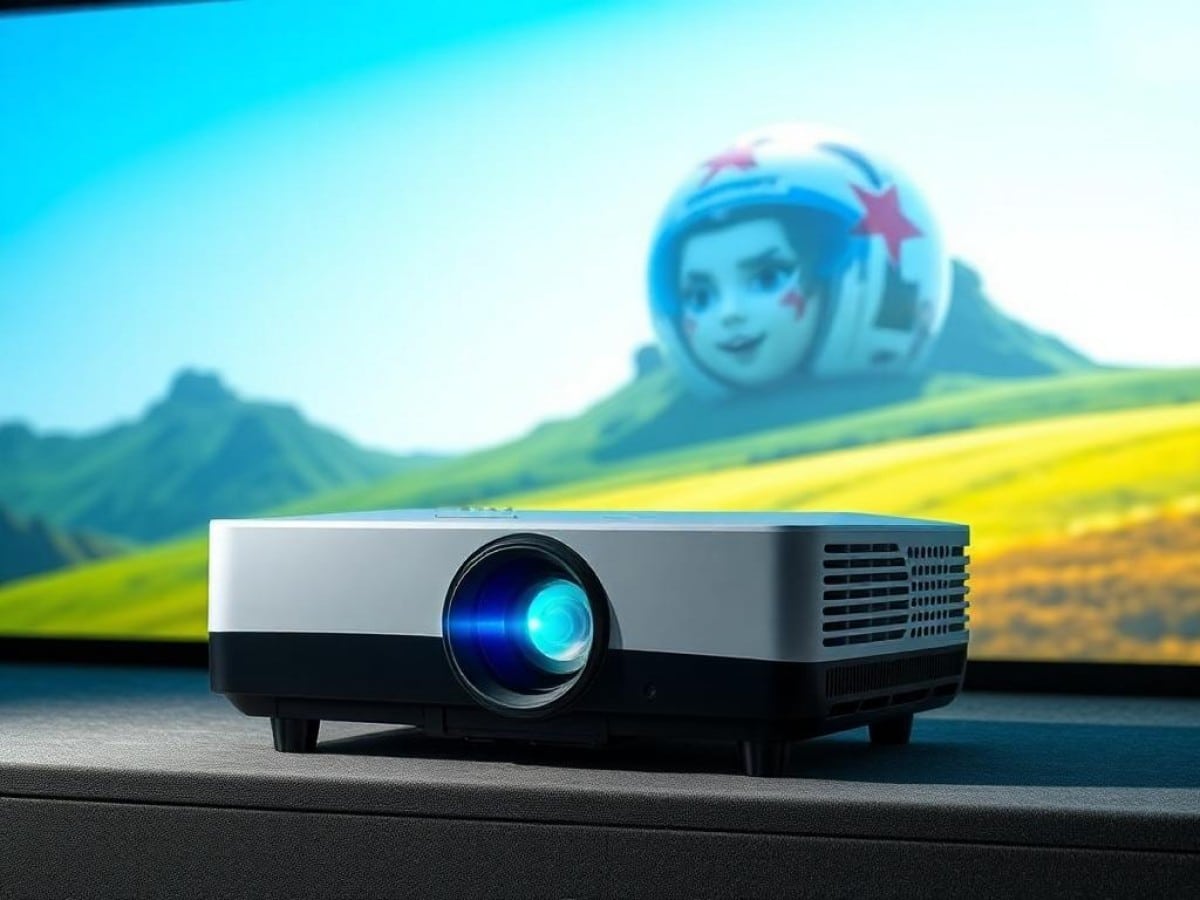
The Dangbei MP1 Max was unveiled at CES 2025 and is positioned as a higher-end model compared to the DBOX02 we recently reviewed. It features hybrid bright technology, combining a triple laser with LEDs, to deliver a 4K image with precision and brightness rarely seen in this price range. With its 3100 ISO lumens, according to the brand, it aims to provide a brilliant projection, even in partially lit rooms, while ensuring exceptional color fidelity thanks to an especially wide coverage of the BT.2020 space and very rigorous factory calibration.
Designed to seamlessly integrate into any interior, the MP1 Max sports a compact and clever design. Its rotating chassis allows it to pivot 360 degrees and tilt 135 degrees vertically, enabling projection on a wall, ceiling, or even the floor, without additional accessories. This flexibility is complemented by advanced automation: focus, keystone correction, and adaptation to ambient light are managed in real-time by embedded artificial intelligence, greatly simplifying the user’s life.
In terms of multimedia, the Dangbei MP1 Max features Google TV, providing access to all popular streaming platforms (Netflix, Prime Video, Disney+, YouTube…) and voice command via Google Assistant. Its comprehensive connectivity (HDMI 2.1, USB 3.0, Wi-Fi 6, Bluetooth 5.2) makes it compatible with most game consoles, sound bars, and other modern peripherals. Audio hasn’t been overlooked, with two 12W speakers and a sound chamber optimized for deep bass and clear sound even at high volumes.
The MP1 Max targets both demanding cinephiles and families looking for a versatile and easy-to-use solution, capable of transforming any room into a true projection hall. It competes with Xgimi Horizon Ultra, JMGO N1S Ultra, and Hisense C2 Ultra or C2 Pro, sharing aesthetics and some technologies with them. It also contends with the Nebula X1, for instance. But how does it really perform? We tested it so you can form your own opinion.
Dangbei MP1 MaxTechnical Specifications
| Model | Dangbei MP1 Max |
|---|---|
| Dimensions | 296 mm x 246.7 mm x 230 mm |
| Maximum Resolution | 3840 x 2160 pixels |
| Screen Size | 300 inches |
| Compatible HDR | HDR10, HDR10+ |
| HDMI Ports | 2 |
| Compatible Surround | DTS-HD, DTS-X |
| Number of Speakers | 2 |
| Speaker Power | 24 watts |
| Audio Output | Headphones, Speakers |
| Operating System (OS) | Google TV |
| Voice Assistant | Google Assistant |
| Product Sheet |
The Dangbei MP1 Max projector we tested was loaned to us by the brand. It was tested in conjunction with a Lumene Movie Palace UHD Platinum 300C screen. Measurements were taken with professional equipment directly in front of the screen to minimize errors and provide values consistent with what the viewer can actually see.
Dangbei MP1 MaxDesign, A Swivel Projector
Similar to the Hisense C2 Pro (and its Ultra and C2 “standard” variants) and the Dangbei DXBOX02 Pro, the Dangbei MP1 Max is mounted on a swivel. Furthermore, it adopts a modern and sleek aesthetic, in line with recent lifestyle projectors. Its chassis is compact and its lines are rather rounded, easily fitting into a contemporary living room. We appreciate its matte finish that limits fingerprints and unwanted reflections.
One of the major strengths of this model is therefore the presence of an integrated support, capable of tilting the device to 135 degrees and rotating it 360 degrees, thus enabling projection on both a wall and the ceiling or even the floor.
This flexibility greatly simplifies installation, which we will return to shortly, and opens up new possibilities for use, especially for families or large-screen gaming enthusiasts. In case needed, below, there is a thread for mounting the device on a suitable stand.
On the front, there is obviously the slightly recessed lens and sensors that automatically optimize the image.
The vents are discreetly integrated on the sides (with a nice fabric covering) and at the back, ensuring good air circulation without harming the overall aesthetics. The whole thing feels robust, with a neat assembly and no play in the moving parts. If the MP1 Max does not revolutionize the genre, it stands out as an elegant technological object, designed to be displayed without complex in the living room.
The projector comes with a substantial power supply. This must be taken into account when moving it.
Dangbei MP1 MaxConnectivity
The MP1 Max offers comprehensive connectivity, matching its ambitions. At the back, there are two HDMI inputs, one of which supports eARC for easy audio return to a sound bar or amplifier, as well as a USB 3.0 port for direct playback of multimedia content from a USB flash drive or external hard drive. The presence of an analog audio mini-jack output allows for connecting headphones or an audio system, if necessary.
Wi-Fi 6 and Bluetooth 5.2 ensure a fast and stable wireless connection, whether for streaming or connecting accessories. The RJ45 Ethernet port allows for a wired connection, ideal for ensuring a constant bitrate when streaming 4K HDR content. All connections are very accessible, even when the projector is placed against a wall, thanks to a clever layout and the ability to rotate the device on its stand.
The power cable plugs into the base and thus rotates with the device, if necessary.
The Remote Control
The remote control provided with the Dangbei MP1 Max is compact. No mystery here, it is the same remote control that comes with the DBOX02. It is comfortable to hold. The keys are spaced enough to avoid manipulation errors, and the overall build feels solid.
We particularly appreciate the presence of direct shortcuts to major streaming platforms such as YouTube, Netflix, and Prime Video. There is also a dedicated button for image and sound settings, allowing for quick adjustments without having to navigate through menus.
The remote control operates via Bluetooth, which avoids the need to point precisely at the projector, and it incorporates a microphone for voice commands via Google TV. However, the lack of backlighting may be inconvenient when used in the dark—a regrettable detail. Power is provided by standard batteries.
Dangbei MP1 MaxThe Screen
The Dangbei MP1 Max projector is delivered without a screen, belonging to the range of long-focus home cinema projectors. This leaves the choice, but if the budget is limited, one might be tempted to install it without a screen by using a wall as the projection surface and thus lose the relatively important benefit of having a surface optimized for projection. Count on spending between 500 and 2700 euros for screens of various sizes whose surface benefits from a specific treatment.
Dangbei MP1 MaxInstallation
Installing the MP1 Max is intended to be accessible and truly is, even for a less experienced user. Thanks to its stand, it simply needs to be placed on a table or a piece of furniture, then adjusted the angle of projection according to the chosen surface.
The InstanPro AI 2.0 system then takes over: focus and keystone correction are automatically and real-time managed, detecting obstacles and adapting the image to remain perfectly rectangular and sharp. This automation saves valuable time and reduces the risk of errors, especially during temporary setups or nomadic use.
Note that it is possible to launch a mode that automatically adapts to the screen size. If you have a screen with fairly wide edges, the device recognizes them within a few seconds and adjusts the diagonal and sharpness instantly.
Of course, in addition to the automatic adjustments, it is possible to take control to make optimizations, if necessary. In our testing phase, however, we were fully satisfied with the automatic configuration.
The entire process, from unpacking to the first projection, takes only a few minutes, making it a particularly user-friendly device.
To get a 100-inch diagonal image, count on a distance of about 2.80 meters. For an image with a base of 3 meters, we needed a distance of about 3.90 meters. If you place the projector 1.5 meters away from the wall or screen, you get an image that is approximately 147 cm diagonally.
Dangbei MP1 MaxImage Quality in Subjective Mode
The Dangbei MP1 Max relies on a hybrid technology combining tri-laser and LED, a choice that allows it to offer impressive brightness of 3100 ISO lumens, according to the brand while ensuring color fidelity of great accuracy. On paper, this is significantly more than the Dangbei DBOX02 (2450 lumens), the Xgimi Horizon Ultra (2300 lumens), Hisense C2 Pro (2600 lumens), and even the Hisense C2 Ultra (3000 lumens). Only the Nebula X1 performs better with its 3500 lumens, according to the brand.
The MP1 Max is equipped with a 0.47″ DLP DMD chip, paired with pixel shifting technology, delivering a 4K Ultra HD image with remarkable precision, where each detail stands out, even on very large diagonals.
The MP1 Max offers several image modes, suitable for all uses: Standard, Vivid, Cinema, Game, User (customizable), and an Eco mode to reduce brightness and noise. Each mode adjusts the colorimetry, contrast, and color temperature settings, allowing the user to find the ideal balance according to the ambiance or type of content. Enthusiasts of fine adjustments will appreciate the ability to customize the User mode to get the most out of the projector.
In terms of HDR compatibility, the Dangbei MP1 Max supports HDR10, HDR10+, and HLG formats, which allows it to render extended dynamic range content with good control. Although Dolby Vision is not supported, the management of HDR10+ and its dynamic metadata is sufficient to provide a convincing rendering on compatible films and series. By the way, note its compatibility with 3D content.
In use, the luminous power of the MP1 Max translates into a brilliant image, even in a partially lit room. The whites remain pure, the colors do not fade, and even in broad daylight, the show remains impressive. The contrast surprises with its ability to render deep blacks and subtle gradients in shadows. When projecting dark sequences, the projector manages to reveal many details in dark areas, without a “muddy” effect or loss of information. The separation between different shades of black remains perceptible, especially on HDR10+ content.
The color rendition is one of the strengths of the MP1 Max. In documentaries like Our Planet (Netflix, HDR), the color palette is fully expressed: the greens of forests, the deep blues of oceans, or the reds of sunsets appear vibrant, without ever falling into artifice. Skin tones remain accurate, even in very bright scenes or against the light. However, be careful, as the factory settings offer sequences that can appear a bit too saturated in terms of colorimetry.
Dynamic and very bright scenes also benefit from careful treatment. In a film with many fast-paced sequences, we enjoy the MEMC motion compensation, which smooths the action without generating artifacts or stuttering. Watching F1 races is very pleasant with this model.
In testing different content, the Dangbei MP1 Max confirms its versatility. However, it is noted that the Standard and Cinema image modes can sometimes lack precision for the most demanding users; a switch to User mode and customized calibration will allow you to exploit the full potential of the device.
Motion Compensation
As mentioned, the MP1 Max incorporates MEMC technology, which can be activated or not according to preferences. During action or sports scenes, motion compensation proves effective, providing appreciable fluidity without generating major artifacts. However, some users sensitive to this may prefer to disable this function to avoid the “soap opera” effect, sometimes considered too artificial. The adjustment options allow you to set the level of MEMC intervention, thus offering a compromise between naturalness and fluidity. Overall, the treatment remains discreet and does not impair the readability of the image, even during the fastest sequences.
Rainbow Effect
Like all DLP projectors, the MP1 Max is not completely free of the rainbow effect, a visual phenomenon that manifests as brief colored flashes on bright objects moving against a dark background. However, the hybrid LED-laser technology used here significantly limits this defect compared to traditional RGB laser models. During tests, the effect was very discreet, even on white subtitles or during high-contrast scenes. Most spectators will not notice it, but the more sensitive may still occasionally perceive it. Overall, the MP1 Max performs better than average in its category on this point.
Dangbei MP1 MaxMeasurements with Probes
As a reminder, as with all tests conducted on Frandroid, measurements are made from the default settings. The MP1 Max offers a native contrast ratio of 770:1, which is decent but not optimal. This is significantly less than the Valerion VisionMaster Pro 2, for example.
Regarding color fidelity with SDR content, we obtained an average Delta E of 8.18 in Cinema mode. This measurement is significantly above the threshold of 3, below which the human eye can no longer distinguish between the requested color and the displayed color. Therefore, optimizations are needed. Concretely, to the eye, this results in colors that are too saturated.
For the average color temperature, the factory settings offer a measurement of 7000 K, which is also above the target value of 6500 K. Colors drift too much. Gamma is relatively well managed with an average of 2.14.
For HDR content, it is also Cinema mode that provides the best rendering. However, here again, the default settings do not fully satisfy, and the most demanding
Similar Posts
- Xgimi Horizon 20 Max Review: Ultimate 4K Laser for Home Cinema Unveiled!
- Xiaomi Smart Projector L1 Pro Review: Compact Google TV Gadget Impresses!
- Optoma Photon Go Review: Transform Any Wall into a Giant Screen with This Mini Projector!
- Nothing Projector Matte White Screen Test: Brighter Images, Less Contrast!
- LG CineBeam S Review: Ultra HD Mini Projector With Winning Design Fits Inches From Wall

Maya Singh is a senior editor covering tablets and hybrid devices. Her work explores how these tools reshape digital productivity and learning. She also contributes to feature editorials on emerging tech.