
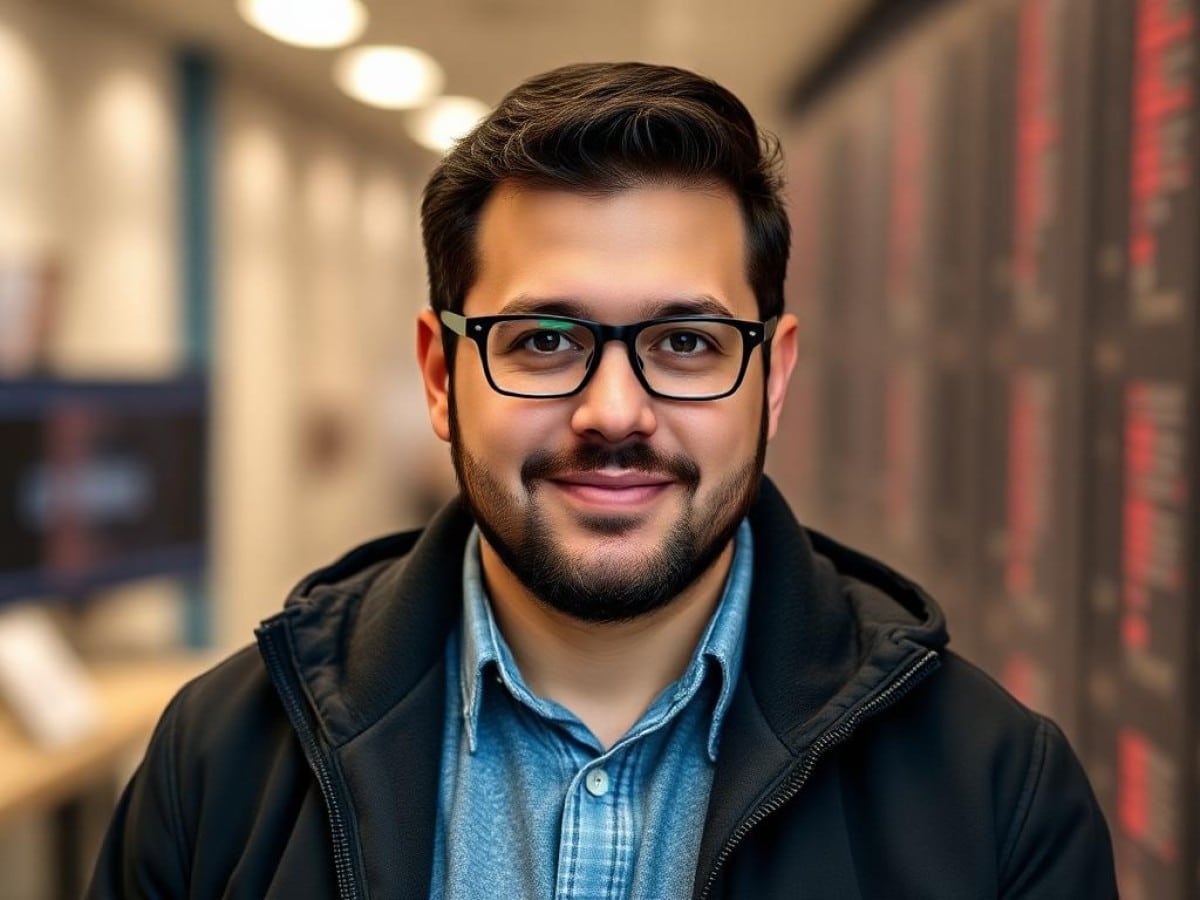
Explore the daily life of Alexandre Sanchez, who works at the Inria Center at the University of Rennes.
Scientists confirm: This is the most effective way to get your cat’s attention, according to new research
Elderly Couple Refuses Reserved Seats—Viral Train Standoff Sparks Fiery Debate on Courtesy
Can you introduce yourself in a few words?
I consider myself a facilitator. My technical expertise helps me streamline processes and consolidate resources to save time, allowing us to focus on research. I work as a research engineer at Inria (National Institute for Research in Digital Science and Technology) in Rennes, within the Experimentation and Development department, also known as CED.
What exactly does your job entail?
My role is to support research activities. In fact, it’s a support role ‘plus +’ because we’re deeply involved in the research itself. The main part of my job is to assist researchers and PhD candidates to progress in their projects as effectively and efficiently as possible, without them needing to worry about technical issues.
Why You Should Never Reheat These Foods in the Microwave – The Hidden Dangers Experts Warn About
I tried the top 5 guard dogs—here’s what makes these breeds the ultimate protectors
What is a typical day like for you?
I don’t really have a typical day because the requests I receive are so diverse. I collaborate with three teams that specialize in cybersecurity. Within just one team, there can be easily a dozen PhD candidates, each with their own unique research topics. They might face challenges with things like code compilation, data exploitation, or even long-term research themes.
In cybersecurity, we focus on compartmentalization and experimentation to ensure the information system at Inria isn’t compromised.
Every day brings different requests. Although my role involves structuring my work and having a roadmap, each day turns out a bit different. Each morning, I arrive wondering what will happen “today.”
What was your journey to this position?
I pursued an academic path in Paris at Jussieu. Originally, I completed a DEUG, followed by a license, a master’s degree, and a DESS, culminating in a level equivalent to a master’s degree. However, this did not grant me an engineer’s status. I began my career in private R&D departments for 12 years.
I realized that my experience lacked meaningfulness for me, especially the focus solely on productivity and profitability.
Therefore, I decided to move to the public sector, where I started on temporary contracts. I worked several fixed-term contracts before joining a research lab and eventually finding my place at Inria. Even though engineering schools are considered the ‘ideal route,’ my university background posed no barrier to my career.
What do you love most about your job?
What I love about my job is the constant learning. Almost every month, there are new technologies and new scientific challenges, which I find thrilling! However, the downside is that nearly every month, there’s something new to learn, which can be exhausting (laughs).
It’s great because it’s always challenging, but it’s also hard to maintain a solid base of knowledge over time.
What skills are needed to become a cybersecurity research engineer?
As a research engineer, patience is crucial, something I didn’t have much of initially. It’s important because we often work on long-term projects, which can sometimes be frustrating. Additionally, a lot of pedagogy is required because, as I mentioned, we are facilitators. We need to understand what a researcher or their PhD candidate wants, and what is feasible within the Inria information system context.
However, if I had to highlight one skill above all, it would be curiosity.
You really need to be curious, willing to delve into topics, do things you’re not used to, explore the current state of the art in science and technology, and push it further.
What has helped you advance in your career (resources, books, podcasts, mentors…)?
What helped me most at the beginning of my career, before becoming a research engineer, was teamwork. I was fortunate to be surrounded by senior colleagues who were kind and took the time to mentor me, helping me grow and advance. This is something I try to pass on today.
Nowadays, with the internet, it’s easier to find information. I advise asking questions and not being afraid to seek help, as this is how you progress.
How do you see the future of your profession in the coming years?
Given that I’m older, I’ve witnessed several technological revolutions. It seems we are on the brink of another major change. Pedagogically speaking, it’s clear that the incoming generations rely heavily on tools like AI, such as ChatGPT. When I started, we used Google and Stack Overflow extensively, and the older generations would say we were pampered. It seems to be a generational issue.
While it may seem like our professions have no future and that we will be replaced by machines, I don’t believe that’s the case.
AI enables us to prototype things quickly and explore many topics faster. However, when it comes to scaling up, real thought, collaboration, and challenges are required. For now, I can’t see AI handling these aspects robustly. Also, despite the impressive capabilities of current AI technologies, I’m not sure if our planet’s resources can sustain their extensive use, as it’s not really sustainable.
I think we need to learn to manage on our own more.
Do you have any advice for those looking to enter this field?
I don’t work in a hoodie, but I’m somewhat of a geek at heart. I love technology. However, it forces us to question ourselves. Many of us are pondering whether what we do justifies the environmental cost of the resources we use. Conducting massive computations on large servers for research that progresses very slowly doesn’t always make sense.
It’s challenging because we also have obligations to publish relevant results and aim for scientific excellence. But these are issues we increasingly question. It may sound a bit stereotypical, but we reflect society with all its diversity.
I especially encourage those who feel they don’t quite fit into the usual profiles to come and diversify this field even more.
Alexandre Sanchez, cybersecurity research engineer at Inria
Alexandre Sanchez holds the position of research engineer at the Inria Center (National Institute for Research in Digital Science and Technology) of the University of Rennes. His role involves supporting research within the Experimentation and Development department.
Similar Posts
- Top Computer Courses in 2025: Discover the Most Popular Programs!
- Exploring Careers After System & Network Technician: What’s Next?
- Tech Salary Guide 2026: Discover France’s Highest-Paying Digital Jobs!
- Apple Shakeup: Jeff Williams Steps Down as COO but Remains at the Tech Giant
- Switch to Cybersecurity Now: Essential Tips for a Successful Career Change!

Jordan Park writes in-depth reviews and editorial opinion pieces for Touch Reviews. With a background in UI/UX design, Jordan offers a unique perspective on device usability and user experience across smartphones, tablets, and mobile software.