
Scientists confirm: This is the most effective way to get your cat’s attention, according to new research
Elderly Couple Refuses Reserved Seats—Viral Train Standoff Sparks Fiery Debate on Courtesy
Leapmotor continues its aggressive push. The startup’s strong sales results in China, enabling it to reach profitability, are no longer enough: the move towards international markets, facilitated by a partnership with Stellantis, is gaining pace.
Europe is clearly among the strategic markets targeted. Initially consisting of the small T03 and the large C10 at its European launch in 2024, the lineup was later expanded with the B10, a compact SUV, before introducing the latest addition: the Leapmotor B05.
This compact electric sedan thus targets a quintessentially European market, dominated by the likes of Volkswagen ID.3 Neo, Renault Mégane E-Tech, and the Peugeot E-308. To carve out a niche for itself, Leapmotor focuses on an expressive style, dynamic performance, and aggressive pricing. To learn more, we went to Germany to discover it.
Leapmotor B05Technical Specifications
| Model | Leapmotor B05 |
|---|---|
| Dimensions | 4.43 m x 1.88 m x 1.52 m |
| Power (HP) | 218 HP |
| 0 to 100km/h | 8.0 s |
| Autonomy Level | Semi-autonomous driving (level 2) |
| Top Speed | 170 km/h |
| Embedded OS | LeapOS |
| Main Screen Size | 14.6 inches |
| Car-side Socket | Type 2 Combo (CCS) |
|
Try it |
Product sheet |
This test was conducted during a press trip organized by the brand.
Leapmotor B05A Very European Design
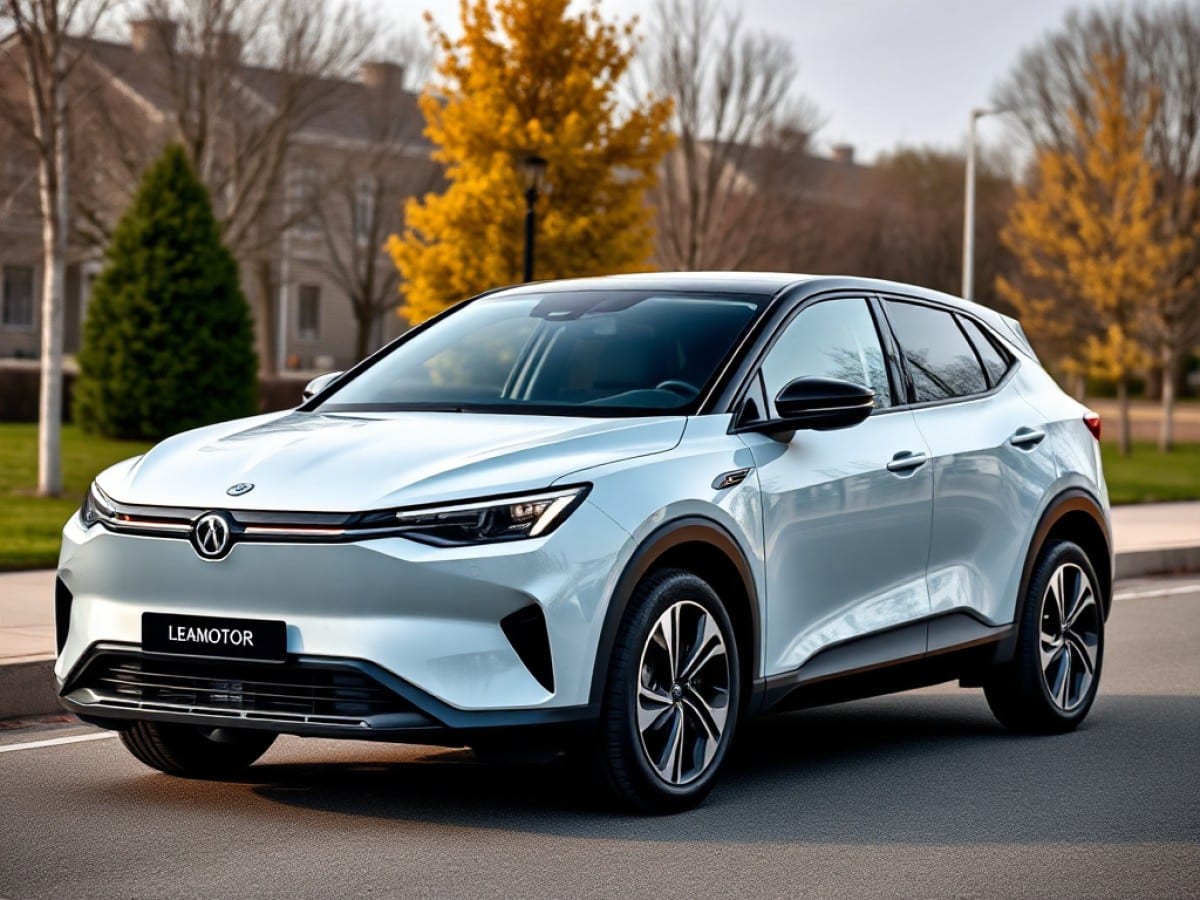
Let’s not beat around the bush: Leapmotor’s European range could hardly rely on its design to stand out. The B05, on the other hand, aims to bring a bit of emotion to the table, particularly through a much more expressive line.
It’s a rather successful mission: while adhering to the essential Leapmotor features (notably the three-point lighting signature and the black strip at the front and rear), the B05 adopts a style that is much more European, almost Latin.
The curves are gentle, the volumes pronounced, the proportions successful, and the large 19-inch wheels make a statement: the mission is accomplished. Add in some quirks, like frameless door windows and invisible handles reminiscent of Tesla, and you get a design that is quite appealing.
However, there are some limitations: the impressive width… isn’t really one: at 1.88 m wide, the Leapmotor B05 might cause some anxiety in parking spaces—its 4.43 m length definitely puts it in a higher category, positioning it at the same level as a Kia EV4, well above the 4.37 meters of a Peugeot E-308 or the 4.26 m of a VW ID.3.
As for the rear window, the absence of a rear wiper might be a source of frustration when it rains—a hard-to-justify omission. Lastly, let’s mention a fairly sophisticated aerodynamics, with an air penetration coefficient (Cx) limited to 0.26, which is good for the category.
Leapmotor B05A Spacious Cabin, Except for the Trunk
A Presentation Within Standards
For those familiar with Leapmotor’s range, the cabin of the B05 will not come as a surprise: based on the same platform as the B10, it shares its dashboard.
For others, let’s review. The presentation of the B05, while not rewriting any standards, is quite well done. Padded materials are within reach, the shapes are soft, and the faux leather upholstery is quite inviting.
The very horizontal dashboard highlights the central screen that we will detail shortly. In front of the passenger, a recess livens up the assembly, while remaining purely decorative.
The central console is very standard, with an upper arch housing an induction charger and hiding a storage space—whose lining is far too slippery to hope to keep things in place. In short, a presentation without much flair, but without any major flaws either.
Passengers Spoiled, Luggage Less So
The advantage of such a large car is that the space reserved for passengers is generous. The B05 is no exception: out of its 4.43 meters in length, 2.74 meters are dedicated to the wheelbase (the distance between the wheels).
As a result, both front and rear passengers are well taken care of. Even on the rear bench, the legroom is more than sufficient, with a flat floor and the ability to slide one’s feet under the front seats—adding to comfort. Central armrest, air vents, numerous storage compartments, and USB ports add to the overall comfort.
At the front, both seats can be heated and electrically adjusted in the top-range version, while the large glass roof (also reserved for the top-range) brings in a lot of light.
Rated 9/10 by Frandroid, the SolarFlow 2400AC+ stores your surplus energy for use in the evening. Save money simply! During Prime Day, the pack drops to 1,927 €
However, the Leapmotor stumbles upon a grievance shared by many Chinese cars: a trunk volume that’s lacking, with no front trunk (frunk) available to alleviate the situation.
With a declared 345 liters, the B05 falls behind more compact cars, such as the Peugeot E-308 (361 liters), VW ID.3 (385 liters), and the Renault Mégane E-Tech (384 liters). At the same length, the Kia EV4 boasts 435 liters.
Leapmotor B05Comprehensive Yet Sometimes Frustrating Infotainment
At the center of the Leapmotor B05’s dashboard sits a 14.6-inch touchscreen, powered by a Qualcomm 8155 chip… and that’s pretty much it, since buttons are notably absent.
As a result, everything is controlled via the screen, requiring some mastery. It’s clear that some settings, buried in sub-menus, could benefit from a good old physical button—for instance, opening the sunroof curtain.
Similarly, driving settings (driving modes, regenerative braking intensity, driving aids) have no physical shortcuts, causing frustration (especially while driving).
However, not everything is to be discarded. The screen is attractive and responsive, and Leapmotor seems aware of the system’s limitations, allowing several shortcuts to be displayed, both on the lower display bar and in a menu accessible by swiping from top to bottom.
Navigation is standard, including a route planner that seemed somewhat limited. Indeed, it’s possible to filter networks according to our preferences (useful when you have a subscription, for example), but we couldn’t manage to set a minimum battery level at charging stops and at the destination. Android Auto and Apple CarPlay are also included.
For the driver, a small 8.8-inch screen, directly mounted on the steering column, is there to display driving information—especially a small onboard computer on the right side. The display is simple yet complete and perfectly legible: exactly what you’d expect from this type of display.
Leapmotor B05Intrusive Yet Easily Disconnectable Driving Aids
Truth be told, we could have titled this section exactly like the previous one: “comprehensive, yet sometimes frustrating.”
Yes, as standard, the Leapmotor B05 includes the full package, allowing for level 2 semi-autonomous driving: adaptive cruise control, active lane keeping, assisted lane changes, not to mention all the equipment made mandatory by the European GSR-2 regulation (driver monitoring, speed alert, etc) and other extras, such as a 360° backup camera.
Driving aids on Chinese cars have rarely been praised for being compatible with European tastes. How does the B05 fare in this context?
First of all, it’s important to note that the conditions of the test, with limited time behind the wheel, did not allow us to form a definitive opinion, but it’s clear that several of them remain very intrusive, such as the lane keeping aid, which aggressively acts on the steering wheel as soon as you get too close to a white line.
To this, Leapmotor responds with a customizable shortcut on the steering wheel, one of the options allows deactivating a previously selected and recorded set of driving aids with a single gesture: just press it at each startup to silence the unwanted beeps.
Leapmotor B05Enjoyable Driving
An Extremely Simple Spec Sheet
The simplicity of the B05’s offering is evident in its technical specifications: while two battery sizes are available (more on that later), only one motor is offered.
Located at the rear, it delivers a power of 160 kW (218 HP) and 240 Nm of torque, enabling the Leapmotor to accelerate from 0 to 100 km/h in 6.7 seconds and to reach up to 170 km/h, regardless of the battery size.
The Leapmotor team heavily emphasizes the chassis and specific settings for the European market: suspensions, anti-roll bars, steering, and tires were fine-tuned at the Stellantis test center in Balocco, Italy, a renowned testing circuit. Oh, and a launch control is also included. Could this B05 be a genuine sports car?
A Successful Handling
While it’s not quite there, it’s clear that driving the Leapmotor is no hardship. The steering wheel surprises with its compactness, but the consistency of the steering isn’t groundbreaking—switching it to Sport mode will simply make it heavier, without gaining in precision.
The same goes for the accelerator pedal, which, a bit too harsh in its calibration in Sport and Standard modes, can quickly cause the occupants’ heads to nod—switching to Comfort mode makes the power delivery much smoother, even if it cuts down on the dynamism. Nothing that a future remote update couldn’t fix.
However, the B05 doesn’t falter on twisty roads, thanks to sound handling and successful suspension. Body roll is contained, direction changes are seamless, and the ride quality is very good, even on rough surfaces: a pleasant surprise.
High speeds couldn’t really be tested during the drive, but the wind noise could have been better contained—the steering stability, on the other hand, calls for no criticism, unlike the rear vision, hampered by the central headrest and the lack of wipers (especially since the test took place in the rain).
In short, without turning into a hot hatch, the Leapmotor B05 dispels many preconceptions about Leapmotor and Chinese cars in general. A good sign for the future.
Leapmotor B05Battery, Range, and Consumption: Numbers That Compete
Two Battery Options
One motor, but two battery choices. The Leapmotor B05 comes standard with a LFP (lithium – iron – phosphate) “Pro” pack of 56.2 kWh, promising up to 401 km of range according to the WLTP mixed cycle; consumption stands at 15.8 kWh/100 km including charging losses.
For more versatility, Leapmotor also offers a “ProMax” battery (any resemblance to a famous smartphone is purely coincidental) of 67.1 kWh, pushing the range to 482 km WLTP; consumption is limited to 15.9 kWh/100 km.
Regarding charging, a unique service to connect to a wall
Similar Posts
- Test Drive Reveals: Stellantis’s Chinese Electric SUV Leapmotor B10 Hits Europe
- I Tested the Leapmotor B03X: Here’s Why This Spacious, Affordable Electric SUV Disappointed Me
- Dacia Spring Review: Is France’s Cheapest Electric Car Still Overpriced?
- We Tested the New Peugeot 308 Electric: Find Out Its Most Impressive Improvement!
- I Tested the Geely E5: China’s Electric Car Giant Hits the French Market

Maya Singh is a senior editor covering tablets and hybrid devices. Her work explores how these tools reshape digital productivity and learning. She also contributes to feature editorials on emerging tech.