
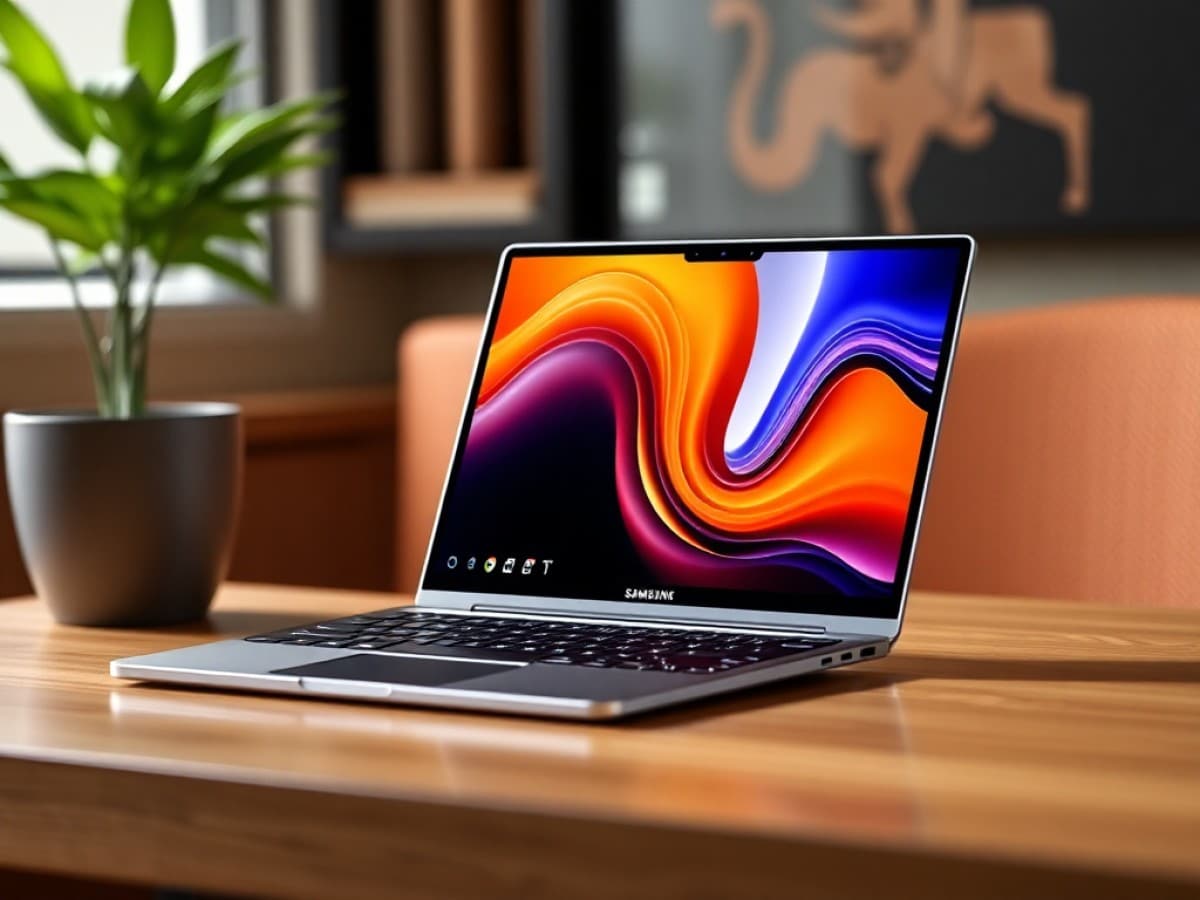
Samsung is leveraging the Intel Core Ultra 300 and RTX 50 series to reintroduce the Book 6 Ultra in France, positioning it firmly in the high-end market of the brand. Here’s what they’ve come up with.
Scientists confirm: This is the most effective way to get your cat’s attention, according to new research
Elderly Couple Refuses Reserved Seats—Viral Train Standoff Sparks Fiery Debate on Courtesy
Over the years, Samsung’s Galaxy Book series has consistently impressed us. Known primarily for its smartphones and tablets, the company has always aimed to produce sleek, pleasant, and modern products.
However, crafting ultra-thin and ultra-powerful laptops is not as straightforward. Almost every Galaxy Book Ultra released in France has had its share of significant frustrations.
Could this new Book 6 Ultra be the first to break this trend? We’ve thoroughly tested it to find out.
Technical Specifications
| Model | Samsung Galaxy Book 6 Ultra |
|---|---|
| Dimensions | 356.9 mm x 15.4 mm |
| Resolution | 2880 x 1800 pixels |
| Display Technology | AMOLED |
| Touch Screen | Yes |
| Processor (CPU) | Core Ultra 7 356H |
| Graphics Chip (GPU) | NVIDIA GeForce RTX 5070 |
| Memory (RAM) | 32 GB |
| Internal Storage | 1024 GB |
| Material | Metal |
| Operating System (OS) | Microsoft Windows 11 |
| Weight | 1890 grams |
| Depth | 248 mm |
| Product Link | Fiche produit |
Design
The Samsung Galaxy Book 6 Ultra follows a long-established design ethos from the South Korean manufacturer, which is far from problematic: it features superior build quality with a fully metallic chassis precisely crafted down to each curve. Despite being the most powerful model yet, it maintains a slim profile at just 1.54 cm thick.
For a 16-inch device that boasts such advanced specifications, its weight of 1.89 kilograms is impressive, especially in a category that typically exceeds 2 kilograms. The Galaxy Book 6 Ultra indeed looks and feels like a premium device that demands careful handling to avoid scratches and falls.
Keyboard and Touchpad
Samsung opts for a classic setup with keys that don’t have a lot of travel but are still quite comfortable. The focus here is more on quiet operation rather than outright comfort, though each key is perfectly stable.
The touchpad is the real highlight, offering a massive area with satisfying haptic feedback, enhancing the user experience of the Galaxy Book 6 Ultra.
Ports and Connectivity
On the left, there is a full-sized HDMI 2.1 port and two USB-C Thunderbolt 4 ports. On the right, you’ll find a USB-A 3.2 Gen 2 port, a combo audio jack, and a full-sized SDXC card reader.
The connectivity options are excellent, only missing an additional USB-C charging port on the right for more flexible charger placement. It’s also worth noting that the machine includes Wi-Fi 7 and Bluetooth 5.4, keeping it up to date with the latest wireless standards.
Webcam and Audio
The Galaxy Book 6 Ultra comes with a 2-megapixel webcam that is, frankly, just serviceable. As is often the case, the dynamic range is limited, resulting in washed-out colors and a noisy output when stretched to 1080p—a typical webcam experience.
However, the audio experience is exceptionally well-executed. Six Dolby Atmos-compatible speakers deliver sound from both sides of the keyboard as well as the bottom, creating a pleasantly wide soundstage. The highs are clean, the mids are slightly more pronounced than average, though they could use a bit more depth, and the bass is surprisingly robust for such a device. It’s a genuinely pleasant surprise.
Display
The Samsung Galaxy Book 6 Ultra features a 16-inch AMOLED display with a resolution of 2880 x 1800 pixels. It is touch-enabled, protected by Corning glass, and supports a refresh rate of 120 Hz.
Its anti-reflective treatment is arguably the best we’ve seen on a laptop to date, especially considering that the screen is touch-sensitive.
Our tests with the CalMAN software from Portrait Displays revealed a color coverage of 171% of the sRGB space and 115% of the DCI-P3 space. The maximum brightness reached 504 cd/m², with a perfect color temperature of 6463K. The average delta e00 was measured at 1.61, with a maximum deviation of just 4.48. There is absolutely nothing to fault here: the display is flawless.
In HDR mode, the brightness peaks at 1147 cd/m². The Delta-E accuracy is nearly perfect at 0.71, demonstrating a color precision that will satisfy even the most demanding creatives, even in this mode.
Software
Samsung is among the laptop manufacturers offering the most comprehensive software experience available. If you are familiar with the brand’s products, particularly smartphones and tablets, you’ll enjoy numerous interesting integrations… assuming you use Samsung’s software, which often gets overlooked in favor of the built-in OS solutions.
That said, some users will certainly appreciate the artificial intelligence features, such as those that analyze display elements. We’re mainly here for the extensive and well-explained advanced settings, though you shouldn’t overlook the need to uninstall bloatware like McAfee immediately.
Performance
The Samsung Galaxy Book 6 Ultra is powered by the Intel Core Ultra 7 356H, a 16-core SoC—4 performance cores, 8 efficient cores, and 4 ultra-efficient cores—that can turbo up to 4.7 GHz. This is the non-X variant, so there’s no Intel Arc graphics but more PCIe lanes to incorporate a NVIDIA GeForce RTX 5070 graphics chip with a TGP of 90W (10W less than the maximum) in our test model.
The system is complemented by 32 GB of LPDDR5X RAM at 8533 MT/s and 1 TB of PCIe Gen 4.0 storage.
Benchmarks
In Cinebench 2026, we recorded scores of 4950 points in multi-thread and 500 points in single-thread. These are the best multi-thread performance results we’ve seen for Panther Lake so far, surpassing the Core Ultra X9 we tested on the Zenbook Duo, though the latter remains better in single-thread. For a product aimed at 3D production and gaming, prioritizing multi-thread performance makes sense.
In Speed Way, which focuses on ray-tracing performance, we saw a score of 3050. In Steel Nomad, which prioritizes rasterized performance, we recorded 2692 points. These scores are on the lower end for a mobile RTX 5070.
It’s worth noting that the two most demanding components must share 140W. Thus, it’s impossible to run both the CPU (up to 80W) and GPU (up to 90W) at their maximum at the same time, not to mention the power consumption of the screen and other hardware components.
In-Game Performance
Even when reducing the native resolution to 1600p rather than 1800p, it’s simply not feasible to fully enjoy path tracing or frame generation with only 8 GB of VRAM on a mobile RTX 5070. You’ll need to drop to 1080p or completely forego ray tracing to achieve good performance—a common theme for a mobile RTX 5070, which is closer in performance to a desktop RTX 5060 Ti 8 GB.
For Creatives
There are no unpleasant surprises here: the integrated RTX 5070 in the Samsung Galaxy Book 6 Ultra delivers the expected performance in video and photo creation. Support for NVIDIA technologies, especially CUDA acceleration, is crucial for creatives, and having this in such a compact form factor is excellent.
Cooling and Noise
The cooling system effectively maintains performance from start to finish. It also keeps the chassis relatively “cool” for a laptop that delivers so much power, with temperatures almost exactly the same as a traditional ultrabook under Panther Lake.
Naturally, the fans are somewhat louder. When pushed to its full potential, the Galaxy Book 6 Ultra produces a background noise that might remind you of a vacuum cleaner in the next room; it’s neither discreet nor bothersome. This is very acceptable for such a powerful setup.
Battery Life
The Samsung Galaxy Book 6 Ultra includes an 80.2 Wh battery that recharges through a 140W USB-C power adapter. The laptop is compatible with the Power Delivery standard.
In office use, with the screen set to 50% brightness, we observed a battery life of between 13 and 14 hours. For such a powerful configuration, this is a significant advantage. Consider that for configurations incorporating an OLED panel (which is more power-hungry) and an RTX 50, the average battery life tends to be between 7 and 8 hours, with the best models generally managing to reach around ten hours, like the Zephyrus G16 from 2024. Here, we see a substantial improvement.
Pricing and Availability
The Samsung Galaxy Book 6 Ultra is available in France for 3599 euros in our test configuration. It’s also possible to opt for a model without the NVIDIA graphics, using a Core Ultra X7 and its Intel Arc B390, but in that case, you might as well choose the Galaxy Book 6 Pro.
Samsung Galaxy Book 6 Ultra
Best Price
Samsung: 2,499 €
Amazon: 3,579 €
Boulanger: 3,580 €
Rakuten: 2,599 €
3600 euros is undoubtedly a steep price. However, for a configuration aimed at professional creatives and demanding users, it is quite competitive in the context of the 2026 crisis. It primarily competes with the MacBook Pro M5 Pro (3000 euros) or Max (4500 euros), and offers a level of quality that the Razer Blade 16 (4000 euros with an RTX 5070 Ti) would not refuse.
Similar Posts
- Samsung Galaxy Book 6 Pro Review: A Vision Fulfilled!
- Samsung Galaxy Tab S11 Ultra Review: A Week of Surprises and Letdowns
- Discover Samsung’s Latest Dex Mode on Galaxy Tab S11 Ultra: Can It Truly Replace a Laptop?
- Galaxy S26 Ultra Drama: European Version Less Powerful Due to Exynos 2600 Chip?
- Samsung Galaxy Tab S11 Hands-On: Revolutionizing Productivity with Upgraded Desktop Mode and S Pen

Maya Singh is a senior editor covering tablets and hybrid devices. Her work explores how these tools reshape digital productivity and learning. She also contributes to feature editorials on emerging tech.