
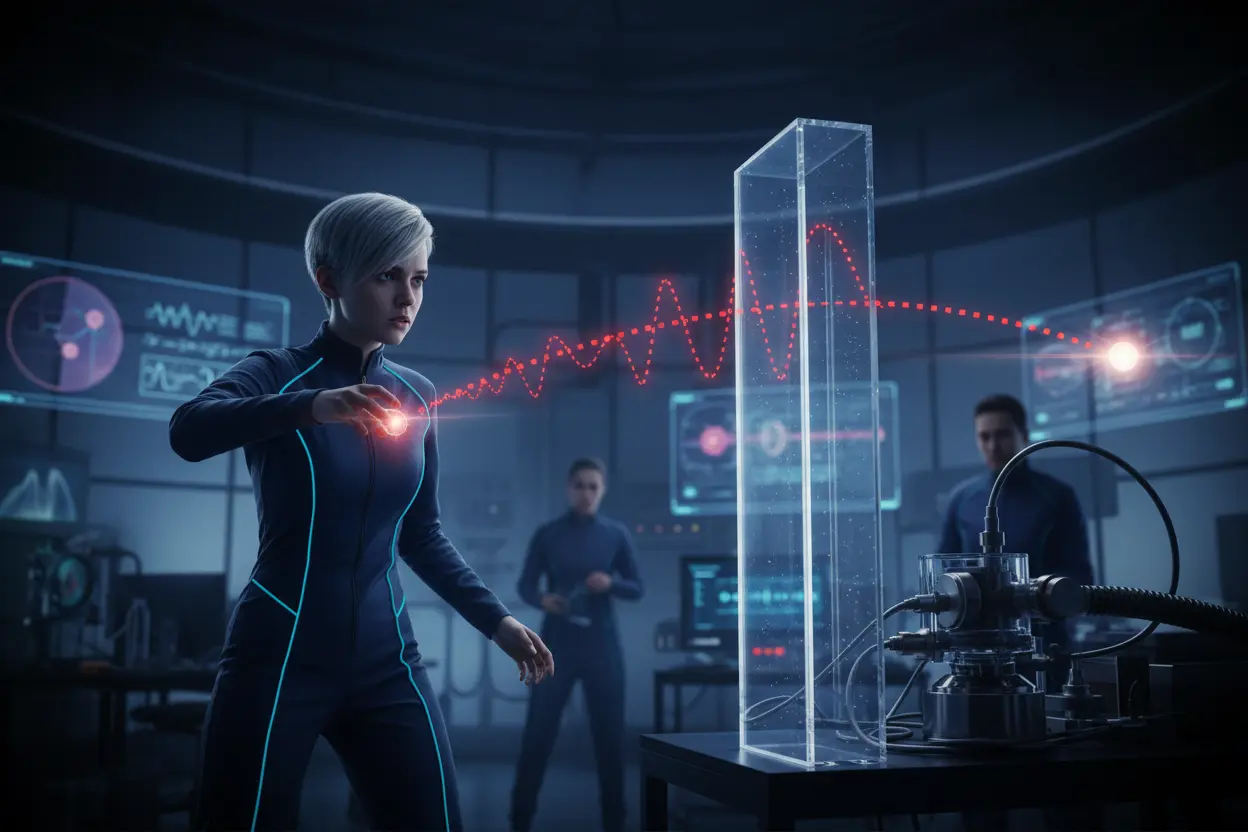
Quantum physics is known for its mind-bending oddities, but this year’s Nobel Prize in Physics proves just how tangible these “strange” quantum effects can be. On Tuesday, October 7th, the Royal Swedish Academy of Sciences in Stockholm awarded the prestigious honor to British researcher John Clarke, French scientist Michel H. Devoret, and American physicist John Martinis for their pioneering research into quantum mechanics—a field that, until recently, seemed to belong more in the realm of science fiction than in our hands.
Scientists confirm: This is the most effective way to get your cat’s attention, according to new research
Elderly Couple Refuses Reserved Seats—Viral Train Standoff Sparks Fiery Debate on Courtesy
Making the Impossible, Possible: Quantum Tunneling and Beyond
If you’ve ever bounced a ball against a wall, you know what to expect: the ball comes back. But at the quantum level, particles play by entirely different rules. The Nobel committee celebrated Clarke, Devoret, and Martinis “for the discovery of macroscopic quantum tunneling and energy quantization in an electric circuit.” Their series of experiments revealed that, yes, those bizarre quantum properties can be made strikingly real in systems large enough to fit in the palm of your hand. No magic tricks, just solid science (though some physicists might keep a wand handy, just in case).
Quantum tunneling is as odd as it sounds: in the microscopic world, a particle is capable of passing directly through a wall—a phenomenon you’d never see with your ordinary handball. The trio’s work in the 1980s demonstrated this surreal behavior, showing that even big-enough-for-your-pocket systems could display the peculiarities of quantum mechanics. So next time you lose your keys, don’t blame quantum tunneling—unless your pockets are exceedingly advanced!
How Big Is Quantum Weirdness?
The question of just how large a system can be while still showing quantum effects leaves even the most seasoned physicists scratching their heads. Quantum mechanics explains how things work at mind-bogglingly tiny scales—down at the level of particles. The Nobel-winning experiments by Clarke, Devoret, and Martinis pushed the boundaries, showing that “the ‘strange’ properties of the quantum world” don’t just evaporate as things get larger. Far from being a curiosity for thought experiments, quantum effects can dominate in systems you can actually see and hold.
- They proved energy can be quantized in an electric circuit, bringing theory to life.
- They confirmed macroscopic quantum tunneling—allowing particles (and systems!) to hop barriers as if physics had simply decided, ‘Why not?’
- Their work lays a cornerstone for applying quantum ideas outside the tiny world of atoms and electrons.
Paving the Road for Tomorrow’s Quantum Tech
According to the committee, this Nobel Prize honors research that “opened the way to the development of the next generation of quantum technologies, including quantum cryptography, quantum computers, and quantum sensors.” While you may not yet own a quantum computer (unless your shopping habits are very avant-garde), the path toward these revolutionary tools is rooted in discoveries like those of this year’s Nobel Prize winners. Their work makes the unbelievable believable—and, more importantly, unveils new horizons for technology.
In case you’re wondering how quickly things are moving, a glance at last year’s Physics Nobel reminds us: the 2023 prize went to Briton-Canadian Geoffrey Hinton and American John Hopfield, who, back in the 1980s, delved into artificial neural networks and paved the way for modern artificial intelligence. That kind of research, too, turned science fiction into reality—though the two recipients did express serious concerns about the rapid technological advances in their field. If you’re feeling a bit dizzy: don’t worry, you’re not alone.
Quantum Mechanics: Not Just for Theorists Anymore
The impact of Clarke, Devoret, and Martinis’s achievements goes well beyond lecture halls and laboratory benches. Their experimental demonstrations reshaped how scientists think about the limits—and possibilities—of quantum behavior. Today’s generation of researchers stands on their shoulders, reaching for innovations in high-security communications, next-level computing, and ultra-sensitive sensors. The question of how big quantum effects can be isn’t only academic: it’s the heartbeat of tomorrow’s technological revolution.
As quantum physics continues to leap from the abstract into the everyday, the best advice is: keep your mind open and your keys in a safe spot—just in case those quantum effects start turning up in your laundry, too.
Similar Posts
- Quantum Security Breakthrough: “Your Secrets Are Safe—Physics Guarantees It!”
- “Time Reflections Are Real”: Scientists Confirm a Discovery That Could Change Physics Forever
- Apple Insider Reveals: Alan Dye’s Departure Seen as Positive Move Within the Company
- Hawking’s 50-year-old black hole prediction finally confirmed in a cosmic collision
- Apple’s AI Chief John Giannandrea Steps Down: Not Retiring Yet!
Why You Should Never Reheat These Foods in the Microwave – The Hidden Dangers Experts Warn About
I tried the top 5 guard dogs—here’s what makes these breeds the ultimate protectors

Jordan Park writes in-depth reviews and editorial opinion pieces for Touch Reviews. With a background in UI/UX design, Jordan offers a unique perspective on device usability and user experience across smartphones, tablets, and mobile software.