
Scientists confirm: This is the most effective way to get your cat’s attention, according to new research
Elderly Couple Refuses Reserved Seats—Viral Train Standoff Sparks Fiery Debate on Courtesy
The Xgimi Horizon 20 Max was unveiled at the IFA 2025 in Berlin in early September 2025. It arrives at the top of the manufacturer’s consumer range, establishing itself as a premium benchmark for movie enthusiasts and tech aficionados. The series also includes the Horizon 20 and Horizon 20 Pro.
This RGB triple laser, Ultra HD, HDR10+, Dolby Vision, and IMAX Enhanced model competes directly with products such as the Valerion VisionMaster Pro 2, JMGO N1S Ultra, Hisense C2 Ultra, Dangbei MP1 Max, and Nebula X1, among others.
Boasting record-breaking brightness, reported at 5700 ISO lumens—significantly more than its competitors—it promises optimal performance even in lit rooms, making it suitable for both cinema use and high-level gaming sessions. Like its competitors, it uses DLP DMD technology with a 0.47-inch chip displaying a simulated Ultra HD resolution via wobulation technique. It runs on Google TV, complete with a suite of apps.
In this model, Xgimi champions innovation with an X-Master Red Ring lens, known for its precision, minimal response time, and support for 240 Hz mode in Full HD. We had the opportunity to test it for a while, and here are our thoughts.
Xgimi Horizon 20 MaxTechnical Specifications
| Model | Xgimi Horizon 20 Max |
|---|---|
| Dimensions | 298 mm x 249 mm x 190 mm |
| Maximum Definition | 3840 x 2160 pixels |
| Screen Size | 300 inches |
| HDR Compatible | HDR10+, Dolby Vision |
| HDMI Ports | 2 |
| Surround Compatible | DTS-HD |
| Number of Speakers | 2 |
| Speaker Power | 24 watts |
| Audio Output | Headphones, Speakers, Optical |
| Operating System (OS) | Google TV |
| Product Sheet |
Xgimi Horizon 20 MaxTest Conditions
The Xgimi Horizon 20 Max projector tested was lent to us by the brand. It was tested in conjunction with a Lumene Movie Palace UHD Platinum 300C screen. Measurements were made with professional equipment directly in front of the screen to minimize errors and provide values that reflect what viewers can actually see. This protocol is the same for all projector tests to allow for comparison.
Xgimi Horizon 20 MaxDesign, Mounted on a Swing
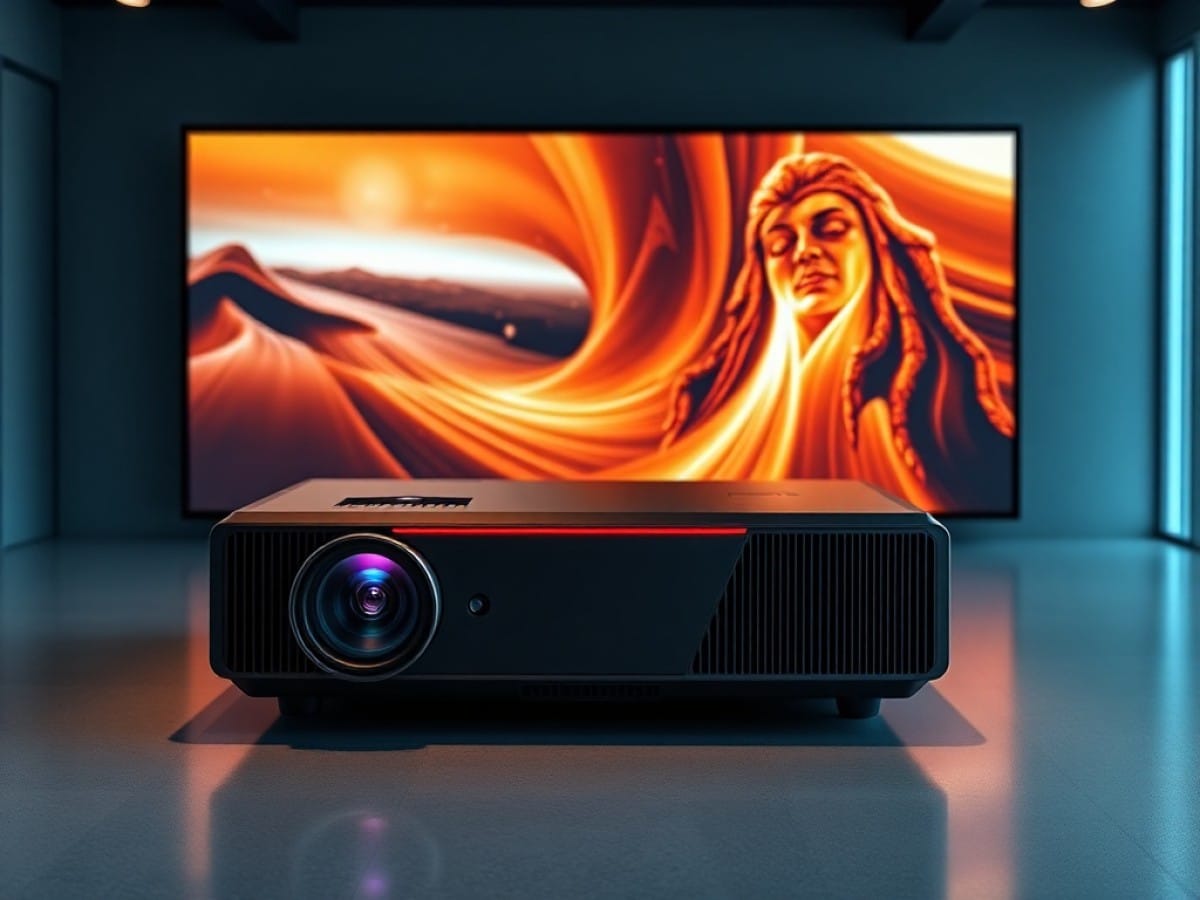
The design of the Xgimi Horizon 20 Max is a continuation of the manufacturer’s high-end productions. Bulky yet elegant with a bronze hue, its rectangular shape with clean lines and high-quality finishes showcases the level of sophistication sought by Xgimi.
The flat front, designed to optimize sound projection, hides the Harman Kardon speakers and sports a decidedly modern look. While the Xgimi Horizon S Pro features a front flap that moves up and down at startup or shutdown to protect the lens, this is not the case here.
Its dimensions are 298 mm wide by 249 mm tall and 190 mm deep, weighing 5.4 kg.
Like the JMGO N1S Ultra, JMGO N3 4K, Hisense C2 Ultra, Dangbei MP1 Max, and previous Horizons, the 20 Max is mounted on a swing.
This allows it to tilt up or down. Additionally, it features a rotating stand that allows for 360-degree rotation.
The top part contains no buttons. The only button available is located at the back, next to the connections for powering the device on or off.
Xgimi Horizon 20 MaxConnectivity
The back of the projector houses most of the connections, except for the power port, which is strategically placed on the base of the swing.
It features two HDMI inputs, one of which is eARC, allowing audio return to a soundbar or amplifier. The Xgimi Horizon 20 Max also includes two USB ports (one 3.0, one 2.0), an analog audio output, and an optical output. Bluetooth/Wi-Fi 6 connectivity is standard here.
However, it lacks a 12V Trigger port for automating a motorized screen, which would have been a significant addition. An USB adapter can be used instead. Compatibility with AirPlay 2 and wireless sharing via Google Cast complete the connectivity.
The projector must be plugged into a power outlet and is connected via a relatively large transformer, typical for this type of device. This should be considered when moving the device, if necessary.
The Remote Control
The remote control provided with the Xgimi Horizon 20 Max is of medium size. Made of aluminum and plastic, it is ergonomic although only a few buttons are backlit. It’s a shame they all aren’t. However, the main buttons (Back, Settings, Home, Focus, and Inputs) light up as soon as you pick it up. This is convenient.
The volume can, of course, be adjusted using two dedicated buttons. There are also 4 specific buttons for streaming platforms: YouTube, Netflix, Prime Video, and one last button that can be customized. The remote is Bluetooth enabled and includes a microphone for voice commands, if needed. It operates on two AAA batteries.
Xgimi Horizon 20 MaxThe Screen
The Xgimi Horizon 20 Max projector does not come with a proprietary screen, allowing the consumer to choose a projection surface that fits their budget and needs. Therefore, the projector can be set up facing a wall or a dedicated screen, though the output is always significantly better with a specific projection screen.
Depending on the size selected, expect to spend between 500 and several thousand euros to get equipped, as the triple laser technology and the projector’s light power make it ideal for projection even on large surfaces.
Xgimi Horizon 20 MaxInstallation, Easy and Intuitive
Like any modern projector, installing the Xgimi Horizon 20 Max starts with placing it at the correct distance from the screen (or wall). Thanks to its optical zoom (1.2-1.5:1) and its lens shift (vertical ±120%, horizontal ±45%) now included in this range, keystone correction can be performed either automatically or manually, with quick and precise results.
Sharpness is adjusted on the fly, resulting in a uniform image across the entire surface, except for some limitations in the corners on very large screens, a common phenomenon at this level of brightness. For a 100-inch diagonal image, count on a distance of about 270 cm, and for a 3 m base, a distance of 390 cm is needed.
The stand ensures perfect stability, even in non-optimized environments. Count on a distance of about 2.5 m for a 100-inch diagonal image. In this case, the image is perfectly sharp, both in the center and on the edges.
Xgimi Horizon 20 MaxThe Image in Subjective Mode
The Xgimi Horizon 20 Max utilizes RGB triple laser technology along with a cutting-edge DLP chip. The simulated UHD 4K resolution complements HDR10+, Dolby Vision, and IMAX Enhanced support.
Various image modes are available: Standard, Vivid Colors, Film, Game, High Power, and Sport. It’s worth noting the support for 3D content. The light power can be adjusted: Standard, Eco, and User (where intensity can be set as desired). The image can automatically adapt to ambient light. The device can detect movie-type content and immediately switch to the appropriate image mode.
The image produced by this model impresses with its pronounced dynamics, very rich colors, and remarkable contrast management, especially in dark sequences where the RGB triple laser excels.
Whether streaming or using Blu-ray discs, blacks appear deep and never artificial, whites are powerful without excessive brightness peaks. The overall impression is that of an immersive, particularly natural image, without digital excess or aggressiveness in sharpness. In HDR content, the gradation from the brightest to darkest areas retains all the details.
As always, Film mode offers the greatest fidelity for an authentic cinema experience, where Standard and Vivid Colors modes enhance visual brilliance and detailed scene reproduction.
Contents from platforms like Netflix, Disney+, and Amazon Prime Video are handled smoothly thanks to the high refresh rate. The consistency of the image, whether in SDR or HDR, for watching movies and series or playing on a console, is particularly appreciated. The subjective experience is marked by a sense of depth and precision rarely found lacking, except perhaps a slight excess of saturation in Standard mode (a mode we do not recommend). Faces, settings, mixed scenes are perfectly rendered on all supports, and the overall performance does justice to the manufacturer’s reputation.
Motion Compensation
The MEMC technology integrated in the Xgimi Horizon 20 Max ensures very effective motion compensation. Action scenes remain fluid, with very few judders or artifacts, even during fast movement of characters or objects in the foreground against complex backgrounds.
The rendering remains natural without introducing a soap opera effect, and interpolation management can be adjusted via the Pro Tuning menu to satisfy all sensitivities. Even in the most demanding sequences, the projection remains controlled, the level of fluidity surpassing that of most competing models.
Rainbow Effect
As with all DLP technologies, the rainbow effect exists, but it is particularly limited here. It only interferes with viewing on very rare occasions, mainly on subtitles and very bright objects moving against a dark background. Sensitive individuals may occasionally perceive it, but this phenomenon is well managed, much less present than in previous generations or some direct competitors.
Xgimi Horizon 20 MaxOur Measurements, Probes Included
As always, the measurements made on Frandroid are based on default settings. The Horizon 20 Max offers a native contrast ratio of 1331:1 in Film mode with the light power set to Standard.
As for color fidelity, with SDR content, we recorded an average Delta E of 3.61, which is quite acceptable with the default settings, still in Film mode. This measure is very close to the 3 threshold below which the human eye cannot differentiate between the requested color and the displayed color. There are some optimizations to be made, which can be easily achieved with the very large number of options available in the configuration menus.
For the average color temperature, factory settings offer a measure of 6452 K, slightly below the target value of 6500 K. Colors vary very little relative to each other, which is always a good thing. Additionally, gamma is well managed with an average value recorded at 2.1.
For HDR content, it is again and logically Film mode that provides the best rendering. Thus, we measured an average Delta E of 2.78, this time below the threshold of 3. For an image that measures 100 inches, we recorded a peak brightness of 378 cd/m², which is much more than the competition. Remember that under the same conditions, the Dangbei MP1 offers 21 cd/m², the Valerion VisionMaster Pro 2 displays 265 cd/m² while the Hisense C2 Pro was flashed at 257 cd/m², where the Nebula X1 was measured at 219 cd/m².
For an image that measures 3 meters in base, the projector offers a brightness of 211 cd/m², which remains quite bright for such a size.
Finally, for the coverage of the colorimetric spaces DCI-P3 and BT2020, we obtained excellent respective values of 99.75% and 95.92%, which is very good.
Xgimi Horizon 20 MaxGaming
Designed for video gaming, the Xgimi Horizon 20 Max offers an input lag of 1 ms in 1080p 240 Hz and 10 ms in 4K 60 Hz, representing exceptionally high performance for a projector and on par with high-end gaming monitors. The high refresh rate and image fluidity make this projector a particularly suitable solution for competition and fast-paced games. VRR compatibility is ensured to limit tearing effects and guarantee an uninterrupted experience.
Optimized modes for gaming are quickly accessible, and adjustable colorimetry allows for gaming without visual fatigue or loss of reference during long sessions. It’s worth noting that the Dolby Vision signal is capped at 60 Hz, as is often the case with this type of product, but overall, it meets the expectations of gamers of all levels, whether professional or amateur, in search of visual performance and responsiveness.
Xgimi Horizon 20 MaxAudio, Suitable for a Medium-Sized Room
The audio part of the Xgimi Horizon 20 Max is handled by a Harman Kardon system with a total power of 24 W (2 x 12 W), with bass extension down to 55 Hz and an acoustic chamber of 630 cc, according to the brand. Compatible with DTS Virtual:X and Dolby Audio, the sound delivered is relatively broad, precise, and balanced enough to sound a medium-sized room.
The voices are intelligible, and the effects are
Similar Posts
- Dangbei MP1 Max Review: Discover Excellence with This LED-Laser Hybrid Projector!
- Xiaomi Smart Projector L1 Pro Review: Compact Google TV Gadget Impresses!
- Valerion VisionMaster Max Review: Triple Laser Projector Targets Home Cinema Heights
- BenQ W2720i Review: Does This Android TV Back-Room Projector Measure Up?
- ViewSonic M1B Max Review: Google TV in a Sub-€500 Mini Portable Projector!

Maya Singh is a senior editor covering tablets and hybrid devices. Her work explores how these tools reshape digital productivity and learning. She also contributes to feature editorials on emerging tech.