
Scientists confirm: This is the most effective way to get your cat’s attention, according to new research
Elderly Couple Refuses Reserved Seats—Viral Train Standoff Sparks Fiery Debate on Courtesy
While the high-end segment is dominated by the Find X models from the manufacturer (see our reviews of the Oppo Find X9 Pro and Oppo Find X9 Ultra), the Reno series models are designed to be more affordable while maintaining a technological appeal.
The Oppo Reno 16 Pro, which is the subject of this review, is thus the manufacturer’s “high-end mid-range” smartphone for the second half of 2026 (it is the big brother of the Reno 16, Reno 16 F, and Reno 16 FS).
Priced at €1099 (excluding the launch offer, see at the end of the article), it competes with heavyweights like the Honor 600 Pro (launched at €999 for 12/512 GB), the Xiaomi 17 (€1103 for 12/512 GB), and the Samsung Galaxy S26 (€999 for 12/256 GB).
Let’s examine the choices made by Oppo to enhance the Reno 15 Pro, which was launched at the beginning of the year.
| Model | Oppo Reno 16 Pro |
|---|---|
| Dimensions | 72.42 mm x 151.21 mm x 8.2 mm |
| Interface | ColorOS |
| Screen Size | 6.32 inches |
| Resolution | 2640 x 1216 pixels |
| Pixel Density | 460 ppi |
| Technology | AMOLED |
| SoC | Mediatek Dimensity 8550 Super |
| Internal Storage | 256, 512 GB |
| Rear Camera |
Sensor 1: 200 MP Sensor 2: 50 MP Sensor 3: 50 MP |
| Front Camera | 50 MP |
| Video Recording Resolution | 4K @ 60 fps |
| Wi-fi | Wi-Fi 6E |
| Bluetooth | 5.4 |
| 5G | Yes |
| NFC | Yes |
| Fingerprint Sensor | Under the screen |
| Connector Type | USB Type-C |
| Battery Capacity | 6000 mAh |
| Weight | 185 g |
| Colors | Black, White |
| Product Sheet |
Design
Although the Oppo Reno 16 Pro falls into the category of “compact smartphones” (like the Samsung Galaxy S26 or the Xiaomi 17), it is not ultra-light or remarkably thin. In fact, it measures 8.36 mm in thickness, which is significantly thicker than the Samsung Galaxy S26 (only 7.2 mm). One of the champions in this category is the Motorola Edge 70 with its 6 mm thickness. However, its weight—188 grams—is on the lower end of the average.
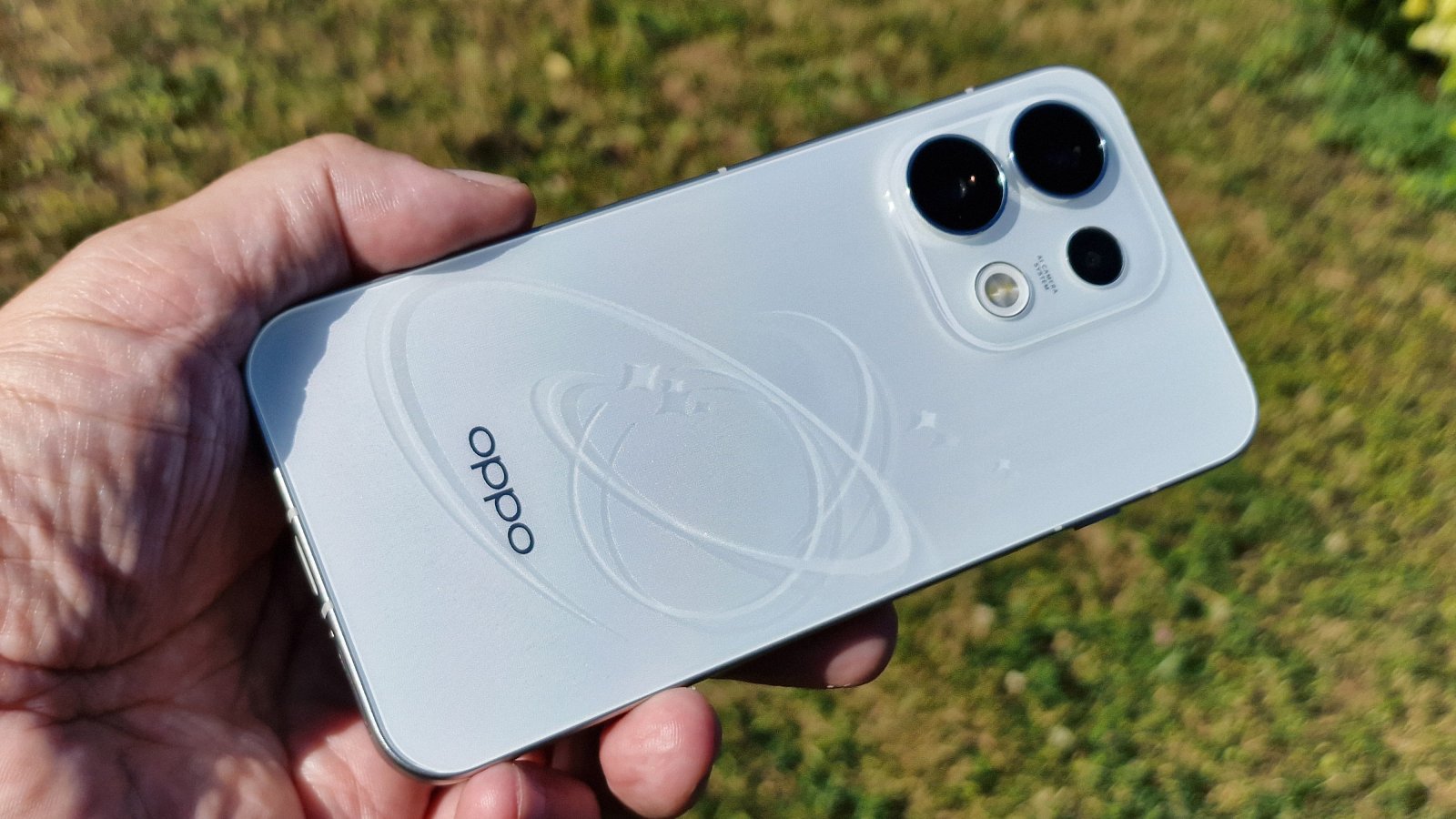
The Oppo Reno 16 Pro is available in black or white. While the former has a matte texture without frills, the white model presents a particular interest: its shiny glass back (where fingerprints are somewhat visible) is adorned with 3D patterns, representing a planet with what might resemble rings (somewhat like Saturn).
If the result is subtly sophisticated, it’s not something that will keep you up at night. Nonetheless, the smartphone can boast an original visual effect that might appeal to some users.
Another positive aspect is that only the manufacturer’s name is visible on the back of the Reno 16 Pro, as the visually more or less invasive markings, which often alter the aesthetics of many smartphones (see the photo below of the recent Xiaomi 17T Pro), have been moved to the edge. And, what’s more, they are almost invisible. This is a detail that makes the smartphone more attractive.
The transparent optical block is quite discreet, with its three lenses, the two main ones protruding (the wide-angle and the telephoto). The overall result is quite appealing.
The frame of the Oppo Reno 16 Pro is made of aluminum to increase its resistance to shocks. Moreover, thanks to its IP68 and IP69K certifications, the smartphone should not malfunction if exposed to water or fine dust.
The Oppo Reno 16 Pro stands out from its predecessor with its Snap Key, placed opposite the traditional power and volume adjustment buttons.
This has exactly the same role as Honor’s IA button. Indeed, it provides immediate access to three functions, depending on whether a short press, a long press, or a double press is applied. By default, the Snap Key is used to record information in the Mind Space app (see below).
Screen
The Oppo Reno 16 Pro (just like its younger sibling, the Oppo Reno 16) is equipped with a 6.32-inch OLED panel (similar to the Xiaomi 17 or the Samsung Galaxy S26).
A good point, like many recent smartphones, the screen features quite thin borders.
The display can be set to two resolutions: low (2344 x 1080 pixels) or high (2640 x 1216 pixels). The former can be used when one wishes to read emails, watch Full HD videos on YouTube or Netflix, or browse websites and social networks. The latter allows for better precision for playing games or viewing photos, for example.
The maximum refresh rate is 144 Hz. However, the benefits of this mode are currently supported in a very limited number of games, such as Mobile Legend or PUBG.
For other games, like Fortnite or Call of Duty, you have to settle for a refresh rate of 120 Hz, which is still quite good. In short, there was no real need to replace the screen of the Oppo Reno 15 Pro. Especially since the LTPO technology is still not current.
Regarding the screen’s performance, Oppo announces a standard brightness level of 600 nits, with the possibility of reaching 1800 nits by activating dynamic brightness, and HDR peaks at 3600 nits.
In practice, we have indeed measured, with our colorimetric probe and the software CalMAN Ultimate from Portrait Displays, a standard brightness of 584 nits. And, with the Automatic Brightness mode, this reached 1235 nits in SDR and 1330 nits in HDR.
While these levels are not extraordinary, especially in HDR, they are sufficient for the screen to be readable when using the smartphone under the sun.
However, the colorimetry of the OLED panel is almost perfect. Indeed, if you use the display profile called Vivid Colors, the average Delta E measured is 3.04, with an average color temperature of 6367 K, and a coverage of the DCI-P3 color space at 100%.
Finally, as is increasingly common, the screen can be used with wet fingers or with gloves.
Performance
A bit of a disappointment, the Oppo Reno 16 Pro is not going to revolutionize computing power compared to the Reno 15 Pro. Indeed, the Mediatek Dimensity 8450 chip that equipped the latter has been replaced by the Dimensity 8550. In fact, you clearly do not get your money’s worth here.
This new chip uses the same 8-core architecture, with just slightly boosted frequencies. Thus, the fastest core of the chip now operates at 3.4 GHz, compared to 3.25 GHz for the one in the Dimensity 8450. And, for graphic operations, the Mali-G720 MP7 GPU gives way to the Mali G720-MP8.
In the end, the smartphone does not really surprise when we observe its scores obtained with the various benchmarks (Antutu, Geekbench, 3D Mark). While – logically – a slight progression compared to the Dimensity 8450 is noted, the Dimensity 8550 is outperformed by other processors used by competing smartphones offered at similar prices.
Logically, Oppo has increased its price compared to the Reno 15 Pro without offering major changes. Consequently, its successor finds itself competing with much higher-end smartphones.
The HONOR Magic V6 pushes the boundaries of the foldable smartphone with a distinctive and robust design, high-level photo performance, and a generous battery designed to last.
And if we compare it to the smartphones it should have faced if it had not incurred its price increase, well, it’s not much more flattering.
For example, the Samsung Exynos 2400 chip present in the Galaxy S25 FE surpasses the Dimensity 8550 in all areas (CPU and GPU). The same goes for the Qualcomm Snapdragon 8 Gen 5 found, for example, in the OnePlus 15R.
The Dimensity 8550 actually turns out to be almost at the level of a Snapdragon 8s Gen 4, which we encountered – just a year ago – in the Xiaomi Poco F7. It is therefore a mid-range processor (at Mediatek, the high-end segment is occupied by the Dimensity 9000 series chips) in a smartphone costing over 1000 euros…
With 12 GB / 512 GB, however, you benefit from good responsiveness for all the tasks you perform every day, such as when editing your photos.
As for gaming performance, Fortnite supports the 120 Hz mode, with the lowest graphic quality, and 60 Hz in the best mode (Epic).
Software
The Reno 16 Pro runs on Android 16, complemented by Oppo’s ColorOS 16 overlay. As a “bonus,” there are also the usual bloatware apps that we regularly encounter (Temu, Autodoc, Aliexpress, etc.), which we will hurry to uninstall.
A good point, the manufacturer announces that it will ensure Android updates for 5 years (and 6 years for security updates). Admittedly, some manufacturers do better in this regard (7 years for Samsung and Google), but others do less well (only 3 years for Nothing smartphones and 4 years for OnePlus) or just as well (Xiaomi).
The software environment includes several functions that take advantage of artificial intelligence:
- Mind Pilot, which allows you to ask a question and get answers from Gemini, Perplexity, and ChatGPT all at once. This is a novelty that was not present on the Reno 15 Pro.
- Mind Space, which stores screenshots or voice notes, analyzes their content, and automatically categorizes them, making it easy to find certain information later.
- AI Editor
- AI Translation
- AI VoiceScribe (audio transcriptions)
Two other “fun” software novelties make their appearance. The first, called AI-powered Remix Collages, allows you to insert stickers, which you have previously created (or predefined), onto a background image.
The second, Highlight Collages, allows you to create a montage by highlighting a person or an object. In both cases, a bit of practice is needed, otherwise you risk obtaining a rather ridiculous result (see the two examples above).
Finally, when editing photos, several functions are boosted by AI:
- Perfect Shot, to avoid closed eyes in group photos (if you’ve taken multiple shots!)
- Recomposition (cropping)
- AI Relighting
- AI Eraser (magic eraser)
- Removal of blur and reflections
- Automatic sharpness enhancement
Photo
The Oppo Reno 16 Pro uses the same photo configuration as the Reno 15 Pro, which was already – it must be acknowledged – very well equipped in this regard. We find the following four lenses:
- Wide-angle
- Ultra wide-angle
- Telephoto
- Ultra wide-angle front for selfies
Wide-angle
With a 24mm focal length and an f/1.8 aperture, the wide-angle lens is suitable for most common situations. It is paired with a 200-megapixel Samsung sensor, which has an optical stabilization system.
Photos are generated by default in 12 megapixels (4096 x 3072 pixels), or 28 megapixels (5888 x 4416 pixels), depending on lighting conditions. It is also possible to activate the High Resolution mode, to shoot directly in 200 megapixels and – possibly – perform manual cropping afterwards.
And, as can be seen in these few
Similar Posts
- Oppo Reno 16 Review: Is a €250 Price Hike Worth Minor Upgrades?
- Xiaomi 15T Review: High-End Smartphone Overshadowed by Poco Contender
- Xiaomi 15T and 15T Pro Launch Date Revealed: Here’s What We Know!
- Xiaomi Redmi Note 15 Pro+ Review: A Convincing Smartphone Challenged by Xiaomi’s Classics
- Huawei Pura 80 Ultra Review: Incredible Camera, But Does It Offset Its Flaws?

Maya Singh is a senior editor covering tablets and hybrid devices. Her work explores how these tools reshape digital productivity and learning. She also contributes to feature editorials on emerging tech.