
Scientists confirm: This is the most effective way to get your cat’s attention, according to new research
Elderly Couple Refuses Reserved Seats—Viral Train Standoff Sparks Fiery Debate on Courtesy
The iPhone 17 Pro Max represents a new direction for Apple: a thoroughly revamped design aimed at enhancing battery life and resolving the overheating issues that marred previous models.
Thanks to its 2nm A19 Pro chip and optimized thermal management, the Cupertino giant has made a significant technical leap forward. However, this overhaul comes with compromises: its imposing dimensions and record weight make it the thickest and heaviest iPhone ever released.
This choice may be divisive, especially for the Max version, the largest in the lineup. For the standard iPhone 17 Pro, we have a complete review.
Technical Specifications
| Model | Apple iPhone 17 Pro Max |
|---|---|
| Dimensions | 78 mm x 163.4 mm x 8.75 mm |
| User Interface | iOS |
| Screen Size | 6.9 inches |
| Resolution | 2868 x 1320 pixels |
| Pixel Density | 460 ppi |
| Technology | OLED |
| SoC | Apple A19 Pro |
| Graphics Chip | Apple GPU |
| Internal Storage | 256, 512, 1024, 2048 GB |
| Rear Camera |
Sensor 1: 48 MP Sensor 2: 48 MP Sensor 3: 48 MP |
| Front Camera | 18 MP |
| Video Recording Resolution | 4K @ 120 fps |
| Wi-Fi | Wi-Fi 7 |
| Bluetooth | 6.0 |
| 5G | Yes |
| NFC | Yes |
| Fingerprint Sensor | No |
| Connector Type | USB Type-C |
| Battery Capacity | 4823 mAh |
| Weight | 231 g |
| Colors | Silver, Blue, Orange |
| Product Sheet |
Video
Check out our test video on YouTube.
Design
This year’s iPhone 17 Pro Max breaks away from the very angular aesthetic that the brand has imposed on us for several generations now.
We have a smartphone with dimensions that are as generous as ever, if not more so. It is the thickest iPhone ever created at 8.75 mm at its thinnest point.
In hand, its weight is noticeable. Coming from an iPhone Air just before, the difference is naturally shocking. However, Apple has opted for a very slight curve at the corners that more naturally fits the palm of the hand. It’s a subtle change, but it makes a difference in use, making the phone much more comfortable to handle, especially for a device of this size.
The full dimensions of the beast are 163.4 mm in height for 78 mm in width, with a significant weight of 231 grams on the scale. This remains a very large format, designed for immersion thanks to its large 6.9-inch display, but it will not be forgotten in a pocket.
The main chassis is made of a unibody aluminum design, a material choice that stands out from the titanium of past generations. The back, however, still contains a glass plate to allow for wireless charging. Here, we have Ceramic Shield 1. While the first photos had left me skeptical, the final rendering is quite successful. The contact offers a silky texture, very pleasant to the touch.
Three finishes are offered this year: a deep blue (the model of our test), a cosmic orange spearhead of Apple’s communication, and a more classic silver color.
A prominent camera block, without solving all the problems
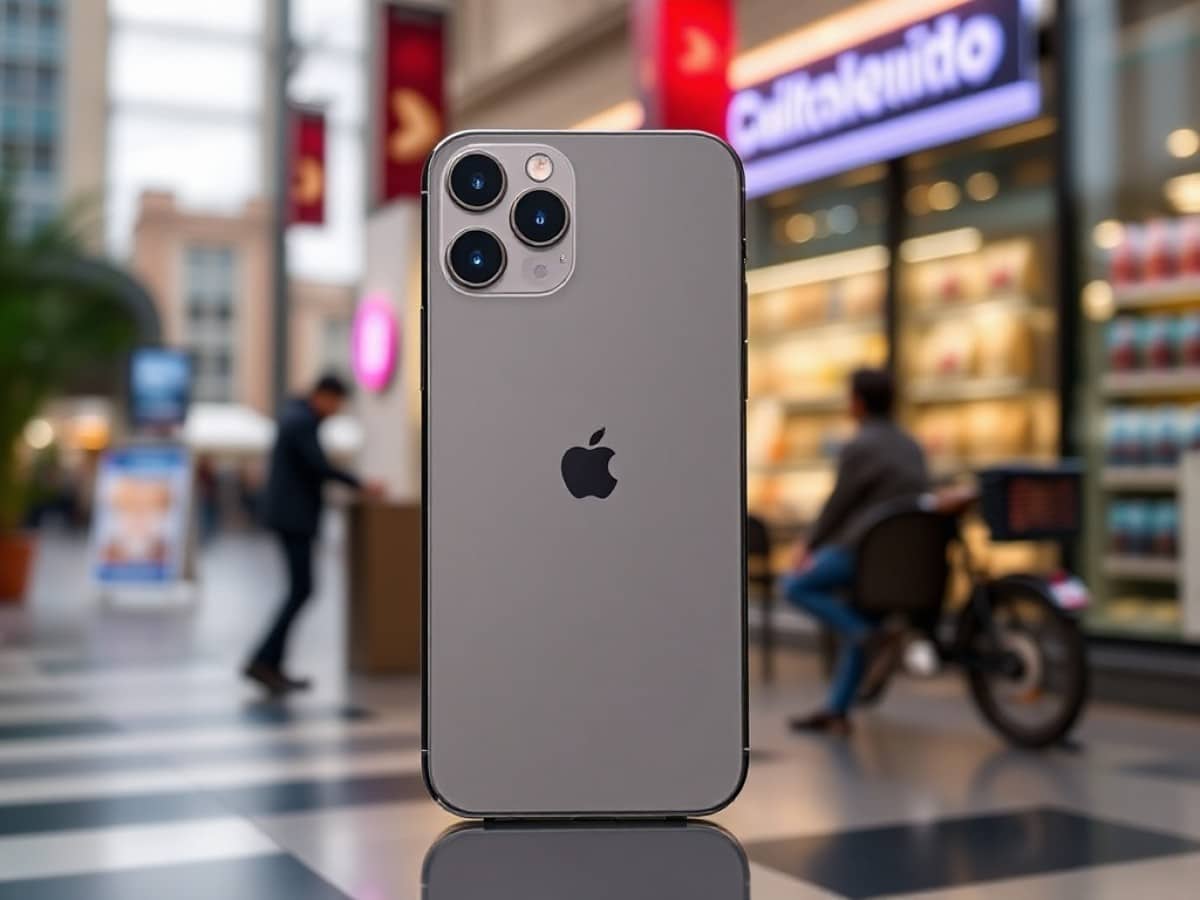
The most visible change is in the camera module. Gone is the traditional square in the upper left corner. Apple has decided to completely revise its approach by integrating a block that takes up the entire width of the phone. This horizontal bar houses the three main optics. The flash and the LiDAR sensor, on the other hand, have been moved and are now on the right side of the chassis.
While this aesthetic choice offers a strong and recognizable visual signature, it does not solve a recurring problem: the stability of the phone once placed flat. Indeed, despite this new design, the three optics still protrude enough for the iPhone 17 Pro Max to rock when used on a table. It’s an annoying detail, one that owners of Google’s Pixel do not know.
On the edges, we find a familiar arrangement. In addition to the traditional volume buttons and the side start button, we still have a customizable Action button as well as the famous dedicated camera control button which we think might disappear next year.
Complicated durability
Finally, let’s talk about the durability of this iPhone 17 Pro Max. The new rounded edges of the chassis are not just for ergonomics. They are also a technical constraint: this shape is necessary for the anodization process of the aluminum to be effective and for the color to hold up over time. However, we observe a radically different treatment on the camera module plate. Its edges are sharp and not rounded, which directly prevents the anodization treatment from adhering properly to this part.
This area is therefore a major point of fragility. It is very likely that it will get damaged and scratched quite quickly when in contact with keys or coins in a pocket. This is a real durability issue for the aesthetics of this iPhone.
Fortunately, the same cannot be said for the screen protection. The front is covered with Ceramic Shield 2, which proves to be particularly resistant. It is capable of withstanding scratches up to grade 8 on the Mohs scale, an excellent score when most competing smartphones get scratched around grade 6 or 7.
Finally, in terms of certifications, the iPhone 17 Pro Max is announced as IP68. According to Apple, it can therefore be submerged up to 6 meters deep for a maximum of 30 minutes. However, it does not have the IP69 certification, which is found in many Android competitors, and which guarantees resistance against hot high-pressure water jets.
Screen
The screen of the iPhone 17 Pro Max does not fundamentally change the formula, but seeks to improve on key points such as brightness and color accuracy.
We find a Super Retina XDR OLED panel of 6.9 inches, a generous diagonal that still makes it an excellent medium for multimedia uses. The definition remains the same, at 2868 x 1320 pixels, offering a resolution of 460 ppi. The ProMotion technology is of course present, ensuring an adaptive refresh rate that can go up to 120 Hz.
Brightness reaching for the peaks
Apple promises very high brightness figures. The spec sheet announces 1000 nits for standard use, a peak at 1600 nits for HDR content and even a boost up to 3000 nits outdoors. Once the screen is tested with our probe and analyzed with the CalMAN Ultimate software from Portrait Displays, the results are, as often, a bit different, but still excellent.
We measured an actual brightness in SDR of 1045 nits, slightly more than promised. In HDR, the peak reached 2400 nits. We are approaching the manufacturer’s data, without however reaching the peaks announced in very specific conditions. The screen remains perfectly legible in all circumstances.
Better controlled colorimetry, but not yet perfect
It is in color accuracy that the iPhone 17 Pro Max makes the most progress this year. In SDR, we measured a Delta E of 2.9. That’s a significant improvement over the iPhone 16 Pro Max, which had a Delta E of 3.8. The display thus gains in precision, falling below the threshold of 3, below which the human eye is fooled and no longer sees color nuances. In HDR, the observation is more mixed: while the rendering improves, the Delta E remains above 6, which can still lead to inaccuracies and color shifts on compatible content.
The color temperature was measured at 6216 K. We are therefore dealing with a display that tends very slightly towards warm tones, with a white that is not perfectly neutral.
The most disappointing aspect of this panel concerns the coverage of color spaces. While the spec sheet mentions a “Wide color gamut (P3)“, our measurements indicate that the DCI-P3 space is only covered at 69%. This is a relatively low result for a high-end smartphone, even if it is consistent with what Apple offered last year. On this point, Apple stagnates and is outpaced by the competition.
In short, the screen of the iPhone 17 Pro Max is an improved version of its predecessor, especially in terms of color accuracy in SDR and its maximum brightness in HDR, but it does not represent a major upheaval and retains some weaknesses.
Performance
Every year, Apple’s new chip is eagerly awaited, and the A19 Pro that powers this iPhone 17 Pro Max is no exception. It features a 6-core CPU (two performance cores and four high-efficiency cores), a 6-core GPU, and 16 neural cores. But the real novelty, the game-changer, is not so much the chip itself as the way it is cooled.
The vapor chamber: Apple finally catches up
Finally! We could almost shout it. After years of seeing high-end Android smartphones benefit from it, Apple is integrating a vapor chamber for the first time on an iPhone. The principle is simple, but effective: a tiny amount of water, upon contact with the heat from the processor, vaporizes. This vapor moves and condenses in a cooler area of the chassis, thereby releasing the heat, before becoming liquid again and restarting the cycle.
Right now, take advantage of exclusive offers on a wide range of refurbished devices: already much cheaper than new, some benefit from additional discounts! Access high-performance products, controlled and guaranteed from now on.

Maya Singh is a senior editor covering tablets and hybrid devices. Her work explores how these tools reshape digital productivity and learning. She also contributes to feature editorials on emerging tech.
Categories
Latest Articles