
Scientists confirm: This is the most effective way to get your cat’s attention, according to new research
Elderly Couple Refuses Reserved Seats—Viral Train Standoff Sparks Fiery Debate on Courtesy
When Bang & Olufsen introduces a new product, it’s rarely just a simple update. The Beosound Premiere is no exception. While most manufacturers aim to pack as much technology as possible into a discreet enclosure, the Danish manufacturer has chosen the opposite approach: to showcase its speakers, turning them into distinct design elements. The result is a soundbar that is as visually striking as it is audibly impressive.
At 3,900 euros on the official website, the price tag is steep—there’s no denying that. But from the first moments of listening, it’s clear that this price is backed by solid engineering work: the sound precision is exceptional, with an accuracy that leaves nothing to chance. The Beosound Premiere delivers an atmospheric, vertical, and enveloping sound without any separate speakers—suggesting highly advanced electronic processing, native support for Dolby Atmos, and a fully internally managed 7.1.4 distribution. Let’s delve deeper.
Bang & Olufsen Beosound PremiereTechnical Specifications
| Model | Bang & Olufsen Beosound Premiere |
|---|---|
| Dimensions | 93.2 cm x 13.3 cm x 16 cm |
| Power | 580 watts |
| Spatial Audio | Dolby Atmos |
| Number of HDMI Ports | 1 |
| HDMI e-ARC | Yes |
| Wifi | Yes |
| Subwoofer | No |
| Rear Speakers | No |
| Product Sheet |
This review was conducted with a speaker provided by B&O.
Bang & Olufsen Beosound PremiereWhen the Soundbar Becomes a Decorative Object
The Beosound Premiere is a product of collaboration between the internal design team at Bang & Olufsen and Factory 5, a high-end manufacturing workshop based in Struer, Denmark. Here, there’s no plastic, no fabric mesh stretched over a plastic frame. The entire enclosure is machined from solid aluminum, sandblasted with glass beads to achieve a matte, silky finish. Clearly, this bar makes a statement.
Its dimensions are average in terms of width (117 cm) but less conventional in height at 17 cm, roughly the same as the Sennheiser Ambeo Soundbar Max. This makes it difficult to place in front of a TV on its stand. Fortunately, it is not designed for such setup but rather to complement a wall-mounted TV or possibly a projector. B&O also provides a wall mounting system.
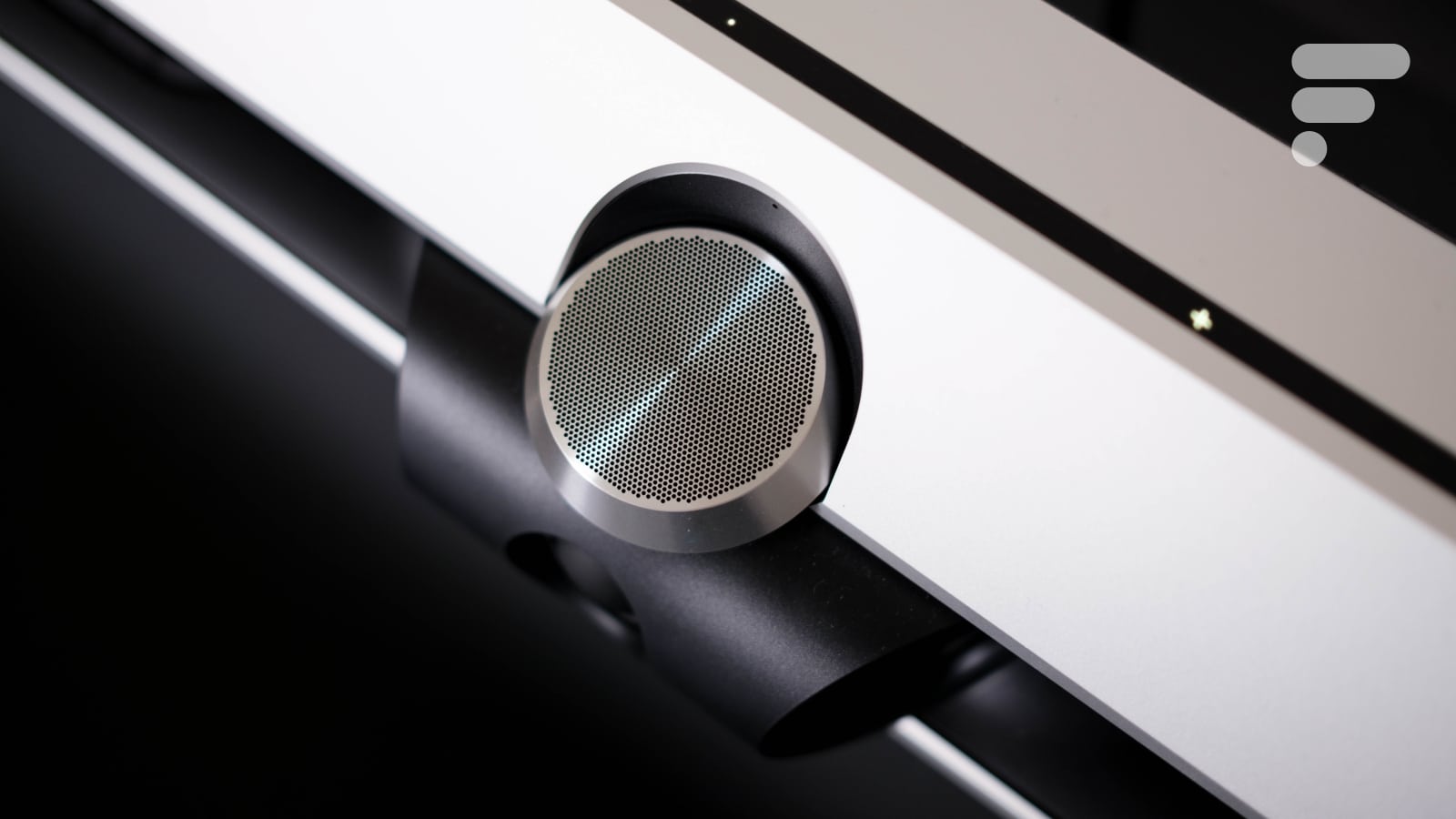
At the center of the bar sits an upward-facing tweeter, set in a turned aluminum housing—a real gem. This driver is protected by a grille with 1,925 micro-perforations machined by laser, a subtle homage to the year Bang & Olufsen was founded.
Inside the bar runs a strip of 90 reactive LEDs. They light up as your hand approaches, revealing the touch-sensitive volume controls, and react to changes in source or sound mode. From the mobile app, two settings manage this behavior: activation of the buttons on approach, and the LED strip itself.
Optional covers are available to conceal the drivers: in gray fabric (300 euros), or in light or dark oak (1,100 euros each), carved from a single piece of wood. Here, we definitely enter the realm of luxury.
Bang & Olufsen Beosound PremiereInternal Architecture: Ten Transducers to Create a Vast Soundstage
Beneath the aluminum, the Beosound Premiere conceals a sophisticated sound architecture. Ten specially developed speakers equip the chassis.
The four bass drivers are elliptically shaped with an 8 cm wide diaphragm. This shape allows for generous diaphragm surfaces within the limited thickness of a soundbar, without (too much) sacrificing the air movement necessary for reproducing low frequencies. These four woofers are each powered by a dedicated 70-watt amplifier, adding up to 280 watts of power just for the bass.
These bass drivers operate in a closed box (without a port) to respond as quickly as possible to variations in the sound signal. The closed box provides the best response time, and the cleanest, most precise bass extension possible, without the artificial bloating sometimes caricatured in bass-reflex systems.
The other six drivers are small-format full-range speakers, strategically oriented to ensure spatialization. Two 5 cm drivers face forward for direct frontal reproduction; two more 5 cm drivers are oriented towards the sides—at 90 degrees—to create lateral ambiance effects and expand the soundstage beyond the physical limits of the bar (spoiler: it works). A fifth full-range driver of 3.8 cm is oriented upwards: it generates the Atmos height effects by reflecting off the ceiling.
Finally, a 2 cm front tweeter completes the setup for reproducing the highest frequencies. Each of these five full-range drivers and the tweeter has its own 50-watt amplifier, for a total of 580 watts of cumulative power.
The proprietary Wide Stage technology orchestrates the ensemble. Through sophisticated signal processing—combining controlled frequency phasing (beam-forming), inter-channel crosstalk, and adaptive filtering—it creates the psychoacoustic illusion of additional speakers positioned to the sides and above the listener. One perceives sound sources beyond the physical limits of the bar, both in width and depth.
Automatic acoustic calibration, accessible from the Bang & Olufsen app, analyzes the room environment via integrated microphones and adapts the system’s response to the room configuration. This is a crucial aspect that B&O has not overlooked.
Bang & Olufsen Beosound PremiereConnectivity: Essentials Without Superfluity
The Beosound Premiere features a minimalist set of connections. It includes a single HDMI eARC port for the main connection to the TV, essential for receiving the Dolby Atmos stream in optimal quality. In the absence of additional HDMI inputs, sources must be connected to the TV. Additionally, an optical Toslink input is available for older sources (CD, DVD players…), as well as a 3.5 mm jack for an analog line input. This was unexpected and allows for the connection of devices like a turntable, for example.
The audio formats supported via HDMI eARC include: Dolby Atmos & MAT (Dolby TrueHD, Digital Plus, Digital 5.1, and 7.1), and 7.1 multichannel PCM. Thus, it fully covers everything from the Dolby sphere, which today represents the vast majority of streamed content—Netflix, Disney+, Apple TV, Amazon Prime Video broadcast almost exclusively in Dolby Atmos.
However, DTS and DTS:X are not natively supported. It’s a deliberate choice by B&O, and frankly not unreasonable in the current context: DTS content is becoming increasingly rare on streaming platforms and is mainly limited to Blu-ray discs. If your source outputs in DTS, you’ll need to convert it to 7.1 PCM upstream—from the Blu-ray player or TV—with slightly less spatialization than if DTS:X were natively decoded. This isn’t a deal-breaker for everyday streaming use, but purists should take note.
Dual-band Wi-Fi and Bluetooth 5.1 cover wireless uses. The bar is compatible with AirPlay 2, Chromecast built-in, and Spotify Connect for easy music streaming. It also supports the Bang & Olufsen Beolink Multiroom protocol for audio distribution across multiple rooms.
Bang & Olufsen Beosound PremiereBang & Olufsen App: Simplified Customization
The Bang & Olufsen app (iOS and Android) is impeccable. It far surpasses what most competitors offer in terms of simplicity while providing a satisfactory level of customization.
The Sound Modes section offers five pre-configured profiles: Night, Game, Movie, Music, and Speech. Each mode tailors the signal processing, dynamic compression, and spatialization to the content. The Music mode favors a wide frontal stage and a more neutral musical reproduction. The Night mode effectively reduces volume discrepancies to keep the peace with neighbors without sacrificing dialogue intelligibility.
For the more curious, the Advanced tab reveals a true arsenal of customization options. In terms of tone settings, you’ll find frequency curve tilting, sound and voice enhancement, bass management (active by default), and dynamic compression with four levels: Off, Low, Medium, High—deactivated by default, which is the right setting for normal cinema conditions. By activating it, you avoid being assaulted late at night, even while watching an action movie.
The spatial control is particularly well-thought-out. Four processing modes are available: Direct (raw signal without any spatial treatment), True Image (the recommended mode, selected by default, which activates B&O spatialization), Downmix (for multichannel content you want to listen to in classic stereo), and Dolby Mode (the most faithful for listening to Atmos programs, but not the most attractive). Below, five sliders allow you to adjust spatial enhancement, Surround, height, scene width, and Envelopment—all set to 5 by default. These settings are saved per sound mode and per source.
The Sound section provides settings for any additional speakers that may be connected (such as Beolink Surround), Loudness (intelligent boost of bass and treble at low volumes, active by default), and the sensitivity of the line input.
Bang & Olufsen Beosound PremiereAudio Quality: Absolute Mastery
The best sound is always a simple and obvious one, that reveals everything in the music with precision and ease, without harshness or acidity. Not necessarily a neutral sound, but one of great intelligibility and never tiring. That’s exactly what the Beosound Premiere delivers, no matter what you listen to: film, series, music, or video game soundtracks.
My measurements of the Beosound Premiere’s response curve show that it doesn’t sound exactly the same at different listening volumes.
- At moderate volume, the reproduction remains balanced: bass, mids, and highs evolve together.
- At very high volume, the bar adopts another sound signature: the bass doesn’t increase as much as the rest, so the sound seems more centered on the mids/highs (less “bass” proportionally).
The reason is mechanical: without a complementary subwoofer, the speakers responsible for bass reach a limit (maximum displacement of their diaphragm). They can’t indefinitely produce more level in the lower spectrum.
In other words, if you listen at a reasonable volume (without disturbing other household members or your neighbors), the sound will be perfectly balanced. If you decide to wake everyone up, it will be at the expense of a less balanced sound, lacking in low frequencies.
A Well-Thought-Out Curve
What immediately strikes about the curve is the absence of excessive volume variations. Across the entire midrange spectrum—from 300 Hz to 3 kHz—the curve progresses within a remarkably tight corridor for a soundbar. No aggressive bumps on the highs, no artificial dips in the vocal zone. The Beosound Premiere sounds right because it is technically accurate.
The transient response is excellent. Attacks are crisp, percussions snap with an authority that contrasts with the majority of soundbars of this length. This aspect bears the hallmark of B&O systems: a responsiveness that makes music come alive and cinema gripping. Cymbals stand out clearly in the highs up to 15 kHz, before a natural and gradual decline.
The bass is deep, ample, and most importantly, controlled. It doesn’t bloat, nor does it linger in notes that are too long or heavy. A cannon blast in an action movie presents with a dry attack and a controlled decay, not with the formless bubbling that is observed in low-end systems. The closed box here fulfills all its promises.
Vertical Scene and Atmos Performance
The vertical scene is one of the most scrutinized aspects of an Atmos soundbar. And the Beosound Premiere performs very honorably, provided that the automatic acoustic calibration has been performed. Without it, the height effects remain present but a bit imprecise in their localization. With active calibration and the True Image mode, the bar succeeds in creating a credible impression of a sound ceiling: a helicopter flying overhead, rain falling from the sky, or an action scene with flying debris are rendered with convincing verticality.
Rear Surround: An Acknowledged Limit
The rear scene (behind the listener) remains that of a standalone soundbar, i.e., limited. The Beosound Premiere cannot physically recreate a true rear channel behind the listener. The sensation of envelopment exists, effects move convincingly to the sides, but we are still far from systems with true remote speakers. This is precisely why B&O has provided the option to associate additional wireless speakers via the Beolink Surround protocol.
Dialogues: Exceptional Clarity
This is probably the most impressive point of the Beosound Premiere, and the most important for everyday home cinema use. The intelligibility of dialogues is impeccable. Voices are precisely placed at the center of the stage, with a texture and definition that rival a very good central speaker in a home cinema setup.
The responsiveness of the drivers directly contributes to this perceived quality: attacks are crisp, the central channel is stable even in intense action sequences. Even at high volume, sound effects never drown out the voices.
Tests on Movie and Series Scenes
Dune: Part One — Harkonnen Night Attack Scene
The sequence is a textbook case for Atmos systems: sound layers that seem to rise from the depths of the earth, ornithopters emerging from all corners of the scene, and a Hans Zimmer soundtrack designed to completely envelop the listener. The Beosound Premiere handles it with honors. The depth of the bass is striking, the ornithopters move laterally with a convincing trajectory, and
Similar Posts
- TCL X11L Review: Can Mini-LED SQD Truly Rival Premium OLED TVs?
- Samsung Q995F Review: Experience 11.1.4 Channel Immersion and Musical Excellence!
- Sharp HT-SBW320 Review: Extreme Slimness at the Cost of Immersion
- Bose Lifestyle Ultra Review: Experience the Power of Immersive Dolby Atmos Sound!
- Samsung HW-Q930H Review: Is This the Easiest Dolby Atmos Soundbar to Recommend?

Maya Singh is a senior editor covering tablets and hybrid devices. Her work explores how these tools reshape digital productivity and learning. She also contributes to feature editorials on emerging tech.