
Scientists confirm: This is the most effective way to get your cat’s attention, according to new research
Elderly Couple Refuses Reserved Seats—Viral Train Standoff Sparks Fiery Debate on Courtesy
Google has launched the next generation of smartphones. As usual, it is the first manufacturer to propel devices that will define the coming year. Among these is its flagship, the Pixel 11 Pro.
The smartphone is neither the most powerful nor the most equipped with photo sensors. Google continues its tradition of prioritizing a well-rounded experience. It is, along with Apple, one of the few manufacturers that controls the entire device ecosystem, including both the processor and the operating system, which it develops in-house.
The Pixel 11 Pro sees incremental upgrades. It features a small colored LED, a faster processor, a brighter screen, and a host of new features with Android 17. These are aspects that I have tested and measured. Here is my verdict.
Technical Specifications
| Model | Google Pixel 11 Pro |
|---|---|
| OS Version | Android 17 |
| User Interface | Android Stock |
| Screen Size | 6.3 inches |
| Resolution | 2856 x 1280 pixels |
| Pixel Density | 497 ppi |
| Technology | OLED |
| SoC | Google Tensor G6 |
| Internal Storage | 256, 512, 1024 GB |
| Rear Camera |
Sensor 1: 50 MP Sensor 2: 48 MP Sensor 3: 48 MP |
| Front Camera | 42 MP |
| Video Recording Resolution | 8K@30fps |
| Wi-Fi | Wi-Fi 7 (be) |
| Bluetooth | 6.0 |
| 5G | Yes |
| NFC | Yes |
| Fingerprint Sensor | Under the screen |
| Connector Type | USB Type-C |
| Battery Capacity | 4850 mAh |
| Colors | Black, Green, Orange |
| Product Sheet |
Design
The Pixel 11 Pro maintains a compact form factor while slightly optimizing its thickness and weight compared to the previous generation. The device measures 152.7 mm in height, 71.9 mm in width, and 8.4 mm in thickness. For comparison, the Pixel 10 Pro measured 152.8 x 72 x 8.6 mm. The weight is set at 204 grams, slightly less than the 207 g of the previous model. Rounded corners coupled with straight edges make the device very comfortable to hold.
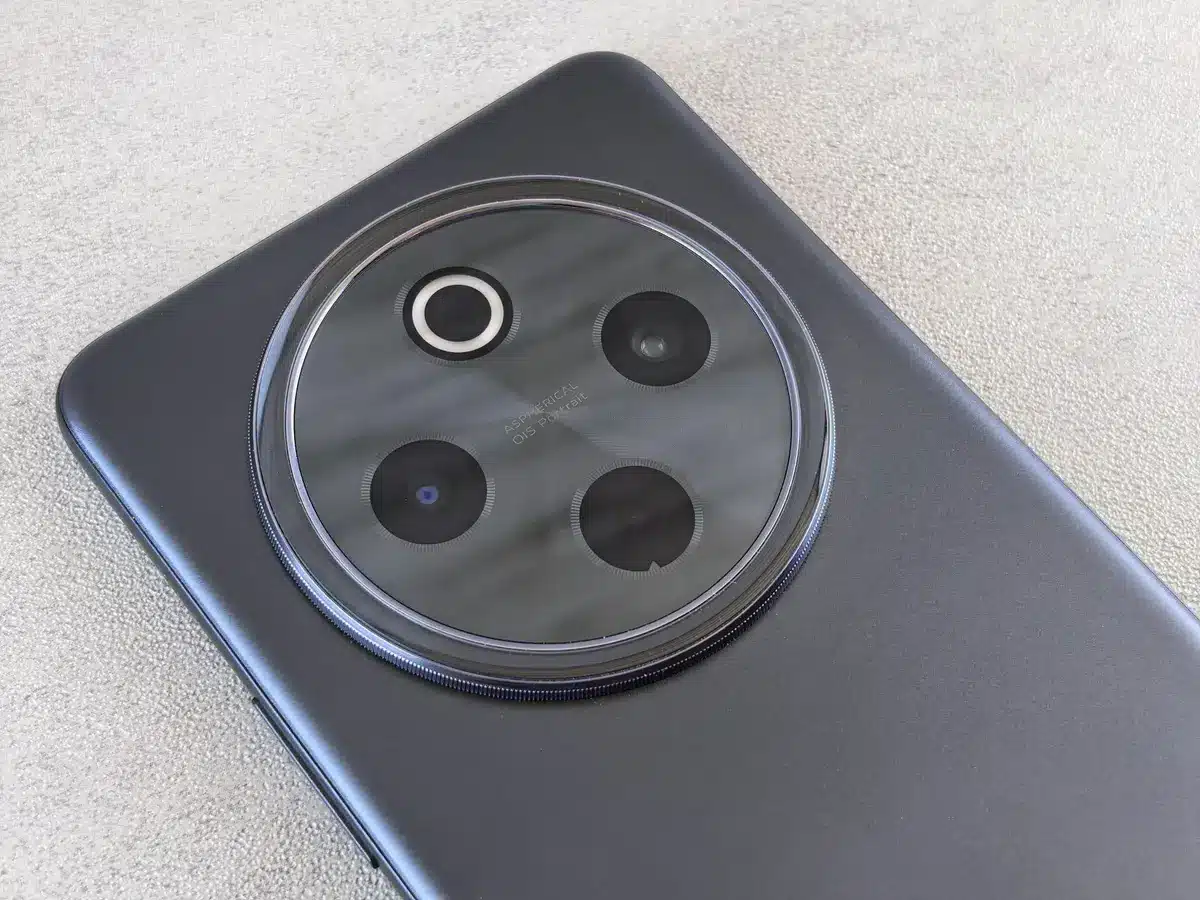
The back of the phone is designed with soft-touch matte glass made of Corning Gorilla Glass Victus 2 with a polished satin finish. The frame is made of aluminum. For the first time on a Pro model, the Volcanic Black (Obsidian) version features a full matte finish, including the aluminum edges. On the other color variants available (Peach Pink, Olive, and Mist), the metal frame retains a glossy finish. The device boasts an IP68 certification, ensuring its resistance to water and dust.
The flat 6.3-inch screen has several notable physical optimizations. Google has slightly thinned the screen’s edges and softened its curvature. Protected by Corning Gorilla Glass Victus 2, the screen incorporates a new coating that makes it twice as resistant to scratches as the previous generation, according to Google. It should be noted that this also means it is less resistant to breakage, as manufacturers cannot equally optimize for both.
The iconic horizontal band housing the cameras on the back has been reworked. On the Pixel 11 Pro, the glass surface now covers the entire photo module, including the LED flash. On the Pixel 10 Pro, a small metal plate interrupted this glass on the far right, around the flash. Unlike the standard Pixel 11, whose photo bar has been slimmed down to minimize bulk, that of the Pixel 11 Pro remains significantly more protruding.
Speaking of this band, let’s talk about the visual novelty of this Pixel 11 Pro: the Pixel HiLight. A hardware novelty exclusive to the Pro models of the range, it is a system composed of several LEDs arranged in a ring around the rear camera flash. It mainly activates when the phone is placed face down to communicate information without having to look at the screen.
HiLight allows you to associate a specific color with your favorite contacts. When one of them calls you, the ring discreetly shines in the corresponding color. This option is directly integrated into the Google Contacts, Phone, and WhatsApp apps. We have five basic shades (green, mustard yellow, magenta, purple, and off-white), but the shades automatically adapt to the color palette of the Material You theme configured on the phone.
For the second interaction, the ring lights up to visually signal that Gemini is listening to you, thinking, or responding to you. Similar to the visual signals of the brand’s connected speakers, this allows for a fluid oral interaction with artificial intelligence hands-free, without ever needing to handle or turn the phone over.
It’s nice, we see the utility, but I regret that there are only two functions. Google has not fully realized its concept. It is to be hoped that it will quickly add new options for Pixel HiLight during future software updates of the Pixel Drops type.
Screen
The Pixel 11 Pro retains a compact 6.3-inch screen, which corresponds to a diagonal of 161 mm at the level of the display rectangle, although the rounded corners slightly reduce the actual area.
It has a 20:9 format. The panel displays a maximum definition of 1,280 x 2,856 pixels, offering a density of 495 ppi. Thanks to LTPO OLED technology, the screen offers a dynamic variable refresh rate ranging from 1 to 120 Hz to ensure maximum fluidity while preserving battery life. In terms of colorimetry and contrast, the panel supports a 24-bit color depth and guarantees full HDR compatibility.
The peak brightness is given at 3,600 nits over an area of 5%. This represents an increase of about 9 to 10% compared to the 3,300 nits of the Pixel 10 Pro. On our side, we measured 3,140 nits over a 100% area in HDR and 2,434 nits in SDR, two very good values that propel it among the brightest smartphones.
The screen of the Pixel 11 Pro also surpasses that of the standard Pixel 11, whose display peaks at 2,090 nits (SDR) and 2,718 nits (HDR).
In terms of colorimetry, we also measured the screen of the Pixel 11 Pro using our probe and the CalMAN Ultimate software from Portrait Displays. We note a DeltaE 2000 of 3.56, which is correct in SDR. It’s a shame to have such a peak on the red, too present. In HDR, it’s worse with far too many colors pushed too far. The rendering is flattering, but lacks naturalness. For the best rendering, you must opt for the Adaptive setting in the screen options.
The white point is also about right at 6,663 K, giving a slightly cool rendering. Overall, except for the very good brightness, we have the same rendering as the Pixel 10 Pro. Good, but others do better.
Performance
At the heart of the Pixel 11 Pro is the Google Tensor G6 processor paired with the Titan M3 security coprocessor.
As usual, Google chooses not to chase benchmarks. Compared to the Tensor G5 of the Pixel 10, the brand announces 25% faster internet browsing, 15% faster app loading, and improved overall energy efficiency by 20%.
However, the Tensor G6 is etched in 3 nanometers by TSMC and not in 2 nm, as one might believe. However, it would not have been the first, this title goes to Samsung’s Exynos 2600, which equips the Galaxy S26.
The AI coprocessor (TPU) is 50% more powerful and benefits from doubled memory bandwidth. Thanks to this architecture, the local AI model Gemini Nano runs up to 3 times faster while consuming 2.5 times less energy for daily tasks such as notification summaries or instant translation.
The base storage space now starts at 256 GB, with the 128 GB version disappearing from the lineup. The 512 GB and 1 TB versions also integrate zoned UFS storage to accelerate data processing.
However, the Pixel 11 Pro with 256 GB of storage is limited to 12 GB of RAM. To benefit from 16 GB of RAM, you must necessarily turn to the 512 GB or 1 TB versions. This configuration constitutes a regression, since the Pixel 10 Pro from the previous year included 16 GB of RAM in all its configurations by default. This setback is directly attributed to “the RAM crisis” and the global increase in memory costs.
On our side, we are testing the 512 GB model, with therefore 16 GB of RAM. In benchmarks, as expected, our Pixel 11 Pro is far from being the best. We observe a performance gain of about 6%. It ranks last in its category, just ahead of the Pixel 11 and Pixel 10 Pro. The Galaxy S26 or the Xiaomi 17T Pro, both do better while being less expensive. We are talking about 20% more raw power.
In use, this does not translate into slowdowns. No, on the contrary, we have a perfectly fluid smartphone for everyday tasks.
For heavy processes, it’s another story. On Fortnite, you have to opt for 30 fps with graphics set to Low for it to be playable. In 60 fps, we have regular drops to 50 fps that interrupt the action. In Epic mode, it’s totally unplayable with a framerate oscillating between 8 and 50 fps.
I add a major issue spotted on Genshin Impact: the image is completely purple. So it is impossible to test the game on the 11 Pro.
As for gaming behavior, I expected more. The Pixel 11 Pro has a vapor chamber to cool its SoC, but it does not seem to be very effective.
Indeed, in an hour of stress test, we observe a drop in performance after a few minutes, and this is not insignificant. Between 40 and 50% of the power is consumed. It’s substantial. However, the smartphone does not get too hot. We stay at 40-41°C on the surface.
I think Google could have let loose a bit more horses even if it meant slightly increasing this perceived temperature. Here, we have a smartphone that responds very well to daily tasks, but is much less comfortable with heavy continuous tasks (video rendering, 3D games). If these are your uses, a Honor Magic 8 Pro would be more suitable for the moment. Google can always improve its management with a later update.
Software
The Pixel 11 Pro comes with Android 17 pre-installed. It benefits from the classic longevity of updates with 7 years of full support. This includes OS updates, regular security patches, and feature additions via Pixel Drops.
The major new software feature is the integration of Gemini Intelligence. Unlike a classic chatbot, Gemini Intelligence analyzes your habits, appointments, time of day, or location to anticipate your needs and offer you useful shortcuts at the right time. Thanks to the NPU of the Tensor G6 chip, the local AI model Gemini Nano processes tasks directly on the device faster and consuming less energy.
In dictating messages, AI smoothens voice communications by automatically removing speech disfluencies (such as “uh”) and formatting your words.
More fun, we have Gemini Omni which allows you to generate 10-second moving videos from a text description with management of camera movements, textures, and audio. The rendering is a bit long, but the result is very correct.
We also have instant translation in videos, podcasts, and voicemail. I tried it on a MKBHD video and was blown away. It’s the equivalent of a human translator who comes to replace the protagonist’s voice with his or her own intonation and vocal timbre. For each language, you need to download a package. About 600 MB for English.
AI in Google’s photo
In the Camera app, AI adds the Magic Capture mode. This records a video and retouched photos with a single press of the shutter button.
We also have access to the Pro Zoom x120 which uses a local generative AI model. To avoid any controversy over photo modification, the device records two versions simultaneously in Google Photos: the unmodified raw version and the optimized and reconstructed version by generative AI. Here is a comparative example.
The Looks function allows you to define your default image style using Real Tone technology.
The Instant Night Sight reduces exposure time in the dark, capturing night photos up to 4.5 times faster, according to Google. On my side, compared to the Pixel 10 Pro XL, I noted a decrease of 1 second on an exposure time of 3 seconds. However, the result is better with more exposures. As can be seen below, the additional second of the 10 Pro allows it to display the stars and a better-defined sky.
Similar Posts
- Google Pixel 10 Pro XL: Not a Powerhouse, But Does it Matter?
- Google’s Pixel 11 Pro and 11 Pro XL Impress: A First Look at the New Smartphones
- I Tested the Google Pixel 11: AI Shines, But Hardware Stalls
- Clash of the titans: iPhone 17, Pixel 10, or Galaxy S25? The comparison that reveals the true winner
- Pixel 10 and Pixel Watch 4 Prices Leak in Europe: Get the Scoop Before the Official Reveal!

Maya Singh is a senior editor covering tablets and hybrid devices. Her work explores how these tools reshape digital productivity and learning. She also contributes to feature editorials on emerging tech.