
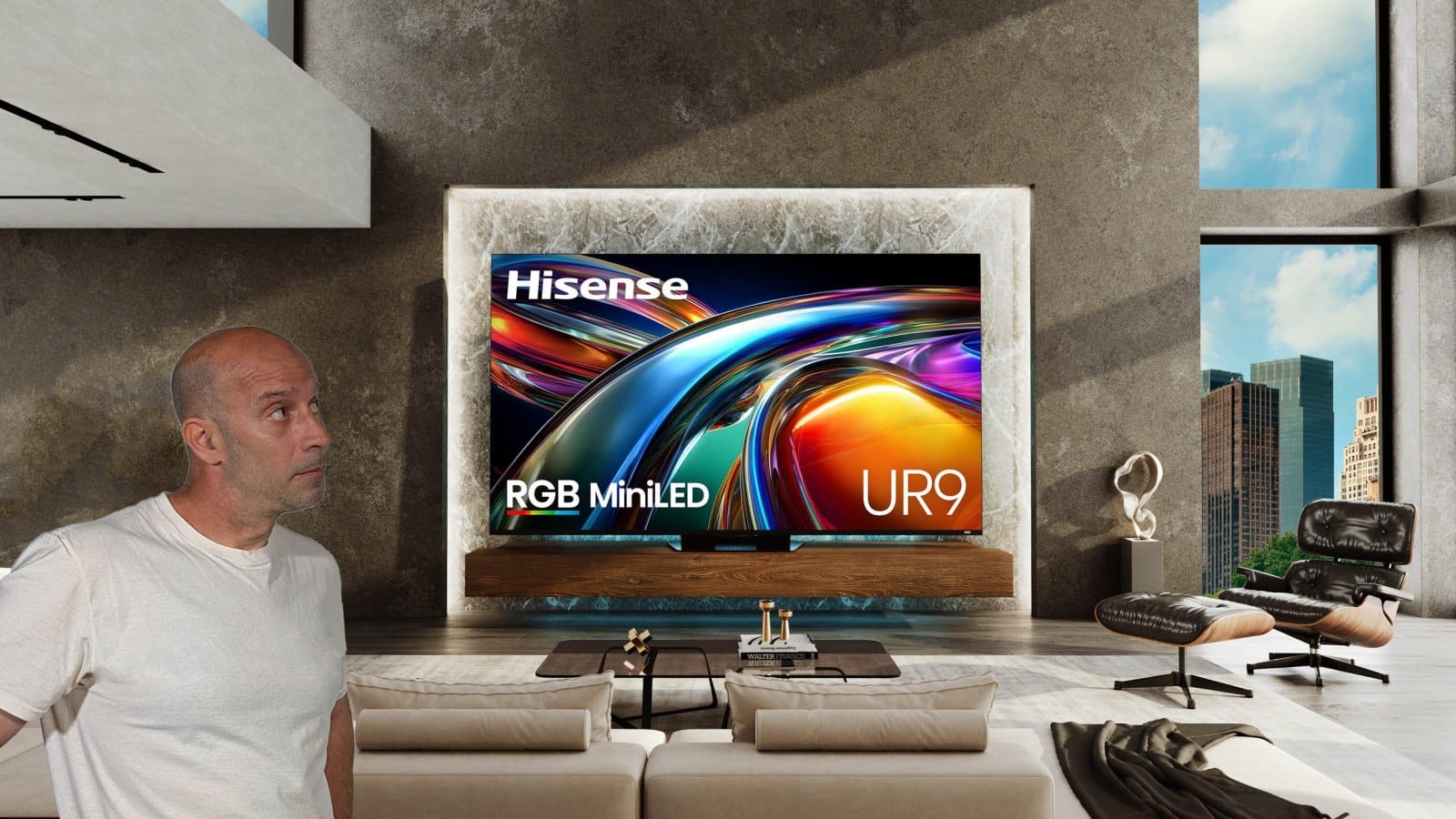
In 2026, Hisense is elevating its technology offerings with the UR9S series of RGB Mini LED TVs, which is positioned above the UR8S series as the brand’s flagship for high-end image and sound. The question remains whether its higher price truly reflects a measurable increase in quality compared to its actively competing counterparts.
Scientists confirm: This is the most effective way to get your cat’s attention, according to new research
Elderly Couple Refuses Reserved Seats—Viral Train Standoff Sparks Fiery Debate on Courtesy
Following the impressive debut of its colossal 116-inch 116UX in late 2025, Hisense is finally expanding its RGB Mini LED technology to more consumer-friendly sizes. The UR9S series succeeds the highly acclaimed U8Q, which had climbed to the top ranks of Mini LED TVs in the market in 2025 due to its formidable peak brightness and unbeatable value for money.
With the introduction of this new series, Hisense is shifting gears to a decidedly more upscale ambition: a new backlighting system, an anti-reflective screen, compatibility with Dolby Vision 2, and a native refresh rate of 170 Hz on the 65-inch model (and even 180 Hz on the 75 and 85-inch models).
Boasting an RGB Mini LED panel that promises a wide color palette, the UR9S series is among the first to bring this technology to the European consumer market, joining the likes of Sony Bravia 9 II, Sony Bravia 7 II, and Samsung R95H. These models, which we have tested, await further exploration with LG and Philips models that incorporate similar technology. Compared to the UR8S series, the UR9S is better calibrated and brighter.
The UR9S series is available in three sizes: 65 inches (163 cm), 75 inches (189 cm), and 85 inches (215 cm). I had the opportunity to test the 65-inch version, and here are my thoughts.
Hisense 65UR9S Technical Specifications
| Model | Hisense 65UR9S |
|---|---|
| Screen Size | 65 inches |
| Maximum Resolution | 3840 x 2160 pixels |
| Display Technology | LCD |
| Backlight | Yes |
| Type of Backlight | RGB Mini-LED |
| HDR Compatibility | HDR10, HDR10+, Dolby Vision |
| Refresh Rate | 170 Hz |
| Processor | Mediatek Pentonic 800 (MT9655) |
| VRR | Yes |
| ALLM | Yes |
| Audio Power | 90 watts |
| Compatibility | Dolby Atmos |
| Channels | 4.1.2 |
| Integrated Soundbar | Yes |
| Audio Outputs | Speakers, Optical |
| Number of HDMI Ports | 3 |
| HDMI ARC/eARC | Yes |
| Antenna Input | 1 |
| Satellite Input | 1 |
| Number of USB Ports | 2 |
| Optical Output | 1 |
| Analog Audio/Video Input | 0 |
| Ethernet | Yes |
| PCMCIA Port (CI+) | Yes |
| Wi-Fi Version | Wi-Fi 6E |
| Frame / Stand Color | Black |
| Stand Position | Central |
| VESA Standard | 400 x 400 mm |
| Operating System (OS) | Vidaa U |
| Assistant | Amazon Alexa, Vidaa Voice |
| AI Functions | Yes |
| Compatible with Airplay | Yes |
| Microphone on the Remote Control | Yes |
| TV Dimensions without Stand (WxHxD) | 1448 mm x 838 mm x 45 mm |
| TV Dimensions with Stand (WxHxD) | 1448 mm x 914 mm x 290 mm |
| TV Weight without Stand | 28.4 kg |
| TV Weight with Stand | 29.2 kg |
| Energy Efficiency | E |
| Product Sheet | Link |
Hisense 65UR9S Design, a Notable Thickness and a Step Above the UR8S
In its 65-inch version, which I tried out for a while, the television takes up a fair amount of space in the living room. The finish is serious, the whole exudes robustness, and it’s clear that Hisense aimed for a premium rendering in line with the price. Neat frame, nicely finished corners, no low-grade plastic in sight: the first impression is that of a well-rounded product, although the design remains in line with recent years, without any significant stylistic breaks.
The chassis, however, is significantly thicker than an OLED of the same diagonal. This is a direct consequence of the more voluminous nature of RGB Mini LED backlighting and the Devialet sound system, which also requires space. With approximately 5 cm of thickness at the center, the UR9S series won’t be winning any awards for discretion once mounted on the wall.
On a TV stand, this thickness doesn’t change the practicality, but those dreaming of a perfectly flat wall integration will need to adjust their expectations or consider an OLED. It’s nothing prohibitive, just the physical reality of an LCD with very dense backlighting.
It rests on a simple and functional central stand, no frills. Note the possibility of routing a number of cables towards the center so they aren’t visible when sitting in front. It’s a good idea, but if you have more than two cables, the others might be left to their sad fate.
A particularly welcome feature is the anti-reflective treatment. Similar to some Samsung TVs (OLED and LCD) and the Sony Bravia 9 II, Hisense has opted for an innovative matte coating, very effective, where one might not necessarily expect it on a television of this type. The surface diffuses reflections without completely erasing them, but in daylight or under abundant artificial light, the result clearly surpasses the majority of competitors.
It’s the same treatment as on the UR8S series but, upon observation, I can say that it’s slightly less effective than that of the Samsung TVs, which is also very slightly inferior to that of Sony, particularly on the Bravia 9 II, coming out ahead in this story.
Hisense 65UR9S Connections
Unlike the UR8S series and its four HDMI 2.1 ports, the UR9S TVs offer only three — all compatible with VRR and ALLM up to 170 Hz in Ultra HD 4K, one of which is eARC for the sound bar or home cinema amplifier. It’s a surprising step back compared to its own predecessor. Also included are two USB-A ports, an Ethernet port, and an S/PDIF optical output, not to mention the usual antenna and satellite sockets. Everything is well arranged and oriented towards the side for easy connections.
A pleasant surprise in terms of connections: a USB-C port compatible with DisplayPort 1.4, absent on the UR8S series. A rarity, almost unique on the television market in 2026, that Hisense seems to want to reserve for its high-end models. For those who want to connect a laptop or a workstation without an adapter, the advantage is real. This somewhat compensates for the limitation to three HDMI ports, which can be restrictive when you want to connect multiple consoles, a UHD Blu-ray player, and a sound bar in eARC at the same time. On a television of this price and rank, the absence of a fourth HDMI 2.1 port remains regrettable.
On the wireless side, the UR9S series features Wi-Fi 6E (AX) where the UR8S was limited to Wi-Fi 5, and Bluetooth 5.4, for stable and fast connections in streaming as well as in home networking. AirPlay 2 compatibility is included for Apple enthusiasts.
Hisense 65UR9S Remote Control
The remote control provided with the UR9S TVs remains true to the brand’s recent approach. It’s exactly the same as that of the UR8S series. Elongated format, decent ergonomics, well-distributed buttons, with several shortcuts to major platforms: Netflix, Prime Video, Disney+, and YouTube each have their own direct access. A microphone button activates voice commands via Alexa or Vidaa Voice, for searching for content, gathering information, or controlling connected devices.
Its main feature is the charging option. A small solar panel on the back is sufficient to power it under normal lighting conditions, supplemented by a USB-C port in case of low energy. No more batteries, and in daily use, it really makes a difference.
The good news is that the remote control benefits from backlighting. However, the TV’s light sensor function must be activated for this feature.
Hisense 65UR9S Subjective Image Mode
The UR9S series is primarily designed for HDR, and this is apparent from the first few minutes. The RGB Mini LED backlighting isn’t just a cosmetic tweak of the classic Mini LED: it revises the very way light is produced behind the panel.
By replacing white or blue diodes with independent red, green, and blue diodes, Hisense achieves purer light at the source, thus an expanded color gamut, especially in high lights. The result: an HDR image that retains its chromatic density where many LCDs start to desaturate.
The image modes offered cover Cinema, Filmmaker — the one I chose for my tests — Dynamic, Standard, and several gaming profiles. The Filmmaker mode remains my recommendation for movies and series: it limits artificial processing and seeks to reproduce the image as it was intended.
The UR9S series carries over the Dolby Vision 2 compatibility already present on the UR8S TVs: the TV replaces the native Dolby Vision processing engine with its own interpretation, finer on brightness, contrast, and colors compared to a reference monitor, with an adaptation to ambient lighting and the Authentic Motion function for fluidity, in the spirit intended by directors.
On Mad Max: Fury Road in 4K HDR Blu-ray, the experience is stunning. The deserts blaze under a light that few LCDs manage to render with such maintained saturation in high lights. Flares, dust particles in the sun rays, explosions: everything displays with a density and punch that concretely illustrate the contribution of RGB Mini LED. In Top Gun: Maverick, the colors are also celebrated along with the dynamism of the various scenes, obviously including the most spectacular ones aboard the jets.
Dark scenes reveal both the strengths and limitations of the LCD. Local dimming is well managed on the vast majority of content: deep blacks, detailed shadows, and no grayish veil like on some less mastered LCDs. But blooming — that light halo around bright objects on a dark background — remains noticeable on the most demanding shots. It’s nothing like the coarse blooming of a low-end LCD, but it’s there, and the RGB Mini LED sometimes adds a slight coloring to the halos, which can be more noticeable than on a classic Mini LED.
Hisense 65UR9S Measurements, Probes Included
As with other TVs, the settings tested are those offered by default by the brand “out of the box,” in Cinema, Filmmaker, and IMAX (HDR) modes.
Regarding color fidelity in SDR, calibration comes out significantly reinforced compared to the UR8S series. In Cinema mode, the average Delta E measured is 2.88 (maximum at 6.53), and 2.87 in Filmmaker mode, in both cases under the threshold of 3 where the human eye can no longer distinguish the displayed color from the requested color. For reference, the UR8S series displayed an average Delta E of 7.83 in SDR: the gap is considerable. Regarding color temperature, the average measured is 6914 K in Cinema mode (average gamma at 2.29) and 6140 K in Filmmaker mode (average gamma at 2.4), for an ideal target of 6500 K and a gamma target of 2.2. The coverage of the color space in SDR (Filmmaker mode) reaches 97.9%.
In HDR, the results are simply excellent. The average Delta E measured is 0.70 in Filmmaker mode, 0.73 in Cinema mode, and 0.75 in IMAX mode. These are values close to what the best reference monitors on the market produce and well ahead of the 2.7 measured in HDR on the UR8S series. The Sony Bravia 9 II, with its record at 0.55, still holds a slight lead on this specific point.
For brightness, the measured peak stands at 3088 cd/m² in Cinema mode, 3075 cd/m² in Filmmaker mode, and 2971 cd/m² in IMAX mode. While far from the 4063 cd/m² of the Sony Bravia 9 II, the UR9S series significantly surpasses the UR8S (2241 cd/m² measured on the latter) and approaches the TCL C89L and its SQD Mini LED (non-RGB) panel, measured at 3114 cd/m².
In full-screen brightness, the measurement recorded in Filmmaker mode stands at 925 cd/m², a clear improvement compared to the 857 cd/m² of the UR8S series, but still lagging behind the 958 cd/m² of the Sony Bravia 9 II.
Finally, regarding the coverage of color spaces in HDR, the UR9S series covers 99.16% of DCI-P3 (excellent) and 93.66% of BT.2020. This is a very good performance in absolute terms, very close to the record of 95.53% measured on the UR8S series, which is less expensive: a point that deserves verification on a second sample before drawing a definitive conclusion.
Overall, what should be remembered about this 65-inch UR9S series is that it is significantly better calibrated than the Hisense UR8S TVs and is also brighter with color spaces just as well covered, more so than the competition, across all technologies.
Hisense 65UR9S Gaming
On paper, this series ticks all the boxes for demanding gamers. Its panel climbs to 170 Hz natively on the 65-inch version and to 180 Hz on the 75 and 85-inch versions, with a potential peak at 330 Hz in HSR (High Smooth Rate) mode, a frequency that will mainly interest PC gamers with a powerful enough graphics card to take advantage of it. The three HDMI 2.1 ports are all compatible with VRR and ALLM, ensuring a smooth and low-latency experience on PlayStation 5 and Xbox Series X. Dolby Vision Gaming compatibility rounds out the package, a format that refines the HDR rendering in games that support it, like Forza Horizon 6.
The integrated Vidaa gaming bar provides one-click access to essential gaming settings: game mode activation, VRR management, latency information, brightness control. But the real strength of this series for gaming is its spectacular HDR image: bright expanses, interiors with marked contrasts, pyrotechnic explosions… Everything displays with a visual impact that few LCDs can match.
The measurements of brightness and color fidelity are substantially identical to those of the Filmmaker mode given that the Game mode can be activated on any image mode.
The gaming sheet is not without its shadows, however. The measured input lag stands at 17.2 ms, a correct and playable value for the overwhelming majority of genres, from RPG to competitive FPS. It’s surprising that the UR8S performs better in this area with a display delay time of 14.7 ms under the same conditions. For comparison, the best OLED for gaming, the Panasonic Z95B, passes the test at 8.9 ms, and even the Sony Bravia 9 II (LCD) displays a much more flattering value with 9.9 ms.
Hisense 65UR9S Audio, Some Welcome Effects
As with the UR8S series, Hisense has taken care of the audio on the UR9S TVs by relying on Devialet, the French high-end
Similar Posts
- Sony Bravia 7 II Review: More Affordable True RGB Mini LED Than Bravia 9 II!
- TCL X11L Review: Can Mini-LED SQD Truly Rival Premium OLED TVs?
- TCL 65C7K Review: Is This the New Premium Segment Leader?
- I Tested the TCL 65C89L: Bright Mini LED for €1800 Struggles to Advance
- Experience the Future: Samsung’s 115-Inch Micro RGB TV Masterfully Combines Size and Tech

Maya Singh is a senior editor covering tablets and hybrid devices. Her work explores how these tools reshape digital productivity and learning. She also contributes to feature editorials on emerging tech.