
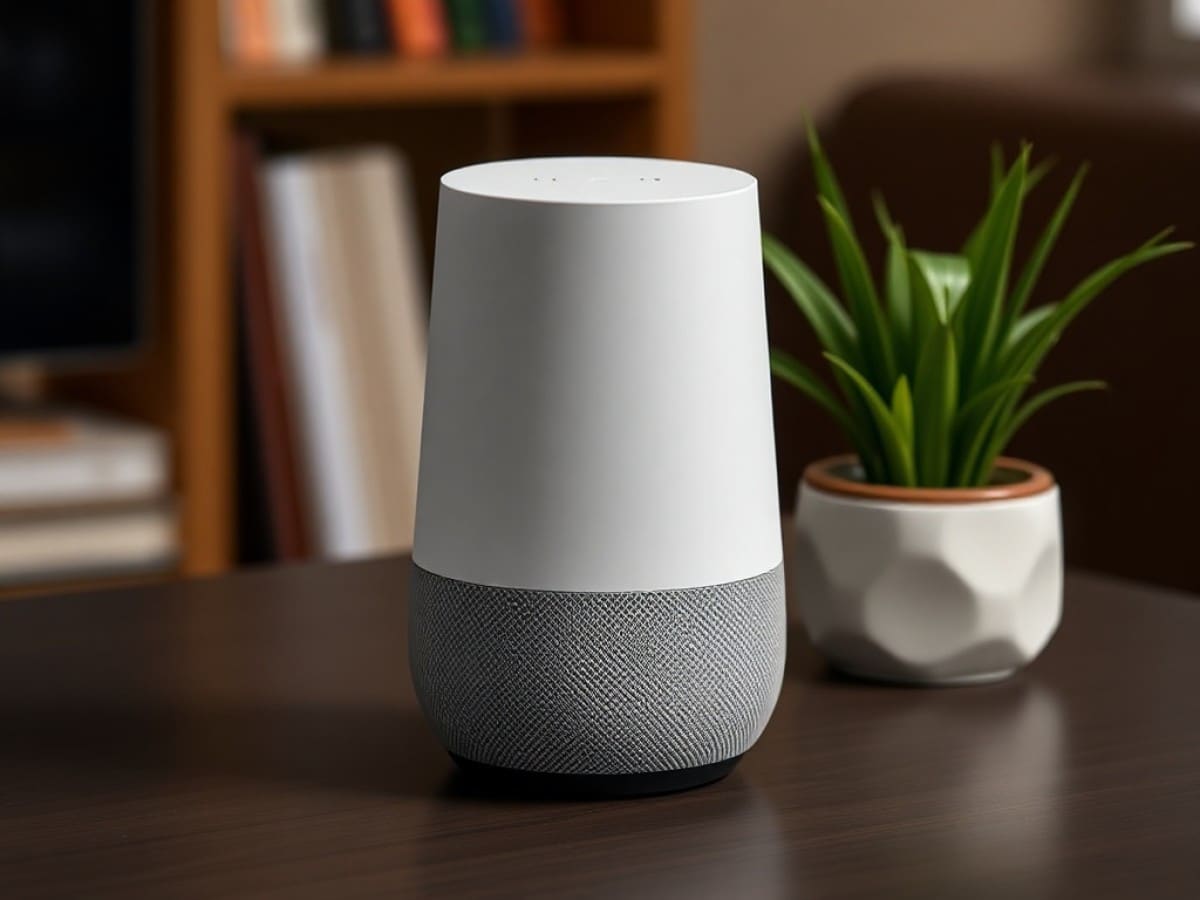
With its new Home Speaker, Google aims to reposition the smart speaker as the central hub of the home. More conversational, better integrated into the smart home ecosystem, and designed to control music, connected devices, and daily services by voice, it strives to outperform previous models without altering its core philosophy.
Scientists confirm: This is the most effective way to get your cat’s attention, according to new research
Elderly Couple Refuses Reserved Seats—Viral Train Standoff Sparks Fiery Debate on Courtesy
The Google Home Speaker is a compact connected speaker designed as a gateway to the Google Home, Gemini, and Matter universes, with a straightforward promise: to answer questions, chat, manage the smart home, stream music, and support daily activities all through a single device.
It’s not geared towards pure audiophiles; instead, it targets smart home assistance, capable of blending seamlessly into any room of the house.
In the market, it competes with Amazon Echo and Apple HomePod, and more broadly, with any smart speakers that emphasize voice assistance as much as audio playback. Its strength lies not only in its seamless integration with Google Home but also in its enhanced conversational capabilities, which allow for more natural communication with the speaker without having to repeat "Ok Google" for every command.
The Google Home Speaker follows the Google Home (2017) and Nest Audio (2020), marking six years since Google’s last living room speaker. It is also the first device designed from the ground up for Gemini for Home, replacing Google Assistant in the home ecosystem.
Google Home Speaker Technical Specifications
| Model | Google Home Speaker |
|---|---|
| Subwoofer | No |
| Assistant | Google Gemini |
| WiFi | Yes |
| OS Compatibility | Android, iOS |
| Color | Black, Red, Green, Gray |
| Product Sheet | Available |
*The Google Home Speaker reviewed was provided by Google.*
Design, Finish, and Ergonomics
Visually, the Google Home Speaker adopts a soft, domestic approach similar to the Nest Audio, featuring a textile cover and colors designed to blend into the background. It is offered in “Porcelain,” a very discreet cream tone, or “sage green,” a more unique but still subtle finish.
Its dimensions of 8.6 x 10.7 cm, with a weight under 1 kg, make it particularly unobtrusive, more so than the Nest Audio.
The finish is generally pleasant, though not flawless. The fabric, reminiscent of the Nest Audio, offers a warm, less “techy” feel than raw plastic, but it seems a bit looser in places compared to the rest of the internal shell. This isn’t noticeable in daily use, but it slightly detracts from the feeling of tension and precision expected from a perfectly refined product.
The ergonomics are simple, though not always ideal. The only physical button present is used to disable the microphone to preserve privacy, a definite plus. However, this button is located at the rear – discreet in terms of design, but requires handling the speaker: it’s impossible to turn off the mic without lifting it, which is less convenient than hoped, although its light weight limits the inconvenience.
On the top, two sensitive areas light up to manage the volume, with small LED indicators confirming the command has been registered. A third touch area, located in the center and without an indicator, allows for pausing or resuming music. Holding it down resets the device.
At the base, a ring of LEDs changes color according to the speaker’s status: white when the assistant is addressed, blue and purple when Gemini is processing a request, orange when the mic is off. The design is attractive, clear, and lively, even though the interface remains intentionally minimalist.
Without a battery, the speaker must be plugged into an electrical outlet. The power cord is long: 1.50 m, with one end fixed to the speaker and the other featuring a USB-C connector, with the charger included. This is convenient for setup but less reassuring for durability or repairability since the cable on the speaker side cannot be simply replaced.
Connectivity
In terms of connectivity, the specifications mention Wi-Fi 802.11ax (Wi-Fi 6), Bluetooth 5.4, Matter, Android, and iOS. There is no analog input or other options, unlike, for example, the Bose Lifestyle Speaker connected speaker, which offers more possibilities like connecting a turntable. Here, everything goes through wireless networks.
Installation and Configuration
The installation is definitely one of the strong points of this speaker. I was able to set it up in less than five minutes using the Google Home app, through a very simple guided process on the smartphone. Just turn on the speaker, detect it from the mobile, and validate the different steps, including linking certain services if necessary.
The experience becomes even smoother if you already have a Google smart home ecosystem. If shutters, lights, sockets, garage doors, or other accessories are already registered in Google Home, there’s no need to reconfigure them: the speaker automatically connects to them and incorporates them into the existing environment. This is exactly the kind of detail that saves time and immediately gives the impression of a well-integrated product.
Application
Like the Nest Audio speaker, the Home Speaker works with Google Home, Android, and iOS, Matter, while also supporting a Thread 1.3 router, allowing it to easily integrate into various environments.
For users already embedded in Google services, the system is perfectly coherent, clear, and quite natural to handle.
From the Home app, you can manage music playback and volume. It is also possible to adjust the light intensity level. An equalizer is present to vary the level of treble and bass.
Accessibility settings are also available, allowing for a sound at the beginning and another at the end of the conversation.
Connected Functions and Daily Use
The major new feature of the Google Home Speaker is its much more conversational aspect. Unlike previous generations, you no longer have to repeat “Ok Google” with each phrase to continue the exchange. Once is enough. It then becomes possible to have a dialogue with the speaker over several rounds of conversation, ask multiple questions, and even change the subject within the same dialogue.
This really changes the daily usage sensation. The exchange appears more natural, less robotic, more akin to a conversation than a series of isolated voice commands. You can ask general questions, request quick answers, rediscover a song you’ve forgotten the title of from a few memories, create reminders, modify a schedule, or initiate actions in the house by simply describing what you want to do.
Everything isn’t instantaneous, though. The reaction time observed during a conversation is around 4 to 5 seconds, which isn’t disastrous but long enough to sometimes create a little doubt: you might wonder if the speaker has heard the command, or if it is still processing the request. However, you can be somewhat reassured by observing the Gemini indicator (blue/violet) swirling around its base. This slight delay doesn’t prevent use but slightly hampers the impression of perfect fluency that Google is precisely trying to establish with its conversational logic.
For voice commands related to smart home control (turning on lights, opening blinds, etc.), I experienced a response time of only 2 seconds.
Some advanced functions go even further, notably with Google Home Premium Advanced. This subscription allows, for example, to obtain a summary of the day at home, including events detected during an absence. This case wasn’t tested here due to the lack of an appropriate subscription, but the idea is clear: to transform the speaker into a vocal access point to an intelligent summary of domestic life.
For Gemini Live functions, a Google Home Premium Standard subscription is required, priced at 10 euros per month. For the most advanced options, the Google Home Premium Advanced subscription is necessary, costing 18 euros per month.
In other words, the base experience is already interesting, but part of the most ambitious software promise is conditional. It’s not a deal-breaker, but it’s an element to keep in mind if you really want to exploit its full potential.
Internal Audio Architecture
Internally, Google continues with a fairly simple design in its conception but consistent with the product’s positioning. The Home Speaker relies on a 58 mm full-range driver, responsible for emitting omnidirectional sound at 360 degrees, to avoid a too directional output and to better cover a room without requiring very precise placement.
This approach has a clear advantage: the speaker doesn’t need to be oriented towards the user like a small audio monitor. It can be placed on furniture, a shelf, or a countertop, and continue to distribute sound evenly in the space. Meanwhile, Google has incorporated three ultra-sensitive microphones to capture voice commands, even from a distance or in an environment already animated by music or domestic noises.
Audio Quality in Music
Because it remains primarily a speaker, audio quality obviously matters. And on this point, the Google Home Speaker performs well. Its 360-degree output allows for broad and uniform music distribution, without needing to be directly in front of it.
Listening reveals a convincing report: the bass and midranges are particularly successful, with a balanced, full, and pleasant output. The highs are slightly more perfectible, less refined and less crisp than the rest of the spectrum, but the overall sound is well maintained and coherent. Especially, the speaker surprises with its power considering its reduced format: it easily fills a bedroom, or even a small living room, without seeming to struggle too quickly.
Google also allows going further by pairing two Home Speakers with a Google TV Streamer to form a stereo pair. The result approaches a small immersive system, even though it’s not a true home cinema: the output remains at 360 degrees, there are no speakers placed behind the viewer, and it’s not possible to go beyond two Home Speakers with a Google Streamer TV to create a true surround ensemble.
Note that it is also possible to pair the Home Speaker with other Google Nest speakers, Google Nest displays, and Google Cast compatible devices. However, this operation passes through the Google Streamer TV, adding an additional dependency on Google’s in-house ecosystem.
Release Date and Price
The Google Home Speaker is available at a price of **119 euros**. Until September 30, 2026, with every purchase of a product, Google is offering 6 months of subscription to Google Home Premium Standard. The subscription to the latter is 10 euros per month (or 100 euros per year), essential for accessing Gemini Live functions.
For the Google Home Premium Advanced subscription, count on a price of 18 euros per month (or 180 euros per year). This allows for voice-command searches in video history and obtaining daily summaries of what happened in your absence.
-
Google
119 €See the offer -
Boulanger
119,99 €See the offer -
Fnac
119,99 €See the offer -
Darty
119,99 €See the offer -
Pixmania Marketplace
123,57 €See the offer
-
Cdiscount Marketplace
124,48 €See the offer
Similar Posts
- Google AI Plus, Pro, Ultra: Discover What Sets Them Apart From Gemini’s Free Version!
- The next generation of smart homes: How Amazon’s AI makes your devices smarter than ever
- Sonos Play Review: Discover the Ultimate Portable Speaker That Delivers on All Fronts!
- Hot Deal Alert: Aqara U200 Smart Lock at Record Low Price: Perfect for Apple Users!
- Gemini Now Transcribes Audio Files: Discover How It Works!

Maya Singh is a senior editor covering tablets and hybrid devices. Her work explores how these tools reshape digital productivity and learning. She also contributes to feature editorials on emerging tech.