
Scientists confirm: This is the most effective way to get your cat’s attention, according to new research
Elderly Couple Refuses Reserved Seats—Viral Train Standoff Sparks Fiery Debate on Courtesy
Last year, DJI took the world by surprise. By adding the “Neo” range to its already extensive ecosystem – Mini for lightness and regulation, Air for balance and dual optics, Mavic Pro for pure performance, and Avata for FPV immersion, the Chinese manufacturer wasn’t just launching another drone. It introduced a new concept: the fully autonomous, remote-free flying camera.
The first Neo was a trial run. A brilliant concept on paper, yet its execution was marred by a few frustrations: occasionally temperamental tracking, decent video quality but limited to 4K30p, overly simplistic obstacle avoidance that didn’t inspire full confidence, and rather average performance against the wind.
A year later, the Neo 2 arrives with a long list of improvements and challenges to overcome. One of the major enhancements is its tracking capabilities, which are very impressive, as is its obstacle avoidance, which could make the drones from the Mini Pro, Air, or Mavic series envious. With the Neo 2, you can film yourself on a travel backdrop or with a friend, without needing a third person to hold the camera. Without giving away too much, one can say: at 239 euros, what this device offers is astounding.
DJI Neo 1 vs DJI Neo 2: Key Differences
| Feature | DJI Neo | DJI Neo 2 |
|---|---|---|
| Weight | ~ 135 g | 151 g |
| Lens (equiv.) | 14 mm (Ultra Wide-Angle, 117.6°) | 16.5 mm (Ultra Wide-Angle, 110°) |
| Obstacle Sensors | Ventral (downward only) | Omnidirectional (Front, back, top, bottom) |
| Max Video Format | 4K30p | 4K60p (and slow motion 4K100p with optional remote) |
| Storage | 22 GB (internal) | 50 GB (internal) |
| Gesture Control | – | Yes |
| Voice Control | No | Yes |
| Battery Life | ~ 10-12 minutes | 18 minutes |
| Max Speed | ~ 8 m/s (~29 km/h) | 12 m/s (~43 km/h) |
Technical Specifications
Why You Should Never Reheat These Foods in the Microwave – The Hidden Dangers Experts Warn About
I tried the top 5 guard dogs—here’s what makes these breeds the ultimate protectors
DJI Neo 2
9/10
Read the review
-
Amazon
239 € -
Fnac
399 € -
Boulanger
579 €
See the offer
Best drones
All DJI drones
This review was conducted with a drone loaned by DJI.
Heavier, denser, smarter
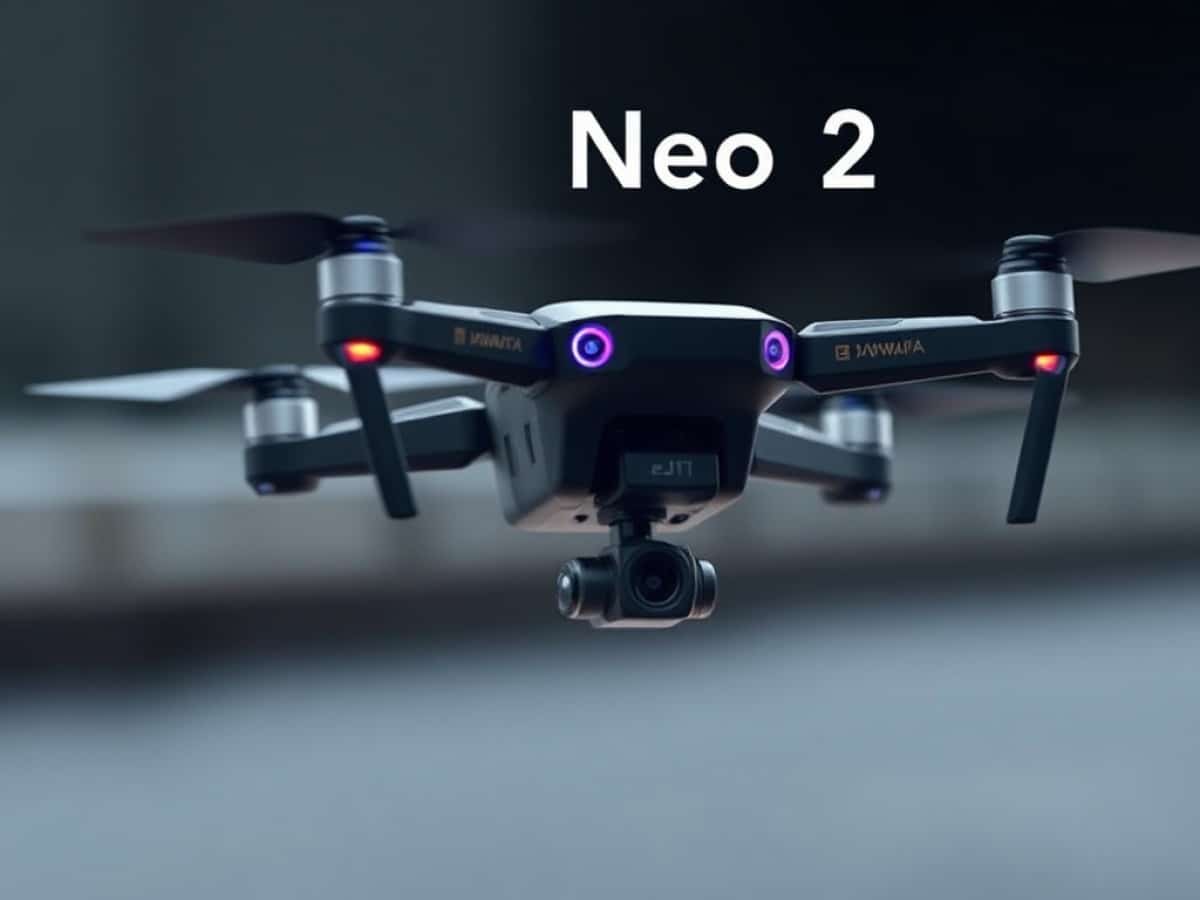
At first glance, the Neo 2 looks a lot like its predecessor. It retains the FPV-inspired format from the Avata 2, with fully enclosed propellers. The protective cages are the DNA of the Neo range: they make it completely harmless in case of a collision (which it carefully avoids).
It can be caught in flight—and it turns off—launched from the hand and landed on it, without any fear. This is a crucial point for the “selfie” and family use it is intended for.
When you hold it, you feel the difference from the first Neo. The weight goes from 135 g to 151 grams, but it’s still a featherweight. It remains well under the critical 250 g mark, which means no training is required and it can fly almost anywhere, of course respecting no-fly zones (the DJI Fly app will remind you).
In terms of size, it measures 147 × 171 × 41 mm and does not fold. However, it fits into most jacket pockets.
A slew of new sensors
But the most significant changes are not cosmetic. They are functional. First, we notice the appearance of two external antennas at the back. These significantly improve the range and stability of the connection when used as a “classic” drone with the optional RC-N3 remote.
Next, and this is the hardware revolution of this model, the vision system has been completely redesigned. The Neo 1 had just two mini-cameras on its belly to manage its landing. The Neo 2 carries an arsenal of sensors:
- Two “fish-eye” cameras: one on the back and one on the belly. They’re not just for landing anymore, but for “seeing” the world 180° above and below.
- A Lidar sensor: located at the front, it measures the distance to objects with great precision, even in low light, where regular cameras start to generate noise and lose reliability.
Combined, these sensors give the Neo 2 omnidirectional obstacle detection. It sees everywhere: in front, behind, above, below, and to the sides. This is what allows it to follow you through a forest, avoiding branches and any obstacles in its path.
Finally, a simple but brilliant addition makes its debut: a small screen on the left side of the drone. Next to it, a mode button and the power/takeoff button. This is the key to the “smartphone-free” experience. Turn on the drone, click the mode button to choose your shot (Follow, Circle, Dronie…), the screen confirms the choice, and you press “takeoff”. The drone takes off from the palm, recognizes you, and starts filming. Simple, immediate, effective.
Switch to 4K/60p and new lens
The specs of the sensor seem unchanged: it’s a 1/2 inch model, thus half the size of those in the recent Mini Pro (1 inch) or the Air and Mavic (1 inch and micro 4/3). On paper, this means less sensitivity in low light and more noise at high ISO settings.
The lens is an equivalent 16.5 mm (f/2.8), an ultra wide-angle with a 110° field of view. It’s a slight tightening compared to the 14 mm of the Neo 1, a wise choice to reduce the “fish-eye” distortion effect while still keeping a very wide frame, perfectly suited to “selfie” use and tracking as it captures both the user and their immediate surroundings.
The real change is the image processor. It finally unlocks what the sensor was capable of. The 4K30p limit is gone, and the Neo 2 now offers ultra-smooth 4K60p capture and even 4K100p for slow motion (but only with the optional remote for 100p mode). The difference isn’t just a number. Moving from 30p to 60p offers a radically superior fluidity and sharpness.
The video processor also seems to make better use of the sensor. Most of the videos obtained during my test were impressive in terms of dynamics, accuracy, and color rendering, as long as there was light. The maximum video bitrate jumps from 75 to 100 Mbps (in HEVC), again with the optional remote. With the smartphone or in autonomous mode, it locks at 50 Mbps, which frankly isn’t a problem, the quality is there.
YouTube Link Subscribe to Frandroid
This content is blocked because you have not accepted cookies and other trackers. This content is provided by YouTube.
To view it, you must accept the use being made by YouTube with your data which may be used for the following purposes: allowing you to view and share content with social media, promoting the development and improvement of Humanoid’s and its partners’ products, showing you personalized ads based on your profile and activity, creating a personalized advertising profile, measuring the performance of ads and content on this site, and measuring the audience of this site (learn more)
By clicking on “I accept all”, you consent to the aforementioned purposes for all cookies and other trackers deposited by Humanoid and its partners.
You retain the ability to withdraw your consent at any time. For more information, we invite you to read our Cookie Policy.
Manage my choices
However, don’t expect advanced “pro” modes. No D-Log or HLG for color grading, nor RAW mode for photos. The Neo 2 films in SDR Rec.709, a universal, clean format, ready to be edited and shared on social media. Given the results obtained, this “limitation” is actually a strength: the Neo 2 is not made for complex post-production, it’s made for efficiency.
The internal memory follows this upgrade
Similar Posts
- Your iPhone May Soon Compete With DSLRs: Discover This Amazing Kit!
- Garmin Forerunner 970 Review: The Ultimate Runner’s Fenix Unveiled!
- iPhone 17 May Finally Feature This Samsung Tech From 2013: Will It Be a Game Changer?
- Apple TV Unleashes Record-Breaking Drone Show for ‘Monarch: Legacy of Monsters’ Series
- DJI Mini 5 Pro Review: Image Quality Takes a Giant Leap Forward

Maya Singh is a senior editor covering tablets and hybrid devices. Her work explores how these tools reshape digital productivity and learning. She also contributes to feature editorials on emerging tech.